Shri Yantra Installation During Navratri
By Pt. Sanjeev Sharma
Simple rules for Prana Pratishtha, daily worship and Lakshmi practice
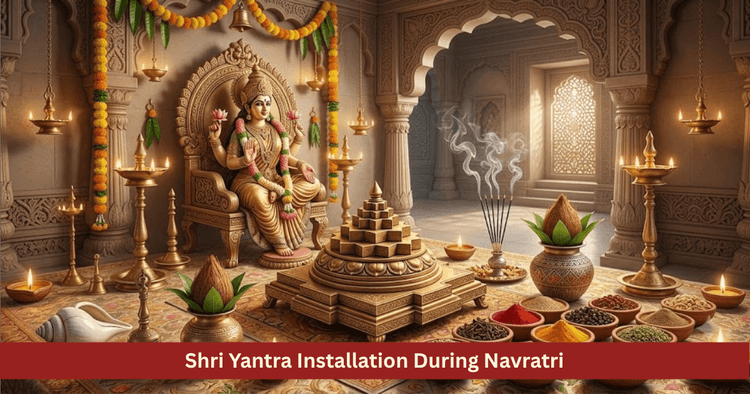
Table of Contents
Know the Auspicious Time First
Installing a Shri Yantra during Navratri is regarded as a practice connected with Goddess Mahalakshmi, Tripura Sundari and the Shri Vidya tradition. The Shri Yantra is not merely a means of gaining wealth. It is a symbol of cosmic order, Shakti and the balance of consciousness. It should be installed with purity, devotion and a resolve for regular worship.
Friday, Ashtami, Navami, Purnima or another auspicious Tithi may be chosen for installing the Shri Yantra during Navratri. The exact timing changes according to the local Panchang, sunrise, Tithi and family worship tradition. If formal Prana Pratishtha, the ritual of invoking sacred presence, is desired, guidance from a qualified Acharya is more appropriate.
Primary Information for Shri Yantra Installation
- Suitable occasions: Navratri, Friday, Purnima, Ashtami or Navami
- Suitable time: after the morning bath or during an auspicious Lakshmi worship period
- Auspicious direction: northeast direction or a clean worship area
- Installation place: home shrine, office worship area or a clean place near a safe
- Base: clean red or yellow cloth and a raised platform
- Purification: traditional process using water, Panchamrit and Gangajal
- Main materials: lamp, incense, flowers, Akshat, Roli, sandalwood and Naivedya
- Main Mantra: Om Shreem Hreem Shreem Mahalakshmyai Namah
- Daily rule: lamp, flowers and Mantra chanting
- Main caution: do not place the Shri Yantra on the floor, in an unclean place or in a disorganised cupboard
| Stage | Required Materials | Main Feeling |
|---|---|---|
| Purification of place | Gangajal and clean water | Sacred atmosphere |
| Purification of Yantra | Panchamrit and water | Respect and purity |
| Installation | Red cloth and platform | Stability and devotion |
| Worship | Roli, Akshat, flowers and sandalwood | Invocation of the Goddess |
| Lamp offering | Ghee or sesame oil | Light and awareness |
| Mantra chanting | Lakshmi Mantra or Shri Sukta | Prosperity and balance |
| Naivedya | Fruit, sweets, Kheer or coconut | Gratitude and surrender |
| Daily service | Lamp, water and flowers | Regular spiritual practice |
Spiritual Form of the Shri Yantra
The Shri Yantra is considered highly important in the Shri Vidya tradition. The arrangement of upward and downward triangles is understood as a symbol of the union of Shiva and Shakti. From the outer lines to the central point, its design suggests a movement from the material world toward subtle consciousness.
The central point of the Shri Yantra is called the Bindu. It represents supreme consciousness, concentration and the original centre of creation. The surrounding triangles represent different levels of Shakti. The lotus petals indicate the expansion of desire, knowledge and action. The outer Bhupura gives the feeling of boundaries, protection and stability.
Treating the Shri Yantra only as a wealth device limits its wider meaning. It is a symbol of prosperity, beauty, knowledge, balance, creativity and spiritual concentration. The grace of Mahalakshmi does not mean only an increase in money. Contentment, health, harmony, right opportunities and righteous use of resources are also forms of Shri.
Why Is Shri Yantra Installation Considered Auspicious During Navratri?
The nine forms of Goddess Shakti are worshipped during Navratri. During this period, the home is purified through worship, Mantra, lamps and restraint. Installing the Shri Yantra at such a time creates a resolve for regular Shri practice.
Each day of Navratri may be understood as one step of spiritual practice. The opening days may develop purification of home and mind, the middle days strength and discipline and the final days surrender and completion. The Shri Yantra gives the entire process a centre of concentration.
Suitable Navratri Days for Installation
- Pratipada: for a new resolve and purification of the place
- Panchami: for knowledge, beauty and balanced prosperity
- Ashtami: for Shakti practice and relief from obstacles
- Navami: for completion, gratitude and the grace of the Goddess
- Friday: for worship connected with Lakshmi and Venus qualities
- Purnima: for light, peace and mental stability
For the Tithi and Muhurat of a particular year, the local Panchang should be checked. A general tradition cannot be treated as the fixed Muhurat for an individual birth chart or a specific place.
Simple Method of Installing the Shri Yantra
A home Shri Yantra may be made of metal, crystal or another traditional material. Its design should be clear, clean and suitable for respectful worship. If the Yantra has already been consecrated, its worship method may be different.
Step by Step Installation Method
- Bathe on the selected Navratri day.
- Wear clean and restrained clothing.
- Clean the worship area thoroughly.
- Place a platform in the northeast direction.
- Spread a red or yellow cloth on the platform.
- Place the Shri Yantra in a clean vessel.
- Wash the Yantra first with water.
- Bathe it with Panchamrit according to tradition.
- Purify it afterward with Gangajal or clean water.
- Wipe it gently with a clean cloth.
- Place it on the red cloth.
- Light a lamp and incense.
- Offer Roli, Akshat, red flowers and sandalwood.
- Chant a Mahalakshmi Mantra.
- Place fruit, sweets, coconut or Kheer as Naivedya.
- Pray for peace, righteous prosperity and wisdom in the home.
- Perform Aarti and distribute Prasad among family members.
A metal Yantra should not be kept soaked in milk for a long time. After purification, it should be cleaned and dried properly. Protect a crystal Yantra from falling, breaking or scratching.
The True Meaning of Prana Pratishtha
Prana Pratishtha means inviting the sacred presence of the Goddess into the Shri Yantra and making it the centre of worship. It should not be understood merely as sprinkling water or speaking a Mantra. An extensive Prana Pratishtha may include resolve, invocation, Nyasa, Mantra chanting, worship, Havan and surrender.
A person performing simple home worship may purify the Shri Yantra, meditate and offer Mantras. However, if a devotee wishes to undertake special Shri Vidya practice, Purashcharana or an extensive Prana Pratishtha, the guidance of an Acharya becomes necessary.
Simple Home Feeling of Prana
- Meditate on Goddess Mahalakshmi.
- Regard the Shri Yantra as a centre of light and consciousness.
- Keep a pure resolve in the mind.
- Chant Om Shreem Hreem Shreem Mahalakshmyai Namah.
- Keep a calm gaze on the central Bindu.
- Pray for prosperity together with wisdom and service.
- Bow to the Goddess and complete the resolve.
The most important part of Prana Pratishtha is the conduct of the devotee. If a Yantra is installed while deceit, excessive greed, insult and disorder continue in the home, the spiritual purpose of worship becomes weak.
Main Mantras for Shri Yantra Worship
The Mantra may be selected according to tradition. Simple Mantras are sufficient for household worship.
Mantras for Daily Chanting
- Om Shreem Namah
- Om Shreem Hreem Shreem Mahalakshmyai Namah
- Om Mahalakshmyai Namah
- Recitation of Shri Sukta
- Lakshmi Gayatri Mantra
One popular form of the Lakshmi Gayatri Mantra is
Om Mahalakshmyai Cha Vidmahe Vishnu Patnyai Cha Dheemahi Tanno Lakshmih Prachodayat
Its simple meaning is that the devotee meditates on Mahalakshmi and the power who is the consort of Vishnu and prays for wisdom, light and auspicious inspiration.
Keep the pronunciation as clear as possible. Regularity and devotion are more important than completing a number. Do not perform complex seed Mantra practices for a long duration without the guidance of a teacher.
Where Should the Shri Yantra Be Placed at Home?
The home shrine is regarded as the most suitable place for a Shri Yantra. If a shrine is not available, it may be placed on a clean raised platform in the northeast direction. Some families keep it near a safe or a place where money is stored, but cleanliness and respect must be maintained there.
Rules for the Installation Place
- Do not place the Shri Yantra directly on the floor.
- Do not keep it near shoes, waste or dirty clothing.
- Do not place it in an unclean cupboard near a bathroom or kitchen.
- Before placing it in a bedroom, consider family tradition and purity of the place.
- Do not place it below the main door or where feet may touch it.
- Keep sufficient light and clean air in the worship area.
- Do not keep too many active Yantras in one place.
- Do not place the Shri Yantra upside down.
- Do not allow dust to collect on it.
- Avoid changing its installation place repeatedly.
If the Shri Yantra is kept in a safe, the safe should symbolise discipline and responsibility rather than only the storage of wealth. The worship of Lakshmi becomes contradictory when it is joined with illegal or unethical income.
Daily Rules for Shri Yantra Worship
After installation, it is not appropriate to leave the Shri Yantra unattended. Daily worship does not mean a lengthy ritual. A few minutes of clean and attentive worship may also be sufficient.
Daily Worship Sequence
- Clean the worship area.
- Light a lamp before the Shri Yantra.
- Offer incense or a fragrant substance if possible.
- Sprinkle a little water.
- Offer flowers or Akshat.
- Chant Om Shreem Namah 11 times.
- On Friday, recite a Lakshmi Mantra or Shri Sukta.
- Pray for contentment, service and wisdom along with wealth.
- Bow at the end and keep the lamp safely.
It is not necessary to wash the Shri Yantra with milk every day. Excessive water or liquid may damage metal. Wiping it occasionally with a clean cloth and keeping the worship area clean is sufficient.
Shri Yantra Worship and Financial Prosperity
The Shri Yantra is associated with Mahalakshmi. Religious belief regards it as a symbol that creates an atmosphere of auspiciousness, balance and prosperity in the home. Even so, it is not appropriate to treat the Shri Yantra as a machine that produces wealth.
Financial prosperity also requires budgeting, saving, skill, honesty and suitable investment. If a person lights a lamp every Friday but does not control unnecessary spending, debt and display, the practical side of spiritual practice remains incomplete.
Financial Discipline Along with Shri Practice
- Keep a regular record of income and expenses.
- Avoid unnecessary debt.
- Maintain honesty in the sources of income.
- Reserve a part of income for service or charity.
- Understand the difference between family needs and desires.
- Take proper advice before investing.
- Do not depend only on fate.
- Use wealth for health, education and welfare.
Shri Yantra from an Astrological View
The Shri Yantra may be viewed symbolically as a centre of qualities associated with Venus, Jupiter and the Moon. Venus is connected with beauty, comfort, art and marital harmony. Jupiter indicates knowledge, Dharma, expansion and auspicious guidance. The Moon relates to the mind, peace and household emotions.
When Venus or Jupiter is weak in a birth chart, Lakshmi worship, charity, respect for women, service to teachers, cleanliness and a restrained lifestyle may be supportive. It is not possible to guarantee that installing a Shri Yantra alone will remove planetary difficulties.
Balancing Planetary Qualities
- For Venus, cleanliness, gentle speech and respect for art
- For Jupiter, knowledge, charity and righteous decisions
- For the Moon, mental peace and family affection
- For Mercury, accurate accounts, business wisdom and communication
- For Saturn, labour, discipline and responsibility
Mistakes That Should Be Avoided
The Shri Yantra is regarded as a sacred symbol. It should not be used only as decoration or as a fear based remedy.
- Do not perform complex Tantric practices without understanding them.
- Do not believe market or public claims without discernment.
- Do not keep the Shri Yantra in an unclean place.
- Do not spend excessive money in the name of worship.
- Do not abandon practical planning during financial difficulty.
- Do not place the Yantra in another person's home without permission.
- Do not continue worship of a broken Yantra.
- Do not move a consecrated Yantra carelessly.
- Do not connect Mantra chanting with fear and greed.
- Do not treat installation as a permanent guarantee of wealth.
Shri Yantra for Home and Workplace
In the home, the Shri Yantra is associated with peace, prosperity and family balance. In a workplace, it may be connected with clear decisions, customer trust, fair transactions and organised growth.
Before placing a Shri Yantra at a workplace, cleanliness, fire safety, respect for employees and proper accounting should also be improved. If dishonest business, deception and exploitation continue along with worship, the spiritual purpose of the Shri Yantra remains incomplete.
Daily Rules at a Workplace
- Keep the Shri Yantra in a clean raised place.
- Light a lamp before opening the shop or office.
- Chant a short Mantra.
- Make financial decisions with clear accounts.
- Maintain proper conduct toward employees and customers.
- Perform special Lakshmi worship on Friday.
- Join the practice with charity or service once a month.
Awakening the Lasting Feeling of Shri
Installing the Shri Yantra during Navratri is not a guarantee that Goddess Lakshmi will remain permanently in the home. It is a resolve to awaken the qualities of Shri within the home. Shri means peace along with wealth, humility along with beauty, service along with success and contentment along with prosperity.
The lamp burning before the Shri Yantra reminds the devotee that outer light remains steady only when inner intention is pure. Daily worship, sound financial decisions, gentle family conduct and help for people in need make Lakshmi practice living and meaningful.
When greed decreases through Shri Yantra worship, actions become purer and wealth is used for welfare, the Navratri installation becomes more than a religious act. It becomes a foundation for an auspicious change in the atmosphere, thoughts and lifestyle of the home.
FAQ
When should the Shri Yantra be installed during Navratri?
It may be installed on Friday, Ashtami, Navami or another auspicious Tithi during Navratri. The final time should be selected according to the local Panchang and worship tradition.
Which direction is best for keeping a Shri Yantra at home?
The home shrine is regarded as the most suitable place. If there is no shrine, it may be kept on a clean raised platform in the northeast direction.
How is Prana Pratishtha of a Shri Yantra performed?
For simple worship, purify the Shri Yantra with water and Panchamrit and chant a Mantra of the Goddess. A qualified Acharya should guide extensive Prana Pratishtha.
Which Mantra should be recited before the Shri Yantra?
Om Shreem Namah, Om Shreem Hreem Shreem Mahalakshmyai Namah and the Lakshmi Gayatri Mantra may be recited. Shri Sukta may also be used according to tradition.
Does keeping a Shri Yantra guarantee wealth at home?
The Shri Yantra is a religious symbol of prosperity and balance. Financial progress also requires effort, saving, honesty and proper financial planning.
Get your accurate Kundali
Generate KundaliDid you like it?
Author

Pt. Sanjeev Sharma (63)
Experience: 20
Consults About: Family Planning, Career
Clients In: Punjab, Haryana, Delhi
Share this article with friends and family
About ZODIAQ
ZODIAQ is an online Vedic Astrology platform. It connects clients seeking astrological advice to experienced astrologers with deep knowledge. Our users also generate kundali and perform kundali milan for free. ZODIAQ also offers services to the Astrologers. Astrologers utilize various offerings by ZODIAQ to serve their clients effectively.
If you are a User
Consult with experienced astrologers and seek their guidance. You can also order handwritten Janm Patrika report with life prediction prepared by experienced astrologers. Generate accurate Kundali, perform Kundali Matching and check horoscope and muhurat. Utilize our online library for all the necessary astrological and spiritual information.
If you are an Astrologer
Create accurate kundali for your clients and perform Kundali Matching for up to 5 people at a time. Write comprehensive Janm Patrika report for your clients with ZODIAQ. Check client details anytime by saving it in client directory. Become more productive by tracking how many clients you guide every day.
WELCOME TO
ZODIAQ
Right Decisions at the right time with ZODIAQ
