Navratri Visarjan Method 2026
By Pt. Narendra Sharma
Respectful and eco friendly immersion of Kalash, barley and idols
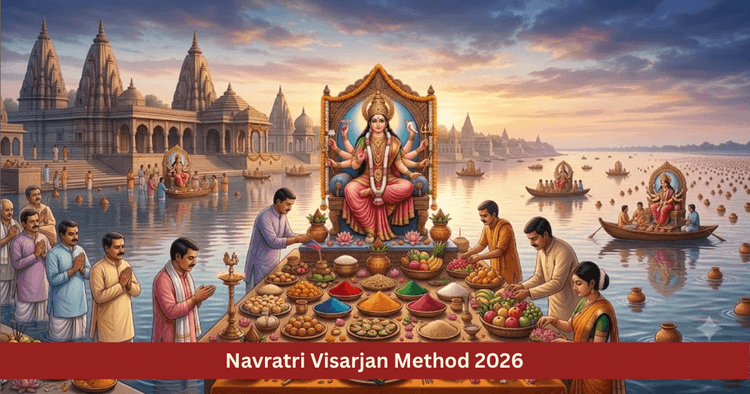
Table of Contents
Know the Dates and Rules First
After Navratri worship is completed, the Kalash, barley shoots, coconut, worship materials and idol are immersed with devotion and respect. Visarjan does not mean the end of worship. It means placing the awakened power of the Goddess within the heart and returning the outer symbols to nature.
Chaitra Navratri 2026 was observed from 19 March to 27 March. Several Panchangs indicate that Visarjan could be done after Navami on 27 March when Dashami began, while devotees who observed the full 9 day fast could perform Visarjan on the morning of 28 March during Dashami. Timings may vary according to the local Panchang and family tradition. [141][143][144]
Sharad Navratri 2026 is observed from 11 October to 19 October and Vijayadashami falls on 20 October. For Sharad Navratri, the Kalash and barley shoots may be immersed after Navami worship on 19 October or during Dashami on 20 October according to the local Panchang. [81][83]
Primary Information for Navratri Visarjan 2026
- Chaitra Navratri begins: 19 March 2026
- Chaitra Navami: 27 March 2026
- Chaitra Kalash Visarjan: after Navami on 27 March or during Dashami on 28 March
- Sharad Navratri begins: 11 October 2026
- Sharad Navami: 19 October 2026
- Sharad Kalash Visarjan: after worship on 19 October or during Dashami on 20 October
- Suitable time: after morning worship or during the auspicious period in the local Panchang
- Main materials: Kalash, barley shoots, coconut, Mauli, flowers, Akshat and water
- Visarjan place: clean water, a pot, garden soil or sacred earth at home
- Main feeling: prayer for forgiveness, gratitude and the return of the Goddess
- Essential caution: do not place plaster, chemicals, plastic or synthetic materials in water
- Fasting completion: follow family tradition and the applicable Tithi
| Worship Material | Traditional Method | Eco Friendly Alternative |
|---|---|---|
| Kalash water | Offer into sacred water | Pour into plants or soil |
| Barley shoots | Immerse in water or soil | Mix into a pot, garden or field soil |
| Coconut | Receive as Prasad | Share with family or use as food |
| Betel nut and coin | Preserve after worship | Use in the next Puja |
| Flowers and leaves | Offer in water | Add to compost or soil |
| Earthen Kalash | Immerse according to tradition | Clean and use for plants |
| Idol | Immerse in clean water | Mix an earthen idol into home soil |
The Real Spiritual Meaning of Visarjan
During Navratri, the Kalash is regarded as the seat of divine Shakti. The water inside represents life, the coconut represents consciousness, Mauli represents resolve and the barley shoots represent growth. When worship is completed, the immersion of these symbols reminds the devotee that no outer form remains permanent.
Sending the Goddess away does not mean sending the Goddess far from the home. It is a resolve to preserve the power awakened during worship through thoughts, actions and conduct. Immersion in water symbolises this transformation. Materials considered sacred during worship should continue to be handled respectfully after Visarjan.
During Visarjan, the devotee may pray that Goddess Durga grants strength, wisdom, health and harmony to the family. Worship is completed with a prayer for another opportunity to worship the Goddess in the next Navratri.
Preparation Before Kalash Visarjan
Kalash Visarjan should not be done suddenly. After the final worship, all materials should be separated in an orderly manner.
Preparation Steps
- Complete the final Goddess worship and Aarti.
- Perform Havan and Kanya Puja if required by tradition.
- Ask forgiveness for any mistake made during worship.
- Light a lamp before the Kalash and offer a final salutation.
- Remove the coconut carefully.
- Collect the Kalash water in a clean vessel.
- Separate the rice, betel nut, coin and other materials.
- Remove the barley shoots carefully with their roots.
- Keep flowers and leaves separately.
- Choose a suitable water or soil location for Visarjan.
The coconut placed on the Kalash may generally be received as Prasad. If it has spoiled, developed an unpleasant smell or is rotten inside, it should not be eaten. It may be placed respectfully in soil.
Simple Kalash Visarjan at Home
When it is not possible to visit a water body, Kalash Visarjan may be performed respectfully at home. This method is useful for apartment residents, elderly devotees and families who cannot attend a public immersion.
Steps for Home Visarjan
- Select a large pot, earthen vessel or clean garden soil.
- Place the Kalash before the worship area.
- Light a lamp and meditate on Goddess Durga.
- Join both hands and pray for permission and forgiveness.
- Pour the Kalash water slowly into the soil of a plant.
- Place the barley shoots in the soil or near a plant.
- Mix flowers and leaves into compost or soil.
- Clean the Kalash and keep it for future use.
- Preserve the betel nut, coin and useful worship materials.
- Conclude with Aarti and distribution of Prasad.
While performing Visarjan in a pot, do not pour so much water that the plant is damaged. If the Kalash contains a large quantity of water, distribute it among several plants. Pouring clean sacred water into a drain or dirty place is not considered appropriate.
Visarjan of Barley Shoots
Sowing barley during Navratri represents fertility, life, growth and auspicious results. As the barley grows over nine days, it reminds the devotee that the results of regular spiritual practice appear gradually.
Method of Barley Visarjan
- Lift the barley shoots respectfully from the worship area.
- Touch them to the feet of the Goddess and then to the forehead.
- Give a small portion to family members as a blessing.
- Place the remaining shoots in a pot or garden soil.
- Mix them into agricultural soil if a field is available.
- If they are placed in water, use only natural and organic barley.
- Do not place plastic, thread, cloth or decorative objects with them.
Many families place barley near the ears or head of family members and offer wishes for victory and auspiciousness. This custom changes according to region. Barley should not be thrown beneath the feet or into general waste.
What Should Be Done With the Kalash Materials?
Each material inside the Kalash should be handled differently. Some items are Prasad, some may be preserved for the next worship and some may be mixed into soil.
Respectful Use of the Materials
- Pour Kalash water into plants, Tulsi or clean soil.
- Share the coconut as Prasad with the family.
- Give rice to birds or use it in food.
- Preserve the betel nut for the next Puja.
- Place the coin in the worship area or near stored wealth.
- Follow local tradition before tying Mauli to a tree branch.
- Mix flowers and leaves into compost.
- Clean the earthen lamp and use it again.
- Wash the cloth and reuse it for worship or household purposes.
- Send chemical colours, plastic and glittering decoration to appropriate waste collection.
Treating worship materials as sacred does not mean placing everything into water without thought. Nature is also a form of the Goddess. Polluting water cannot be considered respect for the Divine.
How to Immerse the Idol
If a small earthen idol was installed during Navratri, it may be immersed in clean water or placed in home soil. Plaster, chemical colours and metal idols may harm the environment if immersed in natural water.
Eco Friendly Idol Visarjan
- Choose an earthen idol.
- Remove decorative plastic and metal from the idol.
- Perform the final Aarti and prayer for forgiveness.
- Fill a large vessel with clean water.
- Place the idol gently in the water.
- After the clay dissolves, pour the water into soil or a plant.
- Do not break the idol or place it beneath the feet.
- For a large idol, use a centre designated by the local authority.
A bucket or tub may be used for home idol immersion. The clay can later be placed in a pot. For public Visarjan, give priority to an artificial pond or designated location arranged by the administration.
What Should Be Done With the Akhand Jyoti?
Families who maintain an Akhand Jyoti, an uninterrupted sacred lamp, follow different traditions on the final day. Some keep the lamp burning until the final worship and others allow it to become calm after the Goddess Aarti.
Rules for the Akhand Jyoti
- Complete the final worship and Aarti.
- Do not extinguish the lamp by blowing on it.
- If ghee or oil is ending, allow the lamp to become calm safely.
- Clean the lamp only after it has cooled completely.
- Remaining ghee or oil may be used in the next worship.
- Keep the lamp away from children and flammable objects.
- Place fire safety above every custom.
The spiritual meaning of the Akhand Jyoti is continuity of spiritual practice. Even after the lamp becomes extinguished, its light should remain in life through truth, restraint and service.
Visarjan Mantra and Prayer
A long Mantra is not compulsory during Visarjan. A simple and devotional prayer is sufficient.
Simple Prayer Sequence
- Om Durgayai Namah
- Om Aim Hreem Kleem Chamundayai Vicche
- Ya Devi Sarvabhuteshu Shakti Rupena Samsthita
- Namastasyai Namastasyai Namastasyai Namo Namah
- O Goddess Durga, forgive the mistakes made during worship.
- Grant the family strength, health, wisdom and peace.
- Give the family another opportunity to worship you in the next Navratri.
After the prayer, return the Visarjan materials slowly and respectfully to nature. If pronunciation is not clear, offer a simple prayer in the local language. Feeling and humility are given the highest importance.
Mistakes That Should Be Avoided
Visarjan is the final stage of worship, so carelessness should be avoided.
- Do not place the Kalash or idol in general waste.
- Do not put any material in water inside a plastic bag.
- Do not release chemicals or colours into rivers, ponds or lakes.
- Do not hang worship materials by breaking branches of living trees.
- Do not leave barley on roads or beneath people's feet.
- Do not eat a coconut without checking its condition.
- Do not allow children to go alone near water bodies.
- Do not enter fast flowing water.
- Do not ignore local administrative rules.
- Do not turn Visarjan into an activity of haste or entertainment.
Fasting Completion and Closing Worship
Devotees who observed a fast should decide the time of Parana, the completion of the fast, according to family tradition. Many families complete the fast after Navami worship and Kanya Puja, while some open the fast during Dashami after Kalash Visarjan.
The first meal after fasting should be light and Sattvic. After a long fast, excessive fried food, very spicy food or a large meal may not be suitable for health.
Simple Arrangement for Parana
- Offer Naivedya to the Goddess first.
- Take water or Panchamrit.
- Eat fruit, khichdi, curd or a light meal.
- Keep the quantity according to health.
- Elderly people, children and those with illness should take special care.
- Share Prasad with the family.
- Feed a person in need.
Environmental and Astrological Message of Visarjan
Visarjan reminds the devotee of the cycle of nature. A form made from earth returns to earth. Water carries worship forward. Barley returns to the soil and becomes part of the foundation of future life. This process offers a simple understanding of creation, preservation and dissolution.
From an astrological view, Visarjan is an exercise in reducing attachment. Chandra, the Moon, represents the mind, Shani, Saturn, represents karma and patience and Ketu represents detachment. Respectfully releasing the worship materials teaches the devotee to maintain faith while reducing excessive attachment to objects.
The Arrival Hidden Within Farewell
Navratri Visarjan is an outer method of bidding farewell to the Goddess but inwardly it is a resolve to preserve divine Shakti in daily life. Kalash water returns to the soil, barley returns to the earth and the idol dissolves into its original element. This is the natural and spiritual order of Visarjan.
Whether the Visarjan in 2026 is for Chaitra Navratri or Sharad Navratri, respect the local Panchang and family tradition. If water is unavailable, use a pot, garden or clean soil. Treat worship materials as an opportunity for service and protection of nature instead of making them a burden for the environment.
The farewell becomes complete when gentle speech, restraint, cleanliness, compassion and the lamp of truth continue to burn in the home after worship.
Get your accurate Kundali
Generate KundaliDid you like it?
Author
Pt. Narendra Sharma (63)
Experience: 20
Consults About: Family Planning, Career
Clients In: Punjab, Haryana, Delhi
Share this article with friends and family
About ZODIAQ
ZODIAQ is an online Vedic Astrology platform. It connects clients seeking astrological advice to experienced astrologers with deep knowledge. Our users also generate kundali and perform kundali milan for free. ZODIAQ also offers services to the Astrologers. Astrologers utilize various offerings by ZODIAQ to serve their clients effectively.
If you are a User
Consult with experienced astrologers and seek their guidance. You can also order handwritten Janm Patrika report with life prediction prepared by experienced astrologers. Generate accurate Kundali, perform Kundali Matching and check horoscope and muhurat. Utilize our online library for all the necessary astrological and spiritual information.
If you are an Astrologer
Create accurate kundali for your clients and perform Kundali Matching for up to 5 people at a time. Write comprehensive Janm Patrika report for your clients with ZODIAQ. Check client details anytime by saving it in client directory. Become more productive by tracking how many clients you guide every day.
WELCOME TO
ZODIAQ
Right Decisions at the right time with ZODIAQ
