Why Did Lord Krishna Take Birth at Midnight
By Pt. Sanjeev Sharma
Time, Date and Nakshatra of Birth: The Mystery of Krishna Janmashtami
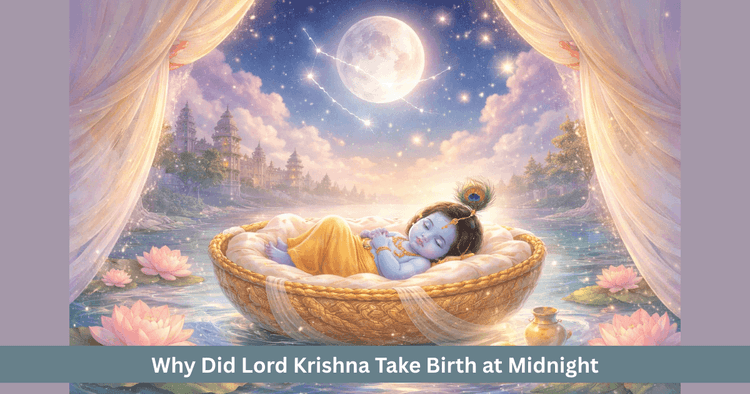
Table of Contents
The birth of Lord Krishna was not an ordinary occurrence. In Dvapara Yuga he incarnated in the prison of Mathura during Krishna Paksha Ashtami of the month of Bhadrapada, on a Wednesday, at deep midnight, under Rohini Nakshatra with the Moon in Taurus. This is the very combination of day, date and star that devotees celebrate as Krishna Janmashtami with great joy and devotion.
Date, lunar phase and special combinations of Janmashtami
According to traditional texts, the birth of Krishna is placed on Bhadrapada Krishna Paksha Ashtami at midnight, with the Moon in Taurus and Rohini Nakshatra. This is considered not only an auspicious moment but also a very rare astrological configuration.
Key points regarding Krishna’s birth.
- Month. Bhadrapada Krishna Paksha
- Tithi. Ashtami
- Nakshatra. Rohini
- Weekday. Special importance is given when the day is Monday or Wednesday
- Moon sign. Taurus
- Time. Midnight
Many Puranas praise this combination and regard it as a rare and highly meritorious alignment.
Eighth son of Devaki and eighth avatar of Vishnu
Shri Krishna is worshipped as the eighth avatar of Vishnu. He was the eighth son of mother Devaki and father Vasudeva. The background of his birth is as remarkable as the later course of his life.
At the time of Devaki and Vasudeva’s marriage, when their cousin Kansa was driving their chariot, a divine voice announced that the eighth son of Devaki would be the cause of Kansa’s death. This message filled Kansa with fear.
Thereafter.
- Kansa imprisoned Devaki and Vasudeva.
- One after another, Devaki’s children were born.
- Six of the infants were cruelly killed by Kansa.
In this same prison, in this atmosphere of fear and cruelty, Krishna took birth on the Ashtami night at midnight.
The wondrous scene of birth in prison at midnight
As the hour of birth approached, the prison environment began to change in a miraculous way.
According to the traditional account.
- At midnight on Ashtami all the locks of Kansa’s prison opened on their own.
- The guards fell into a deep sleep.
- The sky was covered with thick clouds and heavy rain began to pour.
In that divine moment Lord Krishna was born. The nakshatra, tithi and time chosen for his appearance were filled with deep significance. Midnight here does not symbolise only darkness. It marks the emergence of divine light from within the depths of darkness.
Krishna as the lord of sattva among the three gunas
Scriptures describe Krishna as the master of sattva guna within the three gunas sattva, rajas and tamas that pervade the three worlds. Sattva stands for purity, clarity and true understanding.
- Krishna’s birth is seen as light appearing amidst dense darkness.
- The darkness of prison, the tyranny of Kansa and the fear in people’s hearts are all met by the descent of a presence that embodies sattva and protection.
In this way the midnight birth reflects that when ignorance appears strongest, the dawn of wisdom and grace can still arise suddenly and decisively.
Why Krishna is called a lunar dynast and the deeper sense of midnight
The texts refer to Rama as belonging to the Solar dynasty and Krishna as belonging to the Lunar dynasty. This is also linked to the time of their birth.
- An incarnation born around sunrise is associated with the solar line.
- One born at night is associated with the lunar line.
Since Krishna took birth at midnight, he is recognised as a member of the lunar dynasty. The Moon is regarded as his forefather.
The line of descent is described in this way.
- Chandra Deva, the Moon god, is seen as the ancestral head.
- His son is Budha, the deity of Mercury.
- Because of this, the weekday Wednesday (Budha Vara) is considered deeply connected with Krishna’s birth.
- Rohini is honoured as the wife and favourite Nakshatra of the Moon, which is why Krishna’s birth is placed in Rohini.
Thus tithi, nakshatra, weekday and lineage all converge around the Moon, making Krishna’s incarnation particularly fitting for the lunar race and for the welfare of the world.
Ashtami tithi, symbol of shakti and the secret of birth
The Ashtami tithi is traditionally regarded as a strong symbol of shakti, the energy of protection and transformation.
- Lord Vishnu sustains the universe through the support of such divine power.
- Ashtami points to the very strength needed for preservation of dharma.
For this reason the combination of Krishna Paksha Ashtami, Rohini Nakshatra and Wednesday was chosen for Krishna’s birth, a time when the forces of the lunar lineage, the nakshatra and the tithi all were favourable. This is seen not as a random astrological event but as a carefully arranged divine alignment.
How was the atmosphere at the time of birth
Puranic narratives describe that Chandra Deva himself desired that the Lord be born in his lineage.
- In the earlier incarnation the Lord had taken birth in the solar line as Rama.
- Chandra Deva prayed that in this incarnation the Lord should appear in the lunar line so that he too might receive the joy of direct darshan and service.
When Krishna manifested during the night, it is said that.
- The atmosphere of the entire universe became auspicious and serene.
- The gods began to sing auspicious hymns, praising the qualities of the Lord.
- Nature, animals, birds, sages, ascetics and celestial beings expressed joy through dance and song.
- From earth to Indra’s heaven all regions rejoiced at the Lord’s arrival.
- The gods showered flowers from the heavens in welcome.
Thus the small prison cell became the focal point of celebration for all realms.
Why midnight was chosen for leaving the prison
Krishna did not choose midnight only for birth. The same time was used for his departure from the prison as well. This moment was naturally safe and strategically wise.
Immediately after birth.
- All the doors of the prison opened.
- Chains loosened and locks fell away.
- The guards sank into deep sleep.
In this grace filled silence Vasudeva carried the infant Krishna across the Yamuna to Gokula. There he placed the child safely in the home of Nanda and Yashoda and in exchange brought back a baby girl so that no immediate suspicion would fall upon Devaki and Vasudeva. Midnight was ideal for this journey because the city lay quiet and the darkness itself helped to conceal their movement.
How Janmashtami was observed in such a rare combination
Regarding the festival of Janmashtami, traditions also mention specific years when the alignment of tithi and other factors came very close to the original birth conditions.
For example.
- In Vikram Samvat 2078, Bhadrapada Krishna Janmashtami began before sunrise on Monday and extended until 2.02 a.m. at night.
- On that day Ashtami tithi prevailed at both sunrise and moonrise, a very special condition.
In such a configuration.
- Ascetics and householders observe Janmashtami on the same day.
- Smarta, Vaishnava, Shaiva and Nimbarka followers all accept that day together.
- This form of Janmashtami is praised as especially meritorious and as capable of destroying the accumulated sins of three births.
A traditional verse states.
“Somahani budhavare va ashtami rohini yuta.
Jayanti sa samarabhyata hanti papa trijanmajam.”
Meaning. When Ashtami coincides with Rohini Nakshatra on a Monday or Wednesday, that Janmashtami is called Jayanti and is said to destroy sins of three births.
Auspicious combination appearing after eighteen years
According to scriptural tradition the original birth of Krishna is associated with Bhadrapada Krishna Ashtami, Rohini Nakshatra, Monday, Taurus Moon and midnight.
Texts such as Shrimad Bhagavata Purana, Brahma Vaivarta Purana and Bhavishya Purana praise this rare cluster of conditions.
When the same six special factors of Krishna’s birth come together on a Janmashtami.
- Fasting, worship, kirtan and meditation.
- Rocking the cradle of Krishna and night long vigil.
are believed to become inexhaustibly fruitful, bringing lasting blessings for the devotee and benefit for society and the nation. Such a combination may arise only after a long gap and in a noted instance it was said to reappear almost eighteen years after the previous occurrence.
Spiritual message of Krishna’s midnight birth
The account of Krishna’s midnight birth is more than an emotional story. It holds a clear spiritual message.
- Even when outer conditions resemble a prison, inner divine light can still take birth.
- In the thickest darkness, if sattva awakens, all chains can fall away.
- When the right time, right direction and divine support come together, even the impossible becomes possible.
So, when devotees sing at midnight on Janmashtami, they are not only rejoicing over an ancient event. They are also affirming that an inner birth of Krishna is possible at any time, even in the darkest phase of life, if the heart is ready.
Frequently asked questions about Krishna’s birth at midnight
Is Krishna’s birth always placed in Krishna Paksha Ashtami under Rohini Nakshatra
Yes. Traditional, scriptural and astrological opinions converge on Bhadrapada Krishna Ashtami at midnight with Taurus Moon and Rohini Nakshatra as the basis for determining Janmashtami.
What is the main reason for calling Krishna a member of the lunar dynasty
His birth took place at night, his lineage is traced to Chandra Deva, the Moon is his ancestral head and the birth is set in Rohini, the favoured Nakshatra of the Moon. Together these show his connection with the lunar line.
Why was midnight chosen as the time to leave the prison
Midnight is naturally quiet and dark, with less outward vigilance. At that moment divine intervention opened the locks and sent the guards to sleep, enabling Vasudeva to carry Krishna safely to Gokula.
Do the same six rare combinations of Krishna’s birth appear every Janmashtami
No. Those six conditions are considered extremely rare. Only in special years do tithi, nakshatra, weekday, Moon sign and midnight come together in a way that closely reflects the original birth. Such alignments may repeat only after long intervals.
What is the difference between Jayanti Janmashtami and an ordinary Janmashtami
When Ashtami tithi coincides with Rohini Nakshatra on a Monday or Wednesday under specific lunar conditions, the day is called Jayanti Janmashtami. Scriptures praise it as exceptionally auspicious and as capable of erasing the sins of three births.
Get your accurate Kundali
Generate KundaliDid you like it?
Author

Pt. Sanjeev Sharma (63)
Experience: 20
Consults About: Family Planning, Career
Clients In: Punjab, Haryana, Delhi
Share this article with friends and family
About ZODIAQ
ZODIAQ is an online Vedic Astrology platform. It connects clients seeking astrological advice to experienced astrologers with deep knowledge. Our users also generate kundali and perform kundali milan for free. ZODIAQ also offers services to the Astrologers. Astrologers utilize various offerings by ZODIAQ to serve their clients effectively.
If you are a User
Consult with experienced astrologers and seek their guidance. You can also order handwritten Janm Patrika report with life prediction prepared by experienced astrologers. Generate accurate Kundali, perform Kundali Matching and check horoscope and muhurat. Utilize our online library for all the necessary astrological and spiritual information.
If you are an Astrologer
Create accurate kundali for your clients and perform Kundali Matching for up to 5 people at a time. Write comprehensive Janm Patrika report for your clients with ZODIAQ. Check client details anytime by saving it in client directory. Become more productive by tracking how many clients you guide every day.
WELCOME TO
ZODIAQ
Right Decisions at the right time with ZODIAQ
