The Many Lives of Krishna: A Thorough Journey Through Sanskrit Literature
By Pt. Narendra Sharma
From Mahabharata to Geet Govind: Cultural and Spiritual Depths of Krishna’s Leela
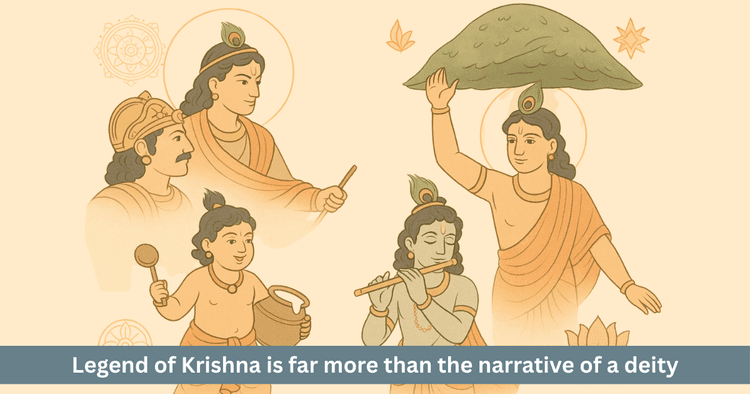
Table of Contents
Within the endless streams of time and culture, the legend of Krishna is far more than the narrative of a deity, it is the living river that stirs the soul of India. In the flowing sands of Sanskrit literature, Krishna’s many forms, child, friend, teacher, beloved, king and avatar, have evolved to meet the needs of every age, land, community and consciousness. His story is not confined within temples or scholarly walls but woven deeply into every shade of life, emotion, sorrow, joy and hope. From the Mahabharata to the Geet Govind, Krishna’s living tradition remains a perennial source within Indian literature, philosophy, art and social thought. His presence glistens in poetry, purana, shastra, drama, folk song, painting and hymns.
Krishna in the Mahabharata: Friend, Guide and Divine Strategist
Duty, Strategy and the Many Sides of Life
In the Mahabharata, Krishna stands as a unique statesman, strategist in war, champion of righteousness and the ever-faithful, steadfast friend amidst calamity. He is the trusted confidant of the Pandavas, their victory, suffering and controversy all steered by his guidance and unwavering support. Through Draupadi’s indignation, Arjuna’s storms of doubt and Yudhishthira’s dilemmas of duty, Krishna’s blend of human compassion and philosophical wisdom comes forth.
Krishna’s life in the Mahabharata is a model of diplomacy, reasoned balance and inspiring hard decisions in defense of dharma. His peace proposal before the Kauravas, absent any ego, aims to win over the whole assembly and avoid war’s devastation; his patience and maturity shine through as he attempts to avert destruction time and again.
Battlefield and the Divine Message of the Gita
Krishna’s role in establishing righteousness transcends practicality and is immortalized in the teachings of the Bhagavad Gita. When Arjuna is overcome with inner conflict and hesitation at the dawn of war, Krishna rises above his friendly form, becoming the universal guru.
Gita’s eighteen chapters unfold every aspect of life, action, righteousness, knowledge, devotion, yoga, detachment, soul, Supreme, nature, death, rebirth, equality and faith. The Gita stands as a source of philosophy, spiritual balance and psychology for seekers worldwide.
Hard Decisions and the Unmatched Scope of Dharma
Krishna often chooses practical wisdom over rigid tradition. Bhishma’s fall, Karna’s end and the judgment regarding Ashwatthama, Krishna sets aside custom for the higher cause of justice. He motivates the Pandavas to make painful choices, guiding them to transcend rules when the well-being of all demands it.
Limitations and Features of Krishna in the Mahabharata
Mahabharata provides little space for Krishna’s childhood, affection for Radha or Vrindavan’s gentleness; his image here is forged in war, counsel, politics and spiritual discourse.
Harivamsa: The Mystical Marvels of Krishna’s Childhood
Birth, Struggle and Parental Sacrifice
The Harivamsa stands as a profound expansion of the Mahabharata, describing Krishna’s birth, childhood and village life with tenderness, devotion and mystery.
To shield Krishna from Kansa, Vasudeva and Devaki bear hardship and sacrifice, crossing the Yamuna at night to deliver the child to Nanda and Yashoda’s protection. The act resonates with maternal devotion and perseverance. Krishna’s upbringing among cows, flute and rural simplicity enlivens the joys and struggles of village existence.
Butter Theft, Flute’s Melody and Friendship’s Meaning
Krishna’s playful butter theft, musical revelry and camaraderie among children offer society a sense of unity, joy and cultural renaissance. His childhood bonds are the soul of cooperation and affection.
Slaying Demons and the Glory of Govardhan Hill
Throughout his childhood, Krishna defeats numerous demons, Putana, Bakasura, Aghasura, Kaliya, modeling courage, faith and union in protection against harm.
The Govardhan episode, where he lifts the mountain to shelter the villagers, leaves a lasting impression of environmental care, nature-worship and trust in the divine among rural communities.
Culture of Gokul and the Social Creations of Devotees
Harivamsa also evokes rural folk culture, song, dance, worship and togetherness. In the village, Krishna is the son, friend, guide and protector to all. The tradition of Gopal Leela, Holi, Jhula and Rasa echoes through generations.
Vishnu Purana: Krishna as the Avatar with a Cosmic Mission
Divine Incarnation and the Vow to Protect Creation
The Vishnu Purana paints Krishna’s role as a direct incarnation of Vishnu, aimed at the protection of creation, destruction of evil and establishment of dharma. Each act, demon-slaying, miracle, eclipse, political decision, is charged with cosmic intent.
End of Kansa, Liberation of Parents and Royal Order
As a youth, Krishna joins Balarama to fell Kansa, liberate his imprisoned parents and revive the Yadu clan, epics of justice, freedom and peace.
His founding of Dwarka, upholding fairness, love and justice in the royal order, crowning him as Vishnu Purana’s emblem of policy and social security.
Political Wisdom, Divine Dialogue and Balance of Relations
Krishna’s counsel with kin, friends, adversaries, masses and rulers demonstrates policy, justice, ideals and love in abundance, his bearing always progressive for social reform.
Shrimad Bhagavata Purana: The Supreme Object of Devotion
Sweetness of Vrindavan, Divinity and Aura of Devotion
Bhagavata Purana ennobles Krishna’s childhood through emotion, ecstasy and spiritual insight, Gokul, Vrindavan, cowherds, flute, dance, Rasa Lila, the words and stories run with gentle affection and devotion. Krishna is the focus of every gopi, friend, artist and parent.
Rasa Lila’s Profoundness and Radha’s Divine Love
Within the Rasa Lila, Krishna dances with each gopi, granting her a sense of private union and divine intimacy. Radha emerges as the ideal of loving surrender and devotion, the epitome of spiritual longing.
Playfulness, Forgiveness, Generosity and Festivity
Break-pot games, teasing, playful camaraderie, Krishna’s antics exemplify love, forgiveness, compassion and joy, their resonance carried in art, song, festival and community gatherings.
Krishna frequently forgives adversaries, spreading mercy, joy and humility throughout the land; festivals, hymns, dances and fairs are suffused with his radiance.
Bhakti Movement and the Growth of Practice
Bhagavata establishes devotion as highest philosophy, Krishna is pleased through song, dance, music and self-realization; the movement spread like sunlight amongst artists, devotees and sages across India.
Geet Govind: Krishna and Radha, The Eternal Dance of Love
Love, Separation, Spiritual Longing and Reunion
Jayadeva’s Geet Govind brings Krishna and Radha’s love, melody, separation, union, reunion, immersion, jealousy, alive through stunning poetry, dance and song.
Radha’s devotion, longing, pain and surrender are the hallmark of spiritual aspiration. Dance, swing, garlands, flute, moonlit river, each image is a musical philosophy of life.
Sensuousness, Beauty and Complete Self-Surrender
Within Geet Govind, love and beauty couple in an unparalleled way, Radha’s ornaments, Krishna’s radiance, flute, forest, all become witnesses of devotion, aesthetics and synchronization. Such love is not mere physical contact but emblematic of spiritual fulfillment.
Radha: Heroine of India’s Spiritual Realization
Radha, through Geet Govind, becomes the queen of bhakti literature, her character, surrender, love and complete absorption inspire art, temple worship, music, poetry and spiritual practice throughout India.
Art, Music and the Wider Impact of Geet Govind
Geet Govind’s impact continues, temples, music halls, classical dance, theater, fairs, festivals and creative arts find inspiration in Krishna-Radha’s endless leela.
Krishna’s Literary, Devotional and Social Expansion
Contribution of Saints, Poetry and Rural Life
Krishna’s stories are carried by Surdas, Mirabai, Chaitanya Mahaprabhu, Tulsidas, Ras Khan and countless saints.
Festivals, Janmashtami, Rasa Lila, Holi, temple events, community drama and poetry competitions, bring Krishna’s plays to life. Village, city, temple, home, courtyard, everywhere Krishna’s legend and spirit thrive.
Social Harmony, Women's Strength, Ecological Reverence
Krishna’s legend includes all, transgender, destitute, women, children, granting love, music, respect, service and beauty.
Trees, nature, animals, birds, music, art, each finds a place within his story; food, worship, service, collaboration and harmony finds Krishna’s soul as their guide.
Music, Painting, Temples and the Spread of Divinity
Indian music, painting, temple architecture, classical dance, poetry and folk art have all been shaped and renewed by Krishna’s story.
Rasa, hymns, music, drama, literary assemblies remain proofs of his everlasting influence.
The Never-Ending Leela: Always New, Always Complete
Krishna’s legend is more than history or scripture, it is an alive leela in which every era, culture and devotee adds renewed curiosity, devotion, love and consciousness.
The hero of the Mahabharata, child of the Harivamsa, avatar in the Vishnu Purana, beloved friend in the Bhagavata, source of ecstatic love in Geet Govind, Krishna is an invitation to service, meditation and joy.
His story flows within every level of society, culture and spiritual practice, love, service, devotion, wisdom, equality, harmony and divinity.
As long as humanity creates music, poetry, prayer, love and celebration, Krishna’s river will keep flowing, without end, ever new, always leela.
Frequently Asked Questions
Q1: What is Krishna’s special importance in the Mahabharata?
A: Krishna stands as the ideal friend, statesman, master of dharma, victor in battle and the eternal guide delivering the Gita’s lesson. His skill, compassion and philosophical teaching remain matchless.
Q2: What message do Krishna’s childhood stories in Harivamsa give to society?
A: Harivamsa’s childhood tales butter theft, playful camaraderie, demon-slaying, lifting Govardhan hill, rural and nature-worship, demonstrate union of simplicity, protection and faith.
Q3: How is Krishna portrayed in Shrimad Bhagavata Purana?
A: Krishna is depicted as the supreme Lord, beloved by all, friend to cowherds, center of devotion and prototype of love, transforming the bhakti movement and social integration.
Q4: How do Radha and Krishna’s relationship reach spiritual heights in Geet Govind?
A: Their love, separation, union and surrender embody intense personal yearning, spiritual convergence and the highest model of devotion in Indian consciousness.
Q5: What is Krishna’s role in expanding India’s culture, society and art?
A: Krishna’s legend expands the movements of devotion, respect for women, social justice, nature, music, painting, community service and universal divinity, flowing into villages, cities and temples everywhere.
What does Nakshatra reveal about me?
My NakshatraDid you like it?
Author

Pt. Narendra Sharma (63)
Experience: 20
Consults About: Family Planning, Career
Clients In: Punjab, Haryana, Delhi
Share this article with friends and family
About ZODIAQ
ZODIAQ is an online Vedic Astrology platform. It connects clients seeking astrological advice to experienced astrologers with deep knowledge. Our users also generate kundali and perform kundali milan for free. ZODIAQ also offers services to the Astrologers. Astrologers utilize various offerings by ZODIAQ to serve their clients effectively.
If you are a User
Consult with experienced astrologers and seek their guidance. You can also order handwritten Janm Patrika report with life prediction prepared by experienced astrologers. Generate accurate Kundali, perform Kundali Matching and check horoscope and muhurat. Utilize our online library for all the necessary astrological and spiritual information.
If you are an Astrologer
Create accurate kundali for your clients and perform Kundali Matching for up to 5 people at a time. Write comprehensive Janm Patrika report for your clients with ZODIAQ. Check client details anytime by saving it in client directory. Become more productive by tracking how many clients you guide every day.
WELCOME TO
ZODIAQ
Right Decisions at the right time with ZODIAQ
