Ashadha Month: The Month of Liberation and Self-Reflection
By Pt. Nilesh Sharma
Spiritual Path Through Chaturmasya and Disciplines in Ashadha
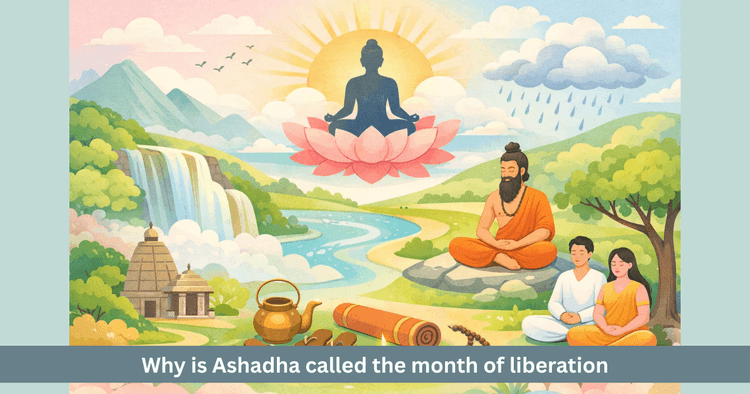
Table of Contents
In the Hindu calendar Ashadha month is regarded as the fourth month of the year and is often described as a month of liberation. This period invites a shift away from routine habits towards inner reflection, surrender to the guru and a life of discipline and tapasya. Ashadha usually falls between June and July of the Gregorian calendar and exactly at this time the most intense spiritual phase of the year begins.
Another key aspect of Ashadha is that it marks the start of Chaturmasya. From the Shukla Paksha Ekadashi of Ashadha a four month period begins which is regarded as a time of special disciplines, vows and spiritual practices for renunciants as well as for householders. This is the basis on which Ashadha is viewed as a month that prepares the ground for the path of moksha.
Religious importance of Ashadha month
The religious significance of Ashadha appears on many levels. On one side it points towards guru worship, devotional practice and the beginning of ashram centred life and on the other it gives direction to the entire spiritual plan of the year.
Some of the main features of this month can be listed as follows.
- The full moon of Ashadha is regarded as extremely sacred.
- This full moon is observed as Guru Purnima.
- From Ashadha Shukla Ekadashi the observance of Chaturmasya begins.
- Monks and many householders adopt special rules and vows starting from this period.
The title of “month of liberation” for Ashadha arises from the understanding that vows, japa, tapas, guru service and spiritual discipline in this time bear deeper and more subtle fruits than in ordinary periods.
Secret of Guru Purnima and Vyasa worship
The full moon of Ashadha is celebrated as Guru Purnima. It is also known as Vyasa Purnima, since tradition holds that on this day Maharishi Vedavyasa took birth, the sage who compiled the Vedas, composed the Mahabharata and is associated with many Puranas.
On this day disciples approach their guru and express gratitude.
- In ashrams and monasteries the seat of Vyasa, the Vyasa Peetha, is honoured.
- Disciples bow to the feet of their guru and receive blessings.
- Many seekers treat this as an auspicious day for beginning a new scriptural study or for renewing their commitment to knowledge.
Guru Purnima reminds everyone that the path of liberation does not open only through books or logic. It opens through guru’s grace, faith and discipline that give the seeker a true direction.
Why does Chaturmasya begin from Ashadha
From Ashadha Shukla Paksha Ekadashi the observance of Chaturmasya begins. These four months are usually counted as Ashadha, Shravana, Bhadrapada and Ashwin.
The main aspects of this period can be understood as follows.
- With the onset of the rainy season monks and renunciants remain in one place.
- In ashrams, monasteries and temples there are special arrangements for meditation, japa, recitation, discourses and study.
- Many householders also adopt some specific discipline for these four months such as regular fasting, daily repetition of a divine name or mantra, refraining from certain foods or working consciously on some weakness.
The Chaturmasya that begins from Ashadha Ekadashi is therefore seen as a support for inner turned sadhana. While rain cleanses the environment outside, detachment and softness begin to grow in the heart of the seeker, turning him towards the path of moksha.
Major festivals and rituals of Ashadha
Ashadha is not only a time of serious practice. It is also a month of devotion and celebration. Important festivals associated with this period in different regions reveal the devotional heart of the month.
Ratha Yatra of Puri
In Puri in Odisha the Ratha Yatra celebrated in Ashadha is world famous.
- During this festival the deities Jagannatha, Balabhadra and Subhadra are placed on huge chariots.
- Millions of devotees consider it a blessing to pull the ropes of these chariots.
- The journey of the chariots from the main temple to the Gundicha temple symbolises the visit of the deities to their garden shrine.
This Yatra is a living expression of devotion, surrender and the idea of walking together, where kings, monks and ordinary people all hold the same rope and move forward as one.
Ashadhi Ekadashi and the Wari pilgrimage
In Maharashtra Ashadha becomes even more significant because of the Wari pilgrimage.
- Devotees known as Varkari walk in large groups towards the Vitthala temple at Pandharpur.
- The peak of this journey is reached on Ashadhi Ekadashi, when lakhs of pilgrims have darshan of Lord Vitthala.
- Walking while singing abhangas, kirtans and bhajans, the travellers turn this into an inner journey that spreads the message of love, equality and service.
Ashadhi Ekadashi is thus honoured as a day of intense Vitthala devotion and nama sankirtana, which is said to make the path of liberation more approachable.
Agricultural meaning of Ashadha and the monsoon
Ashadha month is deeply linked with the monsoon in India.
- Usually the rainy season begins around this time.
- Farmers eagerly await the rains because they signal the start of sowing for many crops.
- In different regions small rituals are performed on the field bunds, lamps are lit and incense offered while praying to Indra and other deities associated with rain so that there will be adequate water through the year.
On occasions like Ashadha Amavasya various forms of deities linked with rain and fertility are worshipped. This shows clearly that in the Indian way of life religion and agriculture support each other rather than standing apart.
Deeper meaning of calling Ashadha the month of liberation
There is not just one reason why Ashadha is called the month of moksha. Several strands come together.
- Through Guru Purnima there is renewed surrender to the guru and a fresh start in the pursuit of knowledge.
- From Ashadha Shukla Ekadashi onwards a four month Chaturmasya journey of continuous sadhana begins.
- Through Ratha Yatra, Wari and other observances one experiences grace, surrender and holy company.
- With the onset of monsoon nature undergoes cleansing and new life arises and in the same way new resolutions and inner renewal become possible for the seeker.
Moksha is not only a state after death. It is also the daily experience in which the mind feels a little lighter, attachment softens and trust in God and guru grows stronger. Ashadha is the period that supports these small but important steps on the spiritual path.
Summary table of key points of Ashadha month
| Topic | Details |
|---|---|
| Position in the year | Fourth month of the Hindu year |
| Gregorian period | Mostly between June and July |
| Main sacred date | Ashadha Purnima, Guru Purnima |
| Important beginning | Start of Chaturmasya from Ashadha Shukla Ekadashi |
| Major festivals | Ratha Yatra, Ashadhi Ekadashi, Guru Purnima |
| Key pilgrimage sites | Puri Jagannatha temple, Pandharpur Vitthala temple, many monasteries |
| Spiritual character | Guru devotion, vows, tapas, pilgrimage, collective singing |
| Agricultural connection | Onset of monsoon, beginning of sowing, prayers for rain |
| Link with liberation | Guru’s grace, Chaturmasya vows and sustained bhakti |
Life guidance offered by Ashadha month
Ashadha month teaches that life is not confined to work and constant busyness. In the midst of the year it brings a time that invites one to pause and reflect, to look towards the guru, to take up a vow of practice and to move in rhythm with nature.
Anyone who, according to personal capacity, expresses gratitude to the guru, adds a little tapasya, chant of the divine name, participation in Wari or Ratha Yatra in spirit or simply takes an inner resolve for purification during Ashadha, finds that this month truly becomes a doorway to the path of liberation.
Frequently asked questions about Ashadha month
Why is Ashadha called the month of liberation?
From Ashadha the observance of Chaturmasya begins, Guru Purnima falls in this month and long standing traditions of vows, fasting and devotion become strong. Hence it is seen as a month that prepares the way towards moksha.
Why is Guru Purnima celebrated specifically in Ashadha?
Ashadha Purnima is regarded as the birth day of Maharishi Vedavyasa. Since the Vedas, Puranas and the Mahabharata are connected with him, this date became the natural occasion to honour the guru and express gratitude.
How does Chaturmasya start from Ashadha?
From Ashadha Shukla Paksha Ekadashi the four month period of Chaturmasya is counted. On this day monks and many householders take special vows and disciplines that they maintain for the entire season, which is regarded as highly supportive for inner practice.
What is the importance of Ashadhi Ekadashi and the Wari pilgrimage?
On Ashadhi Ekadashi the Varkari devotees reach the Vitthala temple at Pandharpur after a long pilgrimage on foot. Continuous bhajans and kirtans make this journey an intense experience of devotion, humility and trust in God.
How is Ashadha connected with agriculture and the monsoon?
In Ashadha the monsoon generally begins, farmers prepare for sowing and people perform rituals to pray for good rainfall. Thus the month is vital for the greenery of the fields, crop production and the sustenance of life.
Get your accurate Kundali
Generate KundaliDid you like it?
Author

Pt. Nilesh Sharma (63)
Experience: 20
Consults About: Family Planning, Career
Clients In: Punjab, Haryana, Delhi
Share this article with friends and family
WELCOME TO
ZODIAQ
Right Decisions at the right time with ZODIAQ
