Bhadrapada Month: Importance of Careful Observances and Vows
By Pt. Suvrat Sharma
Significance of Fasting, Worship, and Religious Discipline During Chaturmasya
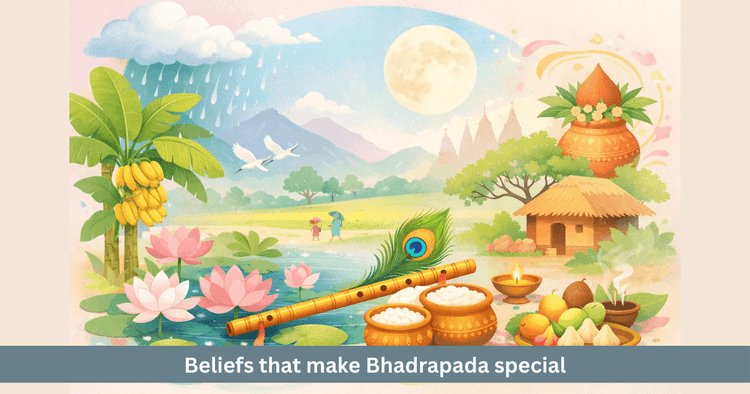
Table of Contents
In the Hindu lunar calendar Bhadrapada month, often called Bhado, begins as soon as the month of Shravan ends. It is counted as the sixth month of the Hindu year and the second stage of the Chaturmasya period, so Bhadrapada carries strong astrological as well as religious significance. During this time the rainy season is at its peak, the climate remains unstable and along with this the traditions of devotion, fasting and restraint grow deeper.
Across India this month is known by different regional names such as Bhadrapada, Bhadra, Bhadwa and Bhado. Names may change, yet the inner sense stays the same. This is the period linked with the grace of Lord Krishna, the arrival of Lord Ganesha and many important vows and festivals, which together make Bhadrapada a very sacred and awakening time.
Calendar position and timing of Bhadrapada month
According to the Hindu calendar Bhadrapada is the sixth month of the year. It comes immediately after Shravan and marks the beginning of the second phase of Chaturmasya. In most years it falls between August and September in the Gregorian calendar.
The order of the four months of Chaturmasya is as follows.
- First month Shravan
- Second month Bhadrapada
- Third month Ashwin
- Fourth month Kartik
As Bhadrapada begins, the Monday fasts and disciplines of Shravan naturally extend into this month through Krishna Janmashtami, Ganesh Chaturthi and Haritalika Teej. For this reason Bhadrapada is often described as a phase of Chaturmasya that is festive yet deeply restrained.
Beliefs that make Bhadrapada special
The importance of Bhado rests on several deep beliefs. From a religious perspective this month is significant because many key festivals of different deities fall in this period.
The main beliefs can be summarised as follows.
- During Bhadrapada the birth of Lord Krishna is celebrated as the festival of Janmashtami.
- The month also contains Ganesh Chaturthi, when the arrival and installation of Lord Ganesha is considered very auspicious.
- For women the very important vow of Haritalika Teej is observed in this month.
- Later in the same period the vows of Ananta Chaturdashi, Dol Gyaras and Rishi Panchami deepen the sacred atmosphere further.
Thus Bhadrapada is not just another segment of the calendar but a combined season of Krishna devotion, Ganesha worship, women’s vrata observances and remembrance of the sages.
Major vows and festivals of Bhadrapada month
Bhado is filled with fasts and celebrations. Through these observances the importance of Bhadrapada becomes part of daily life.
Main vows and festivals of Bhadrapada
Krishna Janmashtami
On this day devotees commemorate the birth of Krishna with night long kirtan, tableaux, fasting and the sacred abhisheka at the moment of birth.
Ganesh Chaturthi
On the Bhadrapada Shukla Chaturthi the installation and worship of Lord Ganesha begins. In many places this leads to ten days of collective puja and celebrations.
Haritalika Teej
A central vrata for women dedicated to the well being, long life and harmony of married life, observed through fasting and special worship.
Ananta Chaturdashi
A day for worship of Lord Vishnu as Ananta, tying the Ananta thread and renewing one’s resolve. In many regions the immersion of Ganesha images is also performed on this day.
Dol Gyaras
Connected with Lord Krishna, this observance includes swing processions of the deity, musical gatherings and kirtan.
Rishi Panchami
A vow that expresses gratitude towards the sages and is often undertaken by women to purify themselves of errors in daily duties.
Through these festivals Bhadrapada constantly reminds the devotee that vows, celebrations and devotion walk together and give balance to life.
Actions to avoid in Bhado month
Scriptural traditions and popular customs both prescribe certain cautions for Bhadrapada. The aim is not merely to create fear but to protect health, maintain restraint and keep the mind focused on spiritual effort.
In general it is advised to avoid the following during this month.
- One should not begin large auspicious works such as marriage, house entry or starting a major new venture in this period.
- Bhadrapada is mostly kept for worship, charity and self discipline, so new beginnings are usually postponed to other auspicious months.
Some dietary restrictions are also mentioned.
- Curd is avoided through the month, because in this rainy season it can aggravate digestive troubles for many people.
- Jaggery is discouraged in this time, especially for those whose digestion or skin reacts quickly.
- Non vegetarian food is to be avoided so that both body and mind stay light.
- Items that increase a tamasic state such as garlic and onion are to be left aside to preserve the sattvic quality of the month.
- There is a strong popular belief that fish should not be eaten in Bhado because of the condition of water bodies and the growth of living beings during the rains, which make it both unhealthy and inauspicious.
- Folk custom also advises that on Sundays of Bhadrapada one should not cut hair and should preferably avoid eating salt. This can be read as a symbolic pattern that supports simplicity, restraint and some rest for the body.
All these rules serve one purpose, to keep heavy and tamasic influences away so that the vrata and devotion of Bhadrapada can unfold in a pure and sattvic environment.
Recommended actions during Bhadrapada month
Alongside restrictions there are many practices that are warmly recommended during Bhado.
According to the dharma shastras and traditional teachers the following actions are especially suitable in this month.
- Taking baths in rivers, lakes or sacred water bodies whenever possible.
- Offering charity to the poor and needy after such bathing, in the form of food, clothing, grains or other useful items.
- Performing regular worship of Lord Krishna, either daily or on special dates.
- Offering Tulsi mixed water to Krishna and placing personal prayers before him with faith.
A common belief connected with Bhadrapada is that earnest prayers made to Lord Krishna in this month receive special attention and that he provides guidance in due time.
In relation to food the following points are emphasised.
- Avoid radish and eggplant in this period.
- Prefer pure vegetarian meals, simple and easily digestible.
- Milk and ghee may be taken in moderation, as they support strength when used wisely.
- Traditional teaching also notes that Krishna’s favourite makhan, that is fresh butter, when taken in balanced quantity in this month, is considered supportive for both intelligence and longevity.
For those bathing at home it is recommended to mix a few drops of gomutra, cow’s urine, in the water as a symbolic act of purification. This is held to represent the washing away of sins and faults.
Summary table of rules and recommended practices in Bhadrapada
| Aspect | What to avoid in Bhadrapada | What to do in Bhadrapada |
|---|---|---|
| Auspicious ceremonies | Do not begin major events like marriage or house entry | Focus on worship, vows, charity and sacred bathing |
| Food related rules | Avoid curd, jaggery, non vegetarian food, garlic, onion, fish | Take pure vegetarian food, with milk, ghee and some makhan |
| Special day cautions | Do not cut hair on Sundays, avoid salt that day | Keep Sunday meals simple and sattvic |
| Lifestyle | Avoid tamasic habits, laziness, anger | Cultivate restraint, service and satsang |
| Bathing and purification | Do not neglect cleanliness and care | Bathe in rivers where possible or use water with gomutra at home |
| Deity worship | Do not ignore daily worship | Worship Krishna, Ganesha and Vishnu with regularity |
Spiritual guidance from Bhadrapada month
On one side Bhadrapada brings joy and enthusiasm through festivals such as Janmashtami and Ganesh Chaturthi. On the other it gently guides the devotee toward light and attentive living through dietary discipline, charity and simple living.
The month teaches that amid unstable weather, rain and shifting patterns in nature, a little care in food, conduct and thought can protect the body and also clear the path of devotion.
Anyone who uses Bhadrapada to pay more attention to health, diet, charity and worship finds that this period becomes a beautiful opportunity to gather strength and create spiritual readiness for the remaining part of the year.
Frequently asked questions about Bhadrapada month
Why is the Bhadrapada month also called Bhado or Bhadwa in many regions?
The sixth month of the Hindu calendar is named Bhadrapada. In local dialects this name changes into Bhado, Bhadwa or Bhadra but all these forms refer to the same Bhadrapada month.
Why are curd and jaggery discouraged in Bhado?
During the rainy season both curd and jaggery can burden the digestive system and may increase the risk of gastric and skin related issues. To avoid such disturbances, traditions advise abstaining from them in Bhadrapada.
Are all auspicious works completely forbidden in Bhadrapada?
The general custom is to avoid major ceremonies such as marriage, house entry or starting big ventures in this month. However worship, charity, fasting, study, travel for reasonable needs and ordinary household duties can continue in a spirit of devotion.
How should Lord Krishna be worshipped during Bhadrapada?
In this month it is considered auspicious to offer Tulsi mixed water, makhan, sugar and simple food to Krishna, with regular aarti, name chanting and heartfelt prayer. It is believed that such devotion in Bhadrapada shapes guidance for the long term.
What is the importance of river bathing and charity in Bhado month?
During the rainy season rivers symbolise purity and constant renewal. Bathing in them and then offering food, clothes or money to the poor is understood as a combined practice of self purification and compassion, both of which are central aims of Bhadrapada.
Get your accurate Kundali
Generate KundaliDid you like it?
Author
Pt. Suvrat Sharma (63)
Experience: 20
Consults About: Family Planning, Career
Clients In: Punjab, Haryana, Delhi
Share this article with friends and family
WELCOME TO
ZODIAQ
Right Decisions at the right time with ZODIAQ
