Names and Timing of the 12 Hindu Months
By Pt. Suvrat Sharma
Understanding Each Hindu Month Based on Sun and Moon
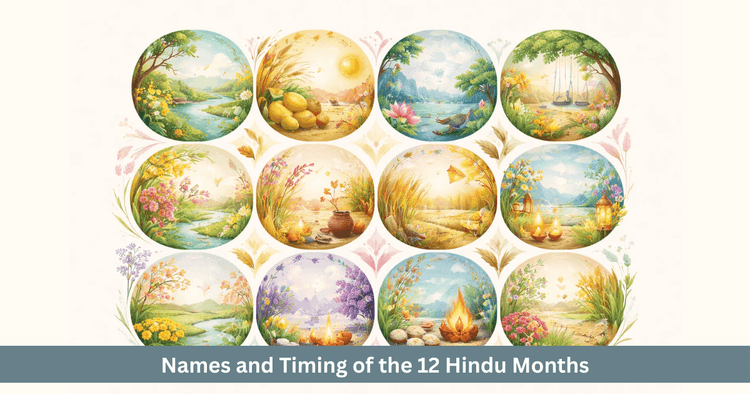
Table of Contents
In daily conversation when someone asks which month is going on most people immediately answer January or February. While teaching children about months many families also begin with the English calendar alone. There are people in India who may not know English language well yet when asked about months they recite the same names from January to December. However all these names belong to the English calendar not to the Hindu calendar.
In the Hindu tradition a very old Hindu panchang has been followed in which the twelve months of the year and their calculation are based on the movements of the sun and the moon. In this panchang Chaitra is regarded as the first month of the year and Phalguna as the last. Anyone who wishes to understand the Hindu New Year properly needs to know these Hindu month names and the approximate time when each month falls.
All 12 months of the Hindu calendar
In the Hindi calendar months are counted in the following order. The first month is Chaitra and the last is Phalguna.
| Order | Hindi month |
|---|---|
| 1 | Chaitra |
| 2 | Vaisakha |
| 3 | Jyeshtha |
| 4 | Ashadha |
| 5 | Shravan |
| 6 | Bhadrapada |
| 7 | Ashwin |
| 8 | Kartika |
| 9 | Margashirsha |
| 10 | Pausha |
| 11 | Magha |
| 12 | Phalguna |
Behind these names lies not only a difference of language but a living connection with seasons, festivals and religious traditions. Every month has its own importance and its own climate which shapes the rhythm of Hindu social and spiritual life.
When does the Hindu New Year begin from Chaitra
The month Chaitra marks the beginning of the Hindu New Year. In terms of the English calendar this month usually starts around the middle of March and continues till the middle of April. In many regions the New Year is celebrated from the first day of the bright fortnight of Chaitra. At this time nature too begins to change as the energy moves forward from spring towards the next phase.
Chaitra is regarded as a favourable period for new beginnings. Traditionally the start of new studies important plans and many religious resolutions is connected with this month.
When does Vaisakha fall
Vaisakha is considered the second month of the Hindu year. It generally runs from the middle of April to the middle of May. The beginning of stronger summer heat is clearly felt in this period.
From a devotional standpoint Vaisakha is seen as a good time for ritual bathing, charitable giving and pilgrimages. In many areas people undertake special river baths and vows during this month.
Why is Jyeshtha known as the month of intense heat
Jyeshtha is the third month in the Hindi calendar. It starts around the middle of May and continues till the middle of June. During this time heat is usually experienced in its most intense form.
In everyday life this month is associated with dryness and thirst. Many people engage in acts like offering water and arranging shade for travellers. The afternoons can be particularly harsh and people often avoid going out in the strong sun.
From which month does the monsoon begin with Ashadha
Ashadha is the fourth month of the Hindi calendar. According to the English reckoning it roughly covers the period from the middle of June to the middle of July. From this month the monsoon is considered to begin.
The first rains, the fragrance of wet earth and the preparation of fields for ploughing become marks of Ashadha. In religious life many vows and the preparations for the four month spiritual period are linked with this time.
Why is Shravan or Sawan regarded as so sacred
Shravan, also called Sawan, is the fifth month of the Hindi calendar. It usually falls from the middle of July to the middle of August. In Hindu dharma this month is considered extremely sacred because it is said to be dear to Lord Shiva.
During Shravan devotees perform Shiva worship water offerings and various fasts. The continuous rainfall, greenery and cool breezes create an atmosphere that is deeply supportive of spiritual focus and inner quiet.
Which important festivals fall in Bhadrapada
The month Bhadrapada is also known colloquially as Bhado. It typically runs from the middle of August to the middle of September. In this period several major festivals such as Teej and Ganesh Chaturthi are observed.
The installation and worship of Ganapati, swings, folk songs and numerous vows mark the spirit of Bhadrapada. The monsoon gradually settles and agricultural activity moves ahead.
Ashwin and the beginning of the autumn season
Ashwin is treated as the seventh month of the Hindu year. It extends from roughly the middle of September to the middle of October. Around this time the autumn season begins to show clearly.
Although the base content does not mention specific festivals here, traditionally this period is linked with vows and observances and the weather becomes clearer and pleasantly mild.
What is special about the month of Kartika
Kartika is the eighth month in the Hindu year. It runs from about the middle of October to the middle of November. This month is highly valued as a time of great merit.
People perform regular bathing, lighting of lamps and disciplined spiritual practice in Kartika. The air becomes cooler and the light of lamps in the evening adds a gentle and uplifting beauty to the nights.
When does Margashirsha or Agahan occur
Margashirsha is the ninth month of the Hindi calendar. It is also known as Agahan. It generally covers the period from the middle of November to the middle of December.
From an agricultural view this time is meaningful. There is a noticeable increase in cold in the air and the arrival of winter becomes clear.
Why is Pausha called Paus
Pausha is the tenth month in the Hindu year. It is popularly called Paus. It usually lasts from the middle of December to the middle of January.
During this time cold is at a stronger level. Fog, cold winds and long nights are typical features of Pausha. People rely more on warm clothing and seek heat from fires or other sources of warmth.
When does the month of Magha arrive
Magha is the eleventh month of the Hindi calendar. Its duration is roughly from the middle of January to the middle of February. The cold still continues yet the direction of the weather starts moving towards change.
At many pilgrimage places special Magha baths are observed. Worship of the sun and early morning bathing are considered auspicious during this month.
When does Phalguna fall and how does the year complete
Phalguna is the twelfth and final month of the Hindu year. It runs from approximately the middle of February to the middle of March. With this month the yearly cycle comes to completion and then returns again to Chaitra.
During Phalguna a gentle warmth appears in the air and the colours of spring begin to show. There is an increase in joy and togetherness in public life and the year seems to take leave with a sense of celebration making space for the arrival of the new year.
Summary of months with approximate English timing
| Hindi month | Order in year | Approximate period in English calendar |
|---|---|---|
| Chaitra | 1 | Mid March to mid April |
| Vaisakha | 2 | Mid April to mid May |
| Jyeshtha | 3 | Mid May to mid June |
| Ashadha | 4 | Mid June to mid July |
| Shravan | 5 | Mid July to mid August |
| Bhadrapada | 6 | Mid August to mid September |
| Ashwin | 7 | Mid September to mid October |
| Kartika | 8 | Mid October to mid November |
| Margashirsha | 9 | Mid November to mid December |
| Pausha | 10 | Mid December to mid January |
| Magha | 11 | Mid January to mid February |
| Phalguna | 12 | Mid February to mid March |
Frequently asked questions on Hindu months
From which month does the Hindu New Year start?
The Hindu New Year begins with Chaitra, which falls roughly from the middle of March to the middle of April and in many regions the New Year is celebrated from the bright first day of this month.
Which month is the last in the Hindi calendar?
The last and twelfth month of the Hindi calendar is Phalguna, which extends from about the middle of February to the middle of March, after which the cycle returns again to Chaitra.
Why is Shravan counted among the most sacred months?
Shravan or Sawan is considered dear to Lord Shiva. It usually lasts from mid July to mid August and during this time Shiva worship, vows and water offerings are widely observed by devotees.
In which months are heat and rainfall at their highest?
The strongest heat is generally felt in Jyeshtha, from mid May to mid June, while the monsoon is considered to begin in Ashadha and both Ashadha and Shravan usually see heavier rainfall.
Why is it important to know the Hindu months?
Knowing the Hindu months clarifies the timing of festivals, vows, seasons and the panchang. It also helps in understanding the true timing of the New Year, religious observances and traditional cultural practices.
Get your accurate Kundali
Generate KundaliDid you like it?
Author

Pt. Suvrat Sharma (63)
Experience: 20
Consults About: Family Planning, Career
Clients In: Punjab, Haryana, Delhi
Share this article with friends and family
WELCOME TO
ZODIAQ
Right Decisions at the right time with ZODIAQ
