Astrological and Spiritual Significance of Jyeshtha Month
By Pt. Narendra Sharma
Importance of Discipline, Devotion, and Charity During Peak Summer
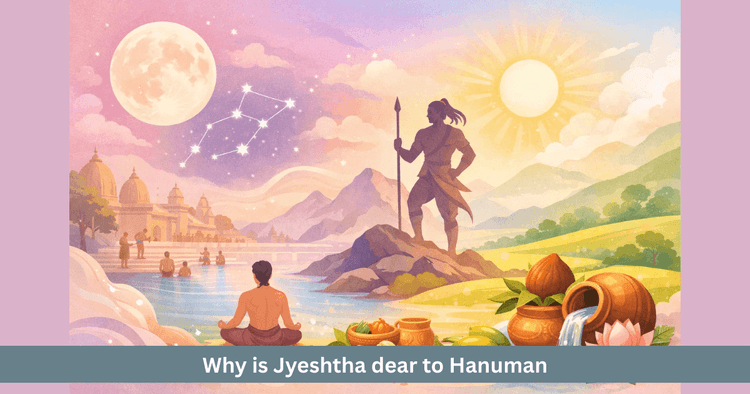
Table of Contents
In the Hindu lunar calendar Jyeshtha month is regarded as a very powerful period that falls in the heart of the summer season. Intense heat, a dry atmosphere and constant demands on the body and mind turn this time into a test of inner discipline and faith. The month usually occurs between May and June and in many years consists of about twenty nine or thirty days. From the day Jyeshtha begins the traditional focus rests on sacred bathing, a controlled lifestyle and charity for those in need.
The most important astronomical feature of Jyeshtha is that on the full moon of this month the moon is placed in the Jyeshtha nakshatra. Because of this placement the month came to be known as Jyeshtha. The governing planet of Jyeshtha is considered to be Mars, so during this period qualities such as courage, effort, restraint and tapasya gain particular importance.
Why is Jyeshtha dear to Hanuman
Jyeshtha month is regarded as especially dear to Hanuman ji. There is a belief that during this very month the first sacred meeting between Hanuman ji and Lord Rama took place. For this reason the Tuesdays of this month are treated as extremely auspicious. These special Tuesdays are known as Bada Mangal, the great Tuesdays.
Devotees hold that if on every Tuesday falling in Jyeshtha one worships Hanuman ji with special care, keeps a fast on Tuesday, recites the Hanuman Chalisa, Sundara Kanda or the name of Rama with devotion, then various troubles, fears and obstacles begin to subside. At this time the energy of Mars and the grace of Hanuman together grant the seeker strength, enthusiasm and a sense of protection.
How did the month get the name Jyeshtha
The names of the lunar months are based on the position of the moon on the full moon day. The month whose full moon falls when the moon is in the Jyeshtha nakshatra is called the Jyeshtha month. The word Jyeshtha carries the sense of seniority, prominence and special importance.
Heat and toil are prominent in Jyeshtha, so the month is viewed as a test of a seeker’s patience, restraint and faith. Those who can follow vows of fasting, bathing, japa and charity during this demanding time receive great merit from this month.
Inauspicious nakshatras and zero tithis in Jyeshtha
In astrological tradition some nakshatras and tithis within Jyeshtha are treated as shunya, meaning empty or unsuitable for initiating auspicious works. Deeds begun at these times are believed not to give the expected result and may even lead to loss or obstruction.
The inauspicious factors in this month are explained as follows.
- Uttara Ashadha nakshatra is considered shunya during Jyeshtha.
- Pushya nakshatra is also said to give empty results in this month.
- On the dates when these nakshatras fall one is advised to avoid major actions such as marriage, house entry, new business or purchase of vehicle or property.
In the same way there are two tithis in Jyeshtha that are specifically known as shunya tithis.
- Krishna Paksha Chaturdashi
- Shukla Paksha Trayodashi
On these tithis it is customary not to perform major auspicious ceremonies or begin new undertakings. Seekers often keep these days for japa, quiet study and inner reflection while keeping away from social celebrations and big decisions.
Recommended discipline and daily routine in Jyeshtha
Because the nature of Jyeshtha is fiery, self discipline receives special emphasis in this month. The scriptures clearly mention that if a person keeps a well regulated routine in Jyeshtha, his life span increases and he gains protection from many illnesses.
Some of the main disciplines recommended for this time are the following.
- As far as possible it is encouraged to eat only one main meal a day. This keeps the body light and offers rest to the digestive system.
- One should avoid sleeping during the daytime so that lethargy does not build up and the night’s sleep remains natural.
- Very oily, heavily fried, overly spicy or dense foods are better avoided because in extreme heat such food puts strain on the body.
- Anger, arguments and unnecessary mental agitation are also to be kept under check, since the strong Martian energy in this month needs to be held in balance.
If someone spends Jyeshtha following these guidelines, the month can become a foundation for inner strength and long term health.
How to worship Lord Vishnu in Jyeshtha
The sacred texts describe special worship of Lord Vishnu during Jyeshtha. In particular the worship of the Trivikrama form of the Lord is regarded as highly auspicious in this month.
Certain dates are given where Vishnu worship bears even greater fruit.
- The Thursdays of Jyeshtha
- The Ekadashi day
- The Dvadashi day
- The Purnima of the month
On these tithis devotees sit quietly in front of an image or deity of Lord Trivikrama and meditate with a pure mind.
A simple form of worship can be arranged in the following way.
- After bathing and wearing clean garments, mix milk and Ganga water and fill a shankha, a conch.
- Perform abhisheka of Lord Vishnu in his Trivikrama form with this sanctified water.
- Offer Tulsi leaves and fragrant flowers.
- As far as possible keep a fast on these days or at least restrict food to simple sattvic items.
- After worship, offer charity to the needy according to capacity, such as food, clothing, water or other useful items.
Worship of the Trivikrama form on the important days of Jyeshtha is said to strengthen patience, stability and right understanding in the devotee’s life.
How Jyeshtha grants the merit of Ashvamedha and Gomedha yajnas
The scriptures state that the month of Jyeshtha can give merit comparable to that of great sacrifices such as the Ashvamedha and Gomedha yajnas. This merit does not arise from external rituals alone but from sincere vows, self restraint, sacred bathing and charity.
- On the Dvadashi tithi of Jyeshtha, if a devotee keeps a fast through the day and night and worships Lord Trivikrama with devotion, the result is said to equal that of a Gomedha yajna.
- According to the Shiva Purana, donating sesame seeds in the Jyeshtha month enhances a person’s strength and life span.
- The text Dharmasindhu notes that giving sesame in charity on the full moon of Jyeshtha bestows merit equal to an Ashvamedha yajna.
Thus those who observe fast, sacred bath and sesame charity on Jyeshtha Dvadashi and Purnima make this month deeply transformative for themselves and their families.
Special importance of Dvadashi in Mathura
A particularly distinctive practice is linked with the Shukla Paksha Dvadashi of Jyeshtha. It is believed that if a seeker spends this day in Mathura, observing a complete fast, bathing in the Yamuna and worshipping Lord Krishna, the result can be equal to the full fruit of an Ashvamedha yajna.
The outline of this observance is understood as follows.
- In the early morning take bath in the waters of the Yamuna or at least bathe while meditating on the Yamuna.
- Keep a fast throughout the day, chanting the names and hymns of Sri Krishna.
- In the evening offer lamp, incense, flowers, Tulsi and food offerings to Lord Krishna with deep attention.
It is said that one who performs this worship with faith begins to shed the burden of sins collected over many births and walks more firmly on the path of devotion.
Jyeshtha Purnima, Narada Purana and the path to Vaikuntha
The Purnima of Jyeshtha is also regarded as very sacred. Scriptural traditions mention that if on this full moon day a devotee especially worships Lord Vishnu, gives sesame seeds in charity and listens with reverence to the Narada Purana, many sins gathered over multiple births start to diminish.
The texts state that those who continue regular worship, vows and charity in honour of Lord Vishnu through the Jyeshtha Purnima become qualified for Vaikuntha. Here Vaikuntha can be understood not only as a heavenly realm but also as a symbol of deep inner peace, devotion and liberation.
Summary table of key features of Jyeshtha month
| Topic | Details |
|---|---|
| Basis of the name | Moon in Jyeshtha nakshatra on full moon |
| Ruling planet | Mars |
| Principal deities | Trivikrama form of Vishnu and Sri Hanuman |
| Special observance days | Bada Mangal, Thursdays, Ekadashi, Dvadashi, Purnima |
| Shunya nakshatras | Uttara Ashadha, Pushya |
| Shunya tithis | Krishna Chaturdashi, Shukla Trayodashi |
| Main vows | One main meal, avoiding daytime sleep, Dvadashi fast |
| Key charities | Sesame charity, food, water, clothing and service to the needy |
| Major spiritual fruits | Merit equal to Gomedha and Ashvamedha yajnas |
| Special places and sadhana | Dvadashi in Mathura, Yamuna bath, worship of Sri Krishna |
Inner guidance offered by Jyeshtha month
Amid the heat and strain of the season the month of Jyeshtha teaches the seeker to transform outer hardship into sadhana, self control and service. When a person eats a little less, avoids daytime sleep, offers water and help to others and turns to Hanuman ji and Lord Vishnu in worship, the month ceases to be a mere calendar period and becomes a step in the inner journey.
Anyone who, according to individual capacity, undertakes vows, japa, sesame charity, sacred bathing or even mental commitments of devotion and service during Jyeshtha gains a strong base for long life, health and spiritual progress.
Frequently asked questions about Jyeshtha month
Why is the month named Jyeshtha after the Jyeshtha nakshatra?
On the full moon of this month the moon is placed in the Jyeshtha nakshatra and therefore this lunar month was named Jyeshtha, indicating prominence and special importance.
Why is the worship of Hanuman in Jyeshtha considered special?
Tradition holds that the first meeting of Hanuman ji and Lord Rama took place in Jyeshtha. Hence the Tuesdays of this month, known as Bada Mangal, are treated as highly auspicious for special worship, fasting and devotion to Hanuman.
Which tithis and nakshatras are considered shunya in Jyeshtha?
In Jyeshtha the nakshatras Uttara Ashadha and Pushya are treated as shunya. The tithis Krishna Paksha Chaturdashi and Shukla Paksha Trayodashi are also called shunya tithis and auspicious works are generally avoided on these days.
How does Jyeshtha grant merit comparable to Ashvamedha and Gomedha yajnas?
By observing fast and worship on Dvadashi in honour of Lord Trivikrama one receives merit equal to a Gomedha yajna, while sesame charity on Purnima of Jyeshtha is said to give fruit comparable to an Ashvamedha yajna as described in Dharmasindhu.
In what form should Lord Vishnu be worshipped during Jyeshtha?
Lord Vishnu is especially worshipped in his Trivikrama form during this month. On Thursdays, Ekadashi, Dvadashi and Purnima performing abhisheka with milk and Ganga water, offering Tulsi leaves, observing a vow and giving charity are considered the proper way to honour him.
Get your accurate Kundali
Generate KundaliDid you like it?
Author

Pt. Narendra Sharma (63)
Experience: 20
Consults About: Family Planning, Career
Clients In: Punjab, Haryana, Delhi
Share this article with friends and family
WELCOME TO
ZODIAQ
Right Decisions at the right time with ZODIAQ
