Significance of Magha Month, Magha Snana and Key Observances
By Pt. Nilesh Sharma
Spiritual Importance of Magha Month and Its Rituals in Vedic Tradition
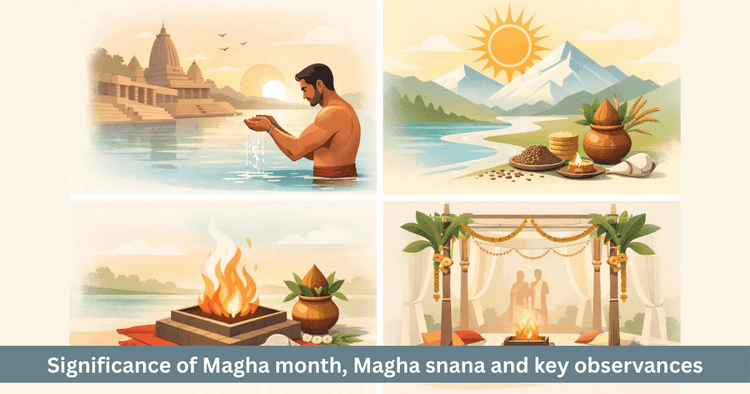
Table of Contents
In Hindu and Vedic tradition Magha month is regarded as a very sacred and rewarding period. It falls in the later part of winter, when body and mind naturally become more ready for discipline and spiritual practice. To understand why Magha has such an honoured place, it is helpful to look together at its bathing practices, offerings, vows and festivals.
Magha is important in both lunar and solar calculations. In the lunar calendar Magha is considered the eleventh month of the year and it may begin either on a New Moon day or on a Full Moon day depending on the tradition. The Full Moon usually falls in the star cluster Magha, which gives the month its name. In the solar calendar Magha begins when the sun enters Makara rashi, Capricorn and there it is known as the tenth month of the solar year. In many South Indian traditions this period is also connected with the Tamil or Dravidian calendars and is considered very auspicious for marriage, house warming and the sacred thread ceremony called upanayanam, provided the specific tithi and nakshatra are well chosen.
How and when is Magha snana performed
The most widely known and respected practice of Magha month is Magha snana, the sacred bathing discipline.
- The period of Magha snana runs from Pushya Bahula Amavasya until Magha Bahula Amavasya.
- During this span it is recommended to bathe daily or as often as possible, before sunrise, during the Arunodaya period.
- Rivers, lakes and the sea are regarded as especially suitable for this bath, although those who cannot reach them may bathe at home in clean water, keeping the same devotional attitude.
This pre dawn bath is not treated as just physical cleansing. It is seen as the foundation of the whole day’s spiritual effort.
Religious and health related aspects of Magha snana
During Magha the climate tends to be cold and the warmth of the sun appears reduced.
Traditional thought explains that
- In Magha the quality of the sun’s rays is such that when they fall on water, they are understood to make it energised and purifying.
- The common salt in sea water acts as a natural antiseptic and cleanser.
- Early morning baths in cool water help open the skin pores, activate blood circulation and gradually increase the body’s endurance.
Because of this, teachers advise that during Magha, if a devotee can, he should perform at least one ghadiya, about forty eight minutes, of bathing in the sea or another natural water body on suitable days. This practice allows the sun’s energy to spread into the body, cleanses the outer skin and reduces heaviness and lethargy.
Those who cannot do this every day are encouraged to observe Magha snana on key dates, still maintaining the same spirit of reverence and readiness.
Why is Magha considered auspicious for marriage and upanayanam
Magha month is viewed in many traditions as favourable for marriage, house entry and household sacraments.
- With the sun in Makara rashi, this time is associated with stability, responsibility and grounded effort.
- In the final phase of winter, new beginnings in family life such as weddings, house warming or the upanayanam of a child are seen as supported by this stable energy.
Especially in South India Magha is often chosen as an excellent period for
- marriages,
- house warming ceremonies,
- sacred thread rituals,
as long as the specific combination of tithi, nakshatra and weekday is examined by a competent astrologer and found favourable.
Which main festivals fall in Magha month
Within Magha several powerful dates and festivals occur. These are not only social celebrations. Each one expresses a different aspect of Magha’s spiritual potential.
Vasant Panchami or Sri Panchami
Vasant Panchami, also called Sri Panchami, is dedicated to Goddess Saraswati, the deity of learning and the arts.
- It is believed that Devi Saraswati manifested on this auspicious day.
- The day is considered ideal for Aksharabhyasa, the formal introduction of a child to education.
- Worship of Saraswati on Vasant Panchami is said to remove ignorance, dullness and laziness and to awaken interest in study, music and fine arts.
Schools, gurukulas and music institutions often perform special puja, place books and instruments before the altar and begin new learning related ventures on this day.
Bhishma Ekadashi and Vishnu Sahasranama
Bhishma Ekadashi is one of the most important dates in Magha.
- According to the Mahabharata, on this day Bhishma Pitamaha, lying on his bed of arrows, instructed the Vishnu Sahasranama, the thousand names of Lord Vishnu, to the Pandavas in the presence of Sri Krishna.
- He used this occasion to teach deep lessons on dharma, governance and devotion.
Listening to or chanting Vishnu Sahasranama on Bhishma Ekadashi is described as a practice that supports
- removal of sins,
- peace of mind,
- and progress towards moksha, liberation.
Ratha Saptami and the journey of the sun
Ratha Saptami is one of Magha’s most famous dates.
- The word “ratha” means chariot and “saptami” is the seventh lunar day.
- It is regarded as the day when Surya Deva, the sun god, symbolically begins his stronger movement towards the northern direction, welcoming the spring season.
- Sun is remembered here as riding a chariot drawn by seven horses, which represent the seven days of the week and also the powers of the senses.
On Ratha Saptami devotees are encouraged to rise early, bathe, offer arghya to the sun, recite Aditya Hridaya or other solar hymns and pray for health, clarity and long life.
Bhishmashtami and remembering Bhishma’s departure
Bhishmashtami is the eighth day of the bright fortnight in Magha, the day following Ratha Saptami.
- The Mahabharata describes this as the day on which Bhishma Pitamaha finally gave up his body and left this earthly plane.
- The day is therefore associated with remembrance of his steadfast brahmacharya, vow keeping and dedication to dharma.
Some traditions observe this day with offerings made for the peace of ancestors, reading of dharma texts and meditations on Bhishma’s life.
Sri Madhwa Navami and the Dvaita tradition
Sri Madhwa Navami falls on the ninth bright lunar day in Magha and is associated with Acharya Madhvacharya, the founder of the Dvaita school of Vedanta.
- Tradition holds that on this day, while he was teaching his students, a shower of flowers descended and Madhvacharya disappeared from within the heap of blossoms, understood as his entrance into Badarikashrama.
Followers of the Dvaita tradition observe this day with worship of Madhvacharya, recitation of his works and special programs related to scriptural study.
Magha Purnima or Maha Maghi
The Full Moon of Magha is known as Magha Purnima or Maha Maghi.
- This date also marks the completion of the month long Magha snana period.
- It is believed that religious activities performed on this day, such as bathing, japa, charity and homa, bear greatly increased fruits.
- In particular, Thilapatra Dana to a worthy brahmin and bathing in sea water or another sacred river on this day are highly praised.
At major tirthas Magha Purnima is marked by community gatherings, discourses, kirtan and extensive offerings to people in need.
Maha Shivaratri within the frame of Magha
In many traditional calendars, Maha Shivaratri is linked with the energy of Magha.
- It occurs on the Krishna Paksha Chaturdashi, the fourteenth waning lunar day, near the end of the month.
- The entire night is dedicated to the worship of Lord Shiva.
On Maha Shivaratri devotees observe
- night long vigil,
- four parts of worship,
- offering of bilva leaves,
- recitation of Mahamrityunjaya and Rudra hymns,
and it is held that such worship, performed with sincerity, helps destroy accumulated sins and guides the soul steadily towards liberation.
Key features of Magha month in a table
| Topic | Details |
|---|---|
| Place in the calendar | Eleventh month in the lunar year, tenth solar month with sun in Makara |
| Origin of name | Full Moon usually placed in Magha nakshatra |
| Magha snana period | From Pushya Bahula Amavasya to Magha Bahula Amavasya |
| Preferred bath time | Before sunrise, during Arunodaya, in river, lake, sea or at home |
| Health aspects | Sun energises water, cool baths open pores and support circulation |
| Auspicious life events | Favourable for marriage, house warming, upanayanam |
| Major festivals | Vasant Panchami, Bhishma Ekadashi, Ratha Saptami, Bhishmashtami, Sri Madhwa Navami, Magha Purnima, Maha Shivaratri |
| Special donations | Thilapatra giving, sea bathing, food offerings, support to brahmins |
| Spiritual emphasis | Discipline in cold season, bathing, japa, charity and preparation for the path of moksha |
What guidance does Magha month give to a seeker
Looking across the full span of Magha, a clear rhythm appears.
The month begins with Magha snana, flows through celebrations linked with Saraswati, Surya, Vishnu and Shiva and culminates in Magha Purnima.
Magha seems to whisper to the seeker that
- Rising a little earlier and facing the cold with courage,
- Allowing water to awaken body and mind,
- Setting aside some time each day for mantra, stotra or study,
- And giving charity, service and attention to sacred places
together can make life more pure, disciplined and meaningful.
Those who cannot take on very strict vows can still
- bathe early on some days each week,
- offer short prayers to the sun and to Saraswati,
- perform special baths on selected dates in river or sea,
- and give food, sesame or garments on Magha Purnima and other key days.
In this way Magha month quietly becomes a period that leads the practitioner towards steadiness, inner brightness and a more balanced heart, ready for the unfolding of the rest of the year.
Common questions about Magha month
Is Magha snana absolutely compulsory or can it be adjusted according to health and capacity
Magha snana is highly praised in texts as a powerful discipline, yet it should always be adapted to personal health and strength. Those who cannot bathe daily in cold water may choose key dates or a few days each week, keeping the same reverent intention and purity of mind.
Which activities are especially recommended in Magha month
Early morning bathing, wherever possible in natural water, simple food discipline, charity of food and Thilapatra, worship of Saraswati on Vasant Panchami, listening to Vishnu Sahasranama on Bhishma Ekadashi, Surya worship on Ratha Saptami, Shiva worship on Maha Shivaratri and special baths and offerings on Magha Purnima are all strongly recommended.
Can every type of marriage or house warming be performed in Magha
Tradition views Magha as generally auspicious for such events but each marriage, house entry or upanayanam should still be timed using proper astrological judgement. Consulting an experienced astrologer for a clean and promising combination of tithi, nakshatra and weekday remains important.
Is sea or Ganga water mandatory for Magha snana to be effective
Sacred rivers and the sea are ideal when one can reach them, yet they are not strictly mandatory. If a devotee bathes at home in clean water while remembering a chosen tirtha with sincerity, many teachers hold that the essential spirit of Magha snana is still honoured.
What is a realistic Magha practice for a busy householder
For a householder it is realistic to bathe earlier on some days, offer a little water to the sun, recite a few mantras or verses, mark Vasant Panchami, Ratha Saptami and Maha Shivaratri with short but focused worship and give small gifts of food or clothing on key days. When done regularly and with faith, even these modest steps allow Magha to quietly deepen awareness and bring a sense of inner freshness.
Get your accurate Kundali
Generate KundaliDid you like it?
Author

Pt. Nilesh Sharma (63)
Experience: 20
Consults About: Family Planning, Career
Clients In: Punjab, Haryana, Delhi
Share this article with friends and family
WELCOME TO
ZODIAQ
Right Decisions at the right time with ZODIAQ
