Pausha Month: Vows, Charity, and Inner Practices
By Pt. Narendra Sharma
Importance of Winter Spiritual Practices, Worship, and Discipline in Pausha
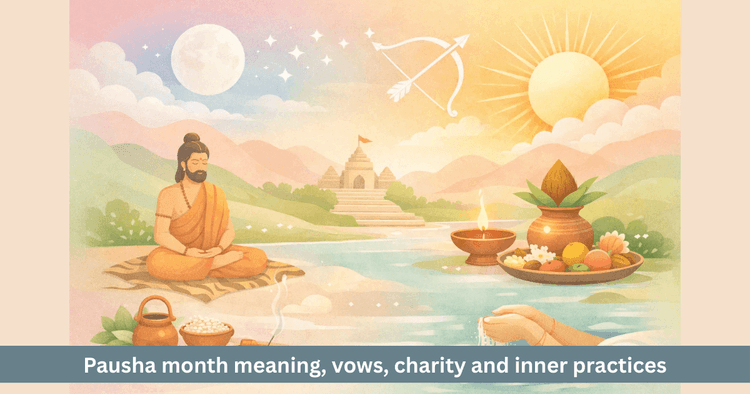
Table of Contents
In the Hindu calendar Pausha month is honoured as the tenth month of the year. It belongs to the latter part of the sun’s southern journey, when winter reaches its stronger phase and the mind quite naturally feels drawn towards introverted spiritual effort. The full moon of Pausha usually coincides with Pushya nakshatra, which is one of the reasons this month is looked upon as a very sacred and awakened time for practice.
In the Vedic text Taittiriya Samhita Pausha is referred to as Sahasya, a name that hints at the serious, disciplined and contemplative nature of this period. From an astrological perspective, for most of Pausha the sun remains in Dhanu rashi, the sign of Sagittarius, which is connected with dharma, wisdom and sadhana. Many traditions treat Pausha as a form of Khar Maas and especially after the sun enters Sagittarius people avoid major social ceremonies such as marriages and house entries, while recognising this month as especially suitable for worship, charity and austerity.
Tithis, nakshatras and auspiciousness in Pausha
To understand the nature of Pausha it helps to notice its indications regarding nakshatras and tithis.
- In this month Ardra, Ashvini and Hasta are counted among the shunya nakshatras, the zero nakshatras. Initiating new and important works, especially financial ventures, under these stars is linked with a risk of loss of wealth.
- Both fortnights’ Chaturthi and Panchami tithis in Pausha are termed mashunya tithis, the zero dates of the month. If mangal karya such as marriages, house entries or large family celebrations are held on these days, tradition warns of possible harm to lineage and prosperity.
- Classical teaching also mentions that performing griha pravesha in Pausha may increase the fear of theft and insecurity in the new home, so other months are preferred for such ceremonies, while worship and saadhana can proceed unhindered.
In this way Pausha may ask for restraint around material celebrations, yet it opens itself widely as a highly rewarding period for worship, vows and inner refinement.
Significance of one meal vow in Pausha
In Mahabharata, Anushasana Parva, chapter 106 a special vrata connected with Pausha is described.
The text states
“Pauṣamāsaṁ tu kaunteya bhaktenaikena yaḥ kṣipet.
Subhago darśanīyaś ca yaśobhāgī ca jāyate.”
Meaning that
- A person who spends the month of Pausha taking only one meal a day with devotion,
- Becomes fortunate, pleasant to behold and a bearer of good fame.
This is not mere harsh self denial. It is a way of using food discipline to support an increase in radiance, strength of character and respect in society. Within Pausha a sincere one meal vow gently draws the mind towards contentment and stability.
Rohini yoga and sleeping under the open sky
In the same Anushasana Parva Brahma explains a beautiful tapas for the bright fortnight of Pausha.
- On the day in Pausha Shukla Paksha when Rohini nakshatra is present, a special observance is advised.
- The seeker bathes, purifies himself and wears one clean garment.
- That night he lies down in an open space, on the ground, beneath the open sky.
- With faith and collected attention he exposes himself to the cool rays of the moon, remaining in a mood of wakeful receptivity.
The Mahabharata states that this simple yet intense practice grants the fruit of a great sacrifice. The touch of moonlight helps quieten the mind, soothe emotions and refine perception, so that Pausha becomes a bridge between the outer sky and the inner sky of awareness.
Pausha month in Shiva Purana and dawn worship
The Shiva Purana explains that when the sun enters Dhanu sankranti and Pausha is underway, dawn worship of Lord Shiva and other deities becomes especially potent.
- Offerings made from Aghani rice as havis are praised as excellent during this period.
- Various forms of grain based naivedya also receive special importance when offered in Pausha.
Pausha Shukla Ekadashi is described as a manvantara type tithi, which makes the merit of charity and shraddha performed on that day inexhaustible. Feeding brahmins, honouring ancestors and giving according to capacity are all strongly encouraged.
Narmada bathing and charity on her banks
Scriptures summarise this with the line
“Pauṣe tu Narmadā puṇyā snāna dānādi karmaṇi.”
Meaning that during Pausha
- bathing in the sacred Narmada river,
- and performing charity and righteous deeds on its banks,
is held to bring very high merit.
Narmada is revered as a remover of sins and a lightener of burdens carried from past lives. In the clear winter atmosphere of Pausha, baths, japa and offerings by her side support a deep process of karmic loosening and inner cleansing.
Surya worship, Gayatri japa and control of the senses
Pausha has a close relationship with Sun worship and Gayatri based practice.
Gayatri japa through the month
According to the Shiva Purana
- A self controlled dvija may spend Pausha in a state of restraint, with limited or carefully regulated intake of food.
- From morning until midday he performs japa of the Gayatri mantra, the mother of the Vedas.
- In the remaining hours he continues with Panchakshara mantra and other mantras of Shiva, while maintaining celibacy, sattvic diet and sleeping on the ground.
Such a practitioner is described as gaining true knowledge and, after leaving the body, liberation. As Gayatri japa requires proper initiation, this path is best followed under suitable guidance, yet its presence in Pausha highlights the month’s deep contemplative potential.
Sunday sunrise worship of the sun
In Pausha, Sundays, particularly at sunrise, are emphasised for Surya worship.
The instruction is that
- One who bathes at dawn on a Pausha Sunday,
- Performs charity, homa, japa and formal worship of the sun,
receives strong support in the form of health, radiance and prosperity.
Surya’s grace is associated with improved eyesight, confidence and overall life energy.
Structure of Pausha Surya vrata
Drawing on the teaching of Sumantu in the Bhavishya Purana, the Krityaratnakara describes the Pausha Surya vrata in detail.
Its main structure can be summarised as follows.
- During Pausha the devotee keeps his senses under control, speaks truth and lives with restraint.
- Up to the Saptami tithis of both fortnights he observes fasting, eating only at night.
- The meal consists of Swati grains, wheat and milk, taken once after sunset.
- Morning, midday and evening he worships Surya and the deities of the Shandilya lineage.
- Each night he sleeps on the ground, avoiding luxury and indulgence.
At the end of the month, especially on the Saptami,
- He performs full snapan and mahapuja of the sun with ghee and other sacred substances.
- He offers rice cooked in milk as naivedya.
- He invites eight brahmins who are sun devotees and Sama Veda chanters and feeds them.
- He donates a kapila coloured cow to Surya in a spirit of surrender.
Traditional verses describe the fruits of this vrata in images of heavenly vehicles, attendants, music and long stays in the realm of the sun. These fruits are best read as inspiring praise that points towards the vrata as a source of merit, health and steady spiritual ascent.
Forms of charity during Pausha month
Pausha is widely recognised as a special time for charity. Different texts highlight complementary aspects.
Teachings of Vishnudharmottara Purana
- Giving gold in Pausha brings deep inner contentment.
- In the bright fortnight, offering flowers is said to attract the grace of Lakshmi.
- In the dark fortnight, donating fruits yields distinguished spiritual merit.
Alongside these, donations of
- mansions,
- settlements,
- houses
and protective coverings are mentioned as means to please Narayana, which in present times may reflect support in the form of shelter, housing or protection.
Guidance from Danadipika
The text Danadipika recommends that during Pausha one should give
- jaggery,
- woollen garments,
- blankets.
It notes that
- cane juice, from which jaggery arises, is held as foremost among juices,
and therefore the gift of jaggery is connected with granting great peace to the giver.
For blankets and woollen cloths the mantras describe
- protection from cold,
- strengthening of vitality,
- and comfort to the body,
and the donor prays that through such gifts calm and stability may grow within.
Cows, grains, salt and other offerings
Verses based on the Skanda tradition explain that in Pausha one should offer
- cows,
- garments,
- grains,
- salt,
- jaggery,
- especially silver, ghee, coconut, citron fruits and pumpkins.
A blanket lined with silk threads inside is praised as a strong protection against intense cold,
and in another context such coverings are linked with balancing extreme weather conditions.
Special deepa dana in Dhanu
Further verses state that when the sun is in Dhanu rashi, one should carry out lamp offerings at
- Kurukshetra,
- Prayaga,
- and the banks of Godavari,
with the thought “May Govinda be pleased.”
This practice is equated with the merit of countless sacrifices and is said to remove the fault associated with men extinguishing lamps and women cutting pumpkins, that is, actions symbolically cutting short auspiciousness.
Salt, ghee and prosperity
The Shiva Purana notes that donating salt in Pausha helps ensure access to balanced six tasted food, a sign of nourishment and completeness.
According to Krityatattvarnava, on Pausha Shukla Trayodashi one should worship the Lord and donate ghee to a brahmin, which is said to fulfil deep held wishes.
In general the giving of ghee, medicinal substances and garments in Pausha is described as a way to invite prosperity, health and stability.
Special days, nakshatras and important worships
Shatabhisha nakshatra and Ganesha puja
When Shatabhisha nakshatra arises during Pausha,
- Devotees are advised to worship Lord Ganesha,
seeking removal of obstacles, clarity in thought and protection in undertakings.
Worship of Vishvadevas
The Narada Purana prescribes Vishvadeva puja on Pausha Shukla Dashami.
This is offered as a prayer for
- peace in all directions,
- upliftment of wandering souls,
- and inner rest for those who left the world without ease.
Lakshmi worship and her darshana
In Brahma Vaivarta Purana, Prakriti Khanda,
- It is stated that on auspicious Tuesdays of Chaitra, Pausha and Bhadrapada,
- Lord Vishnu established the festival of Lakshmi worship throughout the three worlds.
At the year’s end, on Pausha sankranti,
- Manu invited Lakshmi into his courtyard and worshipped her,
and from that time this Lakshmi puja became prevalent in all realms.
In Brahma Vaivarta Purana, Sri Krishna Janma Khanda, chapter 76,
- On a bright fortnight night of Pausha,
- A person who beholds and honours the image of Padma, Lakshmi
is described as loosening the bonds of birth.
Ekadashi to Purnima sequence in Pausha
Summarising Krityaratnakara
- One should fast on Pausha Shukla Ekadashi.
- On Dvadashi one worships Vishnu Narayana with care.
- Trayodashi is suitable for travel.
- On Chaturdashi one maintains fasting,
- And on Purnima one performs extended worship and offerings to Vishnu according to means, completing the cycle of the month’s vow.
Shakambhari Navaratri and Durga Dvatrimshannama mala
The Tripura Rahasya presents the thirty two names of Durga as a powerful garland of names, with special emphasis on Shakambhari Navaratri.
- On Pausha Purnima the Shakambhari Jayanti is celebrated.
- Reciting the Dvatrimshannama mala at this time is said to free one from fear, severe dangers, enemy oppression and confinement.
- Those who suffer from Rahu related afflictions or are undergoing Rahu Mahadasha are especially advised to undertake this anushthana.
The text describes this stotra as unique across the three worlds and explains that regular recitation brings swift protection from sorrow and adversity, along with profound spiritual benefit.
Daily names and Lakshmi stotra for Pausha
In Pausha the twelve names of Vishnu are recommended as a concise, sattvic daily practice.
- Shrikeśavāya namah
- Nārāyaṇāya namah
- Mādhavāya namah
- Govindāya namah
- Viṣṇave namah
- Madhusūdanāya namah
- Trivikrāmāya namah
- Vāmanāya namah
- Shrīdharāya namah
- Hṛṣīkeśāya namah
- Padmanābhāya namah
- Dāmodarāya namah
In a Lakshmi hymn Ishvara says
**“Trailokya pūjite devi, Kamale Viṣṇu vallabhe.
Yathā tvaṁ susthirā Kṛṣṇe tathā bhava mayi sthirā.
Īshvarī Kamalā Lakṣmīś calā bhūtir Haripriyā.
Padmā Padmālayā sampat sṛṣṭiḥ Shrīḥ Padma dhāriṇī.
Dvādaśaitāni nāmāni Lakṣmīṁ sampūjya yaḥ paṭhet.
Sthirā Lakṣmīr bhavet tasya putra dārādibhiḥ saha.”**
Meaning that one who worships Lakshmi with these twelve names
is blessed with steady wealth and good fortune, shared with family and loved ones.
Pushya Pausha Purnima observance
Vishnu Smriti, chapter 90 explains that when Pausha Purnima is joined with Pushya nakshatra, a dedicated ritual is advised.
- The devotee first applies a paste of cow urine, cow ghee and medicinal herbs to the body and then bathes.
- Thereafter he bathes again using a kalasha filled with ghee and in a similar way performs an abhisheka of Lord Vasudeva.
- He worships with incense, lamps and offerings.
- Finally he donates ghee and gold to brahmins and also gives garments in charity.
This combined practice is described as bringing enduring prosperity, health and auspicious results.
Summary table of Pausha essentials
| Topic | Details |
|---|---|
| Place in the calendar | Tenth month, called Sahasya in Taittiriya Samhita |
| Full moon and nakshatra | Full moon commonly aligned with Pushya nakshatra |
| Solar position | Mostly in Dhanu rashi, in the southern course |
| Astrological cautions | Ardra, Ashvini, Hasta as shunya nakshatras, both Chaturthi and Panchami as mashunya, concern about house entry |
| Core vows and practices | One meal vow, Rohini sky sleeping, Surya worship, Gayatri japa |
| Sacred rivers and places | Narmada baths and charity on her banks |
| Main forms of charity | Gold, jaggery, woollens, blankets, cows, grains, salt, ghee, silver, coconuts, pumpkins, lemons |
| Key worships | Surya vrata, Vishvadeva puja, Lakshmi puja, Ganesha worship, Vishnu’s names, Durga’s thirty two name stotra |
| Notable full moon yoga | Pushya Pausha Purnima with Vasudeva abhisheka and ghee gold donations |
| Spiritual themes | Restraint, tapas, purification of karma, health, prosperity, stable devotion |
Inner guidance offered by Pausha month
Pausha comes as a quiet invitation to recognise that
- Some control of the senses,
- Moderate sattvic food,
- A conscious bath at dawn with remembrance of the sun,
- A small but steady space for japa and stotra,
- And thoughtful charity
can reshape the inner landscape in a lasting way.
Even those who cannot embrace strict vows may still
- observe one meal days on selected dates,
- seek baths in sacred rivers when possible,
- offer regular prayers to Surya and Vishnu,
- and share food, blankets, salt or ghee according to capacity.
In this way Pausha gradually becomes a period that leads towards a calmer mind, purified actions and a more settled devotion, preparing the heart for the rest of the year.
Frequently asked questions about Pausha month
Why is Pausha sometimes called Khar Maas and does that mean no auspicious work at all?
Pausha often holds the sun in Dhanu rashi, which some traditions see as less favourable for major social events, hence the term Khar Maas. This does not mean all auspicious work is forbidden. It mainly advises postponing very big ceremonies like marriages and house entries, while worship, pilgrimages, study and charity are especially recommended in this month.
Is it necessary to follow a full month one meal vow during Pausha?
Texts praise the ideal of spending the entire month with one meal a day, yet this depends on individual strength. Those who cannot maintain it for all thirty days can still benefit by choosing some days or key tithis, as long as the approach remains disciplined and devotional.
Which donations are considered most effective in Pausha?
Across scriptures annadana, blankets and woollen clothes, jaggery, salt, ghee, silver, gold, cows, grains, coconuts, pumpkins and lemons receive special praise. For a household devotee, offering food, warm clothing and simple items like jaggery or salt in a sincere spirit is both practical and powerful.
Is it truly inauspicious to perform griha pravesha during Pausha?
Traditional teaching cautions that house entry in Pausha may invite insecurity or theft, so most families prefer a different month. If circumstances force a Pausha griha pravesha, it is wise to choose the date carefully with astrological guidance and to perform strong protective worship and charity along with the entry.
What simple daily practices are realistic for a busy person in Pausha?
A busy person can still align with Pausha by bathing early when possible, offering water to the sun, chanting a few rounds of Vishnu’s twelve names, keeping one or two one meal days and giving small gifts of food or warm clothing. Even these modest steps, when done regularly and sincerely, allow Pausha to deepen awareness and quieten the heart.
Get your accurate Kundali
Generate KundaliDid you like it?
Author

Pt. Narendra Sharma (63)
Experience: 20
Consults About: Family Planning, Career
Clients In: Punjab, Haryana, Delhi
Share this article with friends and family
WELCOME TO
ZODIAQ
Right Decisions at the right time with ZODIAQ
