Importance of Phalguna Month, Vows and Main Festivals
By Pt. Sanjeev Sharma
Spiritual and Social Significance of Vows, Births and Festivals in Phalguna Month
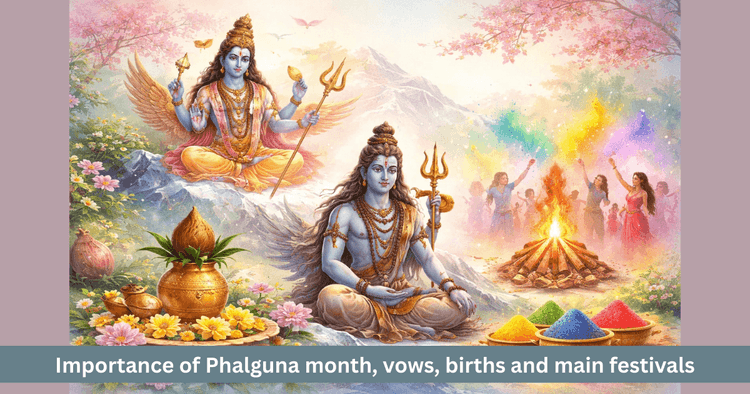
Table of Contents
In the Hindu calendar Phalguna month is regarded as the twelfth month of the lunar year. It arrives at the point where winter slowly loosens its hold and the first touch of spring can be felt. During this Phalguna period many major festivals, vows and memorable events from the epics are recalled, which together make this month spiritually rich and socially vibrant.
Phalguna is especially known for Vijaya Ekadashi, Maha Shivaratri and Phalguna Purnima or Holi. Vijaya Ekadashi is observed as a fast and worship for receiving the grace and victorious protection of Lord Vishnu. Maha Shivaratri is the great night dedicated completely to the worship of Lord Shiva. Phalguna Purnima is celebrated as Holi, the festival of colours, which expresses joy, reconciliation and the triumph of good over harmful tendencies.
How is Phalguna linked with Ramayana and Mahabharata
Phalguna is not only a time of festivals. Several important events associated with the Ramayana and Mahabharata are said to have taken place in this month.
- It is described that the great war in the Ramayana began on Phalguna Bahula Padyami, the first day of the dark fortnight.
- The intense battle between Lakshmana and Meghanatha also took place in this month. That battle began on Phalguna Bahula Ekadashi and continued until Phalguna Amavasya.
Through these references Phalguna can be seen as a period symbolising the struggle between dharma and adharma, courage and justice.
Births in Mahabharata associated with Phalguna
Many central figures of the Mahabharata are also linked with birth dates in Phalguna.
- Dharma Raja Yudhishthira, also called Dharmaraja, is said to have been born on Phalguna Bahula Ashtami.
- Bhimasena is believed to have been born on Phalguna Shukla Trayodashi.
- Duryodhana, Dushasana and fifteen other Kaurava brothers were also born during Phalguna.
Because of these associations, Phalguna is viewed as a month deeply connected with themes of
- righteous conduct,
- heroic strength,
- and the complex movement of destiny.
Main vows observed in Phalguna
Several important vows and devotional practices belong to Phalguna. They guide the seeker through discipline, repentance and worship.
Key observances include
- Payo vrata
- Ganesha vrata
- Amalaki Ekadashi
- Govinda Dwadashi
- Vijaya Ekadashi
Through these vratas devotees seek the blessings of Lord Vishnu, Lord Ganesha and other deities in different forms.
What is Payo vrata and how is it observed
Within Phalguna the Payo vrata stands out as a special vow of Lord Vishnu’s worship.
- This vrata is observed from Shukla Paksha Padyami until Dwadashi, a continuous period of twelve days.
- These twelve days are understood symbolically as a compact form of worship for twelve months offered in one sequence to Lord Vishnu.
- During this period the practitioner is instructed to take only milk as food, using it as the main sustenance.
According to the story behind Payo vrata
- At one time Aditi Devi prayed to Lord Vishnu for the protection of her sons, especially Indra, the lord of the devas.
- Under the power of Mahabali the gods had lost their positions and were in distress.
- Aditi observed a twelve day Payo vrata, taking only milk, engaging herself in mantra, worship and meditation on Vishnu.
As the fruit of this vrata Lord Vishnu is said to have manifested as Vamana, who helped restore the worlds to the devas and set proper balance again. In this way Payo vrata is remembered as a path of deep devotion, firm resolve and deliverance from difficult situations.
How is Ganesha vrata followed in Phalguna
The Ganesha vrata of Phalguna is also given special importance. In this observance devotees worship Ganesha in the form known as Dundi Vinayaka.
Ganesha vrata is kept in two forms
- Avighna vrata
- Putra Ganapati vrata
Their timing is described as follows
- On Shukla Paksha Padyami devotees observe Avighna vrata. On this day they worship Dundi Vinayaka and pray for removal of obstacles and successful completion of undertakings.
- On Shukla Chaturthi they observe Putra Ganapati vrata, praying for the blessing of children and for the well being and bright future of sons and daughters.
During these vows
- a murti or picture of Ganesha is installed and worshipped with lamps, incense, naivedya, durva grass and sweets such as modakas,
- and traditional Ganesha hymns like “Vakratunda Mahakaya” are chanted.
Importance of Amalaki Ekadashi and Govinda Dwadashi
Phalguna’s bright fortnight contains the sacred days of Amalaki Ekadashi and Govinda Dwadashi, which are deeply revered.
Amalaki Ekadashi
- On this day devotees worship the Amla tree, known as Amalaki, which is considered dear to Lord Vishnu.
- Many observe fasting on Ekadashi and spend the day in remembrance of Vishnu’s names and deeds.
The vrata of Amalaki Ekadashi is described as a means of
- reducing sins,
- moving a step closer to liberation,
- and increasing purity and sattva in life.
Govinda Dwadashi
- The next day, on Dwadashi, comes Govinda Dwadashi.
- Devotees bathe in a river or other natural water body and worship Lord Vishnu in his Govinda form.
Taken together
- worship of the sacred tree on Ekadashi,
- and river bathing and Govinda worship on Dwadashi,
show a balanced reverence towards nature and the Lord, strengthening the devotee’s connection with both.
Vijaya Ekadashi within Phalguna month
Among the Ekadashi days of Phalguna, Vijaya Ekadashi has a distinct place.
- It falls on the dark fortnight’s eleventh lunar day, Krishna Paksha Ekadashi.
- This day is devoted to Lord Vishnu as the giver of victory and safe passage through difficulties.
Tradition holds that the fasting and worship of Vijaya Ekadashi help
- overcome obstructions,
- lessen the burden of past wrong actions,
- and make future paths smoother and more protected.
Phalguna Purnima, Holi and Lakshmi Jayanti
The Full Moon of Phalguna, the bright fortnight’s Purnima, is known as Phalguna Purnima. This is also the day when Holi is celebrated across India.
- Holi is recognised as the festival of colours.
- It invites people to set aside divisions and meet each other in a spirit of friendship, laughter and shared playfulness.
- Symbolically it is taken as a celebration of the victory of good over harmful forces and an encouragement to release old negativity.
In some regions the same Full Moon day is observed as Lakshmi Jayanti.
- Lakshmi Jayanti is honoured as the birth anniversary of Goddess Lakshmi.
- The rituals for this day begin with an early holy bath in a sacred river or clean water source.
- After bathing, devotees perform Vishnu puja, worshipping the Lord with offerings and prayers.
The sequence often includes
- chanting of the Gayatri mantra,
- recitation or listening of the Satya Narayana Katha,
- and then a focused repetition of the mantra “Om Namo Narayanaya” 1008 times.
On this auspicious day, it is considered especially meritorious to offer
- food,
- clothing,
- and monetary help
to those in genuine need.
Summary table of Phalguna month essentials
| Topic | Details |
|---|---|
| Place in the calendar | Twelfth month of the lunar year |
| Main festivals | Vijaya Ekadashi, Maha Shivaratri, Phalguna Purnima or Holi |
| Link with Ramayana | Beginning of the war on Phalguna Bahula Padyami, Lakshmana Meghanatha war from Bahula Ekadashi to Amavasya |
| Mahabharata birth references | Yudhishthira born on Phalguna Bahula Ashtami, Bhima on Phalguna Shukla Trayodashi, many Kauravas born in Phalguna |
| Key vratas | Payo vrata, Ganesha vrata, Amalaki Ekadashi, Govinda Dwadashi, Vijaya Ekadashi |
| Duration of Payo vrata | Twelve days from Shukla Padyami to Dwadashi, milk as main food |
| Ganesha vrata dates | Avighna vrata on Shukla Padyami, Putra Ganapati vrata on Shukla Chaturthi |
| Amalaki and Govinda observance | Worship of Amla tree and fasting, followed by river bathing and Govinda worship |
| Special practices on Full Moon | Bathing, Lakshmi Jayanti, Vishnu worship, Gayatri japa, Satya Narayana Katha, 1008 “Om Namo Narayanaya” japa and charity |
Inner direction that Phalguna gives to a seeker
Phalguna comes just before the close of the year and quietly invites both reflection and renewal.
Through
- the battles and turning points of Ramayana and Mahabharata,
- the disciplined observances of Payo vrata and Ekadashi,
- the cheerful openness of Holi,
- and the refined worship of Lakshmi and Vishnu,
this month becomes a meeting point of austerity and joy.
Whether a devotee is a householder, a student or someone immersed in work, Phalguna allows room to
- keep a few chosen fasts and sacred baths,
- listen to stories and teachings,
- engage in mantra japa,
- and share food and resources with others.
When approached in this way, Phalguna gradually shapes life towards balance, calmness and devotion, helping the heart step into the coming cycle with clarity and grace.
Common questions about Phalguna month
Which dates in Phalguna are considered especially significant
Within Phalguna, Vijaya Ekadashi, Maha Shivaratri, Amalaki Ekadashi, Govinda Dwadashi and Phalguna Purnima stand out as particularly important. Fasting, bathing, worship of Vishnu and Shiva, japa and charity on these dates are said to offer strong spiritual benefits.
Is Payo vrata suitable for everyone or can it be adapted
The classical form of Payo vrata involves twelve days of living on milk alone, which may not be suitable for every constitution. It is wise to seek guidance from a teacher or physician and, if needed, adapt the practice while keeping the spirit of simplicity, restraint and continuous remembrance of Vishnu.
Why is Dundi Vinayaka worshipped specifically in the Phalguna Ganesha vrata
In the Phalguna Ganesha vrata Dundi Vinayaka is honoured as the remover of obstacles. Through Avighna vrata devotees pray for the clearing of blockages in life and through Putra Ganapati vrata they seek blessings for the health, protection and progress of their children.
What is the deeper meaning of worshipping the Amla tree on Amalaki Ekadashi
The Amla tree is considered pure, sattvic and dear to Vishnu. Worshipping it on Amalaki Ekadashi and keeping a fast expresses a wish to see the Lord present in nature, to lighten the body and mind and to strengthen the resolve to stay away from actions that create further bondage.
What benefits are associated with observing Lakshmi Jayanti, Satya Narayana Katha and 1008 repetitions of “Om Namo Narayanaya” on Phalguna Purnima
On Phalguna Purnima it is said that bathing, worshipping Lakshmi and Vishnu, listening to Satya Narayana Katha and chanting “Om Namo Narayanaya” 1008 times support release from burdens, harmony in family life, growth of prosperity and steadiness of mind. Acts of charity in food, clothing and financial help on this day are also believed to expand one’s store of merit.
Get your accurate Kundali
Generate KundaliDid you like it?
Author
Pt. Sanjeev Sharma (63)
Experience: 20
Consults About: Family Planning, Career
Clients In: Punjab, Haryana, Delhi
Share this article with friends and family
WELCOME TO
ZODIAQ
Right Decisions at the right time with ZODIAQ
