Ashadha and Ancestors' Blessings
By Pt. Abhishek Sharma
Understand the subtle link between Dakshinayana rain and ancestor tarpana in simple language
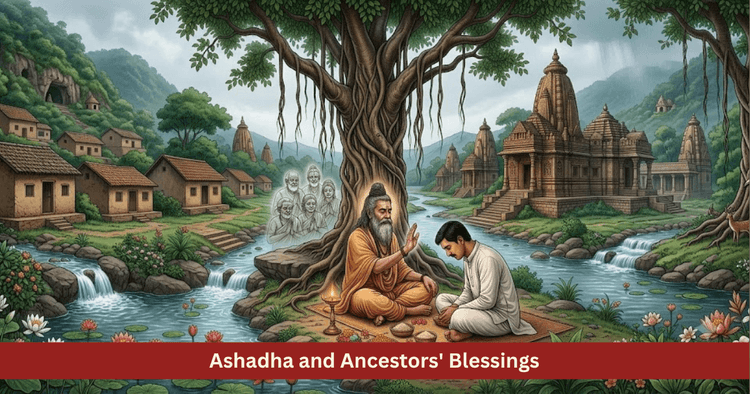
Table of Contents
What to do in Ashadha
The month of Ashadha is regarded as one of those sensitive periods of the year when the relationship between nature, the mind and subtle realms becomes more deeply felt. Especially when Dakshinayana begins and the first rain touches the dry earth, Indian tradition considers this time highly auspicious for remembering the ancestors, tarpana, gratitude and lineage purification. There are many regional traditions in this matter, so it is important to honor the local Panchanga and family custom for the exact date, day and method.
If a person wishes to express reverence toward the ancestors in the month of Ashadha, there is no need for an excessively elaborate ritual. Reverence, purity and the right inner feeling are considered most important. Performing a simple tarpana with tila, meaning sesame, jala, meaning water and kusha, meaning sacred grass, praying in the name of the ancestors, maintaining sattvika conduct and respecting food are all regarded as especially fruitful in this month.
| Element | Brief details |
|---|---|
| Special period | Ashadha month, especially around the beginning of Dakshinayana |
| Main feeling | Ancestor remembrance, gratitude, tarpana, lineage balance |
| Main materials | Sesame, water, kusha, clean vessel |
| Suitable time | Morning or an auspicious time according to the Panchanga |
| Helpful for | Pitru Dosha peace, family unrest, obstacle in progeny, blocked progress |
| Essential rules | Pure mind, sattvika food, humility, reverence for ancestors |
| Main purpose | Satisfaction of the ancestors, peace in the lineage and flow in life |
Simple steps for ancestor tarpana in Ashadha
- Bathe in the morning and wear clean clothes.
- Remember the ancestors in a quiet place.
- Mix black sesame in water.
- If available, use kusha.
- Offer tarpana in the name of your gotra, lineage or known ancestors.
- At the end pray for the peace of the ancestors and the welfare of the family.
What should be kept in mind
- The mind should remain steady and humble during tarpana.
- Do not do it only out of fear but with gratitude.
- If a family tradition is known, follow it accordingly.
- If the detailed method is not known, even a simple prayer is considered meaningful.
- Maintain purity in food, speech and conduct.
When the first rain is not only weather
The first rain of Ashadha is not merely the arrival of clouds for the Indian heart. It is also the opening of a deep memory. When the first raindrop falls on dry earth and a fragrant aroma rises from the soil, the traditional inner imagination does not treat it as only the smell of earth. It is also seen as a sign of contentment, satisfaction and the compassion of the ancestors.
This is symbolic language, yet its basis is not mere imagination. In the Indian view, nature and consciousness are not separate from one another. Seasonal shifts, changes of direction, the movement of the Sun and human samskaras are all believed to remain in subtle dialogue. That is why the transitional time of Ashadha is not only a time of water but also a time of remembrance.
The relation between Dakshinayana and Pitru Loka
When the Sun moves from Uttarayana toward Dakshinayana, the Vedic tradition considers it an important turning point. Dakshinayana is associated with the second phase of the divine day, yet it is also considered a period of heightened sensitivity toward ancestral consciousness. For this reason the month of Ashadha, especially around the beginning of Dakshinayana, carries a stronger feeling of respect and tarpana for the ancestors.
In Puranic and sacred language it is said that during this period the gates of Pitru Loka, meaning the realm of the ancestors, become more accessible. This should not be understood only in a physical sense. Its deeper indication is that this period makes a human being more receptive to lineage memory, gratitude and invisible relationships. Those who repeatedly experience obstacles, unspoken sadness or family tension are advised to honor this transitional time.
What does ancestral blessing mean
The meaning of ancestral blessing is not merely that the ancestors become pleased and grant wealth or success. Its real meaning is much broader. Ancestral blessing is the blessing of balance in the lineage, protection of progeny, mental steadiness, peace in the home and flow in life.
When in a family obstacles arise repeatedly without a clear reason, there is delay in children, tension persists in marriage, money comes but does not stay or an unknown heaviness remains in the home, then traditional astrology and sacred understanding sometimes look toward Pitru Asantosh, meaning ancestral dissatisfaction or Pitru Dosha as a possible spiritual factor. It is not always the final cause, yet it can certainly be an important spiritual indication.
How are signs of ancestral dissatisfaction understood
This subject should not be approached through superstition or fear but through a restrained and balanced vision. It is not proper to label every problem as Pitru Dosha. Even so, certain situations are considered such that remedies for ancestral peace may become meaningful.
Which indications are traditionally noticed
- Repeated unrest in the family without a clear reason
- Continuous obstacles in marriage or progeny
- Repeated blockage in progress and efforts
- A lingering heaviness even after changing home, treatment or effort
- Dreams involving ancestors, water, an old house or a call
- Long neglect of family traditions
These should not be treated as final judgments but as invitations to self reflection. If life is carrying this kind of stagnation, remembrance of the ancestors in Ashadha can become deeply meaningful.
Why is tarpana considered so important
The root meaning of tarpana is to satisfy or nourish. Expressing gratitude toward the ancestors through water, sesame and reverence is the essence of tarpana. This act is not only a ritual method but a recognition of relationship. A human being does not arrive alone. One is born carrying many threads of lineage, samskara, memory, body and destiny. Therefore ancestor tarpana is an act of bowing to one's source.
Water is connected with flow and peace. Tila, meaning sesame, is regarded as a symbol of purity and subtle nourishment. Kusha is accepted in Vedic ritual as a sacred medium. When these three unite with reverence, tarpana no longer remains only an action of the hands. It becomes a spiritual ordinance of honoring lineage energy.
The subtle importance of tarpana in Ashadha
The month of Ashadha has a deep connection with nature. Water touching dry land, seeds awakening within, the atmosphere changing and life beginning to move again all suggest that this is a month that takes one from blockage toward flow. For this reason the feeling of tarpana for the ancestors becomes especially meaningful in this time.
If a person feels that there is much effort in life but little fruit, relationships exist but intimacy does not, a house exists but peace does not, then this period invites one to pause and look backward. At times life does not move forward because the roots have remained neglected. Ashadha directs attention toward those roots.
How is Pitru Dosha seen in astrology
In Vedic astrology Pitru Dosha is a serious subject and its judgment is not made through a single factor. It is considered necessary to examine the Surya, the ninth house, the fifth house, Rahu, Ketu and at times combinations related to lineage tradition in the birth chart. If the Sun is afflicted, the ninth house is under harmful influence or the houses indicating lineage are imbalanced by Rahu or Ketu, then the possibility of ancestor related obstruction in life is considered.
A simple table is given below.
| Astrological factor | Possible meaning |
|---|---|
| Afflicted Surya | Weakness in father principle, lineage honor and inner strength |
| Harmed ninth house | Obstruction in fortune, dharma and ancestral grace |
| Disturbed fifth house | Delay in progeny, blockage in past merit and lineage flow |
| Influence of Rahu | Unresolved lineage karma, confusion, dissatisfaction |
| Influence of Ketu | Separation, detachment, invisible karmic bonds |
It is important to understand that the subject of Pitru Dosha is not meant for fear. Its purpose is not to blame life but to explain the need for lineage balance.
The subtle relation of Ayurveda and ancestral energy
Directly speaking Ayurveda does not use the expression Pitru Dosha in exactly the same way as astrology, yet Ayurveda takes hereditary tendencies, mental samskaras and influences received through conception very seriously. It accepts that the body is not only the result of present diet but also of lineage, seed, parental influence and mental condition.
If for a long time there has been tension, grief, unresolved relationships or ancestral unrest in a family, its effect can be seen in mental health, sleep, digestion and reproductive capacity. From this perspective remembrance of ancestors, forgiveness, prayer and the practice of peace in Ashadha can become supportive for both mind and body.
Useful practices from an Ayurvedic perspective
- Light and digestible food according to the rainy season
- Protection of digestive fire
- Regularity in routine
- Distance from disputes that burden the mind
- Respect for water and bodily cleanliness
- Remembrance, prayer and mental lightness
Does tarpana alone change everything
This is a serious question and it should be answered with balance. It is not proper to assume that all problems of life will instantly end merely by performing tarpana once. If there is unrest in the family, there may also be worldly causes. If there is obstruction in progeny, medical evaluation may also be necessary. If progress has stopped, then action, planning and decision making must also be reviewed.
Even so, the spiritual value of tarpana does not become small. Often change in life begins only when a person steps away from ego and accepts that one is connected to the debt of ancestors, samskaras and invisible protection. Tarpana is the act of that acceptance. It can soften inner hardness into humility and that shift itself can gradually open pathways in outer life.
Which remedies are especially auspicious in Ashadha
Some simple remedies are considered especially useful in this month.
Spiritual remedies
- Offering water in the name of the ancestors
- Tarpana with black sesame
- Proper use of kusha
- Remembrance of Bhagavan Vishnu or Surya
- Respecting the elders of the family
- Feeding a hungry person
Remedies in conduct
- Do not disrespect lineage traditions
- Do not speak harshly to elders
- Maintain cleanliness and peace in the home
- Do not insult food
- Before the rains, remain grateful toward grain, water and the earth
The purpose of these remedies is not merely accumulation of merit but the restoration of harmony with lineage consciousness.
The spiritual meaning of the first earthy fragrance
When the earthy fragrance rises with the first rain, many people feel inwardly calm even without using any scriptural language. This is a deeply human experience. Indian tradition sees it as a symbol of the contentment of the ancestors. This feeling is profound because the meeting of dry earth and rain is seen in the same way as the meeting of memory and compassion.
If this symbol is viewed philosophically, it reveals that when life reconnects with its roots, a fragrance also rises within. That fragrance belongs to peace, acceptance and the invisible bond that keeps generations tied in one thread.
The stream of lineage memory and blessing
The month of Ashadha reminds the human being that life is not built only from present achievements. Behind it stand many unseen hands, unspoken sacrifices, incomplete dreams and currents of protection. The ancestors are not only the past. They remain alive within us as samskara, language, body, courage and sensitivity.
When with this understanding a small tarpana performed with sesame, water and kusha is offered to the ancestors, that act does not remain a ritual alone. It becomes a humble salutation to the lineage. And when reverence toward the lineage awakens, many frozen blockages in life also begin to melt. This is the compassion of Ashadha. This is the true resonance of ancestral blessing.
FAQ
Why is ancestor tarpana done in the month of Ashadha
The month of Ashadha, especially around the beginning of Dakshinayana, is considered auspicious for remembering the ancestors and offering tarpana because it is seen as a sensitive period for lineage peace and gratitude.
What are considered signs of ancestral dissatisfaction
According to traditional understanding, family unrest, delay in progeny, blocked progress, dream indications and neglect of lineage traditions may suggest the need for ancestral peace.
What is used in ancestor tarpana
A simple ancestor tarpana generally uses water, black sesame, kusha and reverential remembrance.
Does tarpana in Ashadha help calm Pitru Dosha
From a religious and astrological perspective, tarpana done with reverence is considered helpful for ancestral peace and lineage balance, though conduct in life also remains important.
Why is the first earthy fragrance of rain linked with the ancestors
In the Indian emotional tradition it is seen as a symbol of ancestral contentment, the satisfaction of the earth and the compassion flowing through the lineage.
Get your accurate Kundali
Generate KundaliDid you like it?
Author

Pt. Abhishek Sharma (63)
Experience: 20
Consults About: Family Planning, Career
Clients In: Punjab, Haryana, Delhi
Share this article with friends and family
WELCOME TO
ZODIAQ
Right Decisions at the right time with ZODIAQ
