Chaturmas Inner Journey Yoga
By Pt. Sanjeev Sharma
Learn why the 4 months of Chaturmas are deeply linked with restraint, fasting, austerity and inner reflection
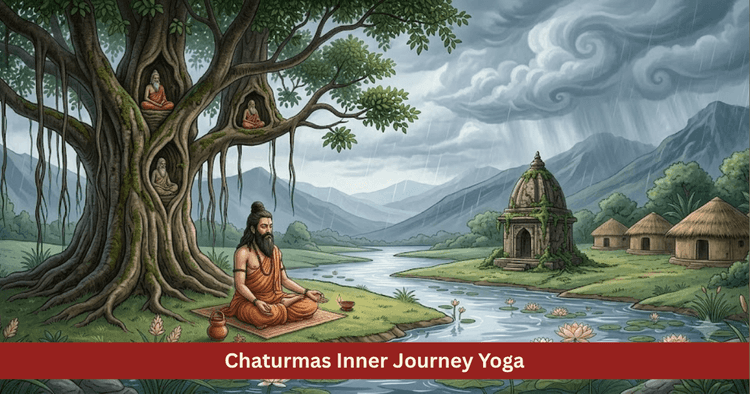
Table of Contents
Main details of Chaturmas
| Aspect | Description |
|---|---|
| Topic | Beginning of Chaturmas and its spiritual significance |
| Beginning | From Devshayani Ekadashi |
| Duration | 4 months |
| Related months | Ashadha, Shravan, Bhadrapada and Ashwin |
| Main feeling | Restraint on outer desires and movement toward the inner self |
| Recommended conduct | Fasting, discipline, japa meaning sacred repetition, meditation, sattvic living and self reflection |
| Ceremonies usually limited | Marriage, mundan meaning first hair ritual, housewarming and similar festive events |
| Message for seekers | Stability, austerity, discipline and remembrance of the Divine |
What should be done in Chaturmas
- Follow a steady daily routine
- Keep food simple, pure and disciplined
- Set aside regular time for japa, meditation and prayer
- Limit unnecessary travel and outer busyness
- Watch anger, laziness and lack of restraint carefully
- Take one resolve to improve a personal weakness
What should be avoided in Chaturmas
| Topic | Caution |
|---|---|
| Pleasure seeking | Avoid excess luxury and sense indulgence |
| Food | Do not take overly fried, heavy or unbalanced meals |
| Speech | Reduce harshness, conflict and criticism |
| Lifestyle | Avoid irregular routine |
| Decisions | Do not take major worldly decisions in impulse |
| Mind | Do not feed comparison, greed or dissatisfaction |
When nature itself asks for a pause
Chaturmas begins with Devshayani Ekadashi and continues through the months of Ashadha, Shravan, Bhadrapada and Ashwin. This is not only a segment of the calendar but a deeply serious and disciplined dimension of Indian spiritual thought. During these 4 months, sages, monks and seekers traditionally stayed in one place and devoted their time to tapas meaning austerity, japa, sacred study and self observation. Behind this tradition there is not only religious feeling but also a deep observation of nature, the body, the mind and cosmic rhythm.
During these rainy season months the outer environment changes. The sky does not remain steady, moisture rises in the air, the water element becomes active and the movement of life naturally slows down. The ancestors did not see this only as a weather shift. They understood that when nature itself is signaling pause, protection and a return inward, human beings too should reduce outer restlessness. This is the central message of Chaturmas.
What is Chaturmas
The word Chaturmas literally means a special disciplined period of 4 months. It is observed from Devshayani Ekadashi until Devuthani Ekadashi. During this time the tradition has been that seekers reduce movement, simplify life and turn more toward yoga than bhoga, meaning indulgence. That is why this period is regarded as especially favorable for fasting, restraint, devotion and spiritual practice.
It is also said that during this period Lord Vishnu remains in Yoganidra, meaning divine rest. The deeper meaning of this symbol is that outer activity in the world becomes somewhat quiet and the need for inner awakening grows stronger. For this reason, it would not be right to see Chaturmas only as a time of restriction. It is an invitation to live with awareness, where a person reviews habits, desires, speech, food and actions.
Why are desires restrained for 4 months
The call to restrain worldly desires during Chaturmas is not for suppression but for purification. In ordinary times, human beings remain constantly engaged in a race to gain, enjoy, display or achieve something. In that race, one often cannot hear the noise within oneself clearly. Chaturmas says that this movement should be slowed for some time, so that one can see what is truly necessary and what has merely been held by habit.
Restraint on desire does not mean all work of life must be abandoned. It means that for some time the definition of happiness should be changed. Where joy was earlier being sought in outer consumption, now peace is sought in silence, simplicity, prayer, study and measured living. This shift gradually steadies the mind and allows a person to feel that inner contentment may be far more lasting than outer achievement.
Spiritual meaning of restraining desires
- To discipline the senses
- To recognize the habits of the mind
- To separate the necessary from the unnecessary
- To value balance over indulgence
- To make time for the Divine and the soul
Why did sages stay in one place
The tradition of sages remaining in one place during Chaturmas is deeply meaningful. Travel during the rainy season was difficult, paths could become blocked and the protection of many tiny living beings was also important. Yet this alone is not the full reason. Stillness itself is part of spiritual practice. A mind that keeps moving outward cannot enter inward easily. The steadiness of place slowly quiets the movement of thought as well.
Remaining in one place is the first step from outer wandering toward inner pilgrimage. When the seeker receives less attraction from new places, new people and new activity, one begins to face the actual state of the mind. That is where tapas begins. So the stillness of Chaturmas is not merely a social rule but an ancient method of centering consciousness.
Why is this time so sensitive astrologically
According to astrology, special changes in the air and water elements are observed during this period. Moisture in the environment increases, digestion may be affected and the body's balance may become relatively sensitive. While the water element makes the mind and emotions more receptive, instability in the air element may also pull a person toward restlessness, fluctuation or indecision. That is why this time asks for inner care more than outer intensity.
At the mental level too this period may create subtle effects. The mind may become more emotional, old memories may surface, questions in relationships may be felt more deeply and the desire for solitude or self reflection may increase. That is why the ancestors considered disciplined food, limited travel, prayer, silence and satsanga, meaning noble company, as useful during this time. Their purpose was not to create fear but to give the right direction to the sensitivity that naturally becomes stronger in this period.
Possible effects on body and mind in Chaturmas
| Area | Signal |
|---|---|
| Body | Digestion may become sensitive |
| Mind | Emotional depth and self reflection |
| Routine | Greater need for discipline and regularity |
| Relationships | Testing of expectations and patience |
| Spiritual practice | Favorable time for japa, meditation and silence |
Why are festive ceremonies considered limited
Marriage, mundan, housewarming and other auspicious ceremonies are generally connected with celebration, expansion and social activity. The nature of Chaturmas is the opposite. This period is regarded more as a time of discipline than festivity, more as a time of inward purification than outward expansion and more as a time of self focused practice than social movement. That is why the ancestors did not consider these months suitable for major worldly celebrations.
This rule should not be seen merely as blind custom. It is wisdom that moves with the rhythm of life. Every period is not the same. Some times are meant for planting seeds and some for letting the tree remain still. Chaturmas is such a time of stillness in which a person strengthens the foundation of life so that later decisions may become more auspicious and enduring.
Which practices are considered best in Chaturmas
During this period fasting, dietary restraint, japa, meditation, silence, listening to sacred teachings, satsanga, service, charity and sattvic food are given special importance. Each of these practices is linked with the purification of one part of life. Fasting disciplines the senses. Japa focuses the mind. Silence disciplines speech. Charity softens the heart. Sattvic food keeps the body light. In this way Chaturmas is not a list of religious rules but a complete process of restoring balance in life.
A person who can maintain even one small resolve throughout these 4 months may feel a clear inner change. This may be something as simple as meditating daily for some time, keeping a weekly fast, reducing negative speech or remembering the Divine every day. The strength of Chaturmas is seen less in large rituals and more in regular, aware and small conduct.
Simple resolves for Chaturmas
- Offer prayer every morning and evening
- Increase simplicity in food
- Keep one day of fasting or fruit based eating each week
- Stay away from unnecessary conflict
- Read sacred or uplifting words daily
- Reflect each day on where the mind became disturbed
How this becomes a great yoga of inner journey
Chaturmas may be called a great yoga of inner journey because it gives a person time to descend into one's own layers. In ordinary life one remains so entangled in outer duties and desires that the movement of the mind is hardly seen clearly. The discipline of these 4 months slows that rush. When speed decreases, hidden emotions rise. When noise lessens, the voice of the soul begins to be heard.
This journey is not always easy. Many times during Chaturmas a person comes face to face with one's own weaknesses. That itself is its blessing. The faults that remain hidden in ordinary days may appear more clearly during this time. If the seeker can face them instead of running away, accept them and slowly transform them, then these 4 months may change the direction of life. For this reason, Chaturmas is not truly a pause. It is preparation for a higher movement.
Where stillness itself becomes tapas
The beginning of Chaturmas reminds us that life is not only about gaining but also about refining oneself. These 4 months from Ashadha to Ashwin create a deep dialogue between nature, body, mind and soul. The rule made by the ancestors to reduce outer rushing did not arise from fear but from deep compassion and foresight. They knew that from time to time, a human being must be given the chance to meet oneself.
The person who accepts Chaturmas not merely as restriction but as an opportunity for self purification, can make these months deeply fruitful. A measured pause on worldly desire, discipline in food, sweetness in speech order in routine and growing devotion to the Divine together form the essence of this great yoga. Walking on this path, a person may touch the hidden peace within.
FAQ
When does Chaturmas begin
Chaturmas is considered to begin from Devshayani Ekadashi.
How long does Chaturmas last
It lasts for 4 months and includes the months of Ashadha, Shravan, Bhadrapada and Ashwin.
Why are marriage and housewarming not usually done in Chaturmas
This period is regarded more for austerity, restraint, fasting and self reflection, so festive ceremonies are generally kept limited.
What is considered auspicious during Chaturmas
Fasting, japa, meditation, sattvic food, charity, service and self reflection are considered auspicious during this period.
What is the spiritual meaning of Chaturmas
Its spiritual meaning is to reduce the intensity of worldly desire and build a deeper bond with the soul, discipline and the Divine.
Get your accurate Kundali
Generate KundaliDid you like it?
Author

Pt. Sanjeev Sharma (63)
Experience: 20
Consults About: Family Planning, Career
Clients In: Punjab, Haryana, Delhi
Share this article with friends and family
WELCOME TO
ZODIAQ
Right Decisions at the right time with ZODIAQ
