Devshayani Ekadashi Inner Mystery
By Pt. Nilesh Sharma
Understand the deeper spiritual and astrological meaning behind Lord Vishnu's Yoganidra, Chaturmas and this sacred Ekadashi
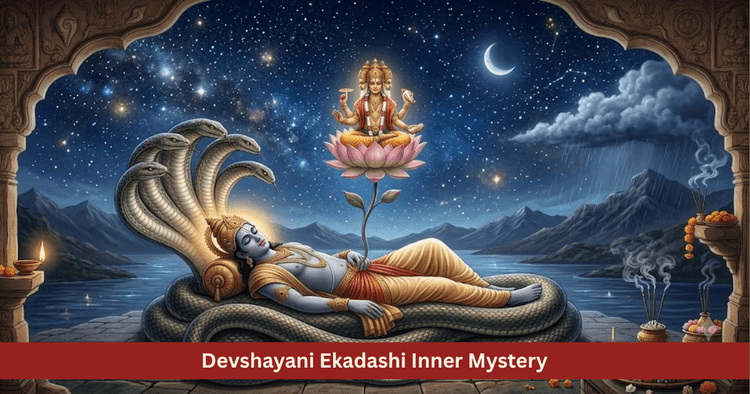
Table of Contents
Tithi, form and main spiritual signals
| Aspect | Description |
|---|---|
| Topic | Spiritual and astrological significance of Devshayani Ekadashi |
| Month | Ashadha |
| Paksha | Shukla Paksha, meaning waxing lunar phase |
| Tithi | Ekadashi, meaning eleventh lunar day |
| Presiding deity | Lord Vishnu |
| Traditional belief | Lord Vishnu enters Yoganidra, meaning divine sleep, for four months |
| Related period | Beginning of Chaturmas |
| Main message | Pause in outer movement and awakening of inner consciousness |
| Recommended practice | Fasting, japa meaning sacred repetition, meditation, Vishnu worship, self reflection and purity |
What to do on Devshayani Ekadashi
- Worship Lord Vishnu with devotion
- Observe a fast or personal discipline
- Chant Vishnu mantras or divine names
- Keep the mind calm through meditation and prayer
- Take one sattvic resolve for Chaturmas
- Stay away from anger, restlessness and negative speech
The subtle signal of this tithi
| Element | Meaning |
|---|---|
| Lord Vishnu | Preservation, balance, protection and compassion |
| Yoganidra | Pause in outer activity and awakening of inner power |
| Kshirasagara | A symbol of peace, infinity and divine consciousness |
| Chaturmas | A period of discipline, tapas meaning austerity, fasting and spiritual practice |
| Ekadashi | A day of sense restraint and purification of the mind |
When the preserver becomes silent
The Ekadashi of the Shukla Paksha in the month of Ashadha is known as Devshayani Ekadashi. This tithi is not only a fast or a sacred observance but also carries very deep meanings in Vedic and Puranic consciousness. The traditional belief says that on this day Lord Vishnu enters Yoganidra in Kshirasagara, meaning the cosmic ocean of milk and this divine sleep continues for the next four months. This period is also regarded as the beginning of Chaturmas. For this reason, this tithi becomes a doorway into an inward spiritual experience rather than only an outer religious celebration.
When the very deity who preserves creation enters rest, a subtle question naturally arises in the heart of the devotee. Will the movement of the world now become slow. Will fortune stop. Will the current of auspiciousness pause. This is the emotional and philosophical point where the mystery of Devshayani Ekadashi begins to open. This tithi teaches that divine silence is not absence. It is a subtler form of presence.
What is Devshayani Ekadashi
Devshayani Ekadashi is also called Hari Shayani Ekadashi. The Puranic account of Lord Vishnu's divine sleep on this day is widely known. It is said that the preserver of creation enters Yoganidra at this time and awakens again on Kartik Shukla Ekadashi, which is known as Devuthani Ekadashi. These four months are called Chaturmas and are regarded as especially important for fasting, restraint, austerity, prayer, charity and self discipline.
It is important to understand that the Yoganidra of the Lord is not ordinary sleep. It is a state of divine consciousness. In this state the protection of the world does not stop but its movement changes at a subtle level. Outer expansion slows somewhat and the need for inner discipline becomes stronger. That is why worldly auspicious ceremonies are considered limited during this period and spiritual practice is given greater importance.
Does fortune really stop
The answer to this question is emotional as well as philosophical. In the context of Devshayani Ekadashi, it can be said that fortune does not stop, its movement changes. This is not a time when the door of destiny closes. Rather, it is a period when life turns us from the outer world toward the inner one. Earlier the energy was moving toward expansion, beginnings and social activity. Now the same energy begins to move toward austerity, patience, waiting, review and inner purification.
Many people feel that during this period the speed of life becomes somewhat calm. Plans move slowly, decisions demand patience and the mind stands before its deeper questions. This should not be seen as misfortune. It is hidden protection within the slower movement of the cosmos. Just as the earth pauses before the rains, in the same way a human being is also taught to pause before Chaturmas. This very pause may later become the foundation of a more mature destiny.
The mystery of Lord Vishnu's Yoganidra
The image of Lord Vishnu resting in Kshirasagara is deeply symbolic. Kshirasagara is not only a mythic realm but also a metaphor for pure consciousness, patience, balance and infinite possibility. Vishnu rests there upon Sheshanaga. This vision shows that even in the midst of cosmic instability, a supreme balance continues to exist. Yoganidra points toward the truth that when outer motion becomes slow, divine protection does not end.
In reality, this divine rest gives human beings the chance to see the imbalance hidden within themselves. When outer activity decreases, the inner voice is heard more clearly. Restlessness of mind, the burden of desires, unresolved cravings, confusion, fear and attachment begin to appear more openly. Therefore Devshayani Ekadashi should not be understood as divine absence but as a sacred arrangement for self examination.
Symbolic meaning of Yoganidra
- A measured pause in outer movement
- An opportunity to awaken inner consciousness
- A time to review life direction
- A test of faith and distance from attachment
- A period that deepens trust in the Divine
Why is Chaturmas considered special
Chaturmas begins from Devshayani Ekadashi. These four months are regarded in Vedic tradition as a time of discipline for seekers, householders and saints alike. The atmosphere of the rainy season itself makes the inner life more active. Outer travel decreases, stillness increases and the possibility of restraint in daily living becomes stronger. That is why fasting, vows, dietary purity, japa, spiritual practice and charity are given special importance in these months.
From a religious point of view, auspicious worldly ceremonies are reduced during this period. The reason is not tradition alone but also a shift in energy. This is a time of refinement more than celebration. If someone looks at this period only as restriction, its depth will not be understood. But if it is seen as a period of purification and preparation, Chaturmas can give new strength to life.
What does this period suggest astrologically
From an astrological point of view, the period after Devshayani Ekadashi is regarded as a symbol of subtle and inward energies becoming active. It is said that during this time outer, material and bodily ambitions may become somewhat slow, while matters connected with mind, karma, impressions, austerity and emotional depth may become more expressive. In this sense, the period is considered highly useful for self observation.
This time encourages a person to ask whether life is being spent only in chasing achievement or also in understanding its higher meaning. In which relationship there is imbalance, which habit needs purification, which desire has made the mind unstable and which actions need correction. Such questions arise more naturally in this phase. That is why meditation and silence are considered especially beneficial during this time.
Which themes rise in this period
| Area | Possible signal |
|---|---|
| Mind | Depth, sensitivity and self reflection |
| Karma | Review of past decisions |
| Relationships | Testing of expectations and trust |
| Spirituality | Increase in japa, meditation and faith |
| Life rhythm | Need for patience, waiting and restraint |
Why does the devotee feel emptiness
When one hears that Lord Vishnu is entering divine rest, a tender emptiness may naturally arise in the heart of the devotee. That emptiness is not only a religious feeling. It is a subtle experience of relationship with the Divine. The devotee may feel that now one must hold oneself more carefully, as if faith must remain steady even without outer reassurance. This feeling gives Devshayani Ekadashi its depth and tenderness.
This emptiness should not be seen through the lens of fear. It may become the beginning of spiritual maturity. When the seeker learns to feel the presence of the Divine even without outer signs, devotion becomes more stable. Devshayani Ekadashi teaches exactly this. God is not present only in the light of celebration but is equally close in the quiet darkness of waiting.
What is considered auspicious on this day
On Devshayani Ekadashi, fasting, worship of Lord Vishnu, chanting of Hari nama meaning the divine name of Hari, recitation of Vishnu Sahasranama meaning the thousand names of Vishnu, offering a lamp and taking a vow of sattvic living are considered especially auspicious. Even those who cannot keep a full fast may still honor this tithi through sense restraint, simple food, gentle speech and a prayerful mind. The main aim of practice on this day is to reduce the intensity of desire and deepen the sincerity of faith.
Taking one vow for Chaturmas is also considered very meaningful on this tithi. The vow does not need to be very large. It may be something simple such as reducing anger, avoiding falsehood, giving up one negative habit, chanting daily or increasing purity in food. These small resolves can make Chaturmas a life changing period.
Simple observances for Devshayani Ekadashi
- Bathe in the morning and worship Lord Vishnu
- Keep the Ekadashi fast or restraint according to capacity
- Chant Vishnu mantras or Hari nama
- Avoid rice, tamasic food and harsh speech
- Take one sattvic resolve for Chaturmas
- Practice prayer and silence at night
Where divine stillness becomes grace
Devshayani Ekadashi reminds us that the rest of the Divine is not the abandonment of the world but a call for awakening within the seeker. Lord Vishnu enters Yoganidra in Kshirasagara, yet his protection does not end. What changes is only the manner in which the devotee must experience divine presence. This is a time to move away from outward rush and turn toward faith, patience, discipline and inward spiritual practice.
Therefore it is more accurate to say that on Devshayani Ekadashi fortune does not stop, it becomes deeper. The person who lives this period not in fear but in trust may discover that waiting too can be grace, pause too can be protection and divine silence too can become the cause of inner awakening.
FAQ
What is Devshayani Ekadashi
Devshayani Ekadashi is the Ekadashi of the Shukla Paksha in the month of Ashadha and is regarded as the beginning of Lord Vishnu's Yoganidra.
Does Chaturmas begin from Devshayani Ekadashi
Yes, according to tradition Chaturmas begins from Devshayani Ekadashi.
Does fortune stop on Devshayani Ekadashi
No, fortune does not stop during this time. Rather, the energy of life turns from outer activity toward inner depth and patience becomes more important.
What is the spiritual meaning of Devshayani Ekadashi
The spiritual meaning of this tithi is the pause of outer motion, the awakening of inner consciousness and a deeper test of faith in the Divine.
What should be done on Devshayani Ekadashi
Fasting, Vishnu worship, mantra chanting, sattvic food, prayer, self reflection and taking an auspicious vow for Chaturmas are considered proper on this day.
Get your accurate Kundali
Generate KundaliDid you like it?
Author
Pt. Nilesh Sharma (63)
Experience: 20
Consults About: Family Planning, Career
Clients In: Punjab, Haryana, Delhi
Share this article with friends and family
WELCOME TO
ZODIAQ
Right Decisions at the right time with ZODIAQ
