Mystery Of Ashadha Gupt Navratri
By Pt. Abhishek Sharma
Learn how the sacred silence, inner practice and worship of the Goddess during Ashadha Gupt Navratri can transform life within
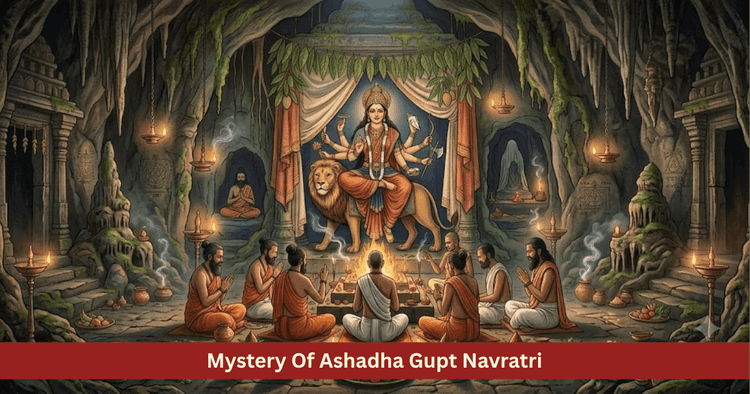
Table of Contents
Tithi, form and main points of practice
| Aspect | Description |
|---|---|
| Topic | Spiritual and esoteric significance of Ashadha Gupt Navratri |
| Month | Ashadha |
| Paksha | Shukla Paksha, meaning the waxing lunar phase |
| Duration | 9 days |
| Presiding power | The subtle and hidden forms of the Divine Mother |
| Nature of practice | Silence, solitude, japa meaning sacred repetition, meditation and inward worship |
| Special quality | Awakening of inner power and subtle spiritual practice |
| Suitable seekers | Those who can hold discipline, reverence and privacy |
| Recommended conduct | Purity, restraint, solitude, mantra japa and remembrance of the Goddess |
What is considered proper in Gupt Navratri
- Meditate upon the Goddess every morning and evening with a calm mind
- Keep spiritual practice away from display
- Maintain restraint in speech and simplicity in life
- Perform regular mantra japa and prayer
- Keep food, sleep and behavior balanced
- Center the practice on one inner fear, fault or obstacle
What should be handled carefully
| Topic | Caution |
|---|---|
| Practice | Keep it free from ego and display |
| Speech | Reduce unnecessary talking |
| Food | Keep it pure, light and sattvic |
| Mind | Avoid fear, confusion and over excitement |
| Routine | Do not allow irregularity |
| Resolve | Keep the purpose of practice clear |
When the Divine Mother is invoked in silence
Most people are familiar with the Navratri of Chaitra and Sharadiya but the Gupt Navratri that comes in the Shukla Paksha of Ashadha is considered far more subtle, serious and inward. This is not merely a festive time. It is a time to awaken the hidden power within. The nature of this period belongs more to private spiritual practice than to public devotion. That is why it is called Gupt Navratri, meaning hidden Navratri.
The atmosphere of Ashadha itself is considered supportive for this practice. The moisture of the rainy season, the dim gravity of the sky and the slowing movement of life together give the seeker a different inner field. Where the mind in ordinary days remains caught in outer objects, during this time it may naturally move toward silence, prayer and inner depth. This is the first sign of Gupt Navratri, that Shakti, meaning divine power, may be felt more closely in silence than in noise.
What is Gupt Navratri
Gupt Navratri is the sacred period of worship of the Goddess that is especially known for subtle spiritual practice. It should not be compared with the more widely known Navratri only on an outer level. While Chaitra and Sharadiya Navratri emphasize collective worship, celebration and broad participation, Gupt Navratri turns the center toward the inner world of the seeker. Here the tone of worship leaves outward display and rests upon inner purification, patience and steadiness in practice.
This period is regarded as special for those who wish to contemplate the deeper forms of the Goddess, discipline their consciousness and rise above invisible obstacles in life. This does not mean that ordinary devotees are excluded. It is better understood as a phase that asks for greater restraint, greater silence and greater seriousness in worship. Whoever can hold this spirit may experience the grace of Gupt Navratri.
Why is Ashadha Gupt Navratri considered mysterious
Ashadha itself is regarded as a month of inward moving energy. During this time the influence of Dakshinayan, the depth of Chaturmas and the calming of outer movement in nature give spiritual practice a very special ground. When the outer world becomes quieter, the inner senses may grow stronger. That is why Ashadha Gupt Navratri is called mysterious. This mystery does not belong to fear. It belongs to subtle experience.
The word Gupt here does not mean hidden in a negative sense. It means protected, sacred and free from unnecessary display. Just as a seed remains in the soil while preparing to sprout, in the same way the seeker nourishes inner strength during this time. This is a period when great changes may not be visible outside, yet they are quietly taking form within. For this reason, this sacred time is linked with serious practice and subtle experience of the grace of the Goddess.
The subtle nature of Gupt Navratri
- Inner worship matters more than outer celebration
- Speaking less and experiencing more
- Keeping practice private and sacred
- Looking at the deeper layers of the mind
- Experiencing the Goddess not only as form but as power
Is it only for tantric seekers
It is often believed that Gupt Navratri belongs only to those who follow esoteric or tantric practice. This is partly true but not entirely. It is true that this time is connected with serious discipline, special mantra observance and deeper worship. Yet this does not mean that a sincere devotee who remembers the Goddess with reverence is excluded. The essence of this period lies in privacy, discipline and inwardness. Anyone who can hold these 3 qualities may benefit from this sacred period.
It is also important to understand that deeper practice and mere curiosity are not the same. Gupt Navratri is not a time for casual experimentation or the hunger for quick results. It is a time of self restraint and sacred resolve. therefore for an ordinary devotee, the most appropriate path is simple and sattvic worship through pure devotion, mantra japa, prayer, offering a lamp and silent contemplation of the Goddess.
What should be understood by esoteric aura
When it is said that the esoteric aura of the cosmos becomes stronger during Ashadha Gupt Navratri, it should be understood in simple language that the experience of subtle energy may become deeper in this period. The combined effect of atmosphere, mind, seasonal rhythm and spiritual focus may increase the possibility of entering within through practice. This does not mean one should seek miracles. It means receptivity in spiritual practice may become stronger.
The essence of tantra also means entering into a conscious relationship with Shakti, meaning divine power. It is not only a matter of method. It is also a matter of worthiness. If the mind is unstable, the resolve unclear and life undisciplined, no practice can give its best fruit. But if the seeker is humble, disciplined and quiet, then even a small worship, a brief japa or a short meditation may bring meaningful inner change. This is the real meaning of that statement.
How invoking the inner Goddess can transform crisis
Many crises in human life are not created only by outer situations. Behind them often stand fear, confusion, imbalance, lack of confidence, negative memory, unrestrained desire and wounded inner strength. When a seeker invokes the Goddess, one is not asking only for outer help. One is also awakening the sleeping power within. That is why worship of the Goddess has long been linked with the removal of obstacles.
When inner power awakens, vision changes. What once looked like a wall may begin to look like a lesson in patience. What was fear may begin to turn into resolve. What was confusion may slowly become clarity. In this way, the practice of Gupt Navratri is not about erasing problems in a magical way. It can make the inner life so strong that the seeker rises above those problems. This is the real and serious meaning of the grace of the Goddess.
Which inner struggles can become the focus of practice
| Inner area | Purpose of practice |
|---|---|
| Fear | To awaken courage and trust |
| Confusion | To gain clarity and discernment |
| Unsteady mind | To develop meditation and patience |
| Negativity | To awaken strength and hope |
| Self doubt | To increase inner confidence and reverence |
| Karmic pressure | To seek purification through prayer and repentance |
Which practices are considered most suitable in Gupt Navratri
The simpler the practice of this period, the deeper it may become. Sattvic worship, mantra japa of the Goddess, disciplined recitation, offering a lamp, meditation, silence, cleanliness, restrained food and daily prayer are all regarded as highly suitable during these days. The most important point is that the practice should be steady and done with purity of feeling. Greater benefit comes from one stable discipline than from running after many methods.
Many people also take one small resolve during this time. It may be staying away from negative speech for 9 days, chanting a fixed number of mantras each day, waking in Brahma muhurta meaning the sacred pre dawn time, remembering the name of the Goddess or working on one mental weakness. These small but truthful actions make Gupt Navratri effective in life.
A simple path of practice for Gupt Navratri
- Meditate on the Goddess at the same time every day
- Light a lamp and pray in a quiet place
- Keep food sattvic and speech restrained
- Chant a fixed number of mantras
- Stay away from unnecessary social contact and noise
- Spend some time in self reflection every night
Why is privacy important in spiritual practice
One of the most important aspects of Gupt Navratri is the privacy of practice. This does not mean a dramatic secrecy. Its simple meaning is that a practice which is gathering inner power should be protected from unnecessary discussion and the desire for praise. Just as a very tender plant needs protection in its early stage, spiritual practice also needs protection. When a seeker feels the need to immediately speak about every experience, the energy of the practice may scatter outward.
Privacy also protects the mind. It reduces comparison, keeps ego quiet and moves the center of practice away from the desire for results toward surrender to the Divine. Gupt Navratri teaches exactly this, that closeness to the Goddess increases not by making noise but by remaining inwardly quiet. That is why in this period, speaking less, revealing less and practicing more are considered better.
What should be avoided
During Gupt Navratri one should avoid fear based imagination, uncontrolled experimentation, display, difficult practices attempted with incomplete understanding and tendencies that increase mental restlessness. This is a time for seriousness, not exaggeration. Worship of the Goddess asks for purity, humility and dignity. Therefore a seeker should observe whether the practice is giving peace or restlessness. If restlessness is increasing, it is better to make the practice simpler, more sattvic and more stable.
During this period staying awake late without purpose, harsh speech, irregular food, instability of mind, over excitement or the desire to impress others may weaken the power of practice. Gupt Navratri is a festival of character more than miracle. The one who understands it in this way comes closer to its real benefit.
Where inner power quietly takes form
Ashadha Gupt Navratri reminds us that the greatest changes in life do not always appear outside. Many of them are quietly forming within. When worship of the Goddess is done with silence, discipline and reverence, it does not remain mere ritual. It becomes a transformation of consciousness. That is the real importance of this mysterious time. It teaches that the power being searched for outside also lives within.
To call upon the hidden Goddess seated in one's own inner being while remaining away from the eyes of the world is not imagination. It is a deep spiritual process. The seeker who lives this time calmly discovers that not only outer problems begin to shift, inner vision also changes. And when vision changes, the direction of life begins to change as well. This is the greatest sadhana, meaning spiritual discipline, of Ashadha Gupt Navratri.
FAQ
What is Ashadha Gupt Navratri
Ashadha Gupt Navratri is the sacred 9 day period in the Shukla Paksha of Ashadha that is especially regarded for subtle worship of the Goddess.
Is Gupt Navratri only for tantric seekers
No, an ordinary devotee who holds reverence, restraint and silence may also worship the Goddess in a sattvic way during this period.
Which practices should be done in Gupt Navratri
Mantra japa, meditation on the Goddess, prayer, lamp offering, sattvic food, silence and self reflection are considered suitable.
Why is privacy maintained in Gupt Navratri
Privacy is considered important to protect the energy of practice, keep ego quiet and deepen surrender.
Can Gupt Navratri help in removing life problems
This practice may awaken inner strength, clarity, patience and faith, helping a person rise above life's difficulties.
Get your accurate Kundali
Generate KundaliDid you like it?
Author

Pt. Abhishek Sharma (63)
Experience: 20
Consults About: Family Planning, Career
Clients In: Punjab, Haryana, Delhi
Share this article with friends and family
WELCOME TO
ZODIAQ
Right Decisions at the right time with ZODIAQ
