Divine Light Of Guru Purnima
By Pt. Sanjeev Sharma
Learn how the sacred meeting of Guru, Vyasa and disciple spirit on Ashadha Purnima opens the path from ignorance to wisdom
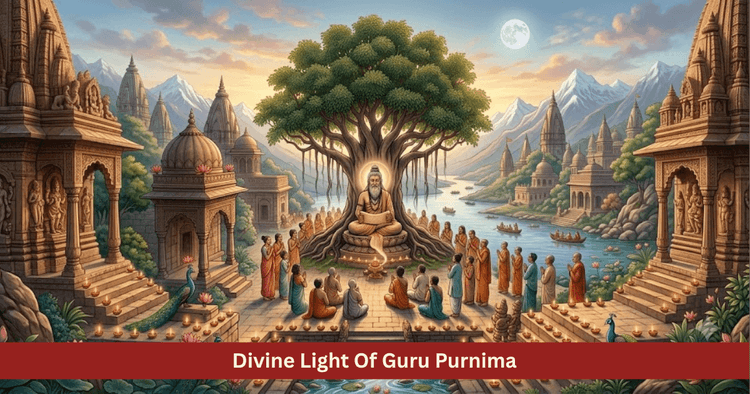
Table of Contents
Tithi, worship and main spiritual signals
| Aspect | Description |
|---|---|
| Topic | Importance of Guru Purnima, Vyasa Purnima and the Guru principle |
| Month | Ashadha |
| Tithi | Purnima, meaning the full moon |
| Other names | Guru Purnima, Vyasa Purnima |
| Dedicated to | Maharshi Vedavyasa and the entire Guru lineage |
| Main practice | Reverence to the Guru, bowing at the feet, mantra japa meaning sacred repetition, self study and gratitude |
| Inner feeling | Humility, receptivity, wisdom, peace and surrender |
| Special message | The journey from ignorance to knowledge becomes easier through Guru kripa, meaning the grace of the Guru |
What is considered auspicious on Guru Purnima
- Express gratitude toward one's Guru, teacher, parents or any guide who has shown direction in life
- Offer respectful remembrance, flowers and pranam at the feet of the Guru
- Set aside time for self study, japa, meditation and silent reflection
- Stay away from ego, argument and harsh speech
- Take a resolve to leave one negative tendency
- Make a vow to bring knowledge into daily life
What deserves special attention on this day
| Topic | Indication |
|---|---|
| Guru bhava | Not only a person but the principle that gives direction to consciousness |
| Purnima | A symbol of fullness of mind and light |
| Remembrance of Vyasa | Gratitude toward the lineage of wisdom |
| Disciple spirit | Humility, reverence and the capacity to receive |
| Practice | Listening, understanding and bringing teachings into conduct |
When light descends through bowing
The full moon of Ashadha is not merely a lunar date. It is the sacred moment when the Indian spiritual tradition places the Guru principle upon the highest seat of the heart. This day is observed as Guru Purnima and Vyasa Purnima. Along with the remembrance of Maharshi Vedavyasa, this festival bows before the unbroken stream of wisdom that lit the lamps of the Vedas, the Puranas, the Mahabharata and countless paths of sadhana.
The feeling of Guru Purnima is deeply gentle and serious. The center of celebration here is not outward noise but inward humility. The disciple lowers the head and in that bowing the first door of knowledge opens within. This is the deepest secret of the festival, that a mind filled with ego cannot hold light. But a mind softened by reverence slowly begins to receive the grace of the Guru.
What is Guru Purnima
Guru Purnima is the sacred festival observed on the full moon of Ashadha and dedicated to the Guru lineage, wisdom, humility and spiritual guidance. It is also called Vyasa Purnima because Maharshi Vedavyasa is remembered on this day. He is not regarded merely as a sage but as a great seer who gave structure to knowledge. For this reason, Guru Purnima means not only worship of the Guru but also gratitude toward the source of wisdom.
On this day the disciple expresses thankfulness toward the Guru. Even if a person has not yet received a formal Guru, one may still bow to that power which showed direction in the midst of darkness. That is why the festival is broad in spirit. It is not limited to ashrams or traditional centers of learning. Wherever truth, wisdom, discipline and inner upliftment exist, the meaning of Guru Purnima comes alive.
Why is it called Vyasa Purnima
Maharshi Vedavyasa is counted among the great pillars of the Indian wisdom tradition who gave vast spiritual knowledge an organized form. The division of the Vedas, the composition of the Mahabharata and the tradition of many Puranas are associated with his name. That is why Ashadha Purnima is also called Vyasa Purnima. This name reminds us that wisdom is not only a matter of realization but also of preservation and transmission.
The remembrance of Vyasa also teaches that Gurus are necessary to carry knowledge across generations. If truth remains only as silent realization, its benefit for society may remain limited. The Guru turns that truth into language, explanation, discipline and a way of life. Therefore Vyasa Purnima rests at the heart of Guru Purnima itself. One name belongs to the Guru, the other to the stream of wisdom that flows from Guru to disciple.
What is the Guru principle
It would be incomplete to see the Guru only as a person. The Guru principle is the force that removes ignorance and awakens discernment. Whatever gives direction to life, brings clarity in the midst of confusion and offers not mere comfort but truth, that is Guru tattva, meaning the principle of the Guru. Sometimes it is received through a living Guru. Sometimes through the words of a realized being. Sometimes through scripture. At times even the harsh events of life can carry the Guru principle if the mind is ready to learn.
Yet the importance of a living Guru or living guide remains unique. Scriptures can indicate a path but to notice the hidden darkness within a human being and guide that person through it is the work of a living relationship. When the disciple becomes confused, the Guru does not only give answers but also builds worthiness. That is why in Indian spirituality the Guru is seen as a medium of light. The Guru is not the owner of knowledge but a bridge to it.
Main dimensions of Guru tattva
- Removing ignorance and awakening discernment
- Giving discipline and direction to the disciple
- Connecting knowledge with experience
- Offering right vision in times of confusion
- Melting ego and awakening reverence
The connection between Purnima and the Guru feeling
The full moon is understood in Indian thought as a symbol of mind, emotion, sensitivity and receptivity. When the moon is full, it reflects light more completely. This symbolism is deeply suited to Guru Purnima. A disciple too can receive wisdom only when the mind is calm, humble and open. A restless, hard or overly doubtful mind may hear teachings but cannot bring them into the soul.
This meeting of Guru bhava and Purnima offers a beautiful spiritual indication. Just as sunlight falls upon the moon and makes it luminous, the knowledge of the Guru falls upon the mind of the disciple and gives direction. Here the Guru is like Surya, meaning the Sun and the disciple is like Chandra, meaning the Moon. When the disciple comes into full receptivity, inner illumination begins. That is why Guru Purnima is not only a festival of remembrance but also a festival of awakened worthiness.
Does even Brihaspati remain incomplete without the Guru
In astrology, Brihaspati, meaning Jupiter, is understood as the significator of wisdom, dharma, fortune, noble understanding, expansion and moksha, meaning liberation. This planet is associated with higher principles, faith, optimism and moral direction in life. Yet it is not considered sufficient that Jupiter alone should be well placed in a birth chart. If ego dominates life, guidance is rejected or knowledge is not brought into conduct, the potential of Jupiter may remain limited. In this sense, Guru grace and planetary promise may be understood as complementary.
A living Guru or a true guide can help activate the principle of Brihaspati within a person. Such guidance explains the meaning of scripture, connects dharma with daily life and prevents fortune from becoming only a matter of waiting. It becomes a matter of karma and sadhana. Therefore it may be said that Guru Purnima is also the day to live the principle of Brihaspati. Here the Guru exists outwardly and also as the force that awakens inner dharma.
The indication of the Moon, Nakshatra and the shower of knowledge
The full moon of Ashadha is traditionally associated with the period in which the field of Purvashadha or Uttarashadha Nakshatra may come into discussion. In this symbolic astrological language, qualities such as water, expansion, steadiness, victory, patience and higher direction may be contemplated. That is why Guru Purnima is often described as a day of the shower of wisdom, knowledge and peace. It is important here to understand that this points less to instant miracle and more to the receptivity of the inner being.
When the Moon represents the mind and Guru represents wisdom, their harmony creates a beautiful atmosphere for spiritual practice. This is why self study, listening to scripture, japa, meditation and reverence to the Guru are considered especially fruitful on this day. If the disciple's mind is pure, even a simple sentence may become life changing teaching. This is the true meaning of the shower of knowledge.
Why practice deepens on Guru Purnima
- The mind becomes more emotional and receptive
- Remembrance of the Guru awakens humility
- The symbolism of the full moon brings inner light
- Scriptural study gains concentration
- Self reflection can become more honest
The karmic bond between Guru and disciple
The bond between Guru and disciple is not merely an outer relationship of teaching and learning. It is understood as a deep karmic and spiritual relationship. Where the disciple becomes stuck, the Guru helps movement happen. Where the disciple stops by believing too strongly in personal understanding, the Guru breaks that illusion. Where the disciple collapses, the Guru offers not only support but also a mirror of hidden strength.
The emotional side of this bond is also very deep. A true disciple may experience the Guru not only as a giver of knowledge but as a giver of life, because the Guru offered direction in the darkest times. In the same way, a true Guru does not make the disciple an extension of the Guru's ego. The Guru leads the disciple nearer to truth. That is why this relationship is not about ownership but about grace and responsibility.
Can Guru Purnima be observed without a formal Guru
Yes, the feeling of Guru Purnima is greater than formality. Even if a person has not yet received a diksha Guru, meaning an initiating spiritual guide, one may still express gratitude toward every source of wisdom in life. Parents, teachers, mentors, a scripture, a realized soul, a silent experience or even a difficult truth of life may be remembered as Guru in essence. What matters is reverence, humility and readiness to learn.
Even then, this day is well suited for an inner prayer that true guidance may come into life. Many search for a Guru outside but first the spirit of discipleship must awaken within. When worthiness develops, guidance also appears in its right time. Therefore Guru Purnima is not only the celebration of a received Guru. It is also the festival of inward preparation to receive one.
What practice should be done on this day
The finest practice on Guru Purnima is gratitude. Along with this, one may add Guru vandana, meaning reverence to the Guru, bowing at the feet, self study, japa, meditation, scriptural reading, silence and service. If a person has received a Guru mantra, it may be chanted with special devotion. If not, then sitting in peace and reflecting upon the teachings, mistakes, corrections and guidance received in life can still be highly meaningful.
A small resolve may also be taken on this day. It may be giving up falsehood, reducing anger, studying regularly, making speech gentler or bringing one noble quality into life. The honor of Guru Purnima is not completed by offering flowers alone. Its real respect is shown when the teaching enters conduct.
Simple observances for Guru Purnima
- Bathe in the morning and wear clean clothes
- Remember the Guru, Vedavyasa or the chosen deity
- Light a lamp and offer pranam and prayer
- Read scripture, satsanga teachings or uplifting wisdom
- Take a resolve to reduce one fault
- Keep humility in speech and mind throughout the day
Where knowledge descends as compassion
Guru Purnima reminds us that the deepest darkness in life is not outside but inner ignorance. To remove that ignorance, information alone is not enough. Guru is needed, grace is needed, humility is needed and the courage to accept truth is needed. The full moon of Ashadha is the bright festival of this inner journey. It teaches the disciple that bowing the head is not defeat. It is preparation to receive light.
When the grace of the Guru falls upon the mind, that mind too begins to shine like the full moon. Thoughts become purified, life receives direction, karma becomes refined and the hidden call of the soul finally finds words. This is the silent blessing of Guru Purnima. It is not only a festival but a living remembrance of the eternal journey from darkness to light.
FAQ
When is Guru Purnima observed
Guru Purnima is observed on the Purnima Tithi of the month of Ashadha.
Why is Guru Purnima also called Vyasa Purnima
Because Maharshi Vedavyasa is remembered on this day as the great sage who gave structure and expansion to the Indian wisdom tradition.
What is the main importance of Guru Purnima
This day especially honors the Guru principle, wisdom, humility, gratitude and the spirit of discipleship.
Can Guru Purnima be observed without a Guru
Yes, even without a formal Guru, one may observe this day by expressing gratitude toward the sources of wisdom that brought direction in life.
What practice should be done on Guru Purnima
Guru reverence, japa, meditation, self study, silence, service and taking a resolve to leave one fault are especially meaningful on this day.
Get your accurate Kundali
Generate KundaliDid you like it?
Author

Pt. Sanjeev Sharma (63)
Experience: 20
Consults About: Family Planning, Career
Clients In: Punjab, Haryana, Delhi
Share this article with friends and family
WELCOME TO
ZODIAQ
Right Decisions at the right time with ZODIAQ
