Divine Mystery Of Rath Yatra
By Pt. Nilesh Sharma
Learn how in Jagannath Rath Yatra the Lord himself comes out, wipes the tears of devotees and awakens devotion in the heart
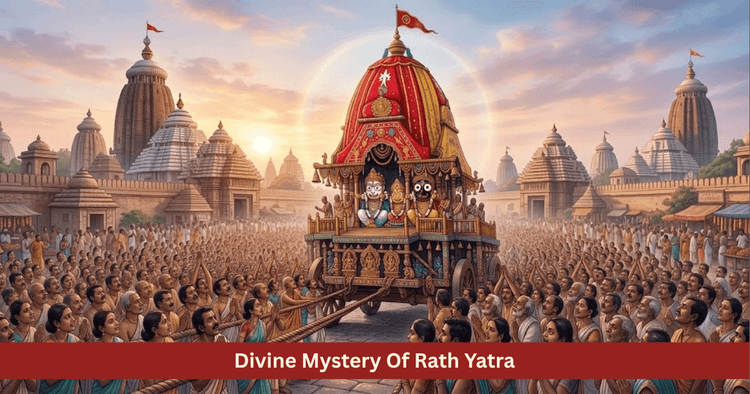
Table of Contents
Tithi, festival and main spiritual signals
| Aspect | Description |
|---|---|
| Topic | Spiritual, cultural and astrological significance of Jagannath Rath Yatra |
| Month | Ashadha |
| Paksha | Shukla Paksha, meaning the waxing lunar phase |
| Tithi | Dwitiya, meaning the second lunar day |
| Main place | Puri, Odisha |
| Worshipped deities | Lord Jagannath, Balabhadra and Subhadra |
| Main event | The Lord comes out of the sanctum and rides upon the chariot |
| Special feeling | The Divine personally comes among the devotees |
| Recommended conduct | Name chanting, darshan bhava meaning devotional seeing, service, humility and devotion |
What is considered auspicious on the day of Rath Yatra
- Chant the name of Lord Jagannath with reverence
- See Rath Yatra not merely as a festival but as an opportunity for darshan
- Increase humility, service and devotional feeling
- Offer your hidden sorrow, prayer and resolve at the feet of the Lord
- Give importance to food charity, water service and simple devotion
- Stay away from ego, conflict and display
The subtle meaning of this festival
| Element | Meaning |
|---|---|
| Jagannath | Lord of the universe, the Divine who belongs to all |
| Chariot | A symbol of life's journey and the path of karma |
| Coming out | The Lord personally reaching the devotee |
| Path | Divine presence moving through the world |
| Tears | Purification of the heart and the flow of surrender |
When the Lord himself comes out
Jagannath Rath Yatra, observed on the Dwitiya Tithi of the Shukla Paksha in Ashadha, is regarded as one of the most compassionate and living festivals of the Sanatan tradition. It is not merely a religious procession. It is the moment when the Lord himself comes out from the dignity of the sanctum and moves among his devotees. There is a tenderness in this feeling that is rarely seen elsewhere.
Usually devotees go to the temple, wait for darshan and bow before their chosen deity within the sacred space. But in Rath Yatra this order changes. Here the Divine himself comes out. This scene is not merely seen with the eyes. It is experienced with the heart. That is why Jagannath Rath Yatra appears not only as a festival but as the moving form of divine compassion.
What is Jagannath Rath Yatra
The Jagannath Rath Yatra of Puri is the sacred journey of Lord Jagannath, his elder brother Balabhadra and his sister Subhadra, in which the three deities ride on chariots and move through the town. This festival takes the relationship between devotee and Lord into a new dimension. Here the deities do not remain distant. They come onto the path, among the crowds and before the eyes of those who may never reach the temple sanctum.
This is the greatest message of the Yatra. God does not belong only to those who have access, comfort or privilege. He belongs to all those who carry love. For devotees who cannot enter the temple for any reason, Rath Yatra becomes an assurance that divine grace is not confined within walls. The Lord can come out and touch every heart himself.
Why is the feeling of this festival so unique
The deepest aspect of Rath Yatra is that it reveals the nearness of the Divine. Lord Jagannath appears immense and yet intimately close. He is not experienced here as a distant power that judges but as a compassionate Lord who wipes the tears of his devotees. As the vast chariot moves slowly ahead, people do not merely take darshan. They feel years of pain, hope, prayer and surrender beginning to flow within themselves.
That is why weeping in this Yatra is not seen as weakness. Here tears become the natural water of devotion. Where words cannot reach, the eyes begin to speak. For many, this moment becomes not only religious but also a deep psychological and spiritual cleansing. It can feel as though the hardness within is melting and the soul is recognizing its own source.
Emotional dimension of Rath Yatra
- The Divine himself comes near the devotee
- A rare union of sacred dignity and compassion
- A vast experience of collective devotion
- Inner purification through tears
- The blessing of closeness replacing distance
Spiritual meaning of coming out of the sanctum
The sanctum of a temple is considered the most sacred and concentrated place. There the deity remains seated in stillness. When the same Lord comes out, it does not mean a mere change of place. It becomes a deep spiritual signal. Its message is that God is not present only in silent sanctity but also in the dust of the road, in the crowd, in the cries of the people and in the tiredness of worldly life.
Rath Yatra teaches that devotion should not remain limited to the four walls of a temple. If the heart is true, then the road too can become a pilgrimage, the chariot too can become a shrine and the crowd too can become a form of spiritual practice. This is the unique expansion of the Jagannath feeling. It breaks boundaries and enters the life of the devotee.
Is this truly special for those who cannot enter the temple
The greatest compassion of this festival is understood in exactly this way, that the Lord himself comes among those who remain deprived of direct temple access for one reason or another. In this feeling, social, physical and personal limitations seem to melt away. Rath Yatra declares that even when there are obstacles on the human side, the path from the side of the Divine can still remain open.
This idea gives immense comfort. Many times in life, a person feels unworthy, unable to reach, lacking time, lacking means or destined only for distance. Jagannath Rath Yatra tells every such heart that divine compassion can be greater than personal effort. When the heart is sincere, the Lord himself shortens the distance.
How can Rath Yatra be understood astrologically
From an astrological perspective, festivals like Rath Yatra may be seen not only as observances tied to a tithi but also as moments that raise collective consciousness. The Dwitiya of the Shukla Paksha in Ashadha itself suggests growing lunar strength, emotional flow and an environment favorable for divine worship. After the seasonal turn, the human being may also become more inward and in such a condition the force of collective devotion can touch the heart even more deeply.
When lakhs of people join in one name, one remembrance and one feeling, the event no longer remains a social gathering alone. It becomes a vast resonance of the collective mind. That is why Rath Yatra may be understood as prayer in motion. Here the planetary influence is not limited to individual outcomes but may also awaken devotion, surrender and shared spiritual merit.
The indication of Guru, Surya and Chandra
A symbolic astrological language can be useful in understanding this festival. Surya, meaning the Sun, is regarded as the significator of divine consciousness, radiance, life center and soul strength. Chandra, meaning the Moon, is linked with mind, emotion, devotion and tenderness. Guru, meaning Jupiter, represents dharma, grace, blessing and spiritual expansion. In the experience of Rath Yatra, all three of these elements seem to awaken together. The radiance of the Lord, the melting of the heart and the rise of dharma begin to move as one stream.
That is why Rath Yatra may be understood as a living movement of transit within the heart. It is not only the planets moving in the sky. Something is also moving within the human being. Old knots loosen, prayers find expression, guilt washes away through tears and sleeping faith begins to awaken again. This is its deep astrological beauty.
Indicative planetary feeling in Rath Yatra
| Planetary element | Feeling in Rath Yatra |
|---|---|
| Surya | The radiance of the Lord and the light of consciousness |
| Chandra | Devotion, tears and softness of heart |
| Guru | Grace, dharma, blessing and expansion |
| Path | The karmic road of life |
| Chariot | The journey of body and time |
Can Rath Yatra awaken sleeping fortune
This question should be understood not through the language of shallow miracle but through spiritual truth. The awakening of fortune is not measured only by wealth, position or external success. Many times, sleeping fortune means that faith has fallen asleep within a person, hope has dried up, soul strength has become tired and trust in God has weakened. Rath Yatra can become a festival of awakening for such a heart.
When a person sees the Lord walking among the people, life no longer feels abandoned. This experience can be profound. It may return hope, give support to the soul and awaken new inspiration for karma. If fortune is understood as inner direction, faith and strength, then Rath Yatra can truly awaken it.
What is the spiritual meaning of tears
The tears that flow during Rath Yatra are not merely emotional weakness. They can work at many levels. They may carry memory, repentance, longing for union, unspoken prayer and the feeling of becoming naked before the Divine. When a heart melts in true surrender, tears can become a medium of purification.
In spiritual tradition it is often understood that where ego begins to break, devotion becomes more genuine. Tears are a tender form of that breaking. They can wash away hardness, guilt, loneliness and exhaustion from within and give a sense of lightness. That is why the weeping of Rath Yatra is not only the weeping of sorrow. It can also be the weeping of release.
What spiritual practice can devotees do in this festival
The finest practice of Rath Yatra is remembrance of the divine name. Along with that, humility, service, silent prayer, food charity, water service and the feeling of offering one's life at the feet of the Lord may be cultivated. On this day, a person may also look within and ask where the heart has become hard and where compassion is needed. The spirit of Lord Jagannath teaches life to become simple and inclusive.
Those who cannot be physically present in the Yatra may still remember Lord Jagannath, Balabhadra and Subhadra at home with a quiet heart. The essence of devotion depends more on inner feeling than on location. If there is sincerity, reverence and inward surrender, then even remembrance from afar can become deeply meaningful.
Simple observances for this day
- Chant the name of Lord Jagannath
- Offer hidden pain to the Lord
- Take a resolve for food or water service
- Remember the Lord with family in devotion
- Pray to release one old burden of guilt
- Offer your life toward divine direction
Where the chariot itself becomes compassion
Jagannath Rath Yatra teaches that the Divine is not far away. When the devotee becomes tired, the Lord himself may begin to walk toward that devotee. This is the greatest consolation of the festival. It is not merely a traditional celebration but an assurance for the soul. As Lord Jagannath comes out of the sanctum, it is as if he says that no heart is so far that grace cannot reach it.
Therefore the real miracle of Rath Yatra happens within. The eyes fill, the mind becomes lighter, faith returns and the soul receives direction again. This is the awakening of sleeping fortune. This is the silent embrace of Jagannath, which supports a human being even in the most difficult times.
FAQ
When is Jagannath Rath Yatra observed
Jagannath Rath Yatra is observed on the Dwitiya Tithi of the Shukla Paksha in the month of Ashadha.
What is the main significance of Jagannath Rath Yatra
Its main significance is that the Lord himself comes out of the sanctum and gives darshan among the people.
Is Rath Yatra considered especially meaningful for those who cannot enter the temple
Yes, the compassionate spirit of this festival is that the Lord himself reaches those devotees who cannot enter the temple for some reason.
What is the astrological meaning of Rath Yatra
In a symbolic astrological sense, it may be understood as a festival of devotion, grace, consciousness and collective spiritual awakening through the feelings of Surya, Chandra and Guru.
What is considered auspicious during Rath Yatra
Name chanting, service, humility, prayer, surrender and reverent remembrance of Lord Jagannath are considered especially auspicious on this day.
Get your accurate Kundali
Generate KundaliDid you like it?
Author

Pt. Nilesh Sharma (63)
Experience: 20
Consults About: Family Planning, Career
Clients In: Punjab, Haryana, Delhi
Share this article with friends and family
WELCOME TO
ZODIAQ
Right Decisions at the right time with ZODIAQ
