Rath Yatra and Sibling Bonds
By Pt. Narendra Sharma
A profound family message through Subhadra Krishna and Balabhadra
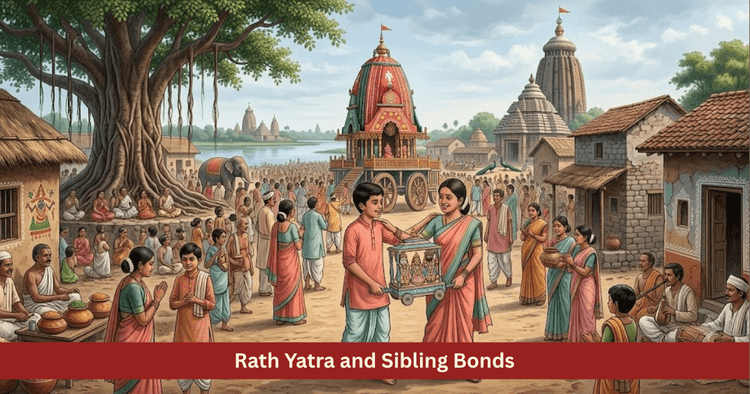
Table of Contents
Tithi rituals and essential guidance
Observed on the Dvitiya Tithi of the Shukla Paksha in the month of Ashadha, Rath Yatra is not only a grand sacred festival but also a profound symbol of family, affection, duty and intimate relationships. On this day Bhagavan Jagannath, His elder brother Balabhadra and His sister Subhadra are seated on three separate chariots and proceed toward the Gundicha temple. This vision is regarded in the Indian spiritual tradition as a wonderful mirror of selfless sibling love, family protection and karmic unity.
The date of Rath Yatra is fixed each year according to the Panchanga, so it is necessary to consult the local calendar for the correct tithi, worship timing and festival observance. If a seeker or family wishes to bring the spiritual meaning of this day into life, merely watching the festival is not enough. On this day, gratitude, dialogue and harmony toward family, especially sibling relationships, are considered especially fruitful.
| Element | Details |
|---|---|
| Tithi | Ashadha Shukla Dvitiya |
| Festival | Rath Yatra |
| Main deities | Bhagavan Jagannath, Balabhadra, Subhadra |
| Main symbol | Sacred bond of brother and sister |
| Spiritual meaning | Family harmony, karmic unity |
| Recommended practice | Darshana, prayer, family dialogue |
| Special feeling | Protection, affection, participation |
What is considered auspicious on this day
- Remember Bhagavan Jagannath, Balabhadra and Subhadra
- Pray together with the family
- If there is distance in sibling relationships, begin a dialogue
- Express respect toward elder brother, sister or younger siblings
- Maintain sattvika living, humility and service
- If possible attend Rath Yatra darshana or perform symbolic worship at home
What should be avoided
- Reviving old family disputes
- Jealousy, comparison and harsh speech
- Treating the festival as only an outer celebration
- Taking sibling relationships lightly
- Remaining emotionally distant from tradition
When it is not only deities upon the chariot
The vision of Rath Yatra appears simple from the outside. There are three chariots, divine images, crowds of devotees, ropes and joy. Yet in the Indian spiritual vision, this is not merely a religious procession. It is a public expression of the feeling in which a family moves together, accepts each other's presence and expresses love not only through words but through shared movement.
When Balabhadra and Subhadra are seated upon the chariot along with Bhagavan Jagannath, the message becomes clear that even within divine play, the place of brother and sister is supremely sacred. Here the relationship is not of power but of affection. Here there is protection but not control. Here there is closeness but not selfishness. This is why the festival of Ashadha Shukla Dvitiya becomes not only an expression of Vaishnava devotion but also a serious lesson in family dharma.
Why is the story of Subhadra Krishna and Balarama special
The united presence of Bhagavan Krishna, Balarama and Subhadra is unique in Indian sacred memory. Usually sacred narratives focus on glory, battle, incarnation or restoration of dharma. But in Rath Yatra a subtle and deeply human dimension appears. Here the Divine is also brother. Here there is also sister. Here there is also family.
Balabhadra symbolizes strength, steadiness and the protective impulse. Krishna represents lila, meaning divine play, karuna, meaning compassion, wisdom and love. Subhadra brings the feeling of tenderness, mediation, family balance and auspiciousness. Their being seated together upon the chariot reveals that family is not merely a blood relationship. It is a balanced circle of energy where strength, love and tenderness are all necessary.
This is the unheard depth of the story. The festival does not only say that siblings are together. It says that family becomes complete when protection, understanding and sweetness exist together.
What is the feeling behind the Gundicha journey
In Rath Yatra, the journey toward the Gundicha temple is lovingly described in common speech as going to the maternal aunt's home. This expression itself is deeply sweet. In Indian family culture, the maternal and paternal sides both hold their own sanctity. When the deities themselves travel with the family, the message becomes clear that movement, meeting, affection and familial extension are also part of dharma.
This journey also signifies movement from stillness into living flow. At times family relationships remain outwardly present, yet movement within them stops. Dialogue ceases. Affection becomes formal. Relationship remains only in name. Rath Yatra breaks this stagnation. It declares that love must move. Relationships must visit one another. Intimacy must travel from one home to another.
Why is the sibling relationship considered so sacred
In Indian culture the relationship of brother and sister is not regarded merely as a birth based bond. It is a relationship of protection, memory, support, ethical responsibility and selfless affection. Within this bond, the feeling of possession is less and the feeling of guardianship is greater. That is why this relationship, though very tender, remains inwardly strong.
A sister often becomes the center of sweetness within a family. A brother often becomes the ground of security. Tradition understood these roles not as rigid rules but as emotional archetypes. The presence of Subhadra in Rath Yatra reminds us that the place of the sister is central to family wholeness. The presence of Krishna and Balabhadra teaches that a brother symbolizes not only authority but also responsibility.
Spiritual qualities of this bond
- Memory in this bond runs very deep
- Sacrifice in this bond is often unspoken
- Intimacy is greater here than formality
- Even after distance an invisible thread remains
- The imprint of childhood can remain active for life
Astrological indications of brother and sister
In Vedic astrology relationships are understood not only socially but also through planets and houses. In relation to siblings, the third house is considered extremely important. It signifies siblings, courage, communication and co born relationships. The condition of the related planets indicates the type of relationship a native may experience with brothers and sisters.
In traditional interpretation Mangala, meaning Mars, is often regarded as especially significant for brothers because it signifies courage, protection, initiative and active support. In the context of sisters, Budha and Shukra can be considered important because Budha represents communication, nearness and intellectual harmony, while Shukra indicates affection, sweetness and relational tenderness.
| Astrological factor | Relationship indication |
|---|---|
| Third house | Siblings, courage, family communication |
| Mangala | Brother, protection, active support |
| Budha | Communication, closeness, understanding |
| Shukra | Sweetness, affection, tenderness in relationships |
| Chandra | Emotional memory and family attachment |
When these indications are viewed through the lens of Rath Yatra, a beautiful interpretation emerges. In Balabhadra one may see the protective force of Mangala. In Subhadra the soft, balancing and relationship binding energy of Budha and Shukra becomes visible. Krishna becomes the bridge of consciousness, love and lila between the two. In this way the festival gives living expression to astrological symbols.
What does karmic depth reveal
Some relationships cannot be understood only through the behavior of this life. In them attraction is deep, expectations are high, pain is felt quickly and yet forgiveness also returns to the same place. The sibling relationship can often be of this kind. It is not only a social arrangement but may also indicate a karmic bond.
In karmic relationships, people do not enter each other's lives merely to play roles. They come to learn, to mature and at times to balance older samskaras, meaning deep impressions. If between siblings there is unusual closeness, repeated distance, constant misunderstanding or repeated reunion, then it should not be understood only through present nature. Some deeper samskara may be active there.
The message of Rath Yatra is that karmic relationships should be understood rather than broken. The family member who challenges us most may also become the source of our deepest learning.
The subtle meaning of Subhadra's presence
Subhadra in Rath Yatra is not only a divine feminine form. She symbolizes auspiciousness, tender balance and emotional mediation within the family. Wherever two powers exist, a third power is needed to connect them. Between Krishna's lila and Balabhadra's stable force, Subhadra is like the compassionate line that prevents the relationship from becoming hard.
This sign is deeply relevant in present family life. A household does not function through logic or discipline alone. It also runs through emotional subtlety. In many homes, a sister, daughter or woman becomes the emotional center who reconnects dialogues that were breaking apart. The chariot of Subhadra is the divine form of this subtle truth.
What can the modern family learn
In contemporary life sibling relationships often grow weak because of geographical distance, busyness, financial competition and emotional hesitation. The nearness of childhood slowly changes into formal conversation. At times love remains but ease of expression disappears. In such a time this festival of Rath Yatra shakes the family inwardly and reminds it that remembering relationships is not enough. They must also be lived.
What a family can do on this tithi
- Brothers and sisters should speak sincerely to one another
- If there is distance, take the first step and begin communication
- Instead of carrying silent anger over old disputes, bring clarity
- Share childhood memories
- Pray together as a family
- Leave aside the ego of elder and younger and give priority to intimacy
The effect of these small steps can be profound. Not every relationship needs a grand solution. At times one truthful sentence, one forgiveness, one phone call, one memory and one humble initiative can melt the distance of years.
The philosophical meaning of sitting together on the chariot
The chariot is not merely a vehicle. In Indian philosophy the chariot is also a symbol of life, the body, journey and destiny. When brother, sister and the Divine are seated together on a chariot, the vision suggests that the journey of life does not move alone. Family, memory, protection and the energy of relationships move with it.
Another deep truth is hidden here. In a family everyone is not the same. One may carry Krishna like compassionate wisdom. Another may carry Balabhadra like direct strength. Another may carry Subhadra like sweet balancing power. Yet the journey remains shared. This means that relationships do not move through sameness but through harmony.
Renewal of family values
This emotional aspect of Rath Yatra is especially relevant today because modernity has given convenience but at times taken away emotional nearness. In such a time the shared journey of Subhadra, Krishna and Balabhadra reminds us that family is not merely a structure. It is a living circle of memory, responsibility, love and shared karma.
If in any home sibling relationships have grown distant, if dialogue has become rare, if old wounds still live silently, then Ashadha Shukla Dvitiya can become a beautiful opportunity. On this day not only worship should be done. Relationships should also be repaired. That is the true sadhana of this festival.
Where relationships begin moving again
The Rath Yatra of Ashadha Shukla Dvitiya teaches that the bond of brother and sister is not something to be remembered only during festivals. It is among the most sacred, selfless and karmic of all human relationships. The united presence of Subhadra, Krishna and Balabhadra teaches that family flourishes when strength, love and sweetness are all established together.
As the chariot moves forward, it carries not only divine forms. It also carries a message for the family. Relationships should move through connection, not force. Distance should not be accepted as fate but softened through dialogue. And those bonds in which childhood memory, sacrifice and silent love still remain alive should be honored again. This is the heart of Rath Yatra. This is the blessing of Ashadha Shukla Dvitiya.
FAQ
Why are Subhadra Krishna and Balarama together in Rath Yatra
Their united presence in Rath Yatra is regarded as a symbol of the sacred sibling bond, family unity and selfless affection.
What is the connection between Ashadha Shukla Dvitiya and sibling relationships
Because of Rath Yatra, this tithi is considered supportive for family, sibling relationships, communication and karmic closeness.
Which planets are connected with brother and sister in astrology
Mangala is considered important for brother, while Budha and Shukra are linked with communication, sweetness and intimacy in relation to sister.
Can Rath Yatra become a spiritual opportunity to heal family relationships
Yes, this festival is not only a celebration but also a beautiful opportunity to reduce distance, increase dialogue and revive love within the family.
What is the spiritual meaning of Subhadra's presence
Subhadra is regarded as the symbol of auspiciousness, emotional balance, tenderness and the connecting force within the family.
Get your accurate Kundali
Generate KundaliDid you like it?
Author

Pt. Narendra Sharma (63)
Experience: 20
Consults About: Family Planning, Career
Clients In: Punjab, Haryana, Delhi
Share this article with friends and family
WELCOME TO
ZODIAQ
Right Decisions at the right time with ZODIAQ
