Rama and Akal Bodhan
By Pt. Suvrat Sharma
The deeper meaning of 108 blue lotuses and Devi grace
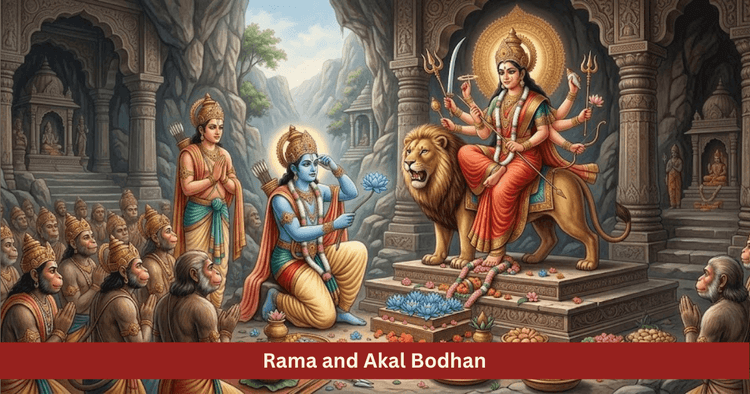
Table of Contents
When Shakti Was Invoked Before Victory
Ashwin Navratri is not only a festival of Devi worship. It also offers an opportunity to understand the relationship between dharma, Shakti, discipline and victory. Within this tradition comes the story of Akal Bodhan, in which Shri Rama invoked Goddess Durga during Ashwin month before the decisive battle with Ravana.
Traditionally the special worship of the Devi was associated with Vasanta Navratri in spring. Shri Rama awakened the Devi in the autumn season because of the need to fight for dharma. For this reason the worship became known as Akal Bodhan. Akal here does not mean impure or harmful. It means an invocation performed at a time different from the usual season.
This story is mainly famous through the Krittivasi Ramayana of Bengal and later regional devotional traditions. The episode does not appear in the same form in the original text of the Valmiki Ramayana. It is therefore more appropriate to understand it as an important regional and devotional Ramayana tradition. Its meaning is deep. When the time comes to protect dharma the invocation of Shakti arises not only from custom but from true need, pure resolve and complete surrender.
Brief Order of Akal Bodhan Worship
During Sharadiya Navratri this story is remembered with special devotion. According to family tradition a household may perform Ghata Sthapana, Durga worship, remembrance of the Navadurga, lighting of a lamp, mantra japa and Kanya Pujan.
| Detail | Traditional meaning |
|---|---|
| Month | Ashwin |
| Paksha | Shukla Paksha |
| Festival | Sharadiya Navratri |
| Special worship | Akal Bodhan of Goddess Durga |
| Main practice | Resolve, mantra japa, flower offering and lamp worship |
| Centre of the story | Shri Rama invoking the Devi |
| Special flowers | 108 blue lotuses |
| Main message | Strength and surrender are needed for victory of dharma |
| Completion feeling | Vijayadashami and restoration of dharma |
The date and time of worship should be decided according to the local Panchanga and family tradition. For a special ritual guidance from a guru or learned acharya is considered appropriate.
What Does Akal Bodhan Mean?
Akal Bodhan is made of two words. Akal means outside the usual time and Bodhan means awakening or invocation. Spring was traditionally regarded as the proper period for Devi worship. Shri Rama invoked the Devi during Ashwin month and therefore this worship became known as Akal Bodhan.
The word should not be understood as inauspicious. Its meaning here is that when the need to protect dharma becomes urgent the sadhaka does not wait for a fixed season. The remembrance of the Divine and Shakti begins immediately.
This aspect of the story remains useful in modern life. Often a person does not recognize inner strength until a crisis arrives. When circumstances become serious prayer, discipline and self confidence must be awakened. Akal Bodhan is a symbol of this awakening.
Why Did Shri Rama Worship the Devi in Ashwin?
The time of the battle in Lanka was near. Ravana was powerful and possessed a large army and many divine weapons. Shri Rama stood on the side of dharma but standing with dharma does not provide a guarantee of external victory. Protection of dharma also requires discipline, strength, strategy and divine grace.
According to the story Shri Rama understood that weapons alone would not be enough. Before the battle it was necessary to receive the blessings of Goddess Durga. The Devi is the form of Shakti. She destroys demonic forces and gives inner radiance to the sadhaka who stands with dharma.
The purpose of Shri Rama worship was not victory of personal ego. It was the rescue of Sita, the end of Ravana oppression and the restoration of dharma. This is why his sadhana reflects the feeling of welfare and protection of dharma more than personal desire.
The Story of the 108 Blue Lotuses
Shri Rama took a resolve to offer 108 blue lotuses to the Devi. A blue lotus is considered rare and special. According to the story Hanuman brought 108 blue lotuses from a distant place and completed the preparation for worship.
The worship began. Shri Rama offered each blue lotus at the feet of the Devi with devotion. The number 108 is connected with completeness, cosmic balance and the sacred count of mantra japa. A japa mala contains 108 beads. In many spiritual practices the number 108 represents a complete cycle.
When it was time to offer the final flower Shri Rama saw that one blue lotus was missing. The worship could remain incomplete. The fear of a broken resolve stood before him but Shri Rama did not become disturbed.
Rama the Lotus Eyed and Complete Surrender
Shri Rama is called Kamalanayana, the lotus eyed one. His eyes are compared with lotuses. When one blue lotus was missing he considered offering one of his own eyes if the Devi required the 108th lotus.
This episode is not meant to encourage physical sacrifice. Its main meaning is that true sadhana requires ego, comfort and personal attachment to be offered at the feet of the Devi. Shri Rama was ready to offer his eye, considering it equal to a lotus. This proves the depth of his surrender.
According to the story when Shri Rama moved forward to offer his eye Goddess Durga appeared and stopped his hand. The Devi was pleased with his devotion and blessed him with victory. This episode represents both the test of the Devi and the steadiness of the devotee.
Spiritual Meaning of the Number 108
The number 108 is regarded as sacred in Indian tradition. Different spiritual and mathematical explanations are associated with it. A japa mala contains 108 beads. Some traditions perform 108 repetitions of Surya Namaskara. The number also appears repeatedly in temples and mantra practices.
| Relationship of 108 | Symbolic meaning |
|---|---|
| 108 beads of a japa mala | Complete cycle of mantra practice |
| 108 blue lotuses | Complete devotion and resolve |
| Connection with directions and cosmic calculation | Wider consciousness |
| 108 offerings in Devi worship | Surrender of mind, speech and action |
These explanations should be understood as spiritual symbols. Completing only the number does not complete sadhana. Feeling, pronunciation, discipline and conduct are equally important.
The Test of the Devi and the Devotee Faith
In the story the missing blue lotus is described as the play and test of the Devi. She wished to see whether Shri Rama worship was limited to outer procedure or whether it contained true surrender.
When everything remains favourable it is easy to maintain faith. Difficulty appears when an obstacle arises at the final stage of a resolve. Shri Rama did not blame the obstacle. He accepted the situation and looked within for a solution.
This episode teaches that the value of sadhana appears not in comfort but in remaining steady during difficulty. The Devi blesses the one who seeks strength and also understands that strength must be used for dharma and the welfare of others.
What Blessing Did the Devi Give Shri Rama?
According to regional versions of the story Goddess Durga was pleased with Shri Rama and blessed him with victory over Ravana. Through her blessing Shri Rama received the inner strength, courage and confidence needed for battle.
Here victory does not mean only winning a war. Victory means the following.
• Victory of courage over fear
• Victory of dharma over ego
• Victory of truth over adharma
• Victory of discernment over confusion
• Victory of hope over despair
• Victory of welfare over personal pain
Shri Rama did not ask the Devi only for the power to defeat an enemy. His story indicates that strength received for a righteous purpose becomes beneficial.
The Connection Between Rama and Durga Worship
Shri Rama is regarded as an incarnation of Vishnu and Goddess Durga is the form of Adishakti. From the Vedic and Puranic view consciousness and Shakti are not separate. Consciousness needs strength to act. Shakti needs dharma and discernment for right direction.
The connection between the Rama story and Durga worship represents this balance. Shri Rama is the symbol of dharma and maryada. Goddess Durga is the presiding deity of strength, protection and transformation. When maryada and Shakti come together the destruction of adharma becomes possible.
For this reason Sharadiya Navratri and Vijayadashami may be seen as two stages of one spiritual sequence. During Navratri Shakti awakens. On Dashami the righteous use of that Shakti appears as victory.
Akal Bodhan and Sharadiya Navratri
In regional and devotional traditions Akal Bodhan is linked with the origin of Sharadiya Durga Puja. This belief is especially famous in the Durga Puja tradition of Bengal. At the beginning of the worship the Devi is awakened and invited to receive worship during the autumn season.
During Sharadiya Navratri the nine forms of the Devi are worshipped. The Mother is remembered through names such as Kali, Durga, Chandi, Bhavani and Jagadamba. The story of Akal Bodhan connects this celebration with the dharmic journey of Rama and the victory of Vijayadashami.
Different Puranas, Ramayana traditions and regional texts may present the story in different forms. It is not appropriate to treat one version as the identical text of all scriptures. Religious narratives developed in different regions through different languages, styles and feelings.
Astrological Basis of the Story
Ashwin month is connected with the Sharad season. The position of the Sun, lunar tithis and the Shukla Paksha of Navratri are considered important for Devi worship. During the bright fortnight the light of the Moon increases. This increase is taken as a symbol of growing hope, concentration and resolve within the sadhaka.
From the astrological view Chandra, Mangala, Surya and Guru are considered in relation to Devi sadhana.
| Planet | Indication in Devi worship |
|---|---|
| Surya | Inner strength, dharma and leadership |
| Chandra | Faith, mind and devotion |
| Mangala | Courage, battle strength and protection |
| Guru | Dharma, blessing and knowledge |
| Shukra | Beauty of devotion and compassion |
| Shani | Discipline, austerity and patience |
The individual fruit of sadhana may be considered through these planetary indications. Even so it is not proper to declare a fixed planetary affliction or fixed result without examining a person horoscope.
What Can Household Life Learn from Rama Sadhana?
The story of Akal Bodhan is not only for kings and warriors. In household life also there are times when a person needs inner strength more than outer resources. During illness, financial pressure, family conflict, examinations, responsibility or moral decisions this story can provide guidance.
A householder may receive the following feelings from the story.
• Prepare the mind before a crisis arrives
• Ask for help and blessing when needed
• Do not limit worship only to fulfilment of desire
• Maintain regularity in the resolve
• Seek a solution instead of blaming others when difficulty arises
• Use strength for the welfare of family and society
• Avoid ego after receiving victory
Shri Rama worshipped the Devi but did not withdraw from his duty. This is an important teaching. He still had to enter the battlefield after worship. Divine grace did not replace his action. It gave strength and direction to his action.
Simple Akal Bodhan Worship During Navratri
A householder may perform simple worship according to ability and family tradition. Complex tantric methods should not be imitated without suitable guidance.
Simple Worship Order
-
Clean the worship area
-
Perform Ghata Sthapana and remember the Devi
-
Light a lamp and incense
-
Offer red flowers or any available pure flowers
-
Chant a Durga mantra
-
Offer 108 flowers if they are available
-
If flowers are not available worship with rice grains, vermilion and devotion
-
Remember Rama and Goddess Durga together
-
Serve a girl, elder or needy person
-
Take a resolve for a righteous life on Vijayadashami
If blue lotuses are not available the sadhaka should not worry. Feeling is most important to the Devi. Damaging nature or adopting an improper method to obtain a rare flower is contrary to the spirit of worship.
Modern Message of the 108 Blue Lotuses
In the present time the story of 108 blue lotuses becomes limited if it is treated only as a miracle. A blue lotus is rare. It requires search, effort and dedication to obtain it. In Rama worship this flower represents the finest offering that a sadhaka wishes to place before the Devi.
When one flower was missing Shri Rama thought of offering his eye. This indicates that the most valuable offering in life does not always come from outside. Time, attention, truth, service and sacrifice of ego can also be offered to the Devi as blue lotuses.
For a modern householder 108 blue lotuses may mean the following.
• 108 repetitions of the Divine Name
• Practice of 108 noble thoughts
• 108 small acts of service
• A resolve to leave one harmful habit
• Avoiding harsh speech for nine days in the family
An outer flower may finish but inner devotion can continue to grow.
Vijayadashami and Restoration of Dharma
The final meaning of Akal Bodhan appears in Vijayadashami. Shri Rama achieved victory over Ravana. This victory is not regarded only as the victory of one king over another. It is the result of the conflict between maryada and ego, dharma and oppression, truth and deception.
Ravana was learned, powerful and also a great ascetic. Yet his knowledge became polluted by ego. Shri Rama received strength but did not abandon maryada. This is the greatest difference between the two characters.
The message of Vijayadashami is that strength remains pure only when it stays under truth, restraint and justice. The grace of the Devi gives the sadhaka more than the ability to win. It also gives discernment about how to behave after victory.
Psychological Meaning of the Story
In human life Ravana represents not only an outer enemy but also inner ego, anger, greed and lack of restraint. The exile of Rama, the search for Sita, the help of the Vanara army and the worship of the Devi represent an inner journey.
Akal Bodhan represents the moment when a person recognizes inner strength in the middle of crisis. The 108 flowers suggest many levels of the mind. The missing flower represents the deficiency that a person searches for in the outer world. The intention to offer the eye indicates that final transformation comes through a change in vision.
When vision becomes pure the same situation can reveal a different path. This is a subtle form of Devi grace.
Understanding the Story with Faith
The story of Akal Bodhan contains devotion, strength, sacrifice and victory. While reading it one should understand that religious narratives do not always aim to provide only historical description. They explain truths of life through symbols, dialogue and character.
Rama worship of the Devi does not say that man and Shakti are separate. It says that even one who follows dharma must humbly seek the support of Shakti. The blessing of the Devi does not say that action is no longer required. It gives correct direction and inner strength to action.
Rama Resolve in the Light of Dharma
The essence of Akal Bodhan is not limited to one flower, one mantra or one ritual. Its centre is the steadfastness of Shri Rama. He remembered the Devi during crisis. He kept worship away from personal ego. He did not lose patience when the final obstacle appeared in the resolve. When he reached the limit of surrender the Devi appeared before him.
During Ashwin Navratri this story reminds people that the purpose must be pure before strength is requested. Before seeking victory the sadhaka should ask for whom the victory is needed and through which path it should be achieved. When dharma, compassion and courage move together the grace of the Devi becomes stable in life.
FAQ
What is Akal Bodhan?
Akal Bodhan means awakening or invoking Goddess Durga at a time outside the usual season. The worship performed by Shri Rama during Ashwin month is connected with this name.
Why did Shri Rama offer 108 blue lotuses to Goddess Durga?
According to the story Shri Rama took a resolve to offer 108 blue lotuses to please the Devi. The number 108 represents completeness and complete surrender.
What did Shri Rama do when one blue lotus was missing?
Shri Rama was known as Kamalanayana, the lotus eyed one. When one flower was missing he resolved to offer his eye as the 108th blue lotus. The Devi appeared and stopped him.
Is the story of Akal Bodhan found in the Valmiki Ramayana?
The episode is mainly famous through the Krittivasi Ramayana and regional devotional traditions of Bengal. It does not appear in the same form in the original Valmiki Ramayana.
How can householders perform Akal Bodhan worship?
Householders can perform simple worship through remembrance of the Devi, lamp worship, Durga mantra japa, flower offering, reading of the Rama story, grain donation and service to a girl or needy person.
Get your accurate Kundali
Generate KundaliDid you like it?
Author

Pt. Suvrat Sharma (63)
Experience: 20
Consults About: Family Planning, Career
Clients In: Punjab, Haryana, Delhi
Share this article with friends and family
WELCOME TO
ZODIAQ
Right Decisions at the right time with ZODIAQ
