Importance of Deep Daan in Ashwin
By Pt. Nilesh Sharma
Spiritual meaning of Yam Deep, Pitru Deep, Peepal Deep and Devi Jyoti
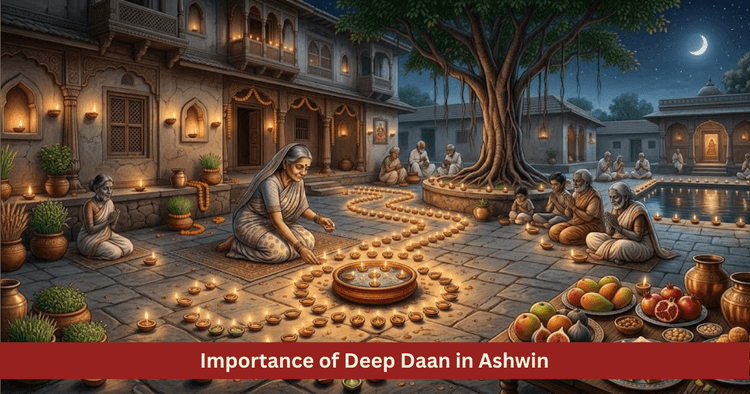
Table of Contents
Understand the Different Lamps First
Deep Daan during Ashwin month is regarded as a symbol of ancestral remembrance, Goddess worship, purification of the home and movement from darkness toward light. During Pitru Paksha, a lamp is lit in the name of ancestors. On Mahalaya Amavasya, Deep Daan is performed with a prayer for Pitru Visarjan and peace. During Sharad Navratri, an Akhand Jyoti or regular lamp is lit before the Goddess.
Yam Deep is mainly connected with Kartik Krishna Trayodashi, known as Dhanteras, in many North Indian traditions. Because month names differ between Amanta and Purnimanta calendars, some regional traditions connect it with Ashwin. therefore Yam Deep, Pitru Deep and Devi Deep should not be treated as one identical ritual. Their different purposes should be understood.
Primary Information About Deep Daan in Ashwin
- Pitru Deep: for remembrance of ancestors during Pitru Paksha
- Mahalaya Deep: for Pitru Visarjan and peace on Sarva Pitru Amavasya
- Peepal Deep: near a Peepal tree during evening with safety
- Home Deep: at the main entrance and worship area
- Devi Deep: before Goddess Durga during Navratri
- Akhand Jyoti: according to family tradition and safety arrangements
- Yam Deep: generally on Dhanteras evening according to regional Panchang
- Main materials: earthen lamp, ghee or sesame oil, cotton wick and flowers
- Core feeling: remembrance, protection, purification and gratitude
- Caution: keep lamps away from dry leaves, cloth and children
| Lamp | Time | Main Feeling |
|---|---|---|
| Pitru Deep | Evening during Pitru Paksha | Remembrance and peace for ancestors |
| Peepal Deep | Safe time after sunset | Respect for nature and ancestors |
| Home entrance lamp | Evening | Protection and auspiciousness |
| Devi Deep | Morning or evening during Navratri | Shakti and spiritual practice |
| Akhand Jyoti | Nine days of Navratri | Continuous devotion and resolve |
| Yam Deep | Dhanteras evening according to tradition | Remembrance of death and protection |
Spiritual Meaning of Deep Daan
The lamp is a symbol of light, consciousness and inner strength in Indian spiritual practice. When a person lights a lamp, the act reduces outer darkness and also expresses a resolve to recognise inner ignorance, fear and confusion.
During Pitru Paksha, the lamp carries gratitude toward ancestors. During Devi Paksha, the same lamp becomes a symbol of strength and inner awakening. In this way, Deep Daan in Ashwin becomes a journey from remembrance to strength and from strength to light.
Deep Daan does not mean that every difficulty will disappear automatically after lighting one lamp. Its deeper meaning is a resolve to bring light into conduct, home, thoughts and actions.
Five Symbolic Messages of the Lamp
- Victory of knowledge over ignorance
- Victory of faith over fear
- Victory of hope over disappointment
- Victory of self control over impurity
- Responsible living through remembrance of death
Deep Daan During Pitru Paksha
During Pitru Paksha, Tarpan, Shraddha, food charity and Deep Daan are performed for ancestors. Some families light a lamp every evening while others perform Deep Daan only on the death Tithi of an ancestor or Sarva Pitru Amavasya.
The purpose of Pitru Deep is not to provide physical light to ancestors. Its religious meaning is remembrance and a prayer for peace and spiritual progress. Psychologically, it may help a family connect with memories of departed loved ones and give grief a respectful direction.
Simple Method of Pitru Deep
- Prepare the lamp and worship place before evening.
- Take a clean earthen lamp.
- Add sesame oil or ghee according to family tradition.
- Place a cotton wick.
- Remember the name and Gotra of ancestors.
- Place the lamp in the worship area or a safe place in the south.
- Offer water, flowers and Akshat.
- Pray for ancestral peace and wisdom in the family.
- Donate food or clothing.
- Keep the place clean after the lamp goes out.
The south is traditionally connected with Yama and ancestors. Even so, choose the lamp location according to home structure, fire safety and family tradition. Do not place it near curtains, wood or dry leaves in the name of the south direction.
Deep Daan Under a Peepal Tree
The Peepal tree is regarded in Indian tradition as a sacred tree connected with Devas, ancestors and nature. Lighting a lamp under a Peepal tree during Pitru Paksha is followed in many regions.
The religious feeling of the Peepal lamp is connected with respect for ancestors, service to nature and patience associated with Saturn. Its shade and long life make it a symbol of continuity.
Method of Peepal Deep Daan
- Choose a safe time after sunset.
- Clean waste from around the tree.
- Put sesame oil or ghee in an earthen lamp.
- Place the lamp at a safe distance from the roots.
- Offer water, flowers and Akshat.
- Remember the ancestors.
- Pray calmly before the lamp.
- Perform circumambulation according to tradition.
- Do not hammer nails into the trunk.
- Do not tie plastic or synthetic items to the tree.
While offering water, do not make the soil muddy by pouring excessive amounts. Damaging a tree in the name of worship goes against the religious feeling.
Mahalaya Amavasya Deep Daan
Mahalaya Amavasya is regarded as the conclusion of Pitru Paksha. On this day, known and unknown ancestors are remembered collectively. It is especially important for ancestors whose death Tithi is unknown or whose Shraddha was missed.
Deep Daan on the evening of Mahalaya expresses Pitru Visarjan, peace and gratitude. Some families light lamps at the worship place, main entrance, near a Peepal tree or near a water source.
Feeling of Mahalaya Deep Daan
- Respectful farewell to ancestors
- Transformation of family grief into peace
- Gratitude toward the past
- Good conduct for future generations
- Hope and light in the home
Releasing lamps, plastic or worship materials into water harms the environment. If Deep Daan is performed near a river or lake, keep the lamp in a safe vessel and bring it back afterward.
Deep Daan During Devi Paksha
After Pitru Paksha, Sharad Navratri begins from Ashwin Shukla Pratipada. During Devi Paksha, the feeling of Deep Daan changes toward Shakti, spiritual practice and inner awakening.
Lighting a lamp before Goddess Durga in the morning or evening is an important part of regular Navratri worship. Some families light an Akhand Jyoti. It symbolises continuous practice, resolve and the grace of the Goddess.
Simple Method of Devi Deep
- Clean the worship area.
- Keep a lamp of ghee or sesame oil.
- Prepare a cotton wick.
- Light it before the image of Goddess Durga.
- Recite a Durga Mantra or Durga Chalisa.
- Offer flowers, Akshat and Naivedya.
- Protect the lamp from wind and children.
- Perform evening Aarti.
- Keep the worship area clean for nine days.
- Conclude the lamp respectfully after Navratri.
Decide in advance who will care for an Akhand Jyoti. An unattended lamp can cause a fire in the home.
Relation Between Yam Deep and Ashwin
Yam Deep is mainly connected with Dhanteras evening. Dhanteras is observed on Kartik Krishna Trayodashi, although regional calendar systems may show a difference in the month name. therefore Yam Deep should be understood separately from daily Deep Daan during the whole Ashwin month.
The feeling of Yam Deep is not to increase fear of death. It reminds a person of the inevitability of death and inspires a careful, righteous and responsible life. Some regions follow the custom of placing the lamp outside the home facing south.
General Method of Yam Deep
- Bathe and wear clean clothes on Dhanteras evening.
- Remember Ganesha and Yama Dev.
- Take an earthen lamp.
- Fill it with sesame or mustard oil according to tradition.
- Prepare thirteen lamps if the family tradition follows this method.
- Place the lamp outside in a safe south facing position.
- Pray for protection from untimely death and for long life.
- Maintain fire safety.
- Keep the lamp away from roads, vehicles and dry leaves.
Do not treat Yam Deep and Pitru Deep as the same ritual. Both may involve remembrance of death and safety but their festival and tradition are different.
Deep Daan from an Astrological View
In astrology, the Sun represents self strength and light, the Moon the mind and emotions, Mars fire and courage, Saturn karma and patience and Jupiter Dharma and knowledge. Deep Daan may become a symbol of balancing these planetary qualities.
Planetary Feelings of Deep Daan
- Sun: morning light and self strength
- Moon: mental peace and a white lamp feeling
- Mars: fire safety and courage
- Mercury: clear Mantra and discipline
- Jupiter: charity, Dharma and knowledge
- Venus: beauty of the home and Lakshmi grace
- Saturn: Peepal lamp, labour and karma
It is not appropriate to claim that Deep Daan alone will automatically remove planetary afflictions. Action, service and lifestyle improvement must accompany any planetary practice.
Psychological Side of Deep Daan
Lighting a lamp may steady the mind. Looking calmly at the flame, reciting a Mantra and remaining silent for a few moments can bring a person into the present moment.
Pitru Deep gives grief an expression. Devi Deep awakens hope and strength. Yam Deep inspires acceptance of the reality of death. In this way, the three lamps can develop remembrance, hope and responsibility in the mind.
Mental Benefits
- Concentration during worship
- A respectful direction for grief
- Reduction of fear
- Collective prayer in the family
- Hope and positivity
- Resolve for responsible living
These benefits should not be treated as medical treatment. Professional support is necessary during serious mental distress.
Practical Rules for Deep Daan in Ashwin
- Use a stable earthen or metal lamp.
- Keep the amount of oil or ghee moderate.
- Do not allow the wick to hang outside the lamp.
- Place it on a level heat resistant surface.
- Keep it away from children and animals.
- Protect it from strong fan air.
- Do not leave a burning lamp unattended.
- Keep paper, cloth and plastic away.
- Follow local rules in public places.
- Do not scatter ash and lamps as waste.
Charity and Service Along with Deep Daan
Deep Daan becomes more meaningful when joined with food, clothing, water and service. During Pitru Paksha, charity may be made in the name of ancestors. During Devi Paksha, Kanya Puja and Navratri charity may be performed. On Mahalaya, food service may be offered.
Useful Service
- Give food to a needy family.
- Offer clothing or medicine to an elder.
- Give a book to a student.
- Offer water and fruit to workers.
- Keep a water vessel for birds.
- Care for trees.
- Give lamps and ghee to a temple or service organisation.
- Support education of poor children.
What Should Be Avoided?
- Do not make Deep Daan a fear based remedy.
- Do not frighten anyone in the name of ancestors.
- Do not release lamps with plastic into rivers.
- Do not harm Peepal or other trees.
- Do not leave an Akhand Jyoti unattended.
- Do not treat Yam Deep as a compulsory daily ritual for all of Ashwin.
- Do not take debt in the name of charity.
- Do not create a fire hazard.
- Do not waste oil or ghee.
- Do not turn worship into display or competition.
Life Awakened Through Light
The tradition of Deep Daan in Ashwin moves from remembrance of ancestors to Goddess practice and remembrance of Yama. Pitru Deep teaches respectful attention to the past. Devi Deep awakens strength and hope in the present. Yam Deep reminds a person to remain careful about the future and the reality of death.
The flame is small but its message is wide. A lamp at the entrance symbolises protection and auspiciousness. A Peepal lamp expresses respect for nature and ancestors. A lamp before the Goddess represents spiritual practice and self strength. A lamp in the name of Yama reminds a person to live responsibly.
When Deep Daan is joined with service, truth, restraint, environmental care and gratitude, it creates a strong path toward facing life's difficulties. Problems do not disappear through outer remedies alone. Right decisions, caution, good conduct and remembrance of God together bring light into life.
FAQ
When should Deep Daan be performed during Ashwin month?
Pitru Deep may be lit during the evening of Pitru Paksha, special Deep Daan on Mahalaya Amavasya and regular Devi Deep during Navratri.
When is Yam Deep lit?
Yam Deep is mainly connected with Dhanteras evening. The month name may differ in regional calendars, so follow the local tradition.
Why is a lamp lit under a Peepal tree?
The Peepal lamp is regarded as a symbol of ancestral remembrance, respect for nature, patience connected with Saturn and movement from darkness toward light.
Does Deep Daan remove every difficulty?
Deep Daan may support spiritual peace, hope and discipline. Practical caution, medical care, financial planning and right decisions are also necessary.
How should an Akhand Jyoti be lit during Navratri?
Keep a stable ghee or sesame oil lamp in a safe place, assign someone to care for it and keep it away from children, cloth and flammable objects.
Get your accurate Kundali
Generate KundaliDid you like it?
Author
Pt. Nilesh Sharma (63)
Experience: 20
Consults About: Family Planning, Career
Clients In: Punjab, Haryana, Delhi
Share this article with friends and family
WELCOME TO
ZODIAQ
Right Decisions at the right time with ZODIAQ
