Ashwin Rain and Agricultural Strength
By Pt. Nilesh Sharma
Swati Nakshatra, soil moisture and Rabi crop guidance
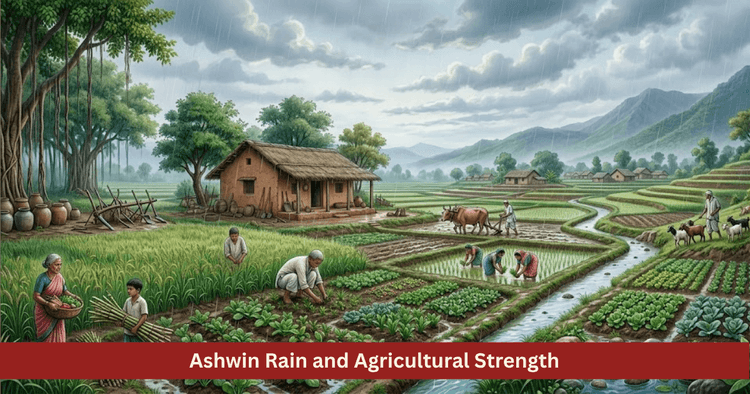
Table of Contents
When Sharad Drops Speak to the Fields
Indian agricultural tradition did not understand weather only through temperature and the quantity of rainfall. Farmers carefully observed the sky, clouds, wind, soil, birds, nakshatras and seasonal changes while planning cultivation. From this long experience came a well known saying, Ashwin water gives strength to grain.
Ashwin month comes between the final phase of the rainy season and the beginning of Sharad. Rain during this period can moisten the upper layer of the field, support the moisture remaining in the soil and prepare the land for the coming Rabi crops. Yet rainfall does not appear in the same way every year or in every region. In some places Ashwin rain is beneficial while in other places excessive rain can create difficulty during harvesting, storage or new sowing.
The drops of Swati Nakshatra hold a special place in Indian rural knowledge. Many agricultural traditions consider rain during Swati to bring subtle changes in nature. This does not mean that every shower during Swati Nakshatra will certainly be like nectar. The real benefit depends on rainfall quantity, soil condition, crop type, drainage and local weather.
Main Agricultural Signals in Ashwin
While planning agriculture during Ashwin month a farmer should not depend only on the Panchanga or a traditional belief. It is more appropriate to consider soil moisture, local weather forecasts, soil testing and crop needs together.
| Agricultural signal | Importance in Ashwin |
|---|---|
| Month | Ashwin |
| Seasonal change | Transition from rain toward Sharad |
| Main agricultural effect | Conservation of soil moisture |
| Coming crops | Wheat, gram, mustard, lentils and other Rabi crops |
| Beneficial rain | Light or moderate rain without waterlogging |
| Harmful condition | Continuous heavy rain, waterlogging and moisture during harvest |
| Traditional belief | Swati drops are considered beneficial for agriculture |
| Scientific caution | Observe rainfall quantity and field drainage |
Rabi crops are generally sown after the rainy season. In many regions fields are prepared around October and November. If enough soil moisture is present during this time seed germination may improve and the initial need for irrigation may decrease.
Why Is Ashwin Rain Useful for Rabi Crops?
Rabi crops grow in comparatively cool weather. Wheat, gram, lentils, mustard, peas and flax require balanced soil moisture at the time of sowing. Moisture received during the final phase of the rainy season may remain stored in the soil. This moisture can support seed germination and early root development.
Some major benefits of light Ashwin rain for farmers are as follows.
• Moisture remains in the upper soil layer
• Seeds receive water needed for germination
• The cost of early irrigation may decrease
• Biological activity in the soil receives support
• Ploughing and soil looseness may improve
• Timely sowing of Rabi crops becomes easier
• Water storage in ponds and wells may receive support
The final benefit depends on the type of rain. A few hours of balanced rain and strong rain continuing for several days have different effects. If the field has no drainage excessive water can harm wheat, gram and oilseed crops.
Traditional Meaning of Swati Rain
In Vedic astrology Swati Nakshatra is connected with independence, movement, the air element and subtle activity. Vayu is regarded as its presiding deity and its symbol is described through a delicate shoot moving in the wind or a seed carried by air. For this reason Swati represents a force that creates movement and expansion even in something that appears still.
Many sayings about Swati rain are found in agricultural folklore. Some say that Swati drops strengthen paddy. Others regard them as beneficial for late crops and soil moisture. These statements should be understood as part of long agricultural experience and not as a fixed rule that applies to every place and every year.
The period of Swati Nakshatra is not fixed in the civil calendar. Its position comes during a particular phase according to the Panchanga and the movement of the Sun but local weather may change. Therefore a farmer should not decide sowing or irrigation without examining the field simply because Swati Nakshatra is active.
A Balanced View of Swati Rain
| Traditional view | Practical agricultural view |
|---|---|
| Swati drops are considered auspicious | Observe the amount and duration of rainfall |
| Nakshatra gives an agricultural signal | Also check soil moisture and weather forecasts |
| Drops are described as nectar | Waterlogging can damage crops |
| It is a time of subtle natural change | Study local climate and crop cycles |
This balanced view preserves respect for tradition while allowing the farmer to use scientific caution.
The Science of Ashwin Moisture and Soil
Soil is not merely dust or sand. It is a living system of water, air organic matter, microorganisms and minerals. Light rain in Ashwin can help keep this system active. Raindrops enter the soil, join dry particles and create a moist environment for roots.
If the soil is extremely dry a sudden heavy shower may run away instead of entering the ground. If the land is already wet the same rain may create waterlogging. Therefore the value of Ashwin rain is decided not only by the number of drops but also by the receiving capacity of the soil.
A farmer can estimate field moisture through the following signs.
• Soil makes a light shape when pressed in the hand
• The upper layer is moist without standing water
• Cracks are not visible in the field
• Earthworms and biological activity are present
• Soil remains crumbly instead of sticking during ploughing
Soil testing gives more accurate information. Organic manure, crop residue and suitable tillage can improve the water holding capacity of the soil.
Effect of Ashwin Rain on Rabi Crops
The success of Rabi crops does not depend only on rainfall. Seed quality, sowing time, temperature, disease control, soil fertility and irrigation arrangements are equally important. Even so balanced Ashwin rain can create a useful base during the early stage.
Wheat
When moderate moisture is present before wheat sowing seed germination may improve. Excess moisture makes the soil sticky and creates difficulty during sowing. Waterlogging can reduce air movement around roots.
Gram
Gram does not tolerate excess water. Light moisture is beneficial but continuous rain or waterlogging can increase disease and root related problems. Drainage is especially important in gram fields.
Mustard
Moisture at the time of mustard sowing supports germination. Excess moisture can affect early plant growth. Timely weed control is also important in mustard fields.
Lentils and Peas
Lentils and peas require crumbly soil and limited moisture. The field should not be prepared in haste after rain. If the soil is too wet ploughing can damage its structure.
Flax
Flax requires both suitable moisture and good drainage. Plants may become weak if water remains in the field. Ashwin rain becomes beneficial only when the farmer has already arranged proper drainage.
Which Agricultural Tasks Should Farmers Perform?
Ashwin month can be a period for field preparation, moisture conservation and crop planning. Tasks will differ according to region and crop but several common precautions remain useful.
-
Check field boundaries and drainage channels
-
Plough after examining soil moisture following rain
-
Select certified and healthy seeds for Rabi crops
-
Plan manure and fertilizer according to soil testing
-
Do not operate heavy machines on extremely wet soil
-
Follow agricultural advice for seed treatment
-
Identify areas where water collects
-
Use crop residue in a balanced manner
-
Continue observing local information for sudden weather changes
-
Do not decide sowing time only through a traditional saying
During Ashwin the farmer should inspect the field in the morning or after the rain stops. Moisture does not remain equal in every part of a field. Higher areas may dry quickly while lower areas may retain water. One field may require more than one type of management.
What Precautions Are Needed After Excess Rain?
Considering Ashwin rain auspicious is useful only when the farmer also understands the harm caused by excess. Continuous rain can increase waterlogging, soil erosion, root rot and disease.
The following steps may be taken during excessive rain.
• Open additional drainage from the field without delay
• Keep channels free from soil and weeds
• Do not leave seeds or fertilizer in the open
• Store harvest ready crops in a safe and ventilated place
• Reduce unnecessary movement through the field
• Identify diseased plants separately
• Consult a local agricultural officer
• Begin the next task only after examining the soil when the weather clears
Immediate ploughing after heavy rain is not always suitable. Ploughing very wet soil can create a hard layer. This may later affect roots and water movement.
How Can Moisture Be Conserved When Rain Is Low?
If Ashwin receives little rain the farmer should focus on saving the moisture already available. Small field bunds, residue management and suitable tillage can support water conservation. Leaving the field completely open may increase evaporation.
The following practices help conserve moisture.
• Keep field boundaries strong
• Use crop residue wisely
• Control weeds at the right time
• Avoid turning the soil repeatedly
• Choose crops according to available water
• Maintain the correct sowing time
• Consider drip or sprinkler irrigation where possible
In areas with water shortage it is wiser to choose crops that need less water. Choosing a crop with high water demand only on the basis of tradition can become an economic risk.
Astrological Basis and Agricultural Signals
In Vedic astrology Surya, Chandra, Mangala, Shukra, Guru, Shani, Budha and Rahu Ketu are observed in relation to agricultural and weather signals. Surya represents season, heat and energy. Chandra is connected with moisture, sap and plant growth. Mangala indicates land, fire and agricultural labour. Shukra relates to water, fertility and a pleasant environment. Guru represents expansion, grain and protection. Shani can represent labour, delay, drought and difficult conditions.
Study of rain through nakshatras has been an old subject in Indian astrology and agricultural folklore. Ardra Pravesha has been observed as a signal of the rainy season. Later nakshatras have been used to estimate continuity of rain, pauses and effects on crops. This method is part of traditional and cultural knowledge. In modern agricultural planning it is better to combine it with local meteorology, soil testing and crop advice.
From an astrological view Ashwin rain may be considered supportive when water related factors, lunar strength and indications connected with land remain balanced. Even so a definite forecast of rainfall for a region cannot be made only by observing planetary positions. A farmer needs both observation of the sky and scientific information.
Meeting of Traditional Knowledge and Modern Agriculture
For centuries Indian farmers collected signs from nature. They observed when wind changed, when moisture remained in soil and when crop growth became stronger. This experience was preserved through sayings, songs and agricultural traditions.
Modern science studies these experiences through rainfall records, soil moisture, temperature, evaporation and crop production. The two views need not be treated as opponents. They can be seen as complementary. A traditional saying can give direction. Scientific observation can make the decision safer.
Balanced Decision Formula for Farmers
| Question | Practical consideration |
|---|---|
| Did rain occur | Check quantity and duration |
| Is the soil ready | Examine moisture by hand and inspect the field |
| Is it time for sowing | Check local agricultural advice and temperature |
| Is water collecting | Improve channels and drainage |
| Is Swati Nakshatra active | Treat it as a signal and not a fixed command |
| Is the crop at risk | Review seed, disease and water management |
Spiritual Meaning of Ashwin Rain
Agriculture is not only an economy. It is a relationship among earth, water, Sun, seed, animals, farmer and society. Ashwin rain reminds people of the delicate nature of this relationship. One drop can give life to a field. The same water can carry away soil if it is uncontrolled.
For this reason Indian tradition regards water as sacred. Insulting water means insulting the foundation of life. For the farmer water conservation is both religious action and economic wisdom. Pond, well, bund, channel and soil are all parts of the water cycle.
During Ashwin month the following water related resolves may be taken.
• Arrange for both drainage and water storage in the field
• Do not throw waste near ponds or wells
• Stop rainwater at a suitable place instead of allowing it to run away
• Use bunds and grass to prevent soil erosion
• Reduce water wastage during irrigation
• Organize community cleaning of village water sources
Farmer Families and Grain Culture
The spiritual importance of grain increases during Ashwin because of Navratri and Pitru Paksha. Grain stored in a home is not merely food. It is the result of ancestral labour, farmer effort, soil fertility and the grace of water. When the family respects grain through this feeling habits of saving and restraint also develop.
It is useful to teach children how many hands work to bring one grain from the field to the kitchen. This reduces food waste and increases respect for agriculture. In farmer families the traditions of saving seeds, protecting stored grain and respecting water must be carried to the next generation.
Is Every Ashwin Shower Beneficial for Grain?
No. The effect of Ashwin rain depends on the region, soil, crop and intensity of rainfall. Light rain can support Rabi preparation and soil moisture. Excessive rain can increase waterlogging, soil erosion and crop disease. Rain during harvest can affect grain quality and storage.
For this reason Ashwin water gives strength to grain is an agricultural observation and not a rule of blind belief. Its correct meaning is that balanced moisture received during seasonal change can give Rabi crops a strong foundation when combined with proper agricultural management.
Future Grain in the Moisture of the Earth
In Ashwin rain the farmer does not see only water. The farmer sees coming sowing, seed germination, family food and the economic security of the village. Tradition expressed this experience through Swati Nakshatra and the language of nectar like rain. Agricultural science explains it through soil moisture, weather cycles and crop production.
The essence of both views is the same. Water should be respected. Rain should be used wisely. The farmer should read the signs of the sky together with the actual condition of the earth. Ashwin water becomes strength for grain only when balance, labour, conservation and correct timing come together in the field.
FAQ
Why is Ashwin rain important for Rabi crops?
Balanced Ashwin rain can preserve soil moisture and support seed germination and early growth of Rabi crops. Its effect depends on local conditions.
Is rain during Swati Nakshatra considered like nectar?
Indian agricultural folklore considers Swati drops auspicious and useful. Actual agricultural benefit depends on rainfall quantity, soil, drainage and crop condition.
Which Rabi crops are sown in Ashwin?
According to the region farmers prepare or sow wheat, gram, mustard, lentils, peas and flax. The correct time should be decided according to local agricultural guidance.
Can excessive Ashwin rain harm crops?
Yes. Continuous heavy rain can cause waterlogging, soil erosion, root rot and disease. Proper drainage is essential.
What does Vedic astrology say about Ashwin rain?
Vedic astrology connects Surya, Chandra, Mangala, Shukra, Guru and Shani along with nakshatras with seasonal, water, land and agricultural signals. Weather and soil information are also necessary for definite agricultural decisions.
Get your accurate Kundali
Generate KundaliDid you like it?
Author

Pt. Nilesh Sharma (63)
Experience: 20
Consults About: Family Planning, Career
Clients In: Punjab, Haryana, Delhi
Share this article with friends and family
WELCOME TO
ZODIAQ
Right Decisions at the right time with ZODIAQ
