Sacred Mahavidya Nights of Ashwin Month
By Pt. Amitabh Sharma
Sattvic path to the ten Mahavidyas for householders
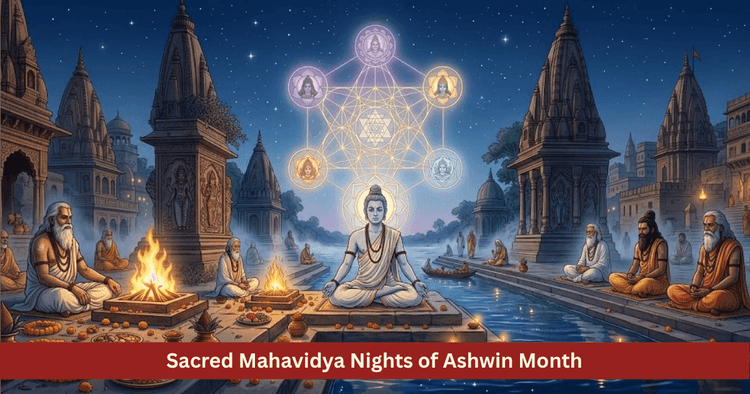
Table of Contents
When Power Awakens After the Dark Moon
The month of Ashwin is regarded in the Hindu calendar as a period when nature itself appears to lean toward sadhana. The rainy season has already withdrawn. The sky becomes comparatively clear. The digits of the moon begin to appear distinct again. Along with this subtle change the activity of the Devi tattva also increases. In the tantra shastra the nights of the Navratri of Ashwin month are called Siddha Ratris. Sadhana performed in these nights is considered to yield fruit more swiftly than sadhana done on ordinary days.
This is not merely popular belief. Vedic astrology and tantra both agree that when the sun moves near the transition from Kanya toward Tula and the moon connects with Devi related lunar mansions in the tithis of Ashwin the concentration of the mind becomes natural. For the householder this time is an outer festival. For the sadhaka this same time becomes a doorway of inner awakening. The path of receiving the grace of the ten Mahavidyas including Kali, Tara and Tripurasundari is not kept limited only to severe tantric practitioners. With sattvic discipline and the guidance of a guru an ordinary householder may also receive the benefit of these nights.
Ashwin Siddha Night: Tithi, Time and Basic Rules
Sharadiya Navratri is observed from the Shukla Pratipada of Ashwin until Navami. Dashami becomes the celebration of victory. From the tantric viewpoint the middle portion of the night is especially powerful because the senses grow quiet and the mind remains less bound to outer noise.
| Detail | Explanation |
|---|---|
| Period of Ashwin Navratri | From Shukla Pratipada to Shukla Navami |
| Most powerful nights | Saptami, Ashtami, Navami and the sandhi period |
| Paksha | Shukla paksha |
| Main purpose | Devi grace, freedom from fear, purity of speech, prosperity and the path of moksha |
| Path for the householder | Sattvic japa, vrata, dana, reading of the Saptashati, meditation |
| Fundamental caution | No fierce practice without a guru, no violence, no pride |
The following basic rules are considered worthy of observance during these nights.
- Bathe in brahma muhurta or in a quiet watch of the night and wear clean clothes
- Keep sattvic food and remain away from substances that increase tamas
- Keep the asana steady and face the east or the north
- Fix the number of mantra repetitions in advance so that the mind does not become restless
- Do not turn the matter of sadhana into a subject of display
- Remain away from anger, untruth and censure because the Devi tattva stabilizes more in a pure mind
What Is Called a Siddha Ratri?
A Siddha Ratri is that period when the resolve of the sadhaka, the vibration of the mantra and the cooperation of time meet at one point. Tantra texts state that the nights of Navratri open the door for the descent of Shakti. During the day worldly conduct continues. At night consciousness turns inward. For this reason japa, homa, yantra worship and meditation are considered more fruitful in these very nights.
The special quality of the month of Ashwin is that this festival is both public and esoteric. Outside there is worship of the nine forms of Durga. Within, the secret of the ten Mahavidyas opens. Both streams belong to the same Adishakti. The difference is only of viewpoint. The devotee asks with love. The sadhaka asks with the balance of knowledge and power. The householder can walk by uniting both if restraint and faith are kept as the foundation.
Who Are the Ten Mahavidyas and Why in Ashwin?
Mahavidya means the power that grants great knowledge. These ten forms are regarded as ten doorways of Adimaya. Each form touches one level of life. Fear, speech, beauty, expansion, renunciation, austerity, dispassion, stambhana, art and prosperity. When these ten currents become balanced the sadhaka does not remain fragmented. That person moves toward wholeness.
Worship of these forms is considered special in Ashwin because in the Sharadiya season nature itself returns toward balance. The excess of heat and rain lessens. Body and mind both become capable of bearing sadhana. From the astrological view this period mixes lunar strength and the gentleness associated with Shukra with the clarity of Surya. The result is that the sadhaka can remain emotional and disciplined at the same time.
Order and Essence of the Ten Mahavidyas
| Order | Mahavidya | Core essence | Indication for the householder |
|---|---|---|---|
| 1 | Kali | Devouring of time and fear | Destruction of fear, anxiety about time and ego |
| 2 | Tara | Deliverance and speech | Crossing crisis, power of the right word |
| 3 | Tripurasundari | Beauty and harmony | Love, attraction and inner balance |
| 4 | Bhuvaneshwari | Expansion of the worlds | Self confidence, place and influence |
| 5 | Chinnamasta | Sacrifice of the ego | Cutting of bad company, sharp discernment |
| 6 | Tripurabhairavi | Austerity and radiance | Discipline, courage, continuous practice |
| 7 | Dhumavati | Void and dispassion | Falling away of attachment, wisdom from sorrow |
| 8 | Bagalamukhi | Stambhana | Stopping of hostile obstacles, control of speech |
| 9 | Matangi | Art and thought | Learning, music, clear expression |
| 10 | Kamala | Lakshmi tattva | Wealth, good fortune, stable prosperity |
Among these the current of the Kali kula is considered more fierce and transformative. The current of the Sri kula is joined with beauty, prosperity and gradual development. For the householder sattvic worship of Kali and Tara along with the Sri kula is also possible if the feeling is of compassion and surrender and not of display.
Kali, Tara and Tripurasundari: Three Entrance Doors
In the tantric tradition three Mahavidyas are often regarded as the first entrance doors. Kali breaks the fear of time. Tara draws one out from the darkness of ignorance. Tripurasundari fills beauty and balance in the three worlds or the three states. If during the Siddha nights of Ashwin the sadhaka remains focused only on these three a deep change in life is still possible.
The sadhana of Kali for the householder need not be through fierce cremation ground methods. It can be done with a lamp, with the mere feeling of dark or deep blue cloth and with compassionate japa. Mother Kali swallows time. Its psychological meaning is the removal from the mind of both the guilt of the past and the terror of the future. When the sadhaka sits steady at night, watches the breath and repeats the name of Kali the racing of the mind slows down.
Tara is the one who delivers. Like a boatman she takes one across the ocean of worldly existence. Impurity of speech, falsehood and the fault of harsh words are considered correctable through Tara sadhana. If a householder takes a daily vow of sweet and truthful speech and remembers Tara coolness enters relationships.
Tripurasundari is also known in the form of Shodashi. The name indicates the completeness of sixteen kalas. Beauty is not only outer. Beauty of thought, beauty of conduct and beauty of the atmosphere of the home also come within this grace. In Ashwin when homes are cleaned, light burns at the doorway and the mind fills with festival the tattva of Tripurasundari becomes active in a natural way.
Life Application of the Remaining Mahavidyas
Bhuvaneshwari is the sovereign of all worlds. Her meditation grants expansion. A person of contracted thinking cannot see opportunity. In Bhuvaneshwari sadhana the sadhaka prays that vision may become large and the heart may not remain small.
The form of Chinnamasta is intense. She appears giving power after severing her own head. Its deep meaning is the dissolution of ego. In household life its application is that wrong habit, harmful relationship and useless pride be cut with courage. Even without fierce outer ritual this inner cutting is possible.
Tripurabhairavi is the presiding deity of austerity. Without discipline no knowledge becomes stable. If every night of Ashwin is kept safe for japa at a fixed time Bhairavi becomes pleased. Her boon turns discipline into love.
Dhumavati is described in widow form. Her smoke like appearance creates the understanding that maya is momentary. In days of sorrow Dhumavati comes to remind that dispassion is also grace. For the householder its message is that when loss comes one should not drown in lament but should take the essence.
Bagalamukhi stuns the speech and movement of the hostile force. Her grace is sought in court, dispute, false accusation and crisis born of speech. In the sattvic sense this means control over one own tongue and remaining firm before injustice.
Matangi is joined with thought, music, writing and speech of the assembly. Students, artists and speakers can gain clarity of intellect through Matangi japa on the nights of Ashwin.
Kamala is the Lakshmi tattva. The lotus blooms in mud yet does not become stained. Let prosperity come yet let the mind not become impure. This is the lesson of Kamala. In the final phase of Navratri the worship of Kamala is considered a sign of stable Lakshmi in the home.
Sattvic Tantric Practice for the Householder
Upon hearing the word tantra many people fall into fear or confusion. In truth the root meaning of tantra is a method that expands. Mantra, yantra and samadhi together become tantra. For the householder sattvic tantra alone is the suitable path. In it there is no insistence on wine and meat. In it purity of mind, respect for the guru, truth and compassion are compulsory.
Sattvic Daily Order
- At evening time light a lamp and remember the family goddess or Durga
- Choose one Mahavidya and perform japa of a fixed number
- Read one chapter of the Durga Saptashati or the Kavacha
- Perform nirajana and silent meditation for a few minutes
- Repeat the resolve for the next day
Possible Emotional Order of the Nine Nights of Ashwin
Many acharyas join the nine days of Navratri with the Navadurga. From the Mahavidya view also a sequence can be made so that the sadhaka does not become confused.
| Night | Emotional centre | Suggested remembrance |
|---|---|---|
| First | Freedom from fear | Kali |
| Second | Deliverance | Tara |
| Third | Beauty and love | Tripurasundari |
| Fourth | Expansion | Bhuvaneshwari |
| Fifth | Sacrifice of ego | Chinnamasta |
| Sixth | Austerity and radiance | Tripurabhairavi |
| Seventh | Sense of dispassion | Dhumavati |
| Eighth | Stambhana of obstacles | Bagalamukhi |
| Ninth | Learning and speech | Matangi |
| Dashami festival | Stability of prosperity | Kamala |
This sequence is not a compulsion but a direction. The sadhaka whose guru tradition is different should keep that tradition primary.
Astrological Reasoning: Why Sadhana Fruits in Ashwin
In Vedic astrology the moon is the mind. Navratri rests on the lunar tithi cycle. When the bright fortnight increases the light of the mind is also considered capable of increase. In the month of Ashwin the sun often remains near the Kanya Tula junction. Kanya gives analysis and purification. Tula gives balance and relationship. Both qualities assist sadhana.
From the nakshatra view if at night the moon is in lunar mansions joined with the Devi then japa becomes even more subtle. Yet the sadhaka should not hold the illusion that fruit will come by only watching yogas without faith. Yoga opens the door. Walking still has to be done by the sadhaka. For natives under hard effects of Shani and Rahu the sadhana of Kali and Tara is considered special support because these forms cut the fear of time and the net of delusion. Natives afflicted in matters of Shukra and Chandra can receive coolness from Tripurasundari and Kamala. In speech faults related to Budha, Matangi and Tara are said to be helpful.
Narrative Element: From Sati to the Mahavidyas
The Puranic story says that when Sati was insulted in the sacrifice of Daksha and Shiva tried to stop her she assumed the ten Mahavidya forms in the ten directions. Wherever Shiva went the Mother stood there. The feeling of this account is that Shakti cannot be avoided. Upon the insult of truth Shakti rebels. In the sadhana of Ashwin this story is worthy of remembrance. Sadhana is not for running away but for remaining steady upon truth. When insult, loss or injustice comes in life the Mahavidyas remind that the Adishakti within is still awake.
Psychological Angle: Why Night Sadhana Changes the Mind
In contemporary language one may say that at night outer stimulation is less. The restlessness of the brain decreases. The breath becomes deep. The repetition of japa gives one rhythm to the nervous system. Memories of fear slowly loosen. In Ashwin the social festival also fills the mind with hope. Both together create an effect similar to healing.
Kali sadhana brings suppressed anger and fear into consciousness and calms them by giving them a name. Tara becomes support in depression and loneliness. Tripurasundari washes self contempt with the sense of beauty. Dhumavati gives meaning to the pain of loss. Kamala opens the knot of scarcity. In this way the ten Mahavidyas are also ten psychological doorways.
What to Do and What Not to Do
Do
- Receive the mantra from a guru or from the pure tradition of the family
- Keep punctuality of time
- Keep the body clean and the mind humble
- Join sadhana with social compassion through dana and kanya pujan
- Do not make the mind impatient by fixing a date for the result
Do not
- Do not perform fear spreading fierce practices without an authorized guru
- Do not take a resolve to cause harm to anyone through sadhana
- Do not mix meat, liquor and forbidden food into the sattvic path
- Do not nurture pride over the count of japa
- Do not turn the Devi into a medium of bargaining
Balanced Use of Homa, Yantra and Mala
If the householder keeps a yantra a genuine seed yantra may be kept wrapped in red cloth in a clean place. Flowers, unbroken rice and a lamp each day are sufficient. Homa is not compulsory. Those who can may perform a small homa on Navami or Vijayadashami with cow ghee and sattvic materials. The mala may be of rudraksha, tulasi or sphatika. For Kali and Tara a mala of deep colour is considered suitable to the mood. Do not keep the mala in an impure place and during japa keep the mind fixed on the mantra and not only on the movement of the fingers.
Equal Door for Woman and Man Sadhakas
In Mahavidya worship gender difference is not an obstacle. For the woman sadhika these forms are the recognition of inner power. For the man sadhaka these forms are respect toward Prakriti and the compassion of the inner self. If in Ashwin the family sits together and performs simple japa the atmosphere of the home itself becomes a yantra. It is proper to give children the understanding of the protection of the Mother and not stories of fear.
Obstacles in Sadhana and Their Resolution
Sleep coming on, the wandering of the mind, sudden anger and haste for results are common obstacles. The solution is to begin with a short sitting. Even fifteen minutes of steadiness is valuable. If there is illness do not insult the body. Medicine and rest are also part of the arrangement of the Devi. If dreams become intense do not become frightened. Dreams can also be the cleaning of the mind. If greater disturbance is felt it is enough to reduce japa and keep only name remembrance and the lighting of the lamp.
The Meeting of Bhakti and Tantra
Sharadiya Navratri proves that bhakti and tantra are not enemies. Kirtan is bhakti. Japa is the spine of tantra. The meeting of both is naturally possible in the night of Ashwin. Going to the temple and performing arati and returning home for silent japa are two banks of the same stream. The one who seeks only miracle becomes tired. The one who asks for character receives grace.
Let the Inner Night Grow Steady in the Mother Shadow
The Siddha nights of Ashwin are not merely nine nights of the calendar. They are that opportunity within the sadhaka when darkness becomes educated. The journey from Kali to Kamala is the journey from fear to prosperity. Yet prosperity does not mean only wealth. Prosperity is that state when the mind does not break, speech does not spoil and the heart does not become cruel toward any being. If the householder adopts sattvic japa, pure diet, dana and silence in these nights the grace of the ten Mahavidyas descends into life even without the noise of events. Shakti is always near. What is required is only that the night awaken and the sadhaka do not sleep.
FAQ
What are called the Siddha nights of the month of Ashwin?
In the tantra shastra the nights of the Shukla Navratri of Ashwin are called Siddha nights because in these nights Devi sadhana is considered more swiftly fruitful than on ordinary days.
What are the names of the ten Mahavidyas?
The ten Mahavidyas are Kali, Tara, Tripurasundari, Bhuvaneshwari, Chinnamasta, Tripurabhairavi, Dhumavati, Bagalamukhi, Matangi and Kamala.
Can an ordinary householder perform Mahavidya sadhana?
Yes. A householder can receive Mahavidya grace through sattvic method by japa, meditation, reading of the Saptashati, offering of lamps and restraint. Fierce practices should not be done without a guru.
Which night is considered most powerful in Ashwin Navratri?
Saptami, Ashtami, Navami and the sandhi period of Ashtami and Navami are considered especially powerful. Even so faith and regularity make any night siddha.
What is forbidden in sattvic tantric sadhana?
Violence, the resolve to cause harm to anyone, consumption of forbidden food, display, untruth and fierce ritual without a guru are considered forbidden on the sattvic path.
Get your accurate Kundali
Generate KundaliDid you like it?
Author

Pt. Amitabh Sharma (56 Years)
Experience: 20
Consults About: Family Planning, Career
Clients In: Punjab, Haryana, Delhi
Share this article with friends and family
WELCOME TO
ZODIAQ
Right Decisions at the right time with ZODIAQ
