Durga Saptashati and Navratri Recitation
By Pt. Suvrat Sharma
Complete method for 13 chapters, 700 verses, Kavach, Argala and Keelaka
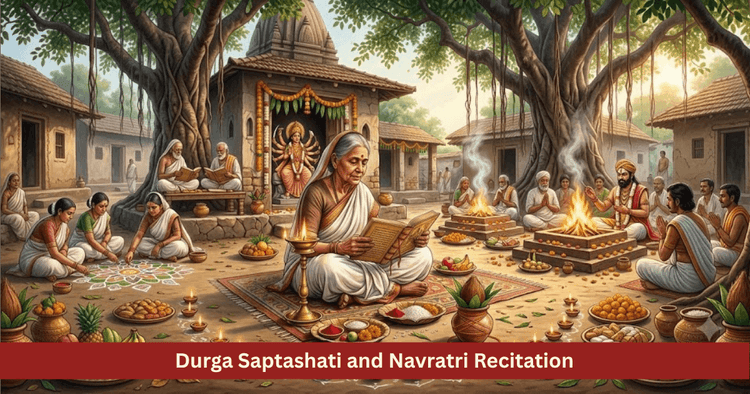
Table of Contents
Know the Recitation Sequence First
Sharad Navratri is considered a special period for worshipping Goddess Durga. During this time, Durga Saptashati, also called Devi Mahatmya and Chandi Path, is recited with devotion and discipline. The text is regarded as an important part of Markandeya Purana and describes the glory of Shakti, victory over demonic forces and protection of devotees.
Durga Saptashati contains 13 chapters and is traditionally regarded as having 700 verses. Some people call them 700 Mantras, but it is more accurate to call them 700 verses. The tradition of reciting Devi Kavach, Argala Stotram and Keelaka Stotram before beginning the main text is widely followed. These three parts are associated with protection, divine grace and removal of obstacles.
Sharad Navratri 2026 Recitation Information
- Navratri begins: 11 October 2026
- Ghatasthapana: 11 October 2026
- Ashtami: 19 October 2026
- Navami: 20 October 2026
- Vijayadashami: 20 October 2026
- Main text: Devi Mahatmya or Durga Saptashati
- Chapters: 13
- Verses: traditionally 700
- Before recitation: Devi Kavach, Argala and Keelaka
- After recitation: forgiveness prayer, Aarti, Havan or Kanya Puja
- Suitable time: morning or evening according to local worship sequence
- Central feeling: removal of fear, inner strength, Dharma and surrender to the Goddess
| Part of Recitation | Main Meaning | Feeling in Practice |
|---|---|---|
| Devi Kavach | Protective covering of the Goddess | Protection and fearlessness |
| Argala Stotram | Prayer for grace and accomplishment | Blessings and heartfelt wishes |
| Keelaka Stotram | Symbolic removal of obstacles in recitation | Concentration and removal of blocks |
| Ratri Sukta | Meditation on primordial Shakti | From darkness to light |
| Devi Mahatmya | Glory and victory of the Goddess | Strength and Dharma |
| Forgiveness prayer | Humility for errors in recitation | Surrender and pure feeling |
Spiritual Nature of Durga Saptashati
The central message of Durga Saptashati is that strength is not only a means of outer victory. The Goddess is also present within a person as discernment, courage, compassion and self control. The stories of Mahishasura, Shumbha, Nishumbha, Raktabija and other demons hold symbolic meanings connected with different inner tendencies.
Mahishasura may represent inertia and ego, Raktabija the negativity that multiplies continuously, Chanda and Munda violent thoughts and Shumbha and Nishumbha the ego of authority and ownership. The battle of the Goddess teaches that outer circumstances are not the only obstacles in life. Fear, laziness, greed and confusion within can become equally powerful opponents.
Main Life Messages of the Recitation
- Strength must remain joined with wisdom.
- Victory should be accompanied by humility.
- Fear can be faced through knowledge.
- Negative habits must be recognised.
- Dharma is not only an idea. It is conduct.
- Regular practice is more important than display of results.
- Goddess grace becomes deeper through improvement in action and character.
Brief Meaning of the 13 Chapters
The 13 chapters of Durga Saptashati are divided into three Charitras. The first chapter is called the Prathama Charitra, chapters 2 to 4 form the Madhyama Charitra and chapters 5 to 13 form the Uttama Charitra.
Chapter 1
The first chapter introduces King Suratha and the merchant Samadhi. Both are troubled by loss and attachment. They approach Sage Medha and hear about the power of Devi Mahamaya.
The chapter describes the destruction of Madhu and Kaitabha. Lord Vishnu is in Yog Nidra and awakens through the power of the Goddess before defeating the demons. This chapter symbolises victory of awareness over ignorance, attachment and mental dullness.
Chapter 2
The second chapter describes the victory of Mahishasura over the Devas and their expulsion from heaven. The Goddess appears from the combined radiance of the Devas. Each Deva presents divine power and a weapon to her.
This chapter gives the message of collective strength. When Dharma is in danger, different abilities must be joined in one direction.
Chapter 3
The third chapter describes the battle between the Goddess and Mahishasura. Mahishasura changes into many forms and is finally defeated by the Goddess.
Mahishasura may be understood as changing ego and an unstable mind. When a person does not accept mistakes, the person keeps changing forms through excuses. The victory of the Goddess represents truth and self awareness.
Chapter 4
The fourth chapter contains the praise of the Goddess by the Devas. She is described as the foundation of the universe and the form of knowledge, compassion and protection.
This chapter is important because it clearly expresses gratitude between devotee and Goddess. A devotee should remember the Goddess not only during difficulty but also in gratitude for grace.
Chapter 5
The fifth chapter continues the story of Shumbha and Nishumbha. Their messenger approaches the Goddess and offers her the wealth of the demon kings. The Goddess preserves her independent nature and self respect.
This chapter teaches that Shakti cannot be controlled through greed, authority or outer attraction. Self respect and independent awareness are also parts of divine power.
Chapter 6
The sixth chapter describes the destruction of Dhumralochana. The name Dhumralochana may be understood as a vision covered by smoke.
When the smoke of confusion and anger covers the mind, truth cannot be seen clearly. The power of the Goddess symbolises removal of this haze and clarity in decision making.
Chapter 7
The seventh chapter describes the destruction of Chanda and Munda. The fierce form of the Goddess known as Chamunda is connected with this episode.
Chanda and Munda symbolise cruelty, violence and uncontrolled thoughts. This chapter teaches that compassion does not mean tolerating injustice. Necessary firmness can also become part of spiritual practice.
Chapter 8
The eighth chapter describes Raktabija. Every drop of his blood creates another demon. Goddess Kali stops his power and brings his destruction.
Raktabija symbolises problems that keep increasing when neglected. One negative thought can become many thoughts if it is not managed in time. The message is to work on the root cause.
Chapter 9
The ninth chapter describes the battle between the Goddess and Nishumbha. Nishumbha may be connected with attachment, ownership and the tendency to consider the self supreme.
When a person treats relationships, objects and positions as personal identity, insecurity begins to arise. The Goddess represents freedom from this bondage and recognition of the true Self.
Chapter 10
The tenth chapter describes the destruction of Shumbha. Shumbha may be understood as ego, authority and the feeling of personal superiority.
The Goddess shows that Shakti appears in many forms but has one source. A person's talent and success also develop through many people, circumstances and divine grace. Therefore, achievement must remain joined with humility.
Chapter 11
The eleventh chapter contains the Narayani Stuti offered by the Devas. The Goddess is seen as consciousness, strength, intellect, sleep, hunger and compassion present in all beings.
This chapter expresses the omnipresence of the Goddess. A devotee should understand that Shakti is present not only in a temple but also in every being, action and responsibility.
Chapter 12
The twelfth chapter contains the description of the merit of Devi Mahatmya. It describes the fruits of recitation, worship and devotion.
The purpose of the Phalashruti is not only to promise fulfilment of wishes. It inspires devotion, regularity and righteous living. The fruit of recitation should appear in character, thought and action.
Chapter 13
The thirteenth chapter describes King Suratha and the merchant Samadhi worshipping the Goddess. The Goddess grants each one a boon according to personal feeling. The king receives his kingdom and the merchant receives self knowledge.
This chapter teaches that every devotee does not have the same desire. One person seeks worldly stability while another seeks spiritual freedom. The Goddess gives direction to both paths.
Kavach, Argala and Keelaka Before Recitation
In the tradition of Durga Saptashati recitation, Devi Kavach, Argala Stotram and Keelaka Stotram hold special importance. Together they are known in some traditions as the opening parts of the Trayangam method.
Devi Kavach
Kavach means a protective covering. Devi Kavach contains prayers for protection of different parts of the body and directions through the power of the Goddess. Its psychological meaning is that the devotee resolves to protect body, mind, speech and action through awareness.
Argala Stotram
Argala may be understood as a force that opens a door or removes an obstacle. Argala Stotram includes prayers for victory, good fortune, knowledge, health and the grace of the Goddess.
Keelaka Stotram
Keelaka is connected with the idea of a lock or binding. Keelaka Stotram carries the feeling of removing inner hesitation, obstruction and fear connected with the recitation.
The tradition is to recite these three parts before beginning Durga Saptashati. Some traditions also include Devi Sukta, Ratri Sukta, Nyasa and other parts.
Simple Method of Durga Saptashati Recitation
Preparation Before Recitation
- Bathe and wear clean clothes.
- Wear red, yellow or another clean light colour.
- Clean the worship area.
- Spread red cloth on a platform.
- Place the Durga Saptashati book on it.
- Do not hold the book in the hands throughout the recitation.
- Establish the image, picture or Kalash of the Goddess.
- Light a lamp and incense.
- Remember Ganesha and the teacher.
- Keep the resolve clear.
Order of Recitation
- Recite the purification Mantra.
- Meditate on the Goddess.
- Recite Devi Kavach.
- Recite Argala Stotram.
- Recite Keelaka Stotram.
- Recite Ratri Sukta according to tradition.
- Recite all 13 chapters of Durga Saptashati.
- Chant the Navarna Mantra if the tradition includes it.
- Recite the forgiveness prayer.
- Offer the recitation to the Goddess.
- Perform Aarti and distribute Prasad.
The purification Mantra expresses the feeling that remembrance of Vishnu purifies the outer and inner self. Learning correct pronunciation is appropriate.
One Day Recitation Method
A capable devotee may recite all 13 chapters in one day. In this method, the required Stotras are recited before the main text and the recitation is followed by the forgiveness prayer and offering to the Goddess.
During one day recitation, unnecessary pauses should be avoided. If it becomes necessary to stop, pause at a suitable point according to tradition and remember the Goddess again when restarting.
Three Day Recitation Method
Those who cannot complete the full text in one day may follow a three day plan.
- First day: Chapter 1
- Second day: Chapters 2, 3 and 4
- Third day: Chapters 5 to 13
This division is based on the Prathama, Madhyama and Uttama Charitras. Follow the tradition of Kavach, Argala, Keelaka and the forgiveness prayer at the beginning and end.
Seven Day Recitation Method
A seven day plan may be useful for devotees who wish to give limited time each day.
- First day: Chapter 1
- Second day: Chapters 2 and 3
- Third day: Chapter 4
- Fourth day: Chapters 5, 6, 7 and 8
- Fifth day: Chapters 9 and 10
- Sixth day: Chapter 11
- Seventh day: Chapters 12 and 13
Havan, forgiveness prayer and Kanya Puja may be performed afterward according to family tradition.
Nine Day Recitation Method
It is also possible to recite a portion of the text each day during the nine days of Navratri. Since the chapters differ in length, equal quantity every day is not necessary.
Simple Nine Day Plan
- First day: Chapter 1
- Second day: Chapter 2
- Third day: Chapters 3 and 4
- Fourth day: Chapter 5
- Fifth day: Chapters 6 and 7
- Sixth day: Chapter 8
- Seventh day: Chapters 9 and 10
- Eighth day: Chapter 11
- Ninth day: Chapters 12 and 13
If a tradition prescribes completing one full recitation in nine days, divide the chapters according to the Acharya. Sequence, devotion and regularity remain central.
Rules and Precautions
- Bathe and wear clean clothes before recitation.
- Place the book on a clean platform.
- Avoid unnecessary conversation during recitation.
- Keep pronunciation clear and balanced.
- Do not recite too fast or too slowly.
- Do not hold hatred toward anyone during recitation.
- Avoid meat, alcohol, intoxicants and Tamasic food during Navratri.
- Avoid onion and garlic according to family tradition.
- Maintain lamp and fire safety.
- Recite the forgiveness prayer after completion.
- Do not turn recitation into a display or competition.
- Learn difficult Mantras from a qualified teacher.
What If an Interruption Occurs?
If an interruption occurs during recitation, there is no need to panic. Bow calmly to the Goddess and complete the chapter or section according to tradition.
If health, a guest, an emergency or another necessary reason requires the recitation to stop, take a proper pause. Honesty and humility are more important in Goddess practice than fear.
Havan and Kanya Puja After Recitation
Havan may be performed after Durga Saptashati recitation. Ghee, barley, sesame, rice and Havan materials are offered into the sacred fire. Swaha is spoken at the end of the prescribed Mantra with each offering.
Kanya Puja is also performed on Ashtami or Navami. Young girls are respected as child forms of the Goddess and offered food, fruit, sweets, Dakshina and useful items.
Steps for Completing the Recitation
- Recite the forgiveness prayer.
- Offer the recitation to the Goddess.
- Perform Havan if the tradition includes it.
- Offer Purnahuti.
- Perform Kanya Puja.
- Offer food or charity to a needy person.
- Perform Aarti and distribute Prasad.
Durga Saptashati and Success in Life
Success in Durga Saptashati does not mean only money, position or outer victory. True success means remaining steady in fear, humble with strength and responsible with achievement.
Recitation disciplines the mind. The 13 chapters repeatedly remind the devotee that victory over ignorance, ego and fear is not possible without self observation. When the devotee observes personal conduct while reading the stories, the text becomes a means of transformation.
Possible Benefits of Recitation
- Increased concentration
- A feeling of reduced fear and stress
- Regularity and discipline
- Spiritual inner strength
- A devotional atmosphere in the family
- Recognition of negative habits
- Inspiration toward service and charity
- Ability to make righteous decisions
These benefits are better understood as mental and spiritual impressions developed through practice rather than as guaranteed miracles.
Astrological Feeling of the Recitation
Sharad Navratri occurs during Shukla Paksha. The waxing Moon is regarded as a symbol of the growth of mind and consciousness. The Sun represents self strength, Mars courage, Jupiter Dharma and the Moon devotion and emotional stability.
Durga Saptashati recitation may become a spiritual method of balancing these planetary qualities. The number of recitations for a planetary difficulty should not be fixed without studying the birth chart.
Spiritual Feelings Connected with Planets
- Sun: self strength and leadership
- Moon: mental peace
- Mars: courage and protection
- Mercury: clear speech and intellect
- Jupiter: Dharma and knowledge
- Venus: beauty and sweetness in relationships
- Saturn: discipline and service
From Peace to Strength
The 13 chapters of Durga Saptashati are not only stories of the destruction of demons. They are a mirror of the struggle within a human being. Every story from Madhu and Kaitabha to Shumbha and Nishumbha offers an opportunity to reflect on ego, attachment, inertia, anger and confusion.
Reading Devi Kavach, Argala and Keelaka before beginning the text is an important part of many Navratri traditions. The forgiveness prayer after recitation creates humility. Havan offers action into the sacred fire. Kanya Puja awakens compassion and charity joins spiritual practice with society.
When the recitation of Saptashati becomes audible not only in words but also in conduct, the secret of success begins to open. Restraint during anger, courage during fear, compassion along with strength and humility during achievement are the true forms of Goddess grace.
FAQ
How many chapters and verses are in Durga Saptashati?
Durga Saptashati contains 13 chapters and is traditionally regarded as having 700 verses. It is also called Devi Mahatmya and Chandi Path.
Should Kavach, Argala and Keelaka be read before Durga Saptashati?
Many traditions consider Devi Kavach, Argala Stotram and Keelaka Stotram important before the main recitation. The sequence may differ slightly by tradition.
Must Durga Saptashati be completed in one day?
One day completion is not compulsory. The text may be divided across three, seven or nine days according to tradition and the guidance of an Acharya.
What should be done after Durga Saptashati recitation?
Forgiveness prayer, offering the recitation to the Goddess, Aarti, Havan, Purnahuti, Kanya Puja and Prasad or charity are followed according to tradition.
Does Durga Saptashati remove every problem?
Recitation may give strength, discipline and hope to the mind. It should not be treated as a guaranteed miracle. Right action, medical care, counsel and practical effort remain necessary.
Get your accurate Kundali
Generate KundaliDid you like it?
Author
Pt. Suvrat Sharma (63)
Experience: 20
Consults About: Family Planning, Career
Clients In: Punjab, Haryana, Delhi
Share this article with friends and family
WELCOME TO
ZODIAQ
Right Decisions at the right time with ZODIAQ
