Dussehra Shami Leaf Tradition
By Pt. Nilesh Sharma
Gold leaf meaning, Pandava story and Raghu Kautsa legend
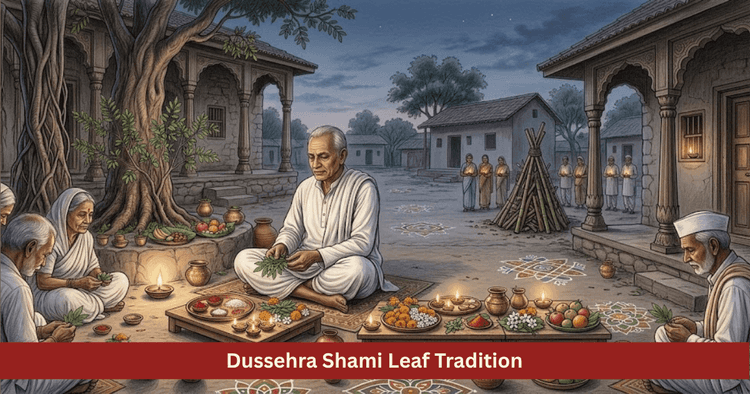
Table of Contents
Know the Date and Method First
On Vijayadashami or Dussehra, the tradition of exchanging Shami leaves is followed in many regions. Shami is also known as Khejri, Apta or Sonpatta. While giving these leaves, people offer auspicious wishes such as take gold, give gold. The leaf is not regarded as actual gold. It is understood as a symbol of prosperity, victory and righteous success.
In 2026, Vijayadashami will be observed on Tuesday, 20 October. For New Delhi, Aparahna Puja is expected from about 1:14 PM to 3:30 PM and Vijay Muhurat from about 1:59 PM to 2:45 PM. Aparahna or Vijay Muhurat is considered suitable for Shami Puja and leaf exchange. Confirm the timing through the local Panchang.
Primary Information About the Dussehra Shami Tradition
- Festival: Vijayadashami and Dussehra
- Date: Tuesday, 20 October 2026
- Suitable time: Aparahna and Vijay Muhurat
- Main tree: Shami or Khejri
- Symbol: gold, prosperity, victory and Dharma
- Main stories: exile of the Pandavas and the story of King Raghu and Kautsa
- Worship materials: water, Roli, Akshat, flowers, lamp and Shami leaves
- Exchange: among family, friends and colleagues with good wishes
- Astrological feeling: qualities connected with Saturn, Mars, the Sun and Jupiter
- Caution: do not harm the tree or remove excessive leaves
| Ritual | Time | Main Feeling |
|---|---|---|
| Shami tree worship | Aparahna | Patience, protection and victory |
| Weapon worship | Vijay Muhurat | Respect for labour and tools |
| Shami leaf exchange | After worship | Prosperity and good wishes |
| Beginning of new work | Vijay Muhurat | Righteous beginning |
| Ravana Dahan | After sunset | Symbolic end of ego |
Why Are Shami Leaves Called Gold?
Calling Shami leaves gold is symbolic. It does not mean that the leaf is a substitute for metallic gold. In Indian culture, gold has long indicated stability, purity, value and auspiciousness. By giving a Shami leaf, a person expresses a wish for prosperity and welfare for another.
This exchange teaches that wealth is not only a matter of accumulation. Wealth becomes meaningful when it is joined with respect, service and righteous action. Exchanging Shami leaves is a cultural language through which people wish stability, victory and auspiciousness in one another's lives.
Symbolic Meaning of the Gold Leaf
- Wish for prosperity
- Righteous victory
- Awakening of hidden strength
- Patience and stability
- Respect for the teacher and knowledge
- Auspiciousness in the family
- A sign of new beginnings
Mahabharata and the Story of the Pandavas
According to a belief connected with the Mahabharata, the Pandavas had to spend twelve years in the forest and one year in concealment after losing the game of dice. During the year of concealment, they lived secretly in the kingdom of King Virata. To hide their identity and keep their weapons safe, they concealed the weapons in a Shami tree.
After completing the year, they retrieved the weapons from the Shami tree, worshipped them and entered battle for the protection of Dharma. Because of this story, the Shami tree came to be regarded as a symbol of hidden strength, protection and victory at the right time.
The deeper message of this story is that every ability does not need to be displayed at every moment. Sometimes preserving strength, remaining patient and waiting for the proper time is also wisdom. When the time arrives, the same hidden strength becomes useful in the protection of Dharma.
Life Messages from the Pandava Story
- Remain patient during difficult times.
- Do not turn ability into ego.
- Respect the right time.
- Do not misuse weapons and tools.
- Remain prepared for the protection of Dharma.
- Duty is more important than identity and prestige.
- Victory becomes possible through cooperation and strategy.
The Story of King Raghu and Kautsa
The second major story is connected with King Raghu and the disciple Kautsa. Kautsa received knowledge from Guru Varatantu. After completing his education, he insisted on offering Guru Dakshina. The Guru first refused but upon the disciple's insistence asked for fourteen crore gold coins for fourteen sciences.
Kautsa did not have so much wealth. He approached King Raghu of Ayodhya, known for generosity. King Raghu had already donated his wealth during the Vishwajit Yajna, so his treasury was empty. Even so, he did not disappoint the disciple. The king sought help from Kubera.
According to tradition, Kubera showered gold coins upon Shami and Apta trees. Kautsa took only the gold required for Guru Dakshina and the remaining wealth remained in the kingdom. Because of this event, Shami leaves came to be regarded as a symbol of gold.
Spiritual Meaning of the Raghu Kautsa Story
- Respect and gratitude toward the teacher
- Fulfilment of promise and Dharma
- Discipline in charity
- Not taking more than required
- Responsibility of a ruler
- Social use of wealth
- Value of knowledge
The story also teaches that even when a generous person is temporarily without wealth, respect for Dharma and promise can still be maintained. Kautsa took only the required amount, which is an example of control over greed.
Tradition of Exchanging Shami Leaves
On Vijayadashami, people worship the Shami tree and give its leaves to family, friends and colleagues. In Maharashtra, the custom of exchanging Apta leaves as gold is especially well known. In Rajasthan and some other regions, Khejri or Shami is worshipped.
While giving the leaf, a person wishes prosperity, health, victory and auspiciousness for the other. This is not only a custom. It is also a way of connecting social relationships with a pure feeling.
Simple Method of Exchanging Shami Leaves
- Go near the Shami tree during Aparahna.
- Bow before the tree.
- Offer clean water at the roots.
- Offer Roli, Akshat and flowers.
- Light a lamp.
- Hold a feeling of forgiveness and permission before taking leaves.
- Take only the required quantity.
- Keep the leaves in a clean cloth or plate.
- Give them to family and friends with good wishes.
- Keep the leaves at the worship place, workplace or near the account book.
Method of Shami Puja
Shami Puja is also connected with Shastra Puja and Aparajita Puja. Some families place Shami leaves near weapons, tools, vehicles or business instruments. The feeling is that strength should be used for righteous work.
Shami Puja at Home
- Clean the worship area.
- Remember Shri Rama, Goddess Durga or the family deity.
- Place Shami leaves on the platform.
- Offer water, Roli, Akshat and flowers.
- Light a lamp and incense.
- Pray for righteous victory and prosperity.
- Give leaves to family members.
- Offer food or Dakshina to a person in need.
If a Shami tree is not nearby, leaves obtained earlier may be worshipped. Artificial gold leaves or plastic leaves should not replace the sacred tree as a religious symbol.
Shami Leaves from an Astrological View
In Vedic astrology, the Shami tree is associated with Saturn. Saturn represents patience, karma, delay, discipline and long term results. Shami worship is regarded as a symbolic way to balance difficulties associated with Saturn.
On Vijayadashami, Shastra Puja disciplines the energy of Mars. Shri Rama worship remembers the self strength and righteous leadership of the Sun. Jupiter indicates knowledge and right direction. In this way, exchanging Shami leaves can become a symbol of balancing planetary qualities rather than only a custom.
Planetary Feelings Connected with Shami Puja
- Saturn: patience, karma and discipline
- Mars: courage and protection
- Sun: self strength and leadership
- Jupiter: Dharma and knowledge
- Mercury: wisdom and transactions
- Venus: prosperity and good fortune
- Moon: mental peace and family harmony
It is not appropriate to claim that Shami Puja will certainly remove every planetary affliction. The birth chart, planetary periods, transits and life circumstances require complete study.
Spiritual Benefits of Shami Leaves
Religious tradition describes prosperity, victory, relief from illness and peace from opposition as results of exchanging Shami leaves. These results should be understood as life messages rather than guaranteed miracles.
Symbolic Benefits
- Wish for prosperity
- Righteous success
- Development of patience
- Auspicious communication in the family
- Respect for work tools
- Honour for the teacher and knowledge
- Control over ego
- Courage for new beginnings
The real benefit appears when a person joins the exchange of leaves with honesty, saving, service, effort and right decisions. Giving leaves alone does not guarantee a change in financial condition.
Environment and Tree Protection
Shami or Khejri is an important tree in dry regions. In Rajasthan, Khejri is regarded as a life giving tree. Protection of the tree is necessary while taking leaves.
Rules for Tree Protection
- Do not remove excessive leaves.
- Do not break branches.
- Do not place nails or metal on the trunk.
- Do not tie plastic or synthetic materials.
- Do not leave waste near the roots.
- Clean the place after worship.
- Plant a new sapling if possible.
- Do not harm public trees.
Protection of the environment is also part of Dharma. If every person removes excessive leaves, trees may be damaged. therefore restraint is necessary in collective events.
Shami Leaves and Modern Life
In the present time, people keep Shami leaves at offices, business places, vehicles and home worship areas. The feeling should be that resources are used with honesty and responsibility.
Practising deceit after keeping a leaf in business or ignoring traffic rules after vehicle worship contradicts this tradition. The Shami leaf is a sign of an auspicious beginning but success requires skill, planning and continuous effort.
Right Modern Uses
- Good wishes at the start of new work
- Auspicious messages within the family
- Respect for teachers
- Respect for work equipment
- Resolve for saving and right spending
- Environmental protection
- Help for people in need
What Should Be Avoided?
- Do not treat Shami leaves as actual gold.
- Do not harm the tree.
- Do not treat plastic leaves as a religious substitute.
- Do not depend only on fate after exchanging leaves.
- Do not take unplanned risks in business.
- Do not practise violence in the name of weapon worship.
- Do not insult or create display while giving leaves.
- Do not encourage children to damage trees.
- Do not forget fire safety during Ravana Dahan.
- Do not limit the festival only to markets and decoration.
Living Message of the Gold Leaf
Exchanging Shami leaves on Dussehra keeps two great stories alive. The story of the Pandavas teaches that preserving strength and using it at the right time is Dharma. The story of King Raghu and Kautsa teaches that respect for knowledge, discipline in charity and control over greed form the foundation of prosperity.
Calling the Shami leaf gold does not mean that metallic gold will arrive by itself. It means that a person should wish auspiciousness for others, respect personal resources, remain patient and walk the path of Dharma.
When the leaf is joined with service, honesty, environmental protection and self improvement, the gold leaf of Dussehra no longer remains only a custom. It becomes a symbol of stability, victory and true auspiciousness in life.
FAQ
Why are Shami leaves exchanged on Dussehra?
Shami leaves are regarded as symbols of prosperity, victory and auspiciousness. People give them to one another with good wishes while calling them gold.
Why are Shami leaves called gold?
In the story of King Raghu and Kautsa, Kubera is believed to have showered gold on the Shami tree. For this reason, Shami leaves are regarded as a symbol of gold.
What is the importance of the Shami tree in the Mahabharata?
The Pandavas hid their weapons in a Shami tree during the year of concealment. Later those weapons were used for the protection of Dharma. therefore Shami is regarded as a symbol of hidden strength and victory.
When is Vijayadashami 2026 and when should Shami Puja be done?
Vijayadashami 2026 falls on 20 October. Shami Puja may be performed during Aparahna or Vijay Muhurat.
Does exchanging Shami leaves bring wealth?
Religious belief regards Shami leaves as a symbol of prosperity. Real financial progress also requires effort, saving, honesty and proper planning.
Get your accurate Kundali
Generate KundaliDid you like it?
Author

Pt. Nilesh Sharma (63)
Experience: 20
Consults About: Family Planning, Career
Clients In: Punjab, Haryana, Delhi
Share this article with friends and family
WELCOME TO
ZODIAQ
Right Decisions at the right time with ZODIAQ
