Spiritual and Scientific Meaning of Pitru Paksha
By Pt. Narendra Sharma
Simple spiritual meaning of Shraddha, Tarpan, Pinda Daan and ancestral debt
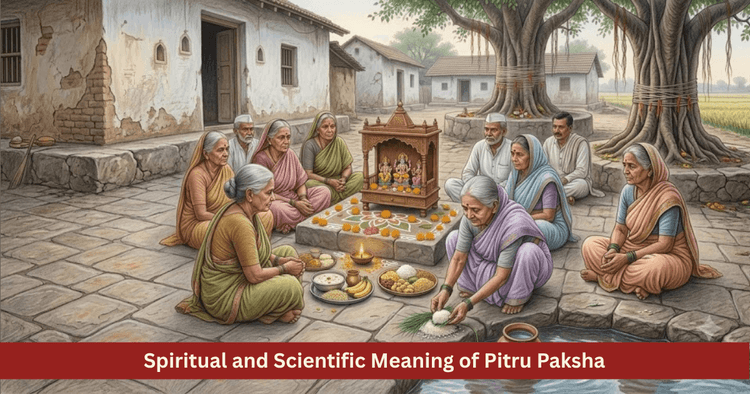
Table of Contents
Know the Main Rules of Pitru Paksha
The Krishna Paksha of Ashwin month is called Pitru Paksha or Shraddha Paksha. This period is dedicated to remembering departed ancestors, offering Tarpan, performing Shraddha, Pinda Daan, food charity and self reflection. The purpose of Pitru Paksha is not only to please an unseen power. It is an opportunity to acknowledge the debt received from ancestors in the form of body, values, language, family and social identity.
Pitru Paksha is regarded as a period of 16 lunar days in many traditions. Its dates may appear different according to the Amanta and Purnimanta calendar systems. Shraddha should be performed according to family tradition, the death Tithi and the local Panchang.
Primary Information About Pitru Paksha
- Period: Ashwin Krishna Paksha, often regarded as 16 lunar Tithis
- Main purpose: remembrance of ancestors and acceptance of Pitru Rina
- Main practices: Tarpan, Shraddha, Pinda Daan, food charity and service
- Main materials: water, black sesame, Kusha grass, barley, rice, ghee and flowers
- Direction: the south has traditional importance during Tarpan
- Suitable time: morning or afternoon according to local method
- Special Tithi: the death Tithi of the ancestor
- Unknown death Tithi: Sarva Pitru Amavasya
- Conduct: Sattvic food, restrained speech and service
- Caution: avoid fear, blind belief and financial exploitation
| Ritual | Main Materials | Central Feeling |
|---|---|---|
| Tarpan | Water, black sesame and Kusha | Satisfaction and remembrance |
| Shraddha | Food, Pinda, ghee and Naivedya | Devotion and gratitude |
| Pinda Daan | Rice, barley, sesame and ghee | Symbol of body and life |
| Food charity | Cooked food or groceries | Nourishment and service |
| Cow offering | Roti, fodder or green grass | Compassion toward living beings |
| Feeding crows | Clean food | Folk tradition and connection with nature |
| Feeding learned persons | Sattvic food and Dakshina | Respect for knowledge tradition |
| Sarva Pitru Amavasya | Collective remembrance and charity | Respect for known and unknown ancestors |
Story and Religious Meaning of Pitru Paksha
Sanatana tradition regards Pitru Paksha as a period of gratitude toward ancestors. A person does not create existence alone. The body carries the contribution of lineage, values come through family and social identity is built through the efforts of many generations.
Garuda Purana describes the journey after death, karma, Shraddha and ancestral rites. From a religious view, Shraddha and Tarpan are connected with peace for departed souls and satisfaction in the ancestral realm. This is a spiritual belief accepted through tradition and devotion.
Religious narrative holds that remembering ancestors during Pitru Paksha is especially fruitful. This period gives descendants an opportunity to fulfil their responsibility toward their ancestors. The word Shraddha is connected with devotion and faith. therefore offering materials without feeling does not express the full meaning of this act.
What Is Pitru Rina?
Pitru Rina does not mean only a financial debt or an old transaction. It is the awareness of the contribution made by ancestors through life, family, property, education, values and social foundation.
Repaying Pitru Rina does not mean carrying the burden of every mistake of the past. It means carrying forward good traditions received from ancestors, respecting family responsibilities and creating a better life for future generations.
Practical Forms of Repaying Pitru Rina
- Serve parents and elders.
- Fulfil family responsibilities honestly.
- Preserve the memory and life stories of ancestors.
- Donate food, clothing or education in their name.
- Follow truth and good conduct in family life.
- Correct harmful habits passed through the lineage.
- Introduce children to family history.
- Remain responsible toward nature and society.
Do Water and Sesame Alone Please Ancestors?
In the ritual method, water and black sesame have special importance. Water symbolises life, peace and satisfaction. Sesame is associated with subtlety, purity and purification of action. Kusha grass is regarded as a sacred medium in tradition.
According to spiritual belief, water mixed with sesame satisfies the ancestors. From a scientific view, there is no evidence that this water physically reaches a deceased person. Scientifically, Tarpan may be understood through its symbolic, psychological and social meaning.
While offering water, a person acknowledges grief, gratitude and unfinished emotions. It gives direction to the mind. When a family gathers to remember ancestors, relationships and memory between generations become stronger.
therefore it is not appropriate to treat water and sesame alone as miraculous substances. The real effect of Tarpan appears through the feeling, discipline and conduct that follow the ritual.
Simple Method of Tarpan
The method of Tarpan differs according to family, Gotra and regional tradition. The general method is given below. Guidance from a qualified priest or family Acharya is appropriate for an extensive ritual.
Simple Tarpan at Home
- Bathe and wear clean clothes.
- Choose a clean place for the ritual.
- Keep clean water in a vessel.
- Add black sesame and Kusha if the tradition requires them.
- Follow the traditional practice of facing south.
- Remember the Gotra and ancestors.
- Remember the father, grandfather and great grandfather in traditional order.
- Also remember ancestors from the maternal side.
- Offer water with both hands.
- Keep the feeling of Swadha and remembrance with each offering.
- Pray for peace and forgiveness at the end.
- Donate food or fruit.
People who do not know the Gotra, death Tithi or method may simply remember all known and unknown ancestors and offer water. There is no need to perform a complex procedure or use an incorrect Mantra because of fear.
Difference Between Shraddha and Tarpan
Tarpan mainly means offering water and praying for satisfaction. Shraddha is a wider ritual that may include invocation of ancestors, offering food, Pinda, feeding, charity and Dakshina.
Shraddha may be performed annually on the death Tithi. That Tithi has special importance during Pitru Paksha. If the death Tithi is unknown, collective Shraddha and Tarpan are performed on Sarva Pitru Amavasya.
Main Differences
- Tarpan mainly uses water and sesame.
- Shraddha has a wider method involving food, Pinda and charity.
- Pinda Daan offers Pindas made from rice or barley.
- Simple Tarpan may be performed at home.
- Guidance from an Acharya is useful for an extensive Shraddha.
Symbolic Meaning of Pinda Daan
Pindas are made from rice, barley, sesame, ghee or other traditional materials. From a religious view, Pindas represent body, nourishment and life. Pinda Daan expresses acceptance of the debt of life and body toward ancestors.
From a psychological view, making Pindas gives a clear form to grief. After the death of a loved one, denial, emptiness and unfinished emotions may remain in the mind. A religious process can help express these feelings and help many families move forward emotionally.
Pinda Daan cannot be treated as a scientific fact that gives a deceased person a new physical body. It is a religious symbol and spiritual belief. It should be understood respectfully without exaggerated interpretations that create fear.
View of Garuda Purana
Garuda Purana describes death, karma, the journey of the soul, the system of Yama and ancestral rites. Its teachings aim to make a person aware of the results of actions, Dharma, restraint and the impermanence of life.
In the religious language of Garuda Purana, ancestors receive satisfaction through Shraddha and Tarpan. Good conduct, charity and righteous action by descendants are also connected with respect for ancestors. It is more balanced to understand this as a reminder that ancestral remembrance becomes meaningful when descendants live with good conduct and service.
Life Messages from Garuda Purana
- The body and life are not permanent.
- Actions affect the person and the family.
- Greed, violence and deceit should be avoided.
- Service and charity purify life.
- Remembrance of death makes life more responsible.
- Respect for ancestors should appear in conduct.
Claims made in the name of Garuda Purana that create fear, promise certain curses or demand excessive money are contrary to spiritual discernment. The purpose of scripture is not to increase fear. It is to awaken Dharma and self reflection.
Scientific and Social Meaning of Shraddha
It is not appropriate to present religious beliefs about Shraddha as scientific proof. Even so, several social and psychological benefits can be understood.
Scientific and Practical View
- The family gathers to remember ancestors.
- Old life stories and family history are preserved.
- It creates an opportunity to express grief and unfinished emotions.
- Food charity gives real support to people in need.
- Elders and senior family members receive respect.
- Connection and identity between generations become stronger.
- People reflect seriously on life and its impermanence.
- Charity and service increase social support.
Some physical traits, disease tendencies and behavioural habits may appear across generations. These may be understood through heredity, family environment and learning. It is not appropriate to present them as certain results of an unseen energy without evidence.
Food and Charity During Pitru Paksha
Sattvic food and charity hold importance during Shraddha. Food should be fresh, clean and according to family tradition. Grains may be given to a needy person, an elder, a student, a cow service organisation or a food service centre.
Useful Donation Materials
- Rice and wheat
- Pulses and flour
- Sesame and jaggery
- Fruits and vegetables
- Clothing and blankets
- Education materials
- Medicine and health support
- Food for birds and animals
- Water vessels and water service
- Daily support for an elderly or isolated person
Maintain the dignity of the recipient during charity. Insulting someone while giving food or clothing goes against the feeling of Shraddha. Taking photographs for publicity is also unnecessary.
Astrological Understanding of Pitru Dosha
Different views exist regarding Pitru Dosha in astrology. Some traditions connect the Sun, Rahu, Saturn and the ninth house with ancestral concerns. Some Acharyas also examine the fifth house, the ninth house, the condition of the Sun and related planetary periods.
It is not appropriate to declare Pitru Dosha after seeing one combination in a chart. Delayed marriage, concern about children, financial obstacles or illness should not all be blamed on Pitru Dosha. The chart, planetary periods, transits, family history and actual life circumstances must be considered together.
Astrological Balance Related to Ancestors
- Respect the Sun and offer regular water.
- Serve the father and elders.
- Perform Tarpan and food charity on Amavasya.
- Maintain truth and responsibility in the family.
- Offer education or health service in the name of ancestors.
- Follow discipline and labour connected with Saturn.
- Seek qualified astrological guidance.
Are There Signs of Angry Ancestors?
Folk belief connects repeated dreams of ancestors, family conflict, interruption in work and health concerns with ancestral dissatisfaction. It is not appropriate to immediately label these experiences as Pitru Dosha.
Dreams may also arise from grief, memory, stress and the subconscious mind. Financial difficulty may arise from poor planning, delayed marriage from social or personal causes and health problems from medical reasons. First investigate practical causes and then use spiritual practice for mental peace.
Simple Way to Repay Pitru Rina
Repaying Pitru Rina is not a one day action. It is a responsibility that continues throughout life.
- Perform Shraddha according to the death Tithi during Pitru Paksha.
- If the Tithi is unknown, perform Tarpan on Sarva Pitru Amavasya.
- Offer water mixed with black sesame with devotion.
- Donate food and clothing to people in need.
- Serve parents and elders.
- Maintain truth, restraint and love in the family.
- Carry forward good traditions of ancestors.
- Stop harmful habits passed through the lineage.
- Support a student or patient.
- Remember ancestors with gratitude every year.
What Should Be Avoided?
- Do not understand Shraddha through fear and curse.
- Do not perform complex Pinda Daan without knowledge.
- Do not spend excessive money in the name of Pitru Dosha.
- Do not insult poor family members.
- Do not waste food.
- Do not pollute rivers and pilgrimage places.
- Do not connect a medical issue only with ancestral rites.
- Do not blame a person only because there is no son.
- Do not make decisions out of fear after dreams of a deceased relative.
- Continue good conduct and service after Shraddha.
From Memory Toward Peace
Pitru Paksha takes a person back toward the roots. While offering water and sesame, the hands hold more than water. They carry memory, gratitude, grief, love and responsibility. Pinda Daan symbolises acceptance of the debt of body and life. Food charity reminds the devotee that respect for ancestors is also expressed through service to the living.
The spiritual view of Garuda Purana teaches the seriousness of karma and death. The modern view may understand Shraddha as grief processing, family memory, social service and dialogue between generations. Maintaining balance between both views is healthier.
The simplest and deepest act for the peace of ancestors is for descendants to live with truth, service, compassion and responsibility. When remembrance of ancestors becomes gratitude rather than fear, Pitru Paksha no longer remains a burden of the past. It becomes a sacred opportunity to improve the present and make the future brighter.
FAQ
What happens when only water and sesame are offered during Pitru Paksha?
In religious belief, water and sesame symbolise Tarpan and satisfaction of ancestors. There is no scientific proof that they physically reach the dead. Their spiritual and psychological meaning remains important.
Why is Shraddha performed during Pitru Paksha?
Shraddha is connected with gratitude toward ancestors, acceptance of Pitru Rina, family memory and service to people in need.
When should Shraddha be performed if the death Tithi is unknown?
When the death Tithi is unknown, the tradition is to perform Shraddha and Tarpan on Sarva Pitru Amavasya. Follow the local Panchang and family tradition.
Does every problem happen because of Pitru Dosha?
No. Every difficulty cannot be attributed to Pitru Dosha. Health, financial, relationship and astrological causes require separate examination.
What is the simplest way to repay Pitru Rina?
Regular Tarpan, Shraddha according to the death Tithi, food charity, service to elders, truthful living and carrying forward good ancestral traditions are meaningful practices.
Get your accurate Kundali
Generate KundaliDid you like it?
Author

Pt. Narendra Sharma (63)
Experience: 20
Consults About: Family Planning, Career
Clients In: Punjab, Haryana, Delhi
Share this article with friends and family
WELCOME TO
ZODIAQ
Right Decisions at the right time with ZODIAQ
