Sharad Navratri 2026 Complete Panchang
By Pt. Nilesh Sharma
Ghatasthapana Muhurat, Choghadiya, Tithi changes and Navadurga worship
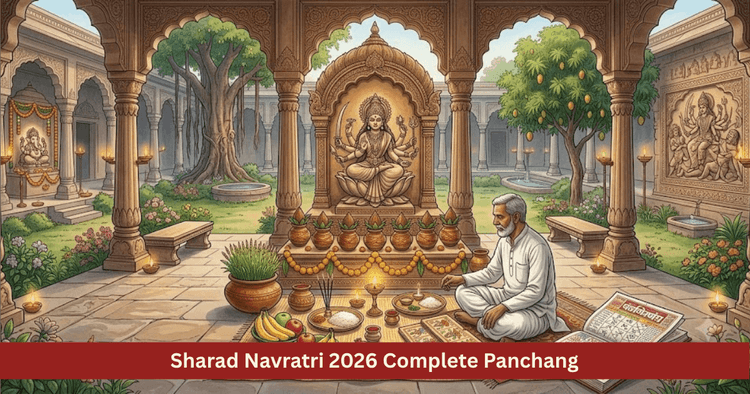
Table of Contents
Know the Dates and Muhurat First
Sharad Navratri 2026 will begin on Sunday, 11 October and conclude with Vijayadashami on Tuesday, 20 October. Ashwin Shukla Paksha Pratipada is expected to begin around 9:19 PM on 10 October and end around 9:30 PM on 11 October. Therefore, Ghatasthapana will be performed on 11 October.
For New Delhi, the main Ghatasthapana Muhurat is expected from 6:19 AM to 10:12 AM. The alternative Abhijit Muhurat is expected from 11:44 AM to 12:31 PM. Timings may differ according to local sunrise, location and Panchang. Confirm the final time through the local calendar.
Primary Information for Sharad Navratri 2026
- Beginning: Sunday, 11 October 2026
- Completion: Tuesday, 20 October 2026
- Paksha: Ashwin Shukla Paksha
- Ghatasthapana: 11 October
- Main Muhurat: 6:19 AM to 10:12 AM
- Abhijit Muhurat: 11:44 AM to 12:31 PM
- Ashtami: 19 October
- Navami: 20 October
- Vijayadashami: 20 October
- Main rituals: Kalash Sthapana, Akhand Jyoti, Navadurga Puja, fasting, Havan and Kanya Puja
- Caution: avoid Ghatasthapana during Rahu Kala and unsuitable periods
- Central feeling: strength, discipline, devotion and self improvement
| Day | Date | Tithi | Goddess Form | Main Worship |
|---|---|---|---|---|
| 1 | 11 October | Pratipada | Shailputri | Ghatasthapana and barley |
| 2 | 12 October | Dwitiya | Brahmacharini | Penance and chanting |
| 3 | 13 October | Tritiya | Chandraghanta | Courage and protection |
| 4 | 14 October | Chaturthi | Kushmanda | Health and creativity |
| 5 | 15 October | Panchami | Skandamata | Motherhood and children |
| 6 | 16 October | Shashthi | Katyayani | Dharma and marriage blessings |
| 7 | 17 October | Saptami | Kalaratri | Relief from fear |
| 8 | 18 October | Saptami continues | Special Goddess practice | Ashtami preparation |
| 9 | 19 October | Ashtami | Mahagauri | Kanya Puja and Sandhi Puja |
| 10 | 20 October | Navami | Siddhidatri | Havan, Purnahuti and Vijayadashami |
The Mathematics of Tithi Loss and Extension
Hindu Panchang Tithis are based on the movement of the Sun and Moon. A difference of about 12 degrees between the Sun and Moon represents one Tithi. Since the Moon does not move at a uniform speed, the duration of a Tithi may be shorter or longer than 24 hours.
When a Tithi ends between two sunrise periods and does not appear at sunrise, it is called Tithi Kshaya. When one Tithi remains present at two sunrise periods, it is called Tithi Vriddhi.
What to Do During Tithi Changes
- Check the local Panchang instead of an ordinary calendar.
- Give importance to the Tithi present at sunrise.
- Confirm the actual dates of Ashtami and Navami.
- Decide Sandhi Puja according to the Tithi transition.
- Consider Navami and Dashami while planning the fast completion.
- Ask a temple or qualified Acharya when confused.
- Do not treat Tithi Vriddhi as an inauspicious sign.
Tithi Kshaya and Vriddhi are results of lunar movement in Panchang calculation. They do not mean that the Goddess is displeased or that worship is obstructed.
Spiritual Importance of Ghatasthapana
Ghatasthapana is the first and principal ritual of Navratri. The Kalash represents life, water, creation and divine consciousness. The water inside it indicates the basic force of life and the coconut represents completeness and awareness.
Barley is traditionally sown in soil below the Kalash. Its growth shows that auspicious change develops gradually. The rising barley reminds the devotee of regularity and patience during nine days.
Simple Method of Ghatasthapana
- Bathe in the morning and wear clean clothes.
- Clean the worship area.
- Spread red or yellow cloth on the platform.
- Fill an earthen vessel with clean soil.
- Sow barley seeds.
- Place water, Akshat, betel nut and coin in the Kalash.
- Place mango leaves and coconut over it.
- Tie Mauli around the Kalash.
- Place an image or idol of Goddess Durga.
- Light a lamp and incense.
- Invoke the Goddess and take a resolve.
- Offer flowers, Roli, Akshat and Naivedya.
- Keep the worship area clean for nine days.
- Maintain fire safety if an Akhand Jyoti is lit.
The Nine Forms of Navadurga
Goddess Shailputri
Shailputri is worshipped on Pratipada. She represents stability, mountain like firmness and a strong foundation for life.
Goddess Brahmacharini
Brahmacharini is worshipped on Dwitiya. She represents penance, restraint and continuous effort.
Goddess Chandraghanta
Chandraghanta is worshipped on Tritiya. Her form represents courage, awareness and balance during difficulty.
Goddess Kushmanda
Kushmanda is worshipped on Chaturthi. She represents creation, light and life energy.
Goddess Skandamata
Skandamata is worshipped on Panchami. She represents motherhood, protection and affection.
Goddess Katyayani
Katyayani is worshipped on Shashthi. She is connected with courage, protection of Dharma and auspicious marriage feelings.
Goddess Kalaratri
Kalaratri is worshipped on Saptami. She represents destruction of fear, ignorance and negativity.
Goddess Mahagauri
Mahagauri is worshipped on Ashtami. She represents purity, compassion and mental peace.
Goddess Siddhidatri
Siddhidatri is worshipped on Navami. She represents accomplishment, completion and spiritual maturity.
Choghadiya and Ghatasthapana
Choghadiya divides daytime into periods such as Shubh, Labh, Amrit, Char, Rog, Kaal and Udveg. Since sunrise differs by city, Choghadiya timings also change.
Shubh, Labh and Amrit Choghadiya are considered suitable for Ghatasthapana in many traditions. Even so, the decision should not be based on Choghadiya alone. Tithi, Lagna, Nakshatra, Rahu Kala and local sunrise should be considered together.
Rules for Using Choghadiya
- Check the sunrise time of the relevant city.
- Do not perform Ghatasthapana during Rahu Kala.
- Prefer Shubh or Amrit periods.
- Use Abhijit Muhurat when available.
- Arrange the materials in advance.
- Choose an alternative auspicious period if the selected time is missed.
Muhurat gives a time discipline to spiritual practice. It should not become a source of fear.
Ashtami, Navami and Kanya Puja
Ashtami and Navami are important days of Navratri. Many families perform Kanya Puja on Ashtami or Navami. Young girls are respected as child forms of the Goddess and offered food, fruit, clothes, Dakshina and useful items.
The comfort and wishes of the child must be respected. No girl should be forced to touch feet, perform worship or pose for photographs.
Simple Method of Kanya Puja
- Clean the home and worship area.
- Arrange clean seats for the girls.
- Offer Roli, Akshat and flowers.
- Serve Sattvic food such as Halwa, chickpeas and Puri.
- Give fruits and sweets.
- Offer Dakshina according to capacity.
- Give books or useful items.
- Maintain respect and comfort for the girls.
Fasting Rules During Navratri
Navratri fasting is observed to bring restraint to the mind, senses and daily routine. A waterless or strict fast is not suitable for everyone.
- Take fruits, milk, curd, fox nuts and fasting grains.
- Use rock salt.
- Reduce excessively fried food.
- Drink sufficient water.
- Simplify the fast if weakness or dizziness appears.
- Pregnant women, elders, children and patients should consult a doctor.
- Do not damage health through night vigil.
- Take light food while completing the fast.
The purpose of fasting is not to harm the body. Peaceful speech, service, chanting and Sattvic food are also parts of the fast.
Navami Havan and Purnahuti
Many families perform Havan on Navami. Ghee, barley, sesame, rice, sacred wood and Havan mixture are offered into the fire. Swaha is spoken at the end of each offering.
Havan Sequence
- Place the Havan Kund in a safe place.
- Light the sacred fire.
- Worship Ganesha and Agni.
- Offer Ahuti with Durga Mantras.
- Chant the Gayatri Mantra or Navarna Mantra.
- Give offerings in limited quantities.
- Offer coconut, ghee and jaggery during Purnahuti.
- Perform Aarti and the forgiveness prayer.
- Distribute Prasad.
- Maintain safety until the fire becomes calm.
Vijayadashami and Fast Completion
On 20 October 2026, the sequence of Navami and Vijayadashami appears on the same date. According to the local Panchang, timings for Havan, Kanya Puja, fast completion, Durga Visarjan and Vijayadashami rituals may differ.
Ayudha Puja, Shami Puja, remembrance of Shri Rama and Ravana Dahan are performed on Vijayadashami. Devotees who observed the nine day fast should complete it according to the local Panchang and family tradition.
Astrological Meaning of Sharad Navratri
The Moon grows during Shukla Paksha. This represents expansion of the mind, energy and consciousness. Qualities connected with the Sun, Mars and Jupiter bring self strength, courage and Dharma to Navratri practice.
Navratri worship does not guarantee automatic removal of planetary difficulties. It may still increase discipline and decision making. For a personal remedy, the planetary periods, transits, houses and planetary strength must be studied completely.
Planetary Feelings of Navratri
- Sun: self strength and leadership
- Moon: mind and devotion
- Mars: courage and protection
- Mercury: Mantra, speech and wisdom
- Jupiter: Dharma and knowledge
- Venus: beauty and prosperity
- Saturn: discipline and service
The Real Message of Sharad Navratri
The Sharad Navratri 2026 Panchang is not only a list of dates. It takes the devotee through stability, penance, courage, creation, protection, Dharma, removal of fear, purity and accomplishment.
The barley planted during Ghatasthapana shows that auspicious change grows gradually. The Akhand Jyoti represents continuity. Fasting teaches restraint of the senses. Kanya Puja awakens compassion. Havan represents offering ego and impure feelings into the sacred fire.
When the power of Navratri appears in life as truth, service, courage and discipline, Goddess worship reaches its true meaning. The nine night festival becomes a celebration of inner light along with an outer celebration.
FAQ
When will Sharad Navratri 2026 begin?
Sharad Navratri 2026 will begin on 11 October and conclude with Vijayadashami on 20 October.
What is the main Ghatasthapana Muhurat?
For New Delhi, the main period is expected from 6:19 AM to 10:12 AM and Abhijit Muhurat from 11:44 AM to 12:31 PM on 11 October.
Is there Tithi Vriddhi during Navratri 2026?
Saptami appears on 17 and 18 October. Ashtami falls on 19 October and Navami on 20 October. Confirm through the local Panchang.
Which Goddess is worshipped each day?
Shailputri is worshipped on Pratipada, Brahmacharini on Dwitiya, Chandraghanta on Tritiya, Kushmanda on Chaturthi, Skandamata on Panchami, Katyayani on Shashthi, Kalaratri on Saptami, Mahagauri on Ashtami and Siddhidatri on Navami.
Should Choghadiya be checked for Ghatasthapana?
Tithi, Lagna, Nakshatra, Rahu Kala, Choghadiya and local sunrise should be checked. Use a Shubh, Amrit or Abhijit Muhurat when available.
Get your accurate Kundali
Generate KundaliDid you like it?
Author

Pt. Nilesh Sharma (63)
Experience: 20
Consults About: Family Planning, Career
Clients In: Punjab, Haryana, Delhi
Share this article with friends and family
WELCOME TO
ZODIAQ
Right Decisions at the right time with ZODIAQ
