Krishna Paksha: Meaning, Lunar Fortnight, and Practical Use in Life
By Aparna Patni
Difference Between Shukla Paksha and Krishna Paksha with Astrological View
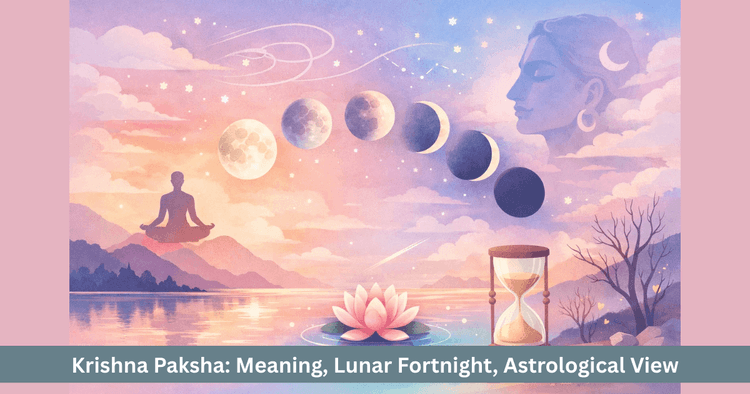
Table of Contents
To understand the Hindu calendar properly it is not enough to know only the date and weekday. The phases of the Moon, that is Shukla Paksha and Krishna Paksha, are equally important. Among these two, Krishna Paksha is the fortnight in which the Moon gradually wanes and moves from fullness towards darkness. This period is often seen as a time of inward turning, quietening and contraction of visible energy.
Basic definition and meaning of Krishna Paksha
In Sanskrit the word “krishna” means dark or shaded and “paksha” means side or part of time. Thus Krishna Paksha refers to that side of the lunar month when the Moon’s brightness is diminishing and the nights grow darker.
A Hindu lunar month is divided into two parts.
- The waxing half is called Shukla Paksha.
- The waning half is called Krishna Paksha.
Krishna Paksha is also described in some texts as Vadhya Paksha, indicating that this period is more supportive of discipline, self restraint and inner work than of outward display and celebration.
Tithis and lunar phases of Krishna Paksha
One lunar month contains about 30 tithis, half belonging to Shukla Paksha and half to Krishna Paksha. Krishna Paksha covers the phase from the day after Purnima until Amavasya.
The tithis of Krishna Paksha are counted as follows.
| Order | Name of tithi |
|---|---|
| 1 | Purnima |
| 2 | Pratipada |
| 3 | Dwitiya |
| 4 | Tritiya |
| 5 | Chaturthi |
| 6 | Panchami |
| 7 | Shashthi |
| 8 | Saptami |
| 9 | Ashtami |
| 10 | Navami |
| 11 | Dashami |
| 12 | Ekadashi |
| 13 | Dwadashi |
| 14 | Trayodashi |
| 15 | Chaturdashi |
Amavasya follows and marks the point at which the illuminated side of the Moon is no longer visible from the earth.
Why is Krishna Paksha often called inauspicious
In many traditional practices Krishna Paksha is considered relatively less favourable or even ashubha for certain kinds of auspicious beginnings.
- The reasoning is that during this time the light of the Moon decreases, symbolising a reduction of mental and emotional fullness.
- Where the waxing Moon of Shukla Paksha represents growth and expansion, the waning Moon of Krishna Paksha points towards contraction, withdrawal and renunciation.
- Families often keep this in mind when choosing dates for marriage, house entry, major celebrations or new ventures.
Yet it would be incomplete to call Krishna Paksha simply negative. Several types of religious acts and spiritual practices find special depth during this phase.
A more nuanced view of auspicious time within Shukla and Krishna Paksha
Some streams of Vedic astrology present a more refined understanding, suggesting that neither Shukla nor Krishna Paksha is absolutely auspicious or inauspicious.
A commonly mentioned view is that.
- From the tenth tithi of Shukla Paksha up to the fifth tithi of Krishna Paksha, the Moon’s brightness is relatively high.
- This span can therefore be regarded as especially favourable for many activities.
This indicates that if one rejects Krishna Paksha simply by name, one may miss genuinely supportive dates. In actual practice tithi, nakshatra, yoga and the charts of the concerned individuals are all considered.
Spiritual meaning of Krishna Paksha energy
Astrologically the Moon governs mind, emotions and inner rhythm. When the Moon wanes in Krishna Paksha, many interpreters see it as a sign to release ego and outer attachment.
- It is a period to focus less on outer shine and more on inner truth.
- Physically and mentally it can be a good time for letting go, fasting, detox and tapas.
- For those who need deep meditation, self analysis or the shedding of old patterns, Krishna Paksha serves as supportive ground.
Thus, although some call it ashubh, for a sincere seeker this fortnight can be a powerful stage of inner cleansing and restructuring.
Role of Krishna Paksha in astrological decisions
When major decisions such as marriage, naming a child, buying a house or starting a business are taken, an experienced astrologer does not look only at the paksha.
- The day’s tithi, nakshatra, yoga and karana.
- The ascendant and planetary positions.
- The combinations present in the birth charts involved.
Even so, as a general guideline many families treat Shukla Paksha as more auspicious for external beginnings and Krishna Paksha as more suited for practices of discipline and inner work.
Common misconceptions about Krishna Paksha
Sometimes a belief spreads that nothing good should ever be done in Krishna Paksha, while the reality is more balanced.
- Many important fasts, Ekadashis, Amavasya rituals, ancestral rites and tantric practices fall in Krishna Paksha.
- For those who wish to release old debts, emotional burdens or harmful habits, this fortnight can be especially helpful.
- Practically, if some necessary task must be done during Krishna Paksha, scholars simply ensure that the tithi and muhurat are not extremely adverse and that relevant planetary factors are supportive enough.
It is therefore wiser to see Krishna Paksha not as a blanket prohibition but as a time to be used thoughtfully.
Life lessons reflected through Krishna Paksha
The cycle of Krishna Paksha returns every month and each time it offers a chance to drop something old.
- Just as the Moon gradually surrenders its light until Amavasya, a person can release some outdated habit, expectation or pain.
- The focus can gently shift from outer expansion to inner depth.
- Those who align their routines, fasts and introspection with this cycle often find their mind moving in closer rhythm with nature.
Seen in this way, Krishna Paksha is not merely the “dark side” of the lunar month but a necessary spiritual phase in which a little darkness prepares the way for renewed light.
Frequently asked questions about Krishna Paksha
Is Krishna Paksha always inauspicious
Krishna Paksha is generally less preferred for large new beginnings, yet it is far from entirely inauspicious. Many fasts, practices for ancestors and inner transformation are especially fruitful during this fortnight.
Is Krishna Paksha suitable for marriage or house warming
As a rule such events are preferred in Shukla Paksha. If circumstances require Krishna Paksha, a careful astrologer will weigh tithi, nakshatra and the individuals’ charts before recommending a date.
Which spiritual activities benefit most from Krishna Paksha
Japa, meditation, fasting, detox, reviewing forgotten resolutions, rites for ancestors and efforts to quit negative habits are all particularly supported in Krishna Paksha.
Is the energy of Krishna Paksha the same every month
Each lunar month has its own mood and associated festivals, so the specific forms of practice differ. However the core theme of release and inward movement is present in every Krishna Paksha.
How can Krishna Paksha be used practically in everyday life
One can avoid unnecessary expenses, conflicts and heavy new commitments and instead focus on simplifying, clearing old clutter, lightening the body and mind and preparing inwardly for the fresh expansion that Shukla Paksha will bring.
Get your accurate Kundali
Generate KundaliDid you like it?
Author

Aparna Patni (63)
Experience: 20
Consults About: Family Planning, Career
Clients In: Punjab, Haryana, Delhi
Share this article with friends and family
WELCOME TO
ZODIAQ
Right Decisions at the right time with ZODIAQ
