How Did Krishna Paksha and Shukla Paksha Begin: The Puranic Story and Its Meaning
By Pt. Amitabh Sharma
Puranic Tales Behind Lunar Fortnights and Their Significance in Life
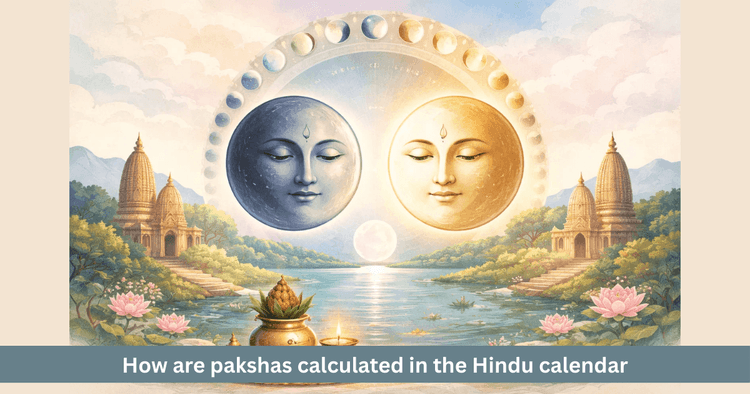
Table of Contents
When the Hindu panchanga is viewed in depth, one sees not only dates and months but also the stories behind Krishna Paksha and Shukla Paksha. The waxing and waning of the Moon are not treated as mere astronomical events. A profound story, a teaching and a clear astrological indication are woven into this cycle and earlier generations lived in tune with this understanding.
How are pakshas calculated in the Hindu calendar
In the Hindu calendar, months are calculated on the basis of the combined movements of the Sun and the Moon. A lunar month is considered to have about 30 tithis and on this structure fasts, festivals and major ceremonies are fixed.
| Reference point | Description |
|---|---|
| Days in a month | Commonly taken as 30 in the panchanga |
| Astronomical base | Combined motion of Sun and Moon |
| Number of pakshas | Two pakshas, each with 15 tithis |
| Names of pakshas | Krishna Paksha and Shukla Paksha |
| Basis for rituals | Most fasts and festivals follow these tithis and pakshas |
After Purnima, that is from Pratipada of Krishna Paksha, a new lunar month is counted. According to the increase and decrease of the Moon’s phases each month is divided into two halves. In one half the Moon wanes and in the other it waxes and this division sets the rhythm for the entire Hindu panchanga.
How are Krishna Paksha and Shukla Paksha measured
The two main periods of decreasing and increasing moonlight are called pakshas. Their calculation is done with careful reference to the position of the Moon.
When is Krishna Paksha counted
- The 15 days from Purnima to Amavasya are called Krishna Paksha.
- After the night of Purnima, as the days pass, the disc of the Moon begins to shrink.
- With each tithi the light of the Moon diminishes and the nights gradually become darker.
During this phase the Moon moves from full brilliance towards the invisible point of Amavasya, where it is not seen in the sky.
When is Shukla Paksha counted
- The period from Amavasya to Purnima is known as Shukla Paksha.
- From the day after Amavasya the Moon appears as a slender crescent.
- With each tithi the Moon’s phase grows and the night gradually fills with more moonlight.
Because of this increasing light, Shukla Paksha is regarded as a symbol of auspiciousness, progress and new beginnings and most auspicious rituals are traditionally sought during this paksha.
How did Krishna Paksha begin: the story of Daksha and the Moon
The central question then arises, how did Krishna Paksha begin. A well known Puranic story explains the origin of the waning Moon in a vivid way.
Once Daksha Prajapati had 27 daughters. These 27 daughters are identified with the 27 nakshatras. Daksha married all of them to Chandra, the Moon god.
According to the story.
- Chandra’s affection was especially strong for Rohini.
- His behaviour towards the other 26 wives became neglectful and distant.
- The ignored wives complained to their father Daksha that the Moon did not give them proper love and respect.
Daksha advised Chandra to treat all his wives equally but the Moon’s heart remained attached mainly to Rohini. When Chandra did not change, an angry Daksha cursed him with kshaya roga, a wasting disease.
The curse had a clear effect.
- The brilliance of the Moon started diminishing day by day.
- His phases reduced and his light became weaker.
This point marks the beginning of Krishna Paksha. The time when the Moon’s radiance keeps decreasing and moves away from fullness was recognised as the dark half of the month. Through this story tradition also teaches that partiality and imbalance gradually dim a person’s light and respect.
How did Shukla Paksha begin: the Moon’s prayer and Shiva’s grace
Because of the curse of kshaya roga, the Moon’s light continued to decline. Finally his end seemed near. Filled with fear and sorrow, Chandra sought the help of the deities.
According to the narration.
- The Moon first went to Brahma and asked for guidance.
- Brahma advised him to join Indra, the king of gods and worship Lord Shiva with full devotion.
- Chandra then performed deep worship and prayer to Shiva.
Pleased with the Moon’s devotion Lord Shiva.
- Placed Chandra on his matted locks.
- Softened the effect of the wasting disease with his own divine radiance.
By the grace of Shiva the Moon’s brightness began to return and he once again became luminous. Yet the curse of Daksha could not be erased completely, so a new arrangement was made.
- The Moon would decrease for a certain number of days and then increase for the same span.
- Due to the curse he must alternately pass through Krishna Paksha and Shukla Paksha.
From here the origin of Shukla Paksha is described, the period in which the Moon, supported by Shiva’s grace, slowly regains his former light and reaches Purnima in complete brilliance.
Puranic story and astrological indication
Within this story several subtle hints help in understanding the energy of Krishna Paksha and Shukla Paksha.
- Krishna Paksha, when the Moon loses light, can be seen as a time of humility, renunciation and inward movement in life.
- Shukla Paksha, when the light increases, signifies growth, fresh beginnings and upward movement.
- The curse of Daksha points to the fact that partial love, ego and imbalance reduce the inner radiance, while refuge and devotion towards Shiva can restore strength and clarity.
Each month, as the Moon wanes and waxes, the same teaching is silently repeated. Decline and renewal are both part of life. One who understands this rhythm can turn the panchanga and the paksha cycles into tools for conscious living and spiritual practice.
Frequently asked questions about the origin of Krishna Paksha and Shukla Paksha
Is this story of Krishna Paksha and Shukla Paksha accepted in all traditions
This account is widely narrated and accepted, especially when explaining the origin of the Moon’s phases. Descriptions may vary in style across regions, yet the central idea remains that because of the curse and Shiva’s grace, the Moon alternately wanes and waxes.
Why should Krishna Paksha not always be seen as negative if it arose from a curse
The story shows Krishna Paksha as a result of diminishing light, yet not all reduction is harmful. Times of letting go, simplifying and turning inward are necessary. Krishna Paksha offers exactly that space, so it is not to be viewed only with fear or rejection.
Why is the beginning of Shukla Paksha considered so auspicious
Shukla Paksha begins when the Moon, after seeking Shiva’s refuge, regains his brightness. It symbolises renewal, new beginnings and rising light. For this reason it is especially favoured for starting new ventures, resolutions and celebrations.
Does the curse of Daksha and the grace of Shiva repeat symbolically every month
Symbolically yes. Each month the waning and waxing of the Moon remind us of mistakes, their consequences, repentance and grace. With this awareness people align their practices and actions with the differing energies of the two pakshas.
How can this story of Krishna Paksha and Shukla Paksha help in daily life
When one understands that every phase of decline is followed by a phase of growth, it becomes easier to remain patient during difficult periods. Using Krishna Paksha for inner clearing and Shukla Paksha for new beginnings allows life to flow more naturally with the lunar rhythm.
Get your accurate Kundali
Generate KundaliDid you like it?
Author

Pt. Amitabh Sharma (56 Years)
Experience: 20
Consults About: Family Planning, Career
Clients In: Punjab, Haryana, Delhi
Share this article with friends and family
WELCOME TO
ZODIAQ
Right Decisions at the right time with ZODIAQ
