Shukla Paksha: Meaning, Lunar Fortnight, and Practical Use in Life
By Pt. Abhishek Sharma
Difference Between Shukla Paksha and Krishna Paksha with Astrological Significance
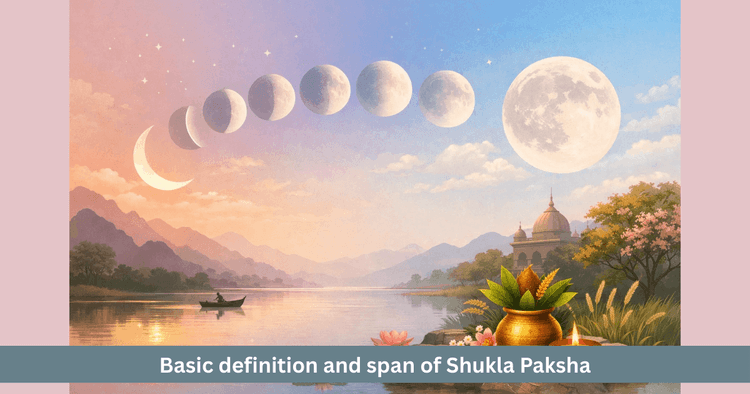
Table of Contents
To truly understand the Hindu panchanga, it is not enough to know only the date or weekday. The waxing and waning of the Moon, namely Shukla Paksha and Krishna Paksha, form the foundation for understanding life’s rhythm and auspicious timings. Among these, Shukla Paksha is the fortnight when the Moon grows brighter each day, nights become more luminous and nature itself moves towards expansion and growth.
Basic definition and span of Shukla Paksha
In Sanskrit “shukla” means bright, white or full of light and “paksha” means side or fortnight. Thus Shukla Paksha is the bright half of the lunar month in which the Moon increases in size and brilliance and its glow in the sky becomes slightly stronger each day.
A Hindu lunar month is considered to contain about 30 tithis.
- The half in which the Moon waxes is called Shukla Paksha.
- The half in which the Moon wanes is called Krishna Paksha.
In most Vedic traditions Shukla Paksha is counted from the day after Amavasya up to Purnima. Many authorities include Purnima itself in Shukla Paksha, making it effectively a 15 tithi period in practice.
Tithis and lunar phases of Shukla Paksha
During Shukla Paksha the Moon rises from the darkness of Amavasya and gradually reaches the fullness of Purnima. The sequence of tithis brings clarity to this journey.
| Order | Name of tithi |
|---|---|
| 1 | Amavasya |
| 2 | Pratipada |
| 3 | Dwitiya |
| 4 | Tritiya |
| 5 | Chaturthi |
| 6 | Panchami |
| 7 | Shashthi |
| 8 | Saptami |
| 9 | Ashtami |
| 10 | Navami |
| 11 | Dashami |
| 12 | Ekadashi |
| 13 | Dwadashi |
| 14 | Trayodashi |
| 15 | Chaturdashi |
| 16 | Purnima (in many traditions counted as the peak of Shukla Paksha) |
Immediately after Amavasya, the Moon appears as a thin crescent. With each passing tithi its disc and radiance expand until on Purnima the Moon shines in complete fullness.
Why Shukla Paksha is regarded as auspicious and growth oriented
The energy of Shukla Paksha is seen as a symbol of increase, development and positive expansion.
- The Moon represents mind and emotion. As the Moon grows, the symbolic reading is that mental stability, enthusiasm and creativity also gain support.
- For this reason Shukla Paksha is generally preferred for marriages, house warming, starting new business ventures, purchasing property or vehicles and performing many samskaras and ceremonies.
- Spiritually too this is considered a favourable time for beginning new japa, sadhana or vows because the rising lunar energy is believed to support fresh efforts.
Many major festivals such as Chaitra Navaratri and Ashvin Navaratri are celebrated in Shukla Paksha so that the worship of Devi coincides with the uplifting flow of the waxing Moon.
Balanced view of Shukla and Krishna Paksha
Although Shukla Paksha is widely regarded as auspicious, this does not mean that Krishna Paksha is always inauspicious. Both halves together complete the lunar cycle.
- In Shukla Paksha, conditions favour new beginnings, outward growth and constructive initiatives, while Krishna Paksha is more suited to letting go, simplifying and inner cleansing.
- Some Vedic perspectives highlight that from the tenth tithi of Shukla Paksha to the fifth tithi of Krishna Paksha, the brightness of the Moon remains especially strong and this entire span can be considered very supportive for many undertakings.
A balanced approach therefore recognises that Shukla Paksha is ideal for planting new seeds while Krishna Paksha is the natural time to remove old, dry leaves from the same plant.
Astrological tendencies of those born in Shukla Paksha
In Indian astrology it is also believed that the phase of the Moon at birth influences the temperament of an individual. When the Moon is in Shukla Paksha at birth, certain tendencies are often noted.
- Such natives typically show a keen desire to learn and an active curiosity.
- Their personality can appear pleasant and attractive, drawing others to them without much effort.
- They are often seen as responsible and hardworking, moving steadily forward in life, just as the Moon grows step by step during Shukla Paksha.
At the same time a person’s full character is never judged by paksha alone. The entire birth chart, including ascendant, planetary positions and dashas, must be studied carefully.
Spiritual and practical use of Shukla Paksha
When understood wisely, Shukla Paksha becomes more than a tool for selecting auspicious dates and turns into a natural guide for planning life.
- The early days of Shukla Paksha can be used to start long pending resolutions and projects.
- New habits such as regular japa, yoga, study or acts of service often settle more easily when begun in this phase, as one feels inwardly supported by the rising lunar momentum.
- In business, education and relationships, Shukla Paksha gently inspires movement towards dialogue, progress and openness to new opportunities.
In this way Shukla Paksha can serve not only as calendar information but also as a framework for advancing both inner and outer journeys in a balanced manner.
Frequently asked questions about Shukla Paksha
Should every auspicious work be done only in Shukla Paksha
For most major auspicious works Shukla Paksha is indeed preferred, yet it is not an absolute rule. In practice astrologers also consider tithi, nakshatra, yoga and the charts of those involved. As general guidance, however starting new ventures in Shukla Paksha is usually safer and more harmonious.
Are all tithis in Shukla Paksha equally favourable
No, each tithi has its own nature. Some are linked to particular deities or vows and some are better suited to certain activities than others. Even within Shukla Paksha it is important to assess tithi and nakshatra before finalising a date.
Does spiritual practice give better results in Shukla Paksha
Many practitioners experience that beginning new mantras or disciplines in Shukla Paksha feels smoother, with more stability and enthusiasm. The waxing Moon seems to encourage new efforts, though the depth of result always depends on sincerity and perseverance.
What special traits may be seen in those born during Shukla Paksha
They are often inclined towards growth, responsibility and constructive action. A gentle manner, pleasant personality and aspiration to progress are frequently observed but final conclusions always require a full chart analysis.
How can Shukla Paksha be used practically in daily life
One can plan important meetings, launches, new routines and fresh commitments during Shukla Paksha as far as possible. This alignment often brings a subtle sense of support and confidence, as if the environment itself is saying that it is indeed the right time to move forward.
Get your accurate Kundali
Generate KundaliDid you like it?
Author

Pt. Abhishek Sharma (63)
Experience: 20
Consults About: Family Planning, Career
Clients In: Punjab, Haryana, Delhi
Share this article with friends and family
WELCOME TO
ZODIAQ
Right Decisions at the right time with ZODIAQ
