Ganesh Chaturthi Moon Sightings
By Pt. Nilesh Sharma
The false stigma account, psychology and discerning remedies
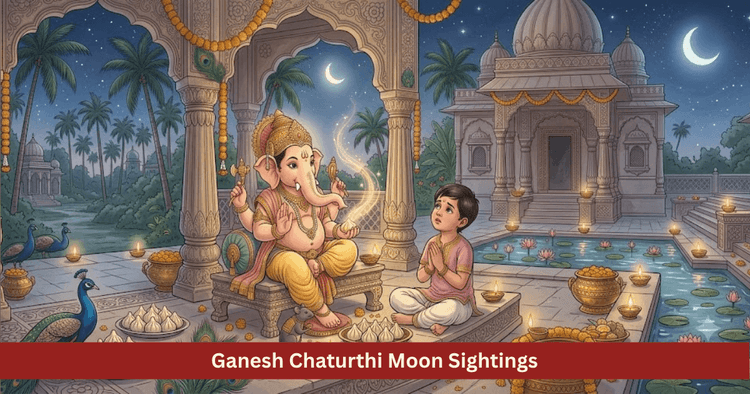
Table of Contents
Tithi, Restriction Period and Remedies
On Ganesh Chaturthi, observed on Bhadrapada Shukla Chaturthi, the tradition advises avoiding the sight of the Moon. This custom is mainly connected with the night period when the Moon is visible in the sky. Moonrise and the restriction period change according to location and year, so the exact time should be checked through the local Panchang.
If someone sees the Moon unknowingly, there is no need for fear. Tradition regards remembrance of Lord Ganesha, listening to the Syamantaka Mani account and truthful conduct as means of inner peace. The purpose is not to fill the mind with fear but to develop alertness against false accusations, confusion and careless speech.
Key Details
| Subject | Details |
|---|---|
| Tithi | Bhadrapada Shukla Chaturthi |
| Festival | Ganesh Chaturthi |
| Tradition | Avoid Moon sighting at night |
| Worshipped deity | Lord Ganesha |
| Main account | Syamantaka Mani account |
| Central message | Discernment, humility and truthfulness |
Essential Rules for the Day
- Know the Moon sighting restriction period for Ganesh Chaturthi from the local Panchang
- Do not consider yourself guilty or fearful if the Moon is seen unknowingly
- Remember Lord Ganesha with devotion
- Resolve to speak truth and not make false accusations against anyone
- Avoid haste in speech, behaviour and decisions
- Do not spread a disputed matter without verifying it
- Maintain peace and clear communication in the family
The Moon in the Sky and the Mirror of Mind
In Vedic astrology, Chandra, the Moon, is regarded as the significator of mind, memory, imagination, emotions and social image. The light of the Moon makes emotions moving within a person seem visible from outside. This is why stories related to the Moon do not only describe a celestial event. They also point toward restlessness of mind, ego and confusion.
The tradition of avoiding Moon sighting on Ganesh Chaturthi should be understood in this wider meaning. It reminds a person that it is not right to make an immediate judgment after seeing a scene, hearing news or receiving a statement. The mind often creates a story based on incomplete information and that story may later become a cause of stigma for someone.
The Sacred Account Behind Moon Sighting Restriction
According to a well known account, Lord Ganesha had eaten many Modakas and set out on his vehicle, Mushaka. When Mushaka became frightened on the way, Lord Ganesha fell. The Moon laughed after seeing this scene. Lord Ganesha became displeased by this mockery and cursed the Moon that anyone who saw it on the night of Bhadrapada Shukla Chaturthi could face a false stigma.
Later, the Moon sought forgiveness. The effect of the curse was then limited and the tradition developed that Moon sighting should be avoided on the night of Ganesh Chaturthi. This account contains the message of the harmful consequences of mockery and the need for humility. Laughing at another person's difficulty or commenting without understanding a situation can create bitterness and false impressions in relationships.
Syamantaka Mani and the Stigma on Shri Krishna
Another important account related to Moon sighting restriction is that of Syamantaka Mani. According to the account, Shri Krishna unknowingly saw the Moon during the restricted time of Ganesh Chaturthi. Later, when Syamantaka Mani went missing, a false allegation of theft was made against him.
Shri Krishna did not run away from the accusation. He searched for truth, examined the events and looked at the evidence. In the end, the real secret of the Mani emerged and his honour was restored. This account teaches that the response to a false accusation is not fear, anger or retaliation but patience, facts and truthful effort.
Life Lessons From the Syamantaka Mani Account
- Do not accuse anyone without evidence
- Do not make decisions in emotional agitation when accused
- Examine facts patiently to reach truth
- Good conduct is the strongest foundation for protecting reputation
- Stay away from matters that spread confusion
Chaturthi, Chandra and Psychological Meaning
Chaturthi Tithi is associated with Lord Ganesha, the remover of obstacles. Ganesha is the deity of intelligence, discernment, beginnings and solutions to obstacles. Chandra is the significator of the mind. therefore one subtle meaning of avoiding Moon sighting on Ganesh Chaturthi is that the reaction of the mind should not be trusted without the guidance of intelligence.
Forming an opinion immediately after hearing something about a person, joining social discussion without knowing the truth, worrying excessively about personal image or treating a small matter as insult can be forms of mental instability. Ganesh worship teaches the practice of taking a discerning pause amid these tendencies.
How False Stigma Can Form in the Mind
| Mental tendency | Possible result |
|---|---|
| Trust in incomplete information | False impression |
| Mockery or harsh comment | Distance in relationships |
| Spreading rumours | Harm to reputation |
| Ego | Difficulty in accepting mistakes |
| Fear | Untruthful or defensive behaviour |
This table is not meant to blame anyone. It is meant for self reflection. Recognising these tendencies of mind can be the beginning of reducing their influence.
Astrological Sensitivity
On Bhadrapada Shukla Chaturthi, the Moon is approximately (48^\circ) away from the Sun because each Tithi is based on an interval of about (12^\circ) between the longitudes of the Sun and Moon. On Chaturthi, this angle indicates a particular movement between mind and self awareness. Tradition connected this with alertness of the mind through the restriction on Moon sighting.
It should not be understood as a certain astronomical announcement of harm. In Vedic astrology, planetary positions are considered in the context of the time of birth, Dasha, transit and the complete birth chart. This Ganesh Chaturthi tradition more broadly draws attention to reactions of the mind, social image and responsibility in speech.
Symbolic Dialogue of Surya and Chandra
| Astrological element | Indication | Practical lesson |
|---|---|---|
| Surya | Selfhood, reputation and clarity | Rise above ego and see truth |
| Chandra | Mind, emotion and image | Pause before reacting |
| Chaturthi | Ganesha principle and discernment | Seek a solution in obstacles |
| Ganesh worship | Intelligence and humility | Make proper decisions and communicate calmly |
What if Moon Is Seen Unknowingly
There is no need for excessive worry or fear if the Moon is seen unknowingly. The purpose of any religious remedy is to create peace, humility and steadiness in dharma within the mind. In this situation, one may remember Lord Ganesha, read or listen to the Syamantaka Mani account and resolve to keep conduct more truthful.
Tradition holds that some people chant a Ganesha mantra and offer Modakas or other sattvic food offerings. If a detailed worship is not possible, offering respectful salutations to Lord Ganesha with a calm mind, resolving to stay away from untruth and refusing to form unfair impressions about anyone are also meaningful.
Simple Remedies for Peace
- Light a lamp before Lord Ganesha
- Offer Durva grass, flowers or available sattvic food offering
- Chant a Ganesha mantra with a calm mind
- Remember or listen to the Syamantaka Mani account
- Resolve to avoid untruth, gossip and unnecessary disputes
- Make it a rule to know facts before accusing anyone
- Keep faith and discernment in place of fear
Ganesha Mantra
Om Gam Ganapataye Namah
This mantra means salutations to Lord Ganapati, the remover of obstacles. It may be chanted as a prayer for a steady mind and rightly directed intelligence.
The Real Remedy Against Stigma
The most effective remedy against false stigma is not only a one day ritual but truthful conduct in everyday life. Clear behaviour, proper communication, transparency in financial dealings, respect for others and refusal to reach conclusions without evidence protect a person's reputation.
At times, a false allegation may still arise against a person. In such a situation, it is not right to blame oneself completely. Presenting facts patiently, communicating with trustworthy people and seeking appropriate support in legal or social situations may also be necessary. Spiritual faith gives a person the strength to remain firm in values even during difficult times.
Reputation Protected Through Discernment
The tradition of avoiding Moon sighting on Ganesh Chaturthi gives a message of discernment, not fear. It makes a person alert toward mockery, rumours, false accusations and hastily formed impressions. Worship of Lord Ganesha is a practice of intelligence, humility and finding the right path in obstacles.
When the mind is restless like the Moon, the steady intelligence of the Ganesha principle becomes necessary. A person who lives with truth, patience and compassion can gradually keep reputation safer and relationships more sacred.
FAQ
Why should the Moon not be seen on Ganesh Chaturthi
According to tradition, Moon sighting on this night may bring false stigma. Its deeper message is to avoid hasty judgments and rumours.
What should be done if the Moon is seen unknowingly on Ganesh Chaturthi
Do not be afraid. Remember Lord Ganesha, listen to the Syamantaka Mani account and resolve to act truthfully.
What is the connection between Syamantaka Mani and Ganesh Chaturthi
According to the account, after Moon sighting, Shri Krishna faced a false allegation of stealing Syamantaka Mani, which he removed by seeking truth.
Until when does the Moon sighting restriction remain on Ganesh Chaturthi
The restriction period changes according to Moonrise and the local Panchang. It is appropriate to know the exact time for one's area.
What is the best remedy against false stigma
Truthful conduct, clear communication, avoiding accusations without evidence and patience during disputes are the most effective remedies.
Get your accurate Kundali
Generate KundaliDid you like it?
Author

Pt. Nilesh Sharma (63)
Experience: 20
Consults About: Family Planning, Career
Clients In: Punjab, Haryana, Delhi
Share this article with friends and family
WELCOME TO
ZODIAQ
Right Decisions at the right time with ZODIAQ
