Hartalika Teej Sacred Vow
By Aparna Patni
Tithi and main details
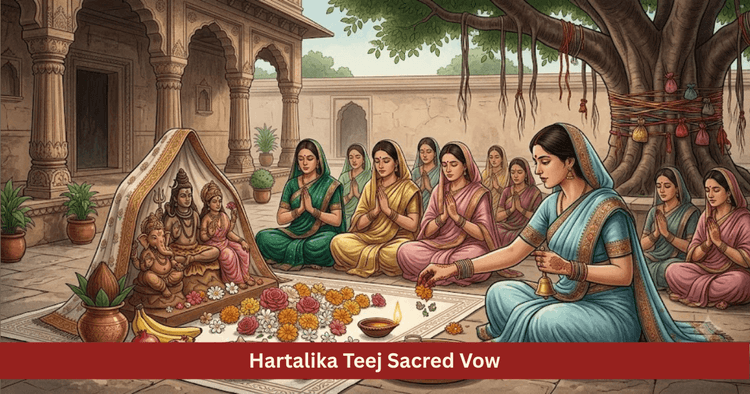
Table of Contents
Tithi and Main Details
Hartalika Teej is observed on the Tritiya tithi of the Shukla Paksha in the month of Bhadrapada. This vow is a sacred symbol of the determination, faith and self control of women. According to tradition, Goddess Parvati went into the forest and performed austere fasting without food and water in order to attain Lord Shiva as her husband.
| Subject | Details |
|---|---|
| Festival | Hartalika Teej |
| Tithi | Bhadrapada Shukla Tritiya |
| Main deities | Goddess Parvati and Lord Shiva |
| Nature of the vow | Without food and water, discipline based |
| Main themes | Eternal marital well being, faith, purity |
| Astrological effect | Purification of the seventh house, balance of Venus and Mars |
The outer form of this vow is certainly difficult but its inner feeling is extremely soft and profound. It is not only a wish for marital well being but also a path of purification for the mind, body and consciousness. Hartalika Teej teaches that true good fortune is not only external gain. It is also shaped by inner firmness.
The Spiritual Meaning Of Hartalika Teej
The core message of Hartalika Teej lies in the sacred bond between Parvati and Shiva. The penance through which Goddess Parvati attained Lord Shiva as her husband was the highest form of determination. This practice shows that when desire is joined with dharma, divinity supports it.
- A festival of resolve and surrender
- A lesson in penance and patience
- A living expression of feminine strength
- An opportunity for purification of body and mind
This vow does not only symbolise women's power. It establishes it as a real spiritual force. Desire, waiting and reverence come together beautifully in this observance.
The Bond Between Parvati And Shiva
The relationship between Goddess Parvati and Lord Shiva is not only the ideal of marriage. It is also the symbol of perfect balance. Parvati represents surrender and energy. Shiva represents stability and consciousness. Hartalika Teej awakens that balance once again.
| Element | Symbol |
|---|---|
| Parvati | Resolve, penance, strength |
| Shiva | Stability, consciousness, detachment |
| Relationship | Balanced marriage |
| Vow feeling | Ideal life harmony |
A woman who observes this vow with reverence is not only praying for her husband's longevity. She is also awakening her own strength, dignity and self respect. That is the unique value of this festival.
Hartalika Teej From An Astrological View
In astrology, this vow is considered especially connected with the seventh house of the horoscope. The seventh house governs marriage, spouse and the quality of relationships. Through this practice, one may seek to calm defects in that house.
| House or planet | Effect |
|---|---|
| Seventh house | Marriage and partnership |
| Venus | Love and attraction |
| Mars | Energy and intensity in relationships |
| Balance | Harmony and stability |
If there is an obstacle in the seventh house of a horoscope or if Venus and Mars are out of balance, this vow is considered helpful on a mental and spiritual level. Its effect is not limited to marriage alone. It touches the whole consciousness of relationship.
Balance Of Venus And Mars
Venus is the significator of love, beauty, attraction and softness in relationships. Mars represents energy, courage, intensity and action. When these two are not balanced, relationships may become either too soft or unnecessarily intense.
- If Venus is too strong, attraction remains but stability may weaken
- If Mars is too strong, enthusiasm remains but peace may reduce
- Balance makes relationships sweet and firm
The vow of Hartalika Teej is a subtle way of creating harmony between these two forces. It does not suppress emotions. It gives them culture and direction.
Why Is This Vow Considered So Difficult
Hartalika Teej is considered difficult because it is observed without food and water. But the purpose of this difficulty is not to torture the body. Its purpose is to place body, mind and speech in one single resolve.
- Fasting strengthens restraint
- Remaining without water deepens the intensity of penance
- Silence and wakefulness turn the mind inward
- Difficulty tests the strength of resolve
This vow is not a matter of ordinary desire. It is a vow of deep faith. Those who observe it are not only following tradition. They are also testing inner strength. That is why it is considered a great spiritual discipline.
A Festival Of Feminine Strength
Hartalika Teej is a celebration of the unbreakable resolve of Indian women. In this observance, the woman does not appear only as a devotee. She appears as a seeker and ascetic. The festival shows that feminine strength can be gentle and yet extremely firm.
| Quality | Meaning |
|---|---|
| Faithfulness | Inner firmness |
| Penance | Self control |
| Patience | Emotional balance |
| Reverence | Spiritual strength |
This vow gives women a deep sense of self respect. It is not only a wish for an external result. It is a celebration of inner identity. That is why its importance is both social and spiritual.
The Meaning Of Marital Good Fortune
Hartalika Teej is called a vow for eternal marital good fortune. Good fortune here does not mean only marital status. It also means stability, love, dignity and protection in life. Marital auspiciousness is not only an outer symbol. It is a complete balance of life.
| Word | Deeper meaning |
|---|---|
| Good fortune | A rich and balanced life |
| Marital dignity | Grace of partnership |
| Continuity | Protection and stability |
| Decorum | Purity in relationships |
In this vow, inner feeling matters more than outer symbols. When the mind becomes full of reverence, the meaning of good fortune becomes much broader.
Mental And Emotional Benefits Of The Vow
Hartalika Teej is not only a religious ritual. It can also have a deep psychological and emotional effect. When a person lives even one day with complete resolve, a new power of self control awakens.
- Patience increases
- Willpower becomes stronger
- Emotional stability grows
- Awareness toward relationships deepens
This vow teaches the mind that love is not only a matter of comfort. Love also requires discipline, sacrifice and reverence. That is what makes it special.
What Feeling Should Be Kept In This Vow
Hartalika Teej should not be observed only as a ritual. In its practice, reverence, humility and silence are especially important. The observer should keep feelings steady within and should not treat the vow as a performance.
- Begin with reverence
- Focus on feeling more than the body
- Keep speech restrained
- Place the mind in the remembrance of Shiva and Parvati
When feelings are pure, the effect of the vow becomes deeper. That is why this Teej is regarded as a festival of penance and surrender.
The Deeper Astrological Message
The deeper astrological message of Hartalika Teej is that relationships are purified not only by outer remedies. Stability in outer life comes when the inner planets are balanced. The seventh house, Venus and Mars are symbolically harmonised through this vow.
| Sign | Meaning |
|---|---|
| Seventh house | Stability of marriage |
| Venus | Softness of love |
| Mars | Restraint of energy |
| Vow | Mental and spiritual purification |
This festival teaches that relationships strengthened through penance, faith and reverence become more lasting and sweeter. That is its astrological power.
FAQ
When is Hartalika Teej observed?
Hartalika Teej is observed on the Tritiya tithi of the Shukla Paksha in the month of Bhadrapada.
What is the main religious significance of Hartalika Teej?
It is the sacred remembrance of Goddess Parvati's penance and her attainment of Lord Shiva as her husband.
Which house is Hartalika Teej connected with in astrology?
This vow is mainly connected with the seventh house, which represents marriage and partnership.
What effect is this vow believed to have on Venus and Mars?
It is believed to calm the imbalance of Venus and Mars and bring harmony into relationships.
Why is Hartalika Teej considered a difficult vow?
Because it is observed with fasting and without water, demanding deep resolve and self control.
Get your accurate Kundali
Generate KundaliDid you like it?
Author

Aparna Patni (63)
Experience: 20
Consults About: Family Planning, Career
Clients In: Punjab, Haryana, Delhi
Share this article with friends and family
WELCOME TO
ZODIAQ
Right Decisions at the right time with ZODIAQ
