What Is The Glory Of Ananga Trayodashi (Madana Trayodashi) In Chaitra?
By Pt. Amitabh Sharma
Adoration Of Kama-Rati, Ashoka Tree Science, Five Floral Arrows And Marital Harmony
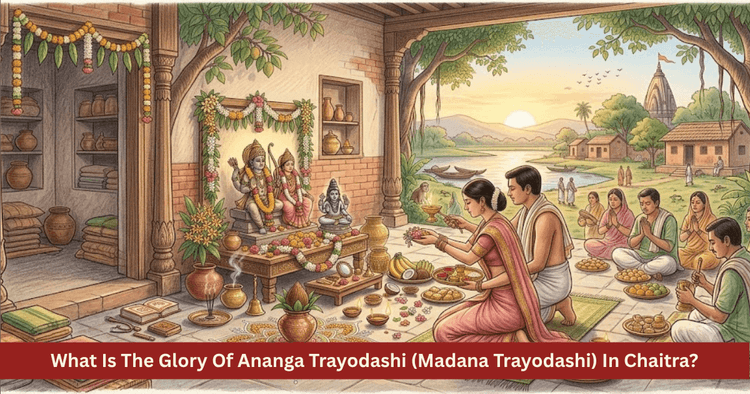
Table of Contents
Panchang Description And The Astrological Dimensions Of Ananga Trayodashi
Within the mathematical cosmology of the classical Vedic calendar and the esoteric Agamic treatises, the thirteenth lunar day (Trayodashi) of the bright fortnight (Shukla Paksha) of the month of Chaitra is celebrated across the cosmos as Ananga Trayodashi-also revered in classical Sanskrit literature as Madana Trayodashi or Kama-Rati Mahotsava. Occurring at the zenith of the spring season (Vasanta Ritu) and following the internal ascetic purification of Kamada Ekadashi, this sacred date represents the celestial gateway for refining human emotional love, somatic beauty, magnetic attraction (Sammohana), vitality (Ojas) and marital harmony.
From an astronomical and astrological perspective, Chaitra Shukla Trayodashi marks that precise seasonal junction where terrestrial botanical life, floral pollens and biological neuro-endocrine systems experience their peak vitality. During this temporal window, Lord Surya Deva approaches the threshold of his exaltation sign of Aries, while the Moon transits the asterisms of Uttara Phalguni or Hasta. The Trayodashi tithi is co-ruled by Kamadeva (the archetype of pure desire and life-force) and Lord Mahadeva Shiva (the sovereign conqueror of primal lust). In predictive astrology, physical beauty, romantic harmony and reproductive vitality are governed by Venus (Shukra) and the Moon (Chandra). Spiritual sadhana executed upon Ananga Trayodashi transmutes base carnal lust into satvic, enduring marital fidelity and mutual spiritual reverence.
| Astrological and Astronomical Factor | Classical Scriptural and Metaphysical Description |
|---|---|
| Lunar Month and Fortnight | Chaitra Month, Shukla Paksha (Bright Fortnight) |
| Lunar Tithi | Trayodashi (Thirteenth Station, active during Pradosha) |
| Canonical Liturgical Titles | Ananga Trayodashi, Madana Trayodashi, Kama-Rati Vrata |
| Sovereign Presiding Powers | Kamadeva (Manmatha / Madana) and Goddess Rati (Delight) |
| Supreme Overseeing Divinity | Lord Mahadeva Shiva and Mother Adishakti Parvati |
| Governing Astrological Planets | Venus (Shukra: Love & Harmony) and Moon (Chandra: Mind) |
| Sacred Botanical Symbols | The Sacred Ashoka Tree (Saraca asoca) & Mango Blossoms |
| Sacramental Altar Offerings | Scarlet Ashoka flowers, natural rose attar, saffron milk rice, betel |
| Bestowed Spiritual Fruit | Resolving Marital Strife, Magnetic Grace, Radiant Vitality |
To assimilate the refined aesthetic and marital blessings of Kamadeva and Goddess Rati on Ananga Trayodashi, a seeker must observe disciplined scriptural decorum from dawn onward:
- Awaken before sunrise during Brahma Muhurta, bathing in fresh ambient water consecrated with natural rose water, jasmine extract and saffron strands.
- Dress in clean, unstitched or festive cotton/silk garments of pristine white, gentle rose-pink or radiant crimson hues.
- Construct an altar beneath the sheltering canopy of an Ashoka tree in a garden; if unavailable, consecrate the northeastern quadrant of the domestic sanctuary.
- Seat an icon, sacred metallic yantra or consecrated portrait of Kamadeva and Goddess Rati upon a silver or copper platter draped in crimson silk.
- Kindle an unbroken lamp fueled by pure indigenous cow clarified butter mixed with sandalwood oil before the altar.
- Present fresh mango blossoms (Amra Manjari), jasmine, Arabian night-jasmine (Mogra) and scarlet Ashoka flowers before the deities.
- Recite the classical Kama Gayatri or the sovereign sonic seed KLEEM at least 108 or 1,008 times with inward stillness.
- Maintain a clean satvic fast throughout the day; partake exclusively of seasonal fruits, cow milk and saffron confections, eliminating anger, dispute and vulgar thoughts.
- Consecrate an abhisheka of milk and sacred water over the Shiva Lingam at twilight (Pradosha Kala), reciting the Uma-Maheshwara Stotra to ensure that desire remains anchored in moral duty.
- For married couples, sit together at the domestic altar, offering fragrant sandalwood paste, flower garlands and sweet betel leaves (Tambula) to one another as a vow of lifelong fidelity.
Puranic Lore: The Incineration Of Desire And The Advent Of The Bodiless Form
The Rudra Samhita of the Shiva Purana, the Matsya Purana and Kalidasa's classical masterpiece Kumarasambhavam preserve the authentic narrative of the incineration and bodiless rebirth of Kamadeva.
Following the tragic self-immolation of Sati at Daksha's sacrificial arena, Lord Mahadeva Shiva entered deep, unshakeable meditation upon the remote peaks of the Himalayas. In his absence, the cosmic order fractured and the demon Tarakasura conquered the three worlds. Tarakasura possessed a divine boon granting that he could be slain only by a child born of the union of Shiva and Parvati.
Seeking to awaken the Lord from meditation, King Indra commanded Kamadeva (the god of cosmic desire) to disrupt Shiva's samadhi. Accompanied by his devoted consort Rati and his celestial companion Vasanta (Spring), Kamadeva entered the hermitage. Vasanta transformed the mountain slopes into an intoxicating paradise of blossoming trees, humming bees and calling cuckoos. Stepping forward, Kamadeva strung his bow and released the arrow of infatuation (Mohana) directly at the heart of the meditating Lord.
The arrow disturbed the cosmic balance. Lord Shiva opened his eyes and perceiving the disruption, his third eye-the blazing vortex of transcendental wisdom and cosmic fire-opened. A column of fire erupted, reducing Kamadeva to a mound of ash within seconds.
| Narrative Milestone | Puranic and Metaphysical Detail | Philosophical Meaning |
|---|---|---|
| The Arrow of Infatuation | Kamadeva targeting the heart of the ascetic Lord | External desire attempting to conquer internal stillness |
| Opening of the Third Eye | Shiva's fire reducing Kamadeva to ashes | Transcendent wisdom incinerating sensory compulsion |
| The Lament of Goddess Rati | Rati weeping over the mound of sacred ash | Worldly beauty grieving the loss of its vital principle |
| Compassion of Parvati | Mother Parvati petitioning Shiva for mercy | Divine feminine grace restoring fallen life-forces |
| The Boon of Ananga | Bestowing the bodiless, omnipresent form | Love liberated from physical confinement into spirit |
| Consecration of Trayodashi | Chaitra Shukla Trayodashi designated for his worship | The annual celebration of refined, spiritualized love |
Witnessing the destruction of her husband, Goddess Rati collapsed in despair, smearing the ashes over her form. Following the sacred marriage of Shiva and Parvati, the Divine Mother pleaded for mercy on Rati's behalf: "O Supreme Lord! Kamadeva acted not out of personal vanity but to serve the gods and orchestrate our divine union. Grant life once more to the lord of love."
Lord Mahadeva smiled and declared:
"O Divine Mother! The mortal, physical frame of Kamadeva has been dissolved, yet upon this sacred thirteenth lunar day of the bright fortnight of Chaitra, he shall be reborn as Ananga-the Bodiless One. Henceforth, he shall pervade the universe as a subtle, omnipresent thoughtform dwelling within the hearts, minds and aesthetic sensitivities of all living beings. In the Dvapara Yuga, he shall take physical birth once more as Pradyumna, the son of Lord Sri Krishna and Queen Rukmini."
Comforted by this boon, Goddess Rati worshiped the subtle form of her consort upon Chaitra Shukla Trayodashi. Ever since, this date has been commemorated as Ananga Trayodashi, honoring the triumph of refined love over carnal compulsion.
The Subtle Psychology Of Kamadeva's Five Floral Arrows
In classical Shakta Tantra and Sanskrit aesthetics, Kamadeva represents the architect of human emotion rather than physical lust. His iconography outlines a detailed map of human neuro-psychology:
- The Sugarcane Bow (Ikshu Dhanusha): His bow is crafted from sweet sugarcane, strung with a line of humming honeybees. This symbol reveals that love is intrinsically sweet, yet accessing its depth requires endurance, patience and vigilance against the sting of attachment.
- The Five Floral Arrows (Pancha Bana): His quiver contains five arrows fashioned from seasonal blossoms, each targeting a distinct cognitive and physiological center:
| Floral Arrow Name | Botanical Source | Associated Psychic Center | Psychological & Somatic Effect |
|---|---|---|---|
| 1. Aravinda (The Lotus) | White / Red Lotus | Heart Center (Anahata Chakra) | Awakening of reverence, attraction and emotional awe |
| 2. Ashoka (Ashoka Flower) | Scarlet Ashoka Blossom | Pelvic Center (Swadhishthana) | Dissolution of grief, deep romantic yearning |
| 3. Chuta (Mango Blossom) | Fresh Mango Blossom | Throat Center (Vishuddha Chakra) | Eloquent expression, shedding shyness, romantic confession |
| 4. Navamallika (Jasmine) | Star Jasmine / Mogra | Brow Center (Ajna Chakra) | Sweet fascination, mental absorption, fascination |
| 5. Nilotpala (Blue Lily) | Sacred Blue Lily | Entire Central Nervous System | Total emotional surrender, somatic dissolution of ego |
- The Parrot Steed (Shuka Vahana): Kamadeva rides an emerald-green parrot, the traditional symbol of articulate speech, affectionate repetition and vocal charm.
- The Crocodile Standard (Makara Dhvaja): His royal pennant bears the emblem of the Makara (water dragon or crocodile), signifying the hidden, powerful depths of the subconscious emotional currents residing within the water element.
Botanical Science And Esoteric Alchemy Of The Ashoka Tree
Classical texts prescribe that the worship of Kamadeva and Goddess Rati on Ananga Trayodashi should be conducted beneath a blooming Ashoka Tree (Saraca asoca):
Ashoka shoka-shamanah kamadah kama-vardhanah.
Tvam namami vishalaksha Kamadeva-priyaya vai.
1. Botanical and Endocrine Therapeutics
- The Dispeller of Grief: In Sanskrit, Ashoka literally denotes: 'That which eliminates sorrow' (A-Shoka). Modern pharmacognosy confirms that the bark and blossoms of the Ashoka tree contain bioactive phytosterols, flavonoids and tannins that nourish the female endocrine system, regulating reproductive hormones and relieving physical stress.
- Aromatherapy and Pheromone Balance: During the early spring bloom, the flowers emit subtle aromatic compounds that stimulate the hypothalamic-pituitary-adrenal axis in the human brain, lowering cortisol levels and promoting the release of oxytocin, the hormone of bonding and trust.
2. The Esoteric Bio-Field
In esoteric Agamas, the Ashoka tree is recognized as a living sanctuary for subtle nature spirits (Yakshas and Gandharvas). Chanting the Kama Gayatri beneath its canopy aligns the practitioner's auric field with frequencies of grace, charm and emotional balance.
Step-By-Step Liturgical Protocol For Ananga Trayodashi
To conduct the traditional worship of Kamadeva and Goddess Rati on Chaitra Shukla Trayodashi, observe the following liturgy:
- Altar Setup: Spread clean red or rose-pink silk over a wooden platform beneath an Ashoka tree or in the domestic shrine. Inscribe a six-pointed star or an eight-petaled lotus using raw rice grains. Position an icon, portrait or two consecrated areca nuts (symbolizing Kama and Rati) upon a silver platter.
- Meditation and Invocation: Hold fresh blossoms in cupped hands and meditate upon the divine couple:
Om Kamadevaya Vidmahe Pushpabanaya Dheemahi Tanno Anangah Prachodayaat.
Dhyayet kamam sa-chapam kusuma-maya-sharam sarva-lokaika-kantam,
Ratya yuktam vasanta-priya-sakham-amalam pushpa-ketum prasannam. - Sixteenfold Worship (Shodashopachara):
- Ablutions: Offer water scented with pure rose water and kewra essence.
- Anointing: Apply natural white sandalwood paste, musk and pure rose attar upon the altar.
- Floral Offerings: Present fresh mango blossoms, fragrant jasmine, red roses and scarlet Ashoka flowers.
- Food Offerings (Naivedya): Offer sweet rice pudding infused with saffron (Kesar Kheer), crystalline rock sugar, red pomegranates and sweet betel leaves garnished with cloves and cardamom (Tambula).
- Mantra Recitation: Using a clear quartz crystal or lotus-seed rosary, chant one of the classical formulas at least 108 or 1,008 times:
Om Kleem Kamadevaya Namah.
or
Om Kamadevaya Vidmahe Pushpabanaya Dheemahi Tanno Anangah Prachodayaat. - The Worship of Shiva-Parvati (Anchoring Moral Duty): Immediately following the rites, offer pure water and bilva leaves over a Shiva Lingam. This step ensures that romantic vitality remains anchored in spiritual duty and mutual respect, mirroring the union of Shiva and Parvati.
- Marital Blessing: Spouses mark each other's brows with fragrant sandalwood paste, exchange floral garlands and wave camphor flames together before the altar.
Remedies For Marital Harmony And Relational Healing
For relationships challenged by communication barriers, cooling affection or chronic domestic tension, the rituals of Ananga Trayodashi offer traditional remedies:
| Marital Challenge | Underlying Astrological Factor | Prescribed Liturgical Remedy |
|---|---|---|
| Chronic Marital Conflict | Sun-Venus or Mars-Venus friction in natal chart | Anoint natural rose attar upon the navel and throat centers for 40 consecutive days |
| Loss of Romantic Affection | Debilitated or afflicted natal Venus | Pour raw cow milk and saffron water at the roots of an Ashoka tree; circumambulate seven times |
| Delays in Finding a Spouse | Weak Jupiter-Venus connections | Offer a sacred red thread uniting Shiva-Parvati icons while chanting the seed KLEEM 108 times |
| Trust Deficits and Tension | Afflictions to the 7th house by Rahu/Ketu | Present two sweet betel leaves (Tambula) filled with rose petals before Kama-Rati at dusk |
The Metaphysics Of Desire: Transmuting Passion Into Awareness
The philosophical heart of Ananga Trayodashi lies not in the puritanical suppression of desire but in its conscious sublimation (Uddhatikarana).
Sanatana Dharma does not condemn desire as sin; rather, it places Kama alongside Dharma (duty), Artha (security) and Moksha (liberation) as one of the four essential pillars of human existence (Purusharthas). In the Bhagavad Gita, Lord Sri Krishna declares: "Dharmaviruddho bhooteshu kamo-asmi Bharatarshabha"-I am that desire in living beings which is aligned with righteousness.
- Lust (Kama as Compulsion): When desire remains confined to selfish physical gratification and exploitation, it degrades human consciousness, fueling greed, anger and moral decline.
- Love (Prema as Connection): When desire matures into mutual sacrifice, empathy and emotional fidelity, it manifests as the pure bond of Rati and Madana.
- Spiritual Awakening (Samadhi as Transcendence): When romantic devotion expands to embrace all creation and the Divine, it merges into the spiritual wisdom of Lord Shiva's third eye.
The bodiless nature of Kamadeva (Ananga) reveals that enduring love does not reside in the physical body alone; it dwells within the soul, the mind and the subtle spiritual link between two beings. Physical forms age and change but love anchored in moral integrity and spiritual reverence remains eternal-radiant, ever-new and indestructible like Ananga.
FAQ
On which specific lunar date is Ananga Trayodashi celebrated?
Ananga Trayodashi is celebrated annually on the thirteenth lunar day (Trayodashi) of the bright fortnight of Chaitra, at the peak of the spring season.
Why is Kamadeva called 'Ananga'?
Following the incineration of his physical body by Lord Shiva's third eye, the Lord blessed him to pervade all creation as a subtle, bodiless (A-n-anga) presence of love within the mind.
Why is the Ashoka tree central to the rituals of Ananga Trayodashi?
The Ashoka tree (Saraca asoca) dispels sorrow and secretes aromatic compounds that reduce stress and awaken vitality, serving as a sacred sanctuary for the worship of Kama and Rati.
What are the five floral arrows of Kamadeva?
The five arrows are the Lotus (Aravinda), the Ashoka blossom, the Mango blossom (Chuta), the Jasmine (Navamallika) and the Blue Water Lily (Nilotpala).
Which mantra is most effective for restoring marital harmony on this day?
The Kama Gayatri formula (Om Kamadevaya Vidmahe Pushpabanaya Dheemahi Tanno Anangah Prachodayaat) and the Kama seed formula (Om Kleem Kamadevaya Namah) are the most powerful recitations.
Get your accurate Kundali
Generate KundaliDid you like it?
Author
Pt. Amitabh Sharma (56 Years)
Experience: 20
Consults About: Family Planning, Career
Clients In: Punjab, Haryana, Delhi
Share this article with friends and family
WELCOME TO
ZODIAQ
Right Decisions at the right time with ZODIAQ
