What Is The Glory Of Bhalachandra Sankashti Chaturthi In Chaitra?
By Pt. Amitabh Sharma
Adoration Of Crescent-Crowned Ganesha, Moon's Redemption And Lunar Libations
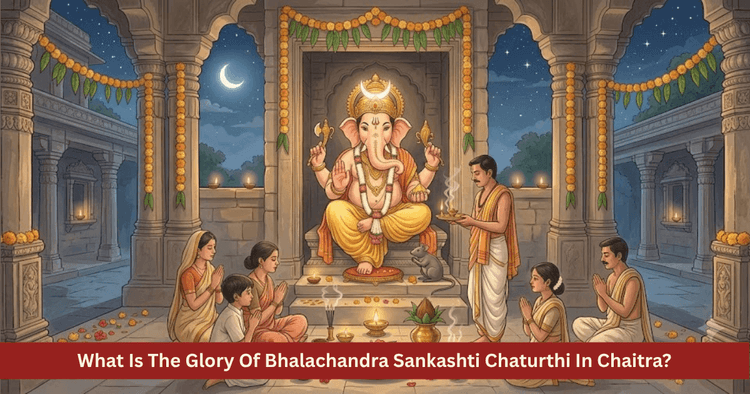
Table of Contents
Panchang Description And The Astrological Dimensions Of Bhalachandra Chaturthi
Within the mathematical and metaphysical taxonomy of the classical Vedic calendar, the Ganesha Purana and the Mudgala Purana, the fourth lunar day (Chaturthi) of the dark fortnight (Krishna Paksha) of every lunar month is observed across the cosmos as Sankashti Ganesha Chaturthi. Etymologically, the Sanskrit root Sankashti derives from Sankata-Harana, designating the supreme liturgical date for uprooting existential crises, physical infirmities, mental afflictions and karmic impediments. Falling during the waning phase of the month of Chaitra, this sacred date is canonically celebrated as Bhalachandra Sankashti Chaturthi.
In classical Sanskrit semantics, Bhala denotes the brow (forehead) and Chandra signifies the radiant crescent Moon. Thus, Bhalachandra designates that effulgent manifestation of Lord Ganesha who bears the ambrosial crescent Moon upon his crown as an ornament of grace.
Astronomically, Chaitra Krishna Chaturthi marks the seasonal threshold where early spring transitions into the heat of summer. Lord Surya Deva navigates the terminal degrees of Pisces, while the Moon traverses through the asterisms of Vishakha or Anuradha across the Libra-Scorpio axis. During this waning phase, the diminution of lunar light subtly influences somatic fluids, neuro-endocrine balance and the emotional mind. Unlike Vinayaka Chaturthi (which is celebrated at midday), Sankashti Chaturthi is governed by the moment of nocturnal moonrise (Chandrodaya Vyapini). Worshiping Lord Bhalachandra Ganesha at night and offering ceremonial libations to the rising Moon dissolves natal lunar afflictions, social defamation, acute anxiety and karmic obstacles.
| Astrological and Astronomical Factor | Classical Scriptural and Metaphysical Detail |
|---|---|
| Lunar Month and Fortnight | Chaitra Month, Krishna Paksha (Dark Fortnight) |
| Lunar Tithi | Chaturthi (Waning Fourth Station, active at Moonrise) |
| Canonical Liturgical Titles | Bhalachandra Sankashti Chaturthi, Crisis-Relieving Chaturthi |
| Sovereign Presiding Divinity | Lord Bhalachandra Ganesha (Adorned with Crescent Moon on Brow) |
| Concurrently Worshiped Deity | Chandra Deva (The Moon God / Regent of the Mind) |
| Core Elemental Matrix | Synthesis of Earth (Muladhara) and Water (Swadhishthana/Ajna) |
| Primary Liturgical Window | Nocturnal Moonrise Hour (Chandrodaya Kala) |
| Prescribed Food Offerings | Modakas, Sesame-Jaggery Sweets, Durva Grass, Shami Leaves |
| Associated Planetary Alignments | Ketu (Ganesha as Deliverer) and the Moon (Manas / Subconscious Mind) |
| Bestowed Spiritual Fruit | Freedom from Worldly Crises, Erasure of False Accusations, Mental Peace |
To assimilate the protective and obstacle-removing grace of Lord Bhalachandra Ganesha and stabilize the subconscious mind, a seeker must observe disciplined scriptural decorum from dawn until nocturnal moonrise:
- Awaken before sunrise during Brahma Muhurta, bathing in ambient fresh water consecrated with sacred river drops and black sesame seeds.
- Dress in clean, unstitched cotton vestments of crimson-red, deep saffron or golden-yellow hues, offering three water oblations to Surya Deva.
- Kindle an unbroken lamp fueled by pure indigenous cow clarified butter before the icon of Lord Ganesha in the domestic shrine.
- Formulate a formal vow (Sankalpa) holding water, unbroken rice, durva grass and a coin, dedicating the day to fasting and meditation.
- Maintain a satvic fast throughout the day; partake exclusively of water, milk or a single salt-free meal of fruit, refraining from anger and negative speech.
- Mentally or audibly recite the primary formula Om Gam Ganapataye Namah or Om Bhalachandraya Namah continuously.
- Offer twenty-one paired blades of fresh green durva grass alongside sacred vermilion paste (sindoor) at the lotus feet of the deity.
- Re-bathe and dress in fresh garments at dusk, conducting the sixteenfold adoration (Shodashopachara) and listening to the sacred vrata katha.
- At the moment of local moonrise, stand facing eastward, offering three water libations mixed with raw milk, unbroken rice and white flowers to Chandra Deva.
- Conclude the fast by partaking of the consecrated sesame-jaggery sweets (Til Laddoos) or steamed modakas offered to Lord Ganesha.
Puranic Lore: The Vanity Of The Moon And The Manifestation Of Bhalachandra
The Upasana Khanda of the Ganesha Purana and the Ganapati Khanda of the Brahmavaivarta Purana preserve the authentic narrative of how Lord Ganesha came to bear the title Bhalachandra.
At the beginning of cosmic manifestation, Chandra Deva became intoxicated by his physical radiance, serene luster and his position as the beloved consort of the twenty-seven stellar asterisms. He believed himself to be the most beautiful being in the three worlds.
One evening, on the fourth day of the bright fortnight of Bhadrapada, Lord Ganesha was returning to Mount Kailash riding his divine mount, the mouse (Mushaka), having partaken of sweet modakas. Suddenly, a venomous serpent slithered across the forest trail. Startled, the mouse leapt aside, causing Lord Ganesha to stumble. Watching this incident from the sky, Chandra Deva burst into laughter. Intoxicated by vanity, he mocked Ganesha's elephant head and prominent belly.
| Narrative Milestone | Puranic and Metaphysical Detail | Philosophical Meaning |
|---|---|---|
| Vanity of Physical Form | Chandra's pride in his beauty and stellar consorts | Pride in external appearance leads to spiritual fall |
| The Mocking Laughter | Deriding the transcendental form of the Lord | Ridiculing divine reality based on surface judgment |
| The Divine Curse | The Moon losing his light and afflicted with decay | Arrogance produces instant loss of vitality |
| Universal Disruption | Oceans stagnant, botanicals drying up, darkness | Living nature depends on balance and gentle light |
| Penance in Chaitra | The Moon performing austerities on Chaitra Chaturthi | Repentance and spiritual discipline restore grace |
| Crown of the Forehead | Ganesha lifting the crescent Moon onto his brow | Divine grace transforms the repentant into an ornament |
Perceiving the arrogance behind the mockery, Lord Ganesha raised his trunk and pronounced a severe curse:
"O proud Moon! Intoxicated by transient beauty, you have mocked the primordial architect of the universe. therefore lose your light, your beauty and your rays this very instant! Whosoever gazes upon your form shall fall into disgrace and suffer false accusations!"
Instantly, Chandra Deva turned dark and lusterless. With the extinction of lunar light, cosmic balance shattered. Medicinal herbs withered, ocean tides ceased and living beings experienced profound depression. Terrified, the Moon hid himself within the water lilies of Lake Manasarovar.
Led by King Indra, the celestial hosts sought the counsel of Lord Brahma. Brahma declared: "Ganapati is the Supreme Reality. His curse can be lifted only by his own grace. Let Chandra observe rigorous penance on the fourth day of the dark fortnight of Chaitra, seeking shelter at the feet of the Lord."
Chandra fashioned an earthen icon of Lord Ganesha, subsisting solely on air while chanting Om Gam Ganapataye Namah. On the fourth day of the dark fortnight of Chaitra, Lord Ganesha manifested before him, moved by his sincere repentance.
Weeping with gratitude, Chandra prostrated at his feet: "O compassionate Lord! Blinded by pride, I committed a grave error. Forgive this fallen servant and restore my life."
Lord Ganesha replied: "O Chandra, a divine curse cannot be undone completely, yet your repentance has pleased me. During the dark fortnight (Krishna Paksha), your phases shall wane and during the bright fortnight (Shukla Paksha), they shall wax until you attain fullness on Purnima."
Lord Ganesha then lifted the young crescent Moon, placing it upon his brow (Bhala). Because he crowned his forehead with the Moon, Lord Ganesha became eternally renowned across the cosmos as Bhalachandra-the bearer of the crescent Moon.
The Ashtavinayaka Tradition: Girijatmaja At Lenyadri
In the sacred Ashtavinayaka pilgrimage circuit of Maharashtra, the manifestation of Bhalachandra holds an essential position, connected with the shrine of Sri Girijatmaja at Lenyadri.
- Sri Girijatmaja of Lenyadri: Situated near Junnar in the Pune district, this sacred sanctuary is located within ancient cave complexes carved into the cliff face. Here, Mother Parvati (Girija) performed penance for twelve years to obtain Lord Ganesha as her son (Atmaja).
- The Cave Sanctuary: The shrine is carved directly into the mountain rock, reached by ascending 307 stone steps. The sanctum sanctorum has no artificial illumination; during the day, sunlight enters directly through the cave entrance, illuminating the form of the deity.
- The Essence of Bhalachandra: Puranic lore records that Lord Ganesha manifested here as a divine child, later redeeming Chandra and placing the crescent moon upon his forehead. Worshiping this form bestows inner focus and relieves mental stress.
| Ashtavinayaka Shrine | Geographical Location | Puranic Importance | Manifested Attribute |
|---|---|---|---|
| Sri Girijatmaja | Lenyadri (Junnar, Pune) | Mother Parvati's twelve-year penance site | Child form, brow adorned with crescent Moon |
| Sri Mayureshwara | Morgaon (Pune) | Subduing the demon Sindhurashura | Primal Ganesha, slayer of obstacles |
| Sri Siddhivinayaka | Siddhatek (Ahmednagar) | Granting victory to Lord Vishnu over Madhu-Kaitabha | Right-turning trunk, bestower of spiritual perfections |
| Sri Ballaleshwara | Pali (Raigad) | Manifesting for his devoted child-disciple Ballala | Compassionate protector of faithful seekers |
The Sacred Science Of Offering 21 Durva Grass Blades
Offering twenty-one blades of fresh green Durva grass (Cynodon dactylon) to Lord Ganesha on Bhalachandra Sankashti Chaturthi is an esoteric practice with deep symbolic and bio-energetic meaning.
The Lore of Slaying the Demon Analasura
The Ganesha Purana records that when the fiery demon Analasura terrorized the cosmos by emitting flames from his eyes and incinerating sages, Lord Ganesha swallowed the demon whole to protect creation.
Upon swallowing Analasura, the intense demonic heat caused burning sensations within Ganesha's stomach and body. The gods applied cooling sandalwood, poured holy river water and offered lunar nectar, yet the burning persisted. Finally, Sage Kashyapa gathered twenty-one blades of fresh Durva grass, placing them upon Ganesha's head. Instantly, the cooling touch of the grass extinguished the internal heat.
Metaphysics of the Twenty-One Offerings
Durva grass represents vitality, resilience and soothing coolness. The human body is composed of twenty-one fundamental principles: five cognitive senses (Jnanendriyas), five active organs (Karmendriyas), five vital airs (Pranas), five physical elements (Mahabhutas) and the analytical mind (Manas). Offering twenty-one pairs of Durva blades symbolizes surrendering one's sensory and mental attachments to the Divine, cooling internal desires.
| Sequential Offering | Accompanying Formula | Associated Principle | Spiritual and Somatic Benefit |
|---|---|---|---|
| 1st Pair | Om Ganadhipaya Namah | Earth Element (Muladhara) | Structural stability, vitality, physical grounding |
| 2nd Pair | Om Umaputraya Namah | Water Element (Swadhishthana) | Emotional balance, subduing base desires |
| 3rd Pair | Om Vighnanashanaya Namah | Fire Element (Manipura) | Digestive health, dispelling anxiety |
| 4th Pair | Om Vinayakaya Namah | Air Element (Anahata) | Purity of heart, dissolution of personal ego |
| 5th Pair | Om Ishaputraya Namah | Space Element (Vishuddha) | Refined speech, alignment with truth |
| 6th Pair | Om Sarvasiddhipradaya Namah | Intellect (Ajna Chakra) | Mental focus, intuitive clarity, memory |
| 7th Pair | Om Ekadantaya Namah | Nondual Awareness | Overcoming duality, emotional resilience |
| 8th Pair | Om Ibhavaktraya Namah | Magnanimity and Patience | Pacifying anger, expanding understanding |
| 9th Pair | Om Mushakavahanaya Namah | Sensory Restraint | Directing restless mental impulses |
| 10th Pair | Om Kumaragurave Namah | Spiritual Guidance | Attaining wisdom, academic progress |
| 11th (Single) | Om Bhalachandraya Namah | Sahasrara Crown Center | Spiritual peace, divine nectar, liberation |
Step-By-Step Liturgical Protocol For Bhalachandra Chaturthi
To conduct the traditional worship of Lord Bhalachandra Ganesha on Chaitra Krishna Chaturthi, observe the following liturgy:
- Morning Purification and Sacred Intention: Awaken before sunrise, bathing in ambient water infused with holy drops. Dress in clean red or yellow cotton garments. Sit facing eastward before the domestic altar, taking water, unbroken rice, durva grass and a coin in the right palm:
Om Vishnave Namah. Adya Chaitra mase krishna pakshe Sankashti Chaturthi tithau, Bhalachandra Ganesha preeti-kamanaya, mama sakala manasika-sharirika sankata nivaranartham, kalanka-dosha shamanartham Sankashti Chaturthi vratam aham karishye.
- Altar Preparation: Drape a low wooden platform in red silk. Inscribe an eight-petaled lotus design using raw rice grains. Position an icon or consecrated portrait of Lord Bhalachandra Ganesha upon a silver or copper platter.
- Sixteenfold Worship (Shodashopachara):
- Panchamrita Abhisheka: Bathe the metallic icon with raw milk, yogurt, ghee, honey and sacred water.
- Vermilion Offering: Anoint the icon with red vermilion paste blended with pure cow clarified butter.
- Sacred Vestments: Offer a yellow silk cloth or sacred thread (Yajnopavita).
- Offering 21 Durva Blades and Shami Foliage: Cleanse twenty-one pairs of Durva grass in Ganga water, offering them pair by pair with the respective mantras upon the feet and head of the deity, accompanied by fresh Shami leaves.
- Sacramental Food Offering (Naivedya): Offer twenty-one sweet sesame-jaggery laddoos (Til Laddoos), steamed modakas, bananas, seasonal fruits and sugar candies.
- Recitation of the Sankatanashana Ganesha Stotra: Recite the Sankatanashana Ganesha Stotra from the Narada Purana (Pranamya shirasa devam Gauriputram Vinayakam...) at least three or eleven times with focused devotion.
- Nocturnal Lunar Libations (Chandra Arghya): At the local moonrise hour, fill a clean silver or copper pitcher with water, raw cow milk, unbroken rice grains, red vermilion and fragrant white blossoms. Stand facing the rising Moon, pouring three continuous libations while reciting:
Gaganarnava-manikya chandra dakshayani-pate.
Grihanarghyam maya dattam Ganesha-priya Rohini-pate. - Arati and Breaking the Fast: Wave burning natural camphor before Lord Ganesha, bow toward the Moon, touch the feet of family elders and break the fast by consuming the consecrated sesame-jaggery prasad.
Astrological Remedies: Pacifying Lunar Afflictions And Mental Distress
In predictive Vedic astrology, the Moon governs the human mind: Chandrama manaso jatah. When the natal Moon is afflicted by Rahu (Eclipse Yoga), conjoined with Saturn (Visha Yoga), challenged by Ketu or debilitated in Scorpio in difficult houses (6th, 8th or 12th), an individual frequently experiences specific life difficulties:
- Chronic anxiety, panic attacks, emotional vulnerability and severe depression.
- Unjust accusations, reputational damage and loss of social standing without fault.
- Health challenges concerning the mother or strain in maternal relationships.
- Insomnia, fear of water and difficulty making sound decisions.
Because Lord Bhalachandra sheltered the disgraced Moon upon his forehead, observing this fast and offering lunar libations acts as a classical remedy for soothing natal lunar afflictions.
| Planetary Affliction | Observable Life Challenge | Remedial Practice on Bhalachandra Chaturthi |
|---|---|---|
| Moon-Saturn Visha Yoga | Chronic pessimism, isolation, persistent sadness | Offering 21 sesame laddoos and blue blossoms to Ganesha |
| Moon-Rahu Grahan Yoga | Unwarranted phobias, nightmares, false accusations | Pouring raw milk libations to the Moon; reciting the Stotra 11 times |
| Debilitated Moon (Scorpio) | Extreme mood swings, digestive lethargy | Gazing at the Moon through water in a silver vessel; chanting lunar mantras |
| Ketu Mahadasha Distress | Unexplained obstacles, sudden disruptions | Offering 21 Durva pairs and applying vermilion tilak |
Philosophical Essence: From False Pride To Divine Grace
Bhalachandra Sankashti Chaturthi imparts an enduring spiritual truth: Arrogance invites a fall, yet sincere humility awakens divine grace.
The Moon possessed radiance, aesthetic grace and elevated status, yet the moment vanity entered his mind, his luster vanished. External wealth or physical beauty cannot shield an individual from the consequences of pride if respect and humility are absent.
Yet the higher message of this sacred lore is one of compassion and redemption. Lord Ganesha did not merely correct Chandra's vanity; when the Moon acknowledged his error and sought shelter with an open heart, the Lord restored his light and lifted the crescent Moon onto his own forehead as a crown of honor.
This pastime reflects the depth of divine forgiveness. Lord Bhalachandra teaches that when a person recognizes their shortcomings and chooses humility, societal condemnation dissolves. By surrendering personal vanity at the feet of wisdom, the human mind is purified, shining with serene, gentle clarity like the crescent Moon upon the brow of Ganesha.
FAQ
On which specific lunar date is Bhalachandra Sankashti Chaturthi observed?
It is observed annually on the fourth lunar day (Chaturthi) of the dark fortnight (Krishna Paksha) of the month of Chaitra, with main rituals performed at nocturnal moonrise.
Why is Lord Ganesha invoked as 'Bhalachandra'?
Following Chandra's sincere penance to redeem a curse, Lord Ganesha placed the crescent Moon upon his brow (Bhala), earning the title Bhalachandra.
Why is offering libations to the Moon mandatory on Sankashti Chaturthi?
Lord Ganesha decreed that the fast remains incomplete without honoring the Moon; offering lunar libations soothes emotional distress and frees the mind from false accusations.
Why are exactly twenty-one blades of Durva grass offered to Ganesha?
The twenty-one blades symbolize the twenty-one somatic and mental faculties of human existence, cooling internal cravings just as Durva cooled Ganesha's body after slaying Analasura.
Which Ashtavinayaka temple is traditionally connected with this manifestation?
The Bhalachandra aspect is celebrated at the mountain cave shrine of Sri Girijatmaja at Lenyadri, near Junnar in Maharashtra.
Get your accurate Kundali
Generate KundaliDid you like it?
Author
Pt. Amitabh Sharma (56 Years)
Experience: 20
Consults About: Family Planning, Career
Clients In: Punjab, Haryana, Delhi
Share this article with friends and family
WELCOME TO
ZODIAQ
Right Decisions at the right time with ZODIAQ
