What Is The Vastu Shastra Science Of Space Cleansing And Torana In Chaitra?
By Pt. Abhishek Sharma
Vastu Purusha Mandala, Science Of Mango Torana, Five Cleansing Remedies And Energy Balance
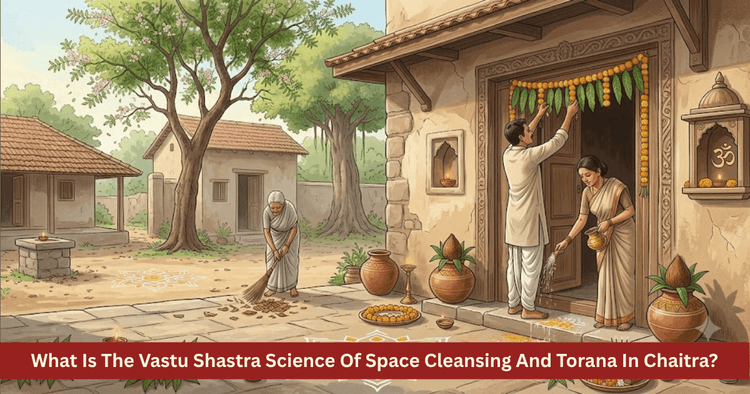
Table of Contents
Panchang Description And The Astrological Dimensions Of Chaitra Space Purification
Within classical Vedic cosmology, spatial architecture (Vastu Shastra) and sacred treatises such as the Vishvakarma Prakasha, the inaugural month of Chaitra is celebrated as the definitive seasonal window for conducting deep pranic space cleansing across living and commercial environments. The arrival of Chaitra marks that precise astronomical junction where Lord Surya Deva revitalizes the bio-electromagnetic grid of the terrestrial sphere with ascending solar prana. The damp, stagnant and tamasic residue accumulated within domestic corners throughout the winter and late Phalguna is naturally dispersed by the warming solar rays of the northern traversal (Uttarayana).
In classical architectural metaphysics, the cosmic conscious entity known as the Vastu Purusha undergoes an annual realignment upon the dawn of Chaitra Shukla Pratipada. As the New Samvatsara unfolds, the quality of subtle energy entering through the main threshold (Simha Dvara) dictates the household's vitality, familial peace, progeny well-being and financial liquidity for the ensuing 365 days. Thoroughly decluttering the living space, clearing stagnant objects, installing freshly woven toranas (festoons) of mango and ashoka leaves and consecrating an earthen or metallic water urn in the northeastern quadrant (Ishanya) align the domestic bio-field with harmonious cosmic frequencies.
| Astrological Factor | Scriptural, Vastu and Architectural Detail |
|---|---|
| Sacred Junction Window | Chaitra Month (Particularly from Amavasya to Shukla Pratipada) |
| Alignment of Vastu Purusha | Head: Northeast (Ishanya) | Feet: Southwest (Nairritya) |
| Primary Energy Threshold | Simha Dvara (The Main Entrance - ideally East, North or Northeast) |
| Sacred Botanical Festoons | Fresh Mango Leaves (Mangifera indica) and Ashoka Leaves (Saraca asoca) |
| Core Elemental Rebalancing | Dynamic synthesis of Air, Water and Fire elements |
| Sacred Purificatory Mediums | Ganga Water, Cow Urine, Rock Salt, Camphor, Guggul, Turmeric |
| Governing Planetary Alignments | The Sun (Prana), Jupiter (Ruler of Ishanya), Mars (Earth Element) |
| Presiding Transcendental Deities | Vastu Purusha, Lord Vishvakarma, Lineage Deities |
| Bestowed Domestic Benefit | Elimination of Negative Energy, Vastu Balancing, Abundance |
To clear domestic space of residual stagnant frequencies and welcome positive pranic currents on the dawn of the New Year, an aspirant should observe disciplined scriptural decorum from early dawn:
- Discard broken glassware, damaged utensils, non-functioning timepieces, rusted metals and unused clutter from every room, closet and stairwell before Chaitra Amavasya.
- Mop all household floors with water infused with coarse sea salt, cow urine and neem extract to clear microbial and subtle energetic residues.
- Awaken before sunrise during Brahma Muhurta on Pratipada, washing the main threshold with clean water infused with turmeric powder.
- String eleven, twenty-one or twenty-seven fresh mango or ashoka leaves along an unbroken red sacred cotton thread (mouli), installing the festive torana across the upper lintel of the main entrance.
- Draw auspicious marks of the Swastika and Om using a paste of red vermilion and cow clarified butter upon both doorposts of the primary threshold.
- Cleanse the northeastern quadrant (Ishanya) of the home, removing heavy objects and installing an unblemished copper or brass pitcher filled with pure water.
- Cleanse the air throughout every room at dusk by burning dried cow dung embers topped with natural camphor, guggul resin, frankincense and yellow mustard seeds.
- Kindle an unbroken lamp fueled by pure cow ghee or sesame oil on both sides of the main threshold at twilight.
The Vastu Purusha Mandala: Realigning Household Bio-Energetics
According to the Brihat Samhita and the Mayamatam, during the cosmic confrontation between Lord Shiva and the demon Andhaka, an immense being manifested from the perspiration of the Lord. To steady this cosmic entity, the gods placed him face downward upon the terrestrial plane, transforming him into the Vastu Purusha-the presiding consciousness of architectural form.
The Vastu Purusha rests with his head in the Northeast (Ishanya), his arms extending toward the North and East, his navel at the central courtyard (Brahmasthana) and his feet resting in the Southwest (Nairritya).
During Chaitra, as the Sun shifts toward Aries, environmental magnetic pathways (running North to South) and solar radiation lines (running East to West) undergo marked seasonal revitalization:
- The Northeast (Ishanya - The Head): Representing the spiritual center, clutter, heavy storage or sanitary facilities in this quadrant cause mental anxiety and indecision for the head of the household. Consecrating water in this sector in Chaitra restores clarity.
- The Center (Brahmasthana - The Navel): Governed by the space element (Akasha), the home's center must remain open, uncluttered and well-lit.
- The Southeast (Agneya - The Fire Center): Governing vitality, digestion and wealth, the kitchen in this sector should receive a thorough spring cleansing, followed by marking the hearth with turmeric.
- The Southwest (Nairritya - The Seat of Stability): The feet of the Vastu Purusha rest here. Maintaining heavy furniture and elevated structures in this quadrant anchors stability, preventing financial volatility.
| Compass Direction | Anatomical Center of Vastu Purusha | Presiding Planetary Ruler & Element | Prescribed Spring Vastu Remedy |
|---|---|---|---|
| Northeast (Ishanya) | Cranium and Eyes | Jupiter (Guru Deva) / Water Element | Consecrate a water urn; remove heavy clutter |
| East (Purva) | Right Arm | Lord Surya Narayana / Fire-Air Element | Open windows; install a copper solar emblem |
| Southeast (Agneya) | Right Elbow | Venus (Shukra Deva) / Fire Element | Deep clean the hearth; burn camphor at dusk |
| South (Dakshina) | Right Thigh | Mars (Mangala Deva) / Earth-Fire | Anchor heavy furnishings; install stability symbols |
| Southwest (Nairritya) | Both Feet | Rahu Deva / Earth Element | Ensure master bedroom is orderly; avoid water pits |
| West (Pashchima) | Left Thigh | Saturn (Shani Deva) / Air-Water | Clean dining spaces; light sunset oil lamps |
| Northwest (Vayavya) | Left Elbow | The Moon (Chandra) / Air Element | Ensure air circulation; refresh guest rooms |
| North (Uttara) | Left Arm | Mercury (Budha Deva) / Water-Earth | Organize accounting and vaults; place green botanicals |
| Center (Brahmasthana) | Navel and Heart | Lord Brahma / Space Element | Keep open, luminous and free of central load |
Botanical Science And Energetics Of The Festive Torana
Installing a festive Torana over the main household lintel on New Year's dawn is a functional biophysical technique for regulating indoor environmental quality:
1. Biophysical Properties of Mango Foliage
- Air Filtration and Oxygen Production: Fresh mango leaves (Mangifera indica) continue cellular respiration long after being plucked. As outdoor air moves across the threshold, mango leaves trap airborne dust and particulate matter while releasing trace oxygen into the entryway.
- Natural Antimicrobial Shield: Mango foliage contains tannins and volatile phytochemicals that neutralize airborne bacteria and viral droplets at the doorway.
2. Energetics of Ashoka Foliage
The Sanskrit name Ashoka translates literally as 'the absence of grief'. Its leaves absorb low-frequency electromagnetic variations. Placing ashoka leaves across the threshold helps dissipate stressful mental impressions brought by visitors, creating an emotionally calm entryway.
3. The Structural Metaphysics of Red Sacred Thread
The leaves are strung upon unbleached cotton thread dyed with turmeric and vermilion (mouli). Red thread corresponds to the protective energy of Mars. Tying knots between the leaves establishes an intentional boundary that helps preserve the home's calm interior atmosphere.
Five Essential Vastu Practices For Clearing Stagnant Energy
To dissolve lingering domestic disharmony and invite stability for the New Year, classical tradition prescribes five foundational steps during Chaitra:
1. Discarding Stagnant Household Clutter
Vastu treatises record that broken mirrors, cracked ceramics, stopped timepieces and rusting iron scraps hold heavy, sluggish energy. Before Chaitra Amavasya, clear out items that have sat unused for a full year. Removing physical stagnation allows fresh pranic currents to circulate freely.
2. Cleansing Floors with Sea Salt and Cow Urine
Washing household floors with plain water alone does not clear subtle energetic residue. Coarse sea salt naturally attracts and neutralizes positive static charges and low-frequency vibrations.
- Dissolve two handfuls of coarse sea salt and a splash of cow urine into a bucket of clean water.
- Mop all hard flooring thoroughly, reaching deep corners and baseboards.
- This practice clears lingering emotional residue and microbial buildup from the floor plane.
3. Consecrating the Water Pitcher in the Northeast
Cleanse the northeastern corner of the home with sacred water, installing an unblemished copper or brass vessel upon a clean platform.
- Fill the pitcher with clean water, adding drops of Ganga water, a silver coin, a turmeric rhizome, an areca nut and fresh durva grass.
- Arrange five fresh mango leaves over its mouth, placing a coconut wrapped in red cotton on top.
- This consecrated water vessel stabilizes the water element in the home, supporting calm focus and financial stability.
4. Threshold Anointing and Swastika Consecration
The main entryway represents the primary energetic barrier of the home.
- Mark a Swastika measuring roughly nine finger-widths on both doorposts using vermilion mixed with cow clarified butter, placing four dots in its quadrants.
- Burying a thin wire of copper or silver beneath the threshold helps shield the home from subtle subterranean geomagnetic stress.
5. Evening Fumigation with Resins and Camphor
At dusk, when day transitions into night (Godhuli Vela), ignite dried cow dung embers within an earthenware bowl, adding cow ghee, pure camphor, guggul resin, frankincense and yellow mustard seeds.
- Carry this fragrant smoke through every room, closet space and along the main threshold.
- The natural antimicrobial smoke clears residual indoor dampness and airborne irritants while lifting mental fatigue.
| Spatial Challenge | Observable Domestic Pattern | Prescribed Chaitra Vastu Practice |
|---|---|---|
| Northeast Affliction (Storage/Toilet) | Headaches, study difficulties, debt | Place a consecrated water urn; remove heavy loads |
| South-Facing Entryway Imbalance | Anxiety, vulnerability to loss | Hang a fresh mango torana; install protective emblems |
| Southeast Kitchen Disharmony | Digestive issues, elevated medical costs | Clean the hearth deeply; burn natural camphor |
| Depressed Southwest Quadrant | Financial drain, marital friction | Add weight to the area; place heavy furnishings |
| Center Load (Brahmasthana) | Heart strain, domestic restlessness | Clear central space; encourage quiet, open airflow |
Environmental Color Palette For The New Year
The seasonal energy of Chaitra is supported by conscious color choices for walls and interior textiles:
- North and East Zones: Rely on soft ivory, gentle celadon green or pale yellow to support Mercury and the Sun, encouraging intellectual focus and commercial clarity.
- South and Southeast Zones: Soft coral, warm cream or peach tones balance the fire element without provoking agitation.
- West Zone: Muted slate, soft grey or warm taupe stabilize the air-water balance of Saturn.
- Colors to Minimize: Avoid heavy applications of matte black, dark chocolate brown or aggressive crimson on primary walls, as excessive dark tones trap stagnant energy.
Philosophical Essence: Refining The Inner Dwelling
Vastu purification in Chaitra reveals an essential truth: Just as physical rooms benefit from seasonal cleansing, the vessel of the human body and mind requires regular purification from negative impressions.
The senses are the entryways of consciousness. If we allow negative speech, jealousy and unrestrained sensory consumption to enter unchecked, our inner space becomes cluttered and disturbed.
Hanging a torana at the doorway reminds us to maintain mindful boundaries at the threshold of the mind. Admit only thoughts grounded in kindness, truth and peace. When both the external living space and the interior heart are cleansed of bitterness and pride, the dwelling naturally becomes a sanctuary of peace, abundance and grace.
FAQ
Why are mango and ashoka leaf festoons (toranas) hung at the main doorway in Chaitra?
Mango and ashoka leaves trap airborne dust, release trace oxygen and emit natural antimicrobial compounds, while their energetic presence buffers the home from external stress.
What is the best day to clear out household clutter for the New Year?
The optimal window is Chaitra Amavasya, the dark moon day preceding the New Year, ensuring that all stagnation is cleared before Pratipada dawn.
Why is a water pitcher placed in the Northeast (Ishanya) corner?
The Northeast represents the water element and the cranium of the Vastu Purusha; consecrating clean water here supports mental peace and spiritual balance.
What is the benefit of adding sea salt when mopping floors?
Coarse sea salt absorbs low-frequency static charges and subtle energetic dampness while providing natural antimicrobial cleansing for the floor plane.
How should the auspicious Swastika be drawn on the entryway?
The Swastika should be drawn using pure vermilion mixed with cow clarified butter on both doorposts, including the four traditional dots within its quadrants.
Get your accurate Kundali
Generate KundaliDid you like it?
Author

Pt. Abhishek Sharma (63)
Experience: 20
Consults About: Family Planning, Career
Clients In: Punjab, Haryana, Delhi
Share this article with friends and family
WELCOME TO
ZODIAQ
Right Decisions at the right time with ZODIAQ
