What Is The Glory Of Chaitra Purnima In Chitra Nakshatra?
By Pt. Nilesh Sharma
Science Of Chitra Nakshatra, Five Chapters Of Satyanarayan Lore And Lunar Libations
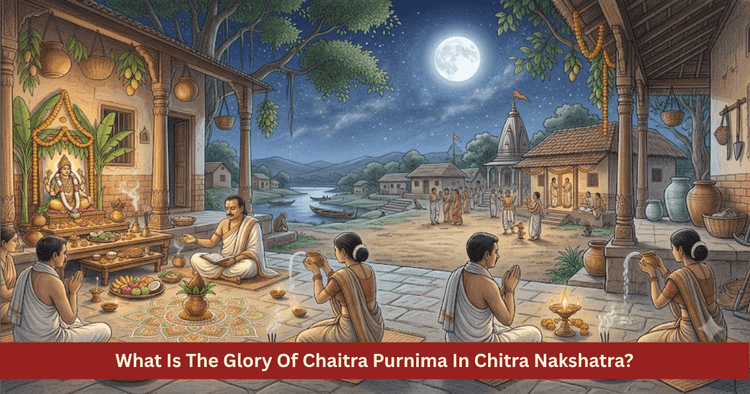
Table of Contents
Panchang Description And The Astrological Dimensions Of Chaitra Purnima
Within the mathematical cosmology of the classical Vedic calendar and the experiential science of the Puranas, the final lunar phase of the bright fortnight (Shukla Paksha) of the month of Chaitra is celebrated across the cosmos as Chaitra Purnima-popularly venerated as Chaitri Poonam. Occurring as the inaugural full moon of the entire Vedic New Year (Vikram Samvat cycle), this sacred date represents the definitive completion of the thirty lunar days of Chaitra. It marks the vital astronomical and meteorological transition where the blossoms of early spring (Vasanta) yield to the radiant heat of impending summer (Grishma). In predictive astrology, a Vedic month derives its canonical designation from the specific asterism occupied by the Moon at its exact full-phase conjunction; thus, the month of Chaitra is christened after the effulgent, jewel-like asterism of Chitra Nakshatra.
From an astronomical perspective, Chaitra Purnima marks a state of supreme energetic equilibrium across the solar-terrestrial axis. During this nocturnal window, Lord Surya Deva traverses the initial degrees of his exaltation sign of Aries (Mesha), channeling intense solar fire (Tejas) into the earth's atmosphere. Concurrently, the Moon attains its complete sixteenfold digital radiance (Purna Chandra), positioning itself in the sign of Libra (Tula) precisely opposite the Sun at an exact 180-degree alignment within Chitra Nakshatra. Chitra Nakshatra is presided over by the cosmic celestial architect Tvashtar (Vishwakarma) and ruled by the energetic, fiery planet Mars (Mangala). The rare synthesis of the Moon's cooling water matrix with the focused heat of Mars exerts a direct somatic influence upon human neuro-endocrine secretions, blood circulation and emotional equilibrium. Spiritual sadhana, sacred river ablutions, lunar libations and the adoration of Lord Satyanarayana performed upon this night steady the fluctuations of the mind, bestowing physical longevity, auric luster and profound inner peace.
| Astrological and Astronomical Factor | Classical Scriptural and Metaphysical Detail |
|---|---|
| Lunar Month and Fortnight | Chaitra Month, Shukla Paksha (Bright Fortnight) |
| Lunar Tithi | Purnima (The Inaugural Full Moon of the Vedic Year) |
| Governing Asterism | Chitra Nakshatra (Spica / Conjunction of Virgo & Libra) |
| Solar Celestial Station | Sun Exalted in Aries (180° Solar Opposition) |
| Lunar Effulgence | Full Sixteen Lunar Digits (Complete Reflective Radiance) |
| Sovereign Presiding Powers | Lord Satyanarayana (Vishnu), Chandra Deva, Chitragupta |
| Core Elemental Matrix | Perfect Harmony of Fire and Water Elements, Somatic Soma |
| Consecrated River Sanctuaries | Ganga, Yamuna, Narmada, Shipra, Godavari |
| Traditional Sacramental Offerings | Roasted Wheat Panjiri, Panchamrita, Bananas, Kheer, Tulsi |
| Bestowed Spiritual Fruit | Mental Equilibrium, Health, Erasure of Sins, Spiritual Liberation |
To assimilate the transformative celestial nectar of Chaitra Purnima, bathe in the ambient moonlight and secure the grace of Lord Satyanarayana, an aspirant must observe disciplined scriptural decorum from dawn onward:
- Awaken before sunrise during Brahma Muhurta, bathing in ambient fresh water consecrated with drops from the holy Ganga, Yamuna or Narmada rivers.
- Dress in clean, unstitched cotton or silk garments of pristine white or auspicious golden-yellow hues, offering three water oblations to Surya Deva.
- Take a formal vow (Sankalpa) while holding water, unbroken rice, flowers and kusha grass, dedicating the day to the Satyanarayana vrata and lunar contemplation.
- Cleanse the domestic shrine, erecting a sacred canopy utilizing banana stems and mango leaves in the northeastern quadrant (Ishanya) for the evening rites.
- Maintain an unbroken satvic discipline throughout the day; refrain from cooked grains, processed salts and negative speech, partaking exclusively of fruits and milk.
- Recite or listen to the five classical chapters of the Sri Satyanarayana Vrata Katha from the Skanda Purana during the late afternoon or twilight hours.
- Prepare the sacred sacramental offering (Sapada Prasad) consisting of roasted whole-wheat flour, cow ghee, raw sugar, chopped bananas and fresh tulsi leaves.
- Stand facing eastward as the full moon rises above the horizon, offering libations of raw cow milk, ambient water, white flowers and unbroken rice to Chandra Deva.
- Spend twenty minutes seated quietly in direct moonlight, engaging in silent breath contemplation to soothe the cranial nerves and stabilize the mind.
The Astronomy Of Chitra Nakshatra And The Ambrosial Lunar Nectar
In the classical astronomical wheel of the 27 lunar asterisms, the 14th station is designated as Chitra (astronomically identified with the brilliant primary star Spica in the constellation Virgo). Located approximately 250 light-years from earth, Spica is a luminous spectroscopic binary star system renowned for its brilliant blue-white radiance.
In ancient Vedic cosmology, Chitra is celebrated as 'The Brilliant Jewel'-the cosmic artisan that weaves multifaceted patterns of physical beauty and material structure across creation. Its presiding deity is Tvashtar, the divine shaper of universal forms, while its planetary ruler is Mars.
The Phenomenon of Ambrosial Lunar Radiation (Soma)
The classical medical treatises of Ayurveda-most notably the Charaka Samhita and the Sushruta Samhita-record that the full moon does not merely reflect physical solar photons but acts as a cosmic lens focusing ambient Soma (the subtle nectar of biological rejuvenation) upon the earth.
- Revitalization of Plant Chemistry: On Chaitra Purnima, the botanical realm absorbs this concentrated lunar nectar into its cellular matrix. Consequently, medicinal roots, wild herbs and flowering plants harvested or exposed to moonlight on this nocturnal station possess superior therapeutic potency.
- Neuro-Emotional Stabilization: The human physical frame is approximately 70 percent fluid. Just as the gravitational and electromagnetic pull of the full moon produces oceanic tides, it similarly creates subtle energetic surges within the cerebral spinal fluids and neurotransmitter pathways of the human brain. If an individual indulges in heavy, tamasic consumables, this surge exacerbates restlessness and emotional instability; conversely, when guided by satvic fasting, pranayama and mantra recitation, it facilitates the smooth ascension of subtle prana through the Sushumna nadi toward the crown center.
| Somatic and Astronomical Component | Full Moon Physiological Phenomenon | Prescribed Classical Sadhanic Remedy |
|---|---|---|
| Cerebral Fluid Matrix | Heightened energetic surge and emotional intensity | Chanting Om Som Somaya Namah; milk-water libations |
| Blood Circulation & Vigor | Martially charged Chitra asterism warming blood tissue | Complete dietary fasting; renunciation of table salt |
| Endocrine Glands | Amplified secretions of serotonin and melatonin | Direct moonlit meditation; gentle eye-gazing (Trataka) |
| Gastric Metabolic Fire | Subdued metabolic heat due to lunar dominance | Light, unctuous offerings of roasted flour panjiri |
The Literature Of Sri Satyanarayana Vrata Katha: Analysis Of The Five Chapters
The liturgical practice of the Sri Satyanarayana Vrata Katha originates within the Reva Khanda of the classical Skanda Purana, compiled by Sage Veda Vyasa.
In the sacred forest of Naimisharanya, when the eighty-eight thousand gathering sages led by Shaunaka asked the venerable sage Suta: "In the challenging era of Kali Yuga, humanity will be constrained by short lifespans, limited resources and persistent anxiety. What accessible, universal discipline can grant worldly fulfillment while ensuring ultimate spiritual liberation?"
Sage Suta revealed that this exact query was posed by Sage Narada to Lord Narayana in the transcendental realm of Vaikuntha, whereupon the Lord revealed the sacred path of the Satyanarayana Vrata.
Satyameva param Brahma satyameva param tapah.
Satyameva paro dharmah satye sarvam pratishthitam.
Truth alone is the Supreme Brahman; Truth alone is the ultimate penance; Truth alone is the supreme righteous duty; upon Truth rests the architecture of the cosmos. Whosoever anchors their life in Truth naturally dissolves karmic bonds.
Structural and Philosophical Breakdown of the Five Chapters
- Chapter One (The Origin and the Liturgy): Sage Narada's travels across the terrestrial plane, his compassion for human suffering and Lord Narayana's instruction outlining the simple materials required for the vow (roasted wheat flour, raw sugar, cow ghee, milk, bananas and tulsi leaves).
- Chapter Two (Shatananda the Priest and the Woodcutter): An impoverished ascetic named Shatananda in Varanasi attains contentment and material stability through the practice of the vow. A poor woodcutter witnesses the rite, resolves to speak truth and finds his poverty transformed into prosperity. This chapter illustrates that truth knows no social or economic divisions.
- Chapter Three (The Merchant Sadhu and the Broken Vow): A wealthy merchant vows to perform the worship of Satyanarayana if blessed with a child. Following the birth and wedding of his daughter Kalavati, he postpones the vow out of greed. Embarking on a commercial voyage, he and his son-in-law are falsely imprisoned for theft. This chapter illustrates that compromising ethical vows for worldly expedience invites karmic instability.
- Chapter Four (The Test of Faith and Deliverance): The merchant's wife Lilavati and daughter Kalavati remember their forgotten vow during acute distress, observing the rites with sincere repentance. The king is moved to release the merchants, restoring their wealth. Later, when tested by the Lord disguised as an ascetic, the merchant lies about his cargo, causing his wealth to turn to leaves. Upon repenting, his prosperity is restored.
- Chapter Five (King Tungadhvaja and the Annihilation of Pride): King Tungadhvaja encounters rural cowherds performing the worship of Satyanarayana in a forest but scorns their humble offerings out of royal arrogance. Returning to his palace, he finds his children dead and his kingdom ruined. Repenting of his vanity, he joins the humble cowherds, accepts the consecrated offerings and witnesses the restoration of his realm.
Step-By-Step Liturgical Protocol For Sri Satyanarayana Puja
To conduct the traditional worship of Lord Satyanarayana on Chaitra Purnima, observe the following liturgy:
- Altar Construction: Cleanse the northeastern quadrant of the room with water infused with holy river drops. Construct a sacred canopy using four banana saplings at the corners of a low wooden platform, adorning the rim with mango leaf garlands. Drape the platform in clean yellow silk.
- Consecrating the Water Urn (Kalash): Sketch an eight-petaled lotus using raw rice grains upon the altar. Seat an unblemished copper or brass vessel filled with spring water, river drops, an areca nut, a coin, turmeric rhizome and durva grass upon the lotus. Crown the vessel with fresh mango foliage, an earthenware bowl filled with raw rice and a husk-intact coconut wrapped in scarlet silk.
- Deity Installation: Position an icon of Lord Satyanarayana alongside Mother Lakshmi or the sacred Shaligram stone upon the platform. Formally invoke Lord Ganesha, the Nine Planets (Navagrahas), Lord Varuna and the Guardian Divinities.
- Panchamrita Abhisheka: Pour raw cow milk, yogurt, ghee, honey and rock sugar through a Dakshinavarti conch shell over the metallic icon while reciting the Purusha Sukta, concluding with a stream of pure Ganga water.
- Adornment and Tulsi Offerings: Anoint the deity with fragrant yellow sandalwood paste, ashtagandha and vermilion. Dress the icon in yellow vestments and drape a garland of fresh yellow marigolds alongside unbroken tulsi leaves around his neck.
- The Consecrated Sacramental Food (Sapada Prasada):
- The Sovereign Proportion: Lightly roast whole-wheat flour in pure cow clarified butter. Combine it with raw unrefined sugar, chopped bananas, foxnuts and fresh tulsi leaves.
- Offer this preparation alongside fresh Panchamrita, seasonal fruits (mangoes and bananas) and sweet milk rice (kheer).
- Scriptural Recitation: Light an unbroken ghee lamp and burn guggul incense, reciting the five chapters of the Satyanarayana Vrata Katha with the family. Sound the conch shell at the conclusion of each chapter.
- Sacred Fire Oblations (Homa): Kindle dried cow dung cakes and mango wood in a small copper fire pit, offering eleven or twenty-one oblations of ghee, sweet pudding and panjiri using the Gayatri Mantra and the twelve-syllable formula Om Namo Bhagavate Vasudevaya.
- Camphor Arati and Distribution: Conclude with the traditional arati waved before the altar, distributing the consecrated food to all participants before partaking of the meal to conclude the fast.
The Science And Protocol Of Lunar Libations (Chandra Arghya)
Offering ceremonial libations to the full moon on Chaitra Purnima soothes nervous tension, relieves insomnia and pacifies natal lunar afflictions.
Required Materials for Lunar Libation
- A clean silver or copper pitcher.
- Pure ambient water mixed with half a cup of raw cow milk.
- Unbroken white rice grains (Akshata), white sandalwood paste and fragrant white blossoms (jasmine or mogra).
- Crystals of raw rock sugar.
Liturgical Procedure and Mantras
At the moment of moonrise across the eastern horizon (typically between 06:30 PM and 07:30 PM), stand facing eastward. Elevate the pitcher with both hands above the level of your brow. Allow a steady, unbroken stream of water to pour toward the earth, gazing at the luminous orb of the Moon through the descending stream while intoning the classical formula three times:
Ksheerodarnava-sambhoota atri-netra-samudbhava.
Grihanarghyam shashankesha Rohinya sahito mama.
Om Som Somaya Namah. Om Cham Chandramase Namah.
Circumambulate clockwise three times upon the spot. Touch a drop of the consecrated libation water from the earth to your eyelids and brow. This practice cools the sensory pathways, steadying the mind.
The Veneration Of Lord Chitragupta: Transmuting The Karmic Ledger
In southern India and among ancestral scribal lineages, Chaitra Purnima is also consecrated to Lord Chitragupta, the celestial recorder of human actions who assists Yamaraja, the lord of justice.
- Realigning Daily Actions: Scribes, merchants and spiritual seekers clean and consecrate their accounting ledgers, journals and writing instruments with vermilion and sandalwood paste on this day.
- Prayer of Conscience: Facing eastward, the seeker reflects on moral lapses committed over the departing year, resolving in writing to uphold ethical principles and compassion over the coming year:
Chitragupta masibhahanam lekhanisahitam vibho.
Maya kritam shubham karma papam cha parimarjaya.
Philosophical Essence: Truth As The Living Divine
The underlying spiritual teaching of Chaitra Purnima centers upon an essential principle: Truth is not an intellectual abstraction; it is the living presence of the Divine.
Outward rituals, temple construction and ascetic disciplines remain hollow if daily life is compromised by deceit, manipulation and broken promises. Lord Satyanarayana represents truth in action.
The poor woodcutter possessed nothing of material value, yet his honesty and sincerity secured divine grace. The wealthy merchant commanded vast fleets of ships, yet his deceit and arrogance brought him ruin and imprisonment.
The luminous full moon of Chaitra Purnima invites humanity to illuminate the inner mind with honesty and humility. Just as the Moon reflects the light of the Sun to cool and nourish the earth, an awakened individual reflects divine truth to bring peace, compassion and clarity into human society.
FAQ
Under which specific asterism does Chaitra Purnima occur?
Chaitra Purnima occurs under Chitra Nakshatra (Spica), from which the month of Chaitra derives its classical name.
Which classical Purana contains the original text of the Sri Satyanarayana Vrata Katha?
The original text is preserved in the Reva Khanda of the Skanda Purana, compiled by Sage Veda Vyasa.
What is the symbolic meaning of the 'Sapada' proportion in the Satyanarayana offering?
The Sapada measurement (a quarter portion added to a whole unit) represents generosity, abundance and devotion that transcends rigid calculation.
What spiritual benefits arise from offering libations to the Moon on this night?
Offering raw milk and water to the full moon soothes cranial nerves, balances emotional distress and pacifies natal lunar afflictions.
Which planetary ruler and presiding deity govern Chitra Nakshatra?
Chitra Nakshatra is governed by the energetic planet Mars and presided over by Tvashtar, the divine celestial architect.
Get your accurate Kundali
Generate KundaliDid you like it?
Author
Pt. Nilesh Sharma (63)
Experience: 20
Consults About: Family Planning, Career
Clients In: Punjab, Haryana, Delhi
Share this article with friends and family
WELCOME TO
ZODIAQ
Right Decisions at the right time with ZODIAQ
