What Is The Mystery Of Chaitra Shukla Pratipada?
By Pt. Amitabh Sharma
Inception Of Nav Samvatsara And Cosmic Time Reckoning
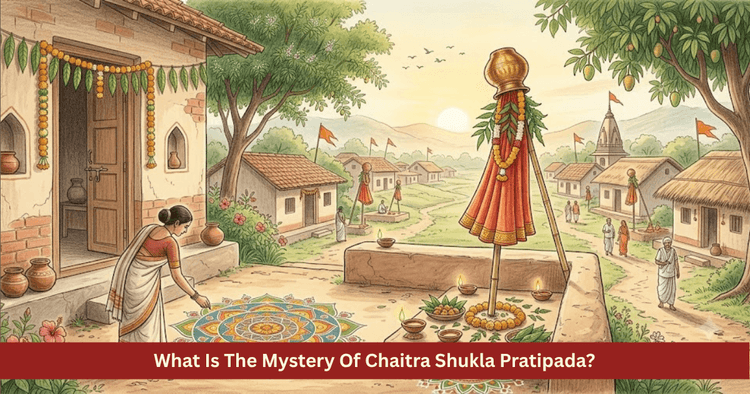
Table of Contents
Panchang Description And The Astronomical Genesis Of Cosmic Time
Within the mathematical chronology of the classical Vedic calendar, the first lunar day of the bright fortnight of Chaitra (Chaitra Shukla Pratipada) represents the cosmic origin point of universal time. This sacred astronomical junction marks the recalculation of the annual journey of Kala Purusha, the cosmic embodiment of time. According to authentic scriptural science, this date is far more than the opening day of a secular calendar; it signifies the birth of manifest creation, the inception of cosmic yugas and the harmonization of solar-lunar mechanics.
Classical authorities of astronomical science-the Surya Siddhanta, the Vedanga Jyotisha and the Panchasiddhantika of Varahamihira-record that at the dawn of creation on Chaitra Shukla Pratipada, the seven primary visible planets (the Sun, the Moon, Mars, Mercury, Jupiter, Venus and Saturn) stood aligned at zero degrees, anchored at the initial coordinate of the sign Aries within the Ashwini asterism. This exact geometric alignment proves that the Vedic calendar does not rely on arbitrary dates; it mirrors observable astronomical mechanics.
| Astrological and Astronomical Factor | Classical Scriptural Description |
|---|---|
| Lunar Phase and Fortnight | Chaitra Month, Bright Fortnight, First Lunar Day (Pratipada) |
| Canonical Liturgical Titles | Nav Samvatsara, Samvatsara Pratipada, Vasanti Navratri |
| Astronomical Solar Orientation | Transition of the Sun from Pisces to Aries (Vernal Equinox) |
| Astronomical Lunar Dynamics | First appearance of the waxing crescent Moon after Amavasya |
| Sovereign Presiding Powers | Lord Brahma, Lord Surya Deva, Supreme Mother Adishakti |
| Historical Eras Commencing | Vikram Samvat (57 BCE), Shaka Samvat (78 CE), Yugabda |
| Bestowed Spiritual Fruit | Dissolution of Inertia, Vitality, Attainment of Fourfold Pursuits |
To assimilate the transformative energy of Chaitra Shukla Pratipada, eliminate subtle impurities and secure health and abundance throughout the year, an aspirant must observe rigorous scriptural conduct from dawn onward.
- Awakening before sunrise during Brahma Muhurta, gazing upon both open palms while chanting the Karagre Vasate Lakshmi verse.
- Bathing in cool, fresh water consecrated with sacred river drops and unadulterated neem extract.
- Dressing in clean, unstitched white or saffron cotton vestments following morning ablutions, sitting quietly facing eastward.
- Pouring three continuous water oblations to Surya Deva from a copper vessel mixed with unbroken rice, kumkum, scarlet flowers and raw jaggery.
- Inscribing an auspicious Swastika upon the entrance threshold utilizing turmeric and vermilion and hanging mango-ashoka leaf garlands above the doorway.
- Raising an auspicious silk victory standard (Gudi) adorned with a metal vessel upon the eastern roofline or threshold of the dwelling.
- Consuming seven tender neem shoots blended with black pepper, rock sugar, carom seeds and rock salt upon an empty stomach at dawn.
- Consecrating the sacred water vessel (Ghatasthapana) in the domestic shrine to commence the nine-day discipline of Vasanti Navratri.
- Listening with reverence to a qualified astrologer recite the annual forecast detailing the planetary ruler, minister and agrarian outlook.
- Kindling an unadulterated cow clarified butter lamp near the base of the sacred Tulsi plant and upon the main doorstep at sunset.
The Inception Of Creation: Cosmic Manifestation By Lord Brahma
Authoritative digests including the Chaturvarga Chintamani of Hemadri, the Brahma Purana and the Matsya Purana describe Chaitra Shukla Pratipada as the foundational date of universal existence. When absolute dissolution enveloped the cosmos in darkness, Lord Brahma manifested from the lotus navel of Lord Sri Hari Vishnu, conceiving the creation of manifest form.
The Brahma Purana proclaims this eternal truth:
Chaitre masi jagad Brahma sasarja prathame-ahani.
Shuklapakshe samagre tu tada suryodaye sati.
Meaning: The cosmic creator Lord Brahma commenced the manifestation of the cosmos, the subtle units of time (truti, kashta, nimesha), seasons, constellations, planets and diverse biological species at dawn on the first lunar day of the bright fortnight of Chaitra.
Upon this day, the inaugural dawn of the Golden Age (Satya Yuga) illuminated the universe. Consequently, Chaitra Shukla Pratipada is celebrated as the birthday of creation. Greeting the rising Sun on this date connects the soul with that primordial dawn when divine light pierced universal darkness.
| Subtle Time Measurement | Modern Physical Equivalent | Classical Description |
|---|---|---|
| 1 Truti | 1/33750 of a Second | Sub-atomic interval of ocular movement |
| 100 Trutis = 1 Vedha | 8/1350 of a Second | Puncturing a lotus petal with a needle |
| 3 Vedhas = 1 Lava | 8/450 of a Second | Micro-velocity of celestial light |
| 3 Lavas = 1 Nimesha | 8/150 of a Second (1/18.75s) | Natural physiological blink of the eye |
| 15 Nimeshas = 1 Kashta | 1.6 Seconds | Foundational rhythm of human respiration |
| 30 Kashtas = 1 Kala | 48 Seconds | Core cycle of neurological arterial pulse |
| 30 Kalas = 1 Muhurta | 48 Minutes | Basic operational unit of Vedic liturgy |
| 30 Muhurtas = 1 Ahoratra | 24 Hours (Diurnal Day & Night) | One complete axial rotation of the Earth |
Historical Renown And Mathematical Precision Of The Vikram Samvat
Unlike modern civil calendars that commence at midnight without astronomical rhyme or reason, the Vikram Samvat represents a luni-solar system harmonized with the movements of the Sun and Moon.
In 57 BCE, when foreign invaders (the Shakas) ravaged ancient India, Emperor Vikramaditya defeated them in battle, establishing the Vikram Samvat from the sacred city of Ujjain. Marking this triumph, Emperor Vikramaditya settled all private and public debts across his dominion utilizing the imperial treasury, inaugurating a righteous, prosperous era.
| Calendrical System | Epoch Inception | Computational Basis | Scientific Precision and Nature |
|---|---|---|---|
| Vikram Samvat | 57 BCE | Luni-Solar Synchronization | Precise harmony of agricultural seasons, solar path and lunar phases |
| Gregorian Calendar | 1582 CE | Solar Calculation | Arbitrary calendar disconnected from cosmic and biological cycles |
| Shaka Samvat | 78 CE | Solar Calculation | National civil calendar of the Republic of India |
| Yugabda (Kali Era) | 3102 BCE | Astronomical Alignment | Initiated upon the departure of Lord Sri Krishna to his supreme realm |
The crowning scientific achievement of the Vikram Samvat lies in its intercalary month (Adhikamasa). The lunar year comprises 354 days, while the solar year measures 365.25 days. To reconcile this eleven-day variance, an intercalary month is integrated every thirty-two months and sixteen days. Consequently, Vedic festivals, seasonal transitions and agricultural rhythms never drift across the calendar.
The Sixty-Year Planetary Cycle And The Cosmic Dance Of Jupiter-Saturn
In classical astrology, cosmic time is further tracked through the Shashti Samvatsara Chakra, a continuous cycle of sixty individual years. This framework rests upon the orbital mechanics of the two largest planetary bodies in the solar system: Jupiter and Saturn.
Lord Brihaspati (Jupiter) requires approximately twelve years to complete an orbital traversal of the Sun, whereas Lord Shani (Saturn) requires thirty years. These two planetary titans return to their original conjunction point every sixty years. This sixty-year cycle is divided into three generational segments ruled by the divine trinity:
- First 20 Samvatsaras (1 to 20): Governed by Lord Brahma (Era of creative manifestation and intellectual exploration).
- Second 20 Samvatsaras (21 to 40): Governed by Lord Vishnu (Era of administration, agrarian abundance and sustained peace).
- Third 20 Samvatsaras (41 to 60): Governed by Lord Mahadeva Shiva (Era of societal transformation, purification and karmic reckoning).
| Cyclical Year Order | Canonical Samvatsara Title | Presiding Divine Power | General World Predictive Influence |
|---|---|---|---|
| First Samvatsara | Prabhava | Lord Brahma | Emergence of novel ideologies, technological invention |
| Second Samvatsara | Vibhava | Lord Brahma | Commercial prosperity, expansion of worldly assets |
| Eleventh Samvatsara | Ishwara | Lord Vishnu | Religious revival, abundant rainfall, societal welfare |
| Thirty-First Samvatsara | Hemalamba | Lord Vishnu | Agrarian abundance, accumulation of gold and grain |
| Forty-First Samvatsara | Plavanga | Lord Mahadeva Shiva | Political volatility, transformation, ideological shifts |
| Sixtieth Samvatsara | Kshaya (Akshaya) | Lord Mahadeva Shiva | Dissolution of the old cycle, preparation for rebirth |
Upon Chaitra Shukla Pratipada, the planetary ruler and minister for the incoming year are determined. The weekday on which Pratipada falls provides the planetary sovereign (Raja) for the year, while the weekday on which the Sun enters Aries (Mesha Sankranti) reveals the minister (Mantri). When benevolent planets hold these offices, the world experiences peace, health and abundant harvests.
The Coronation Of Lord Sri Rama And The Inception Of Sacred Eras
Chaitra Shukla Pratipada is celebrated not only for cosmic creation and imperial victories; it also marks the coronation of Lord Sri Rama and the founding of Rama Rajya.
The Yuddha Kanda of the Valmiki Ramayana records that after fourteen years of exile, the conquest of Lanka and the elimination of Ravana, Lord Rama returned to Ayodhya alongside Mother Sita and Lakshmana. Sage Vasishtha anointed Lord Rama upon the throne on Chaitra Shukla Pratipada, inaugurating an era devoid of poverty, untimely mortality and strife, where every citizen walked in righteousness.
Additional historical events tied to this sacred date include:
- Coronation of King Yudhishthira: Following the Mahabharata War, the righteous King Yudhishthira was crowned sovereign of Hastinapura on Chaitra Pratipada, initiating the Yudhishthira Era.
- Appearance of Guru Angad Dev Ji: The second sovereign teacher of the Sikh tradition, Guru Angad Dev Ji, descended upon earth on this lunar day.
- Founding of the Arya Samaj: Maharshi Dayananda Saraswati established the Arya Samaj in Mumbai on Chaitra Shukla Pratipada to revive pristine Vedic wisdom.
Liturgical Consecration, Gudi Installation And Listening To The Panchang
To infuse the domestic sanctuary with positive energy on Chaitra Shukla Pratipada, follow these traditional liturgical protocols:
1. Consecrating the Auspicious Victory Standard (Gudi)
At dawn, secure an unstitched yellow, crimson or saffron silk cloth to the upper end of a clean bamboo staff. Adorn the tip with fresh mango leaves, neem twigs, red blossoms and a garland of crystalline sugar candies. Invert an unblemished copper, silver or brass urn over the apex. Fasten this standard firmly above the main entrance or upon the eastern roofline. This emblem shields the domestic sphere from negative vibrations while proclaiming the victory of dharma throughout the year.
2. Consuming the Medicinal Neem-Mishri Prasad
Following morning ablutions and solar libations, all family members should partake of a traditional medicinal paste prepared from fresh neem foliage.
- Ingredients: Seven tender neem shoots, crystalline rock sugar, two black peppercorns, a pinch of carom seeds, roasted cumin and rock salt.
- Preparation: Grind the botanicals upon a stone mortar into small pills. Swallow this preparation while praying: "O Divine Mother Neem, purify my vascular channels and shield my body from illness throughout the year."
3. Classical Listening to the Panchang (Panchanga Shravanam)
Listening to a qualified scholar recite the astrological forecast on Chaitra Pratipada is an ancient practice that yields spiritual merits through its five limbs:
- Hearing the Tithi: Bestows material wealth, enduring prosperity and divine favor.
- Hearing the Vara (Weekday): Promotes longevity, physical stamina and vitality.
- Hearing the Nakshatra (Asterism): Cleanses past karmic blemishes and ancestral debts.
- Hearing the Yoga: Heals physical infirmities and averts separation from loved ones.
- Hearing the Karana: Guarantees success in noble undertakings.
Following the reading, honor the scholar with gifts of fresh unstitched vestments, harvest fruits, monetary dakshina and sweets.
The Philosophical Vision: The Eternal Rebirth Of The Soul
Chaitra Shukla Pratipada teaches humanity that every new temporal cycle offers an opportunity for self-renewal. The departed year was a repository of lessons; the incoming year is a pristine canvas of divine grace.
Just as trees shed withered leaves to put forth emerald shoots under the spring sun, so must human beings cast aside lingering grudges, past failures and spiritual apathy. The inaugural sunrise of the sacred New Year assures us that when our intentions align with dharma and our lifestyle respects nature, daily existence transforms into an expression of joy.
Let us welcome the dawn of Chaitra Shukla Pratipada with gratitude, honoring this scientific and sacred New Year while praying for universal peace: 'Sarve bhavantu sukhinah, sarve santu niramayah'-May all beings experience happiness and may all life be free from affliction.
FAQ
Why is Chaitra Shukla Pratipada celebrated as the authentic Vedic New Year?
According to the Brahma Purana, Lord Brahma initiated the manifestation of cosmic time and creation on this day and Emperor Vikramaditya founded the Vikram Samvat.
How many years ahead of the Gregorian calendar is the Vikram Samvat?
The Vikram Samvat runs exactly 57 years ahead of the Gregorian calendar (for example, the Gregorian year 2026 corresponds to Vikram Samvat 2083).
Why is consuming tender neem leaves mandated on the morning of the New Year?
Ingesting tender neem leaves purifies the bloodstream, reinforces cellular immunity and reminds the seeker to embrace life's joys and sorrows with equanimity.
How many years comprise a complete Samvatsara planetary cycle?
The classical Vedic Samvatsara cycle consists of sixty individual years, determined by the combined orbital mechanics of Jupiter and Saturn.
What spiritual benefits arise from listening to the Panchang on this sacred day?
Listening to the five limbs of the Panchang dissolves past karmic faults, expands physical longevity, clears disease and ensures success in endeavors.
Get your accurate Kundali
Generate KundaliDid you like it?
Author
Pt. Amitabh Sharma (56 Years)
Experience: 20
Consults About: Family Planning, Career
Clients In: Punjab, Haryana, Delhi
Share this article with friends and family
WELCOME TO
ZODIAQ
Right Decisions at the right time with ZODIAQ
