What Is The Glory Of Chaitra Shukla Vinayaka Chaturthi In The New Year?
By Pt. Narendra Sharma
Varada Vinayaka Worship, Midday Liturgical Science, 21 Durva Blades And Atharvashirsha
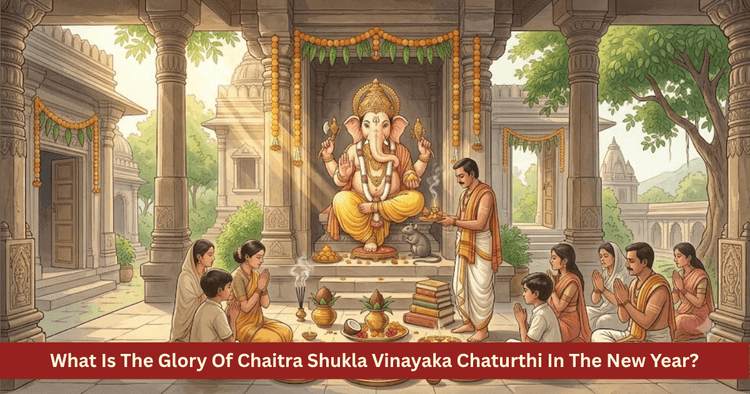
Table of Contents
Panchang Description And The Astrological Dimensions Of Vinayaka Chaturthi
Within the mathematical cosmology of the classical Vedic calendar, the Mudgala Purana and the Ganesha Purana, the fourth lunar day (Chaturthi) of the bright fortnight (Shukla Paksha) of every lunar month is observed across the cosmos as Vinayaka Chaturthi. While the dark fortnight's Sankashti Chaturthi is nocturnal-culminating at moonrise to purge deep-seated karmic afflictions-the bright fortnight's Vinayaka Chaturthi is strictly diurnal, observed during the midday hours (Madhyahna Kala) to invoke expansive intellect, righteous wisdom (Buddhi), executive prosperity (Siddhi) and the unhindered inception of new enterprises. Occurring within the inaugural fortnight of the Vedic calendar, Chaitra Shukla Vinayaka Chaturthi is celebrated as the very first Vinayaka Chaturthi of the entire New Year (Nav Samvatsara).
Astronomically and astrologically, Chaitra Shukla Chaturthi falls upon the fourth station of Vasanti Navratri, coinciding with the adoration of Mother Kushmanda (the cosmic creator dwelling within the solar sphere). Lord Surya Deva traverses the final degrees of Pisces, preparing for his exaltation ingress into Aries, while the Moon transits the asterisms of Krittika or Rohini across the Aries-Taurus threshold. Rohini represents the Moon's sign of absolute exaltation. According to classical predictive astrology, Chaturthi tithi is presided over directly by Lord Ganesha, the lord of beginnings, while its subtle elemental forces are governed by Mercury (Budha, significator of analytical intelligence and commercial enterprise) and Ketu (the mystical node of obstacle elimination). Worshiping Lord Varada Vinayaka at the solar zenith aligns cerebral neuro-pathways with higher intuitive discernment.
| Astrological and Astronomical Factor | Classical Scriptural and Metaphysical Detail |
|---|---|
| Lunar Month and Fortnight | Chaitra Month, Shukla Paksha (Bright Fortnight) |
| Lunar Tithi | Chaturthi (First Vinayaka Chaturthi of the New Year Cycle) |
| Canonical Liturgical Titles | Chaitra Vinayaka Chaturthi, Varada Vinayaka Chaturthi |
| Sovereign Presiding Divinity | Lord Varada Vinayaka (The Bestower of Righteous Boons) |
| Concurrent Navratri Divinity | Mother Kushmanda (Ruler of the Anahata and Solar Matrix) |
| Prescribed Liturgical Window | Madhyahna Kala (Midday: 11:00 AM to 01:30 PM) |
| Core Elemental Matrix | Synthesis of Fire (Manipura) and Earth (Muladhara) |
| Traditional Sacramental Offerings | 21 Steamed Modakas, Besan Laddoos, 21 Durva Blades, Red Hibiscus |
| Associated Planetary Alignments | Mercury (Intellect and Commerce) and Ketu (Spiritual Liberation) |
| Bestowed Spiritual Fruit | Awakening of Intellect, Erasure of Vastu Flaws, Business Momentum |
To assimilate the protective and intellect-bestowing grace of Lord Varada Vinayaka and clear obstacles for the incoming year, a seeker must observe disciplined scriptural decorum from early dawn:
- Awaken before sunrise during Brahma Muhurta, bathing in ambient spring or river water consecrated with holy drops and red sandalwood powder.
- Dress in clean, unstitched cotton vestments of vibrant crimson, deep saffron or golden-yellow hues, offering three water oblations to Surya Deva.
- Cleanse the northeastern quadrant (Ishanya) of the domestic sanctuary, draping a wooden platform in unblemished red silk.
- Seat an icon of Lord Varada Vinayaka or a sacred clay murti upon a copper or silver platter inscribed with an eight-petaled lotus design.
- Initiate the primary liturgy during the midday window (between 11:00 AM and 01:30 PM), kindling an unbroken lamp fueled by pure cow clarified butter and burning guggul incense.
- Present twenty-one paired blades of fresh green Durva grass alongside pure vermilion paste (Sindoor) while chanting the twelve traditional names of Ganesha.
- Recite the Atharvavedic Ganapati Atharvashirsha at least three, eleven or twenty-one times with focused acoustic precision.
- Present twenty-one freshly prepared sweet modakas or chickpea-flour laddoos before the deity, followed by the sounding of the conch shell.
- Maintain a satvic diet throughout the day; initiate a new educational project, philosophical study or commercial plan during the late afternoon.
- Refrain from directly gazing at the night sky or the Moon, as viewing the Chaturthi crescent can induce mental agitation and perceptual flaws.
The Ashtavinayaka Tradition: Varada Vinayaka At Mahad
In the sacred Ashtavinayaka pilgrimage circuit of Maharashtra, the fourth divine station is dedicated to Sri Varada Vinayaka at Mahad, in the Raigad district.
1. Etymology and Iconographic Grace
In classical Sanskrit, Varada signifies 'The sovereign dispenser of righteous boons and spiritual grace'. The icon of Varada Vinayaka faces eastward, his trunk turned gently toward the left (Vamamukhi), flanked by the celestial consorts Riddhi (Prosperity) and Siddhi (Attainment). This left-turning trunk represents the gentle, accessible, maternal aspect of Ganesha, making this form ideal for domestic householders seeking peace and family harmony.
2. The Living Mystery of the Nandadeep
The sanctum sanctorum of the Mahad temple preserves an unbroken oil lamp known as the Nandadeep. This holy flame was kindled in 1892 CE (Samvat 1848) and has burned continuously without interruption for over a century. The flame symbolizes the enduring presence of unblemished knowledge (Jnana) dispelling the darkness of material ignorance.
3. Sage Gritsamada's Penance in the Bhadraka Forest
The Ganesha Purana records that Sage Gritsamada-a celebrated seer who formulated numerous Vedic hymns and advanced the Ganapatya tradition-endured severe social humiliation regarding his lineage. Distressed by worldly injustice, he retreated into the Bhadraka forest (modern Mahad).
Subsisting solely on air, he practiced unbroken penance for thousands of years, chanting the sacred seed formula GAM. Pleased by his devotion, Lord Ganesha manifested before him during the bright fortnight of Chaitra, embracing the ascetic: "O noble sage! You shall be renowned as a supreme seer of the Vedas. Henceforth, I shall reside in this sacred grove as Varada Vinayaka, granting the noble aspirations of all sincere seekers who take refuge in my name."
| Ashtavinayaka Dimension | Historical and Puranic Milestone | Subtle Spiritual Influence |
|---|---|---|
| Sacred Deity Title | Sri Varada Vinayaka (Fourth Ashtavinayaka Shrine) | Fulfillment of righteous ambitions, intellectual awakening |
| Geographical Sanctuary | Mahad, Khalapur Taluka, Raigad District (Maharashtra) | Kundalini awakening from Muladhara to Ajna center |
| Iconographic Orientation | East-facing, trunk turned gently to the left | Calm, accessible grace tailored for household stability |
| The Sacred Nandadeep | Unbroken cow ghee flame burning since 1892 CE | Unbroken light of spiritual truth dispelling mental gloom |
| Sage Gritsamada | Seer of the sacred Ganapati Atharvashirsha | Dissolution of societal disgrace, restoration of dignity |
The Midday Science: Solar Meridian And Yogic Solar Breath
Why is Lord Shiva worshiped at twilight (Pradosha), the Divine Mother at midnight (Nishita), yet Lord Ganesha specifically at midday (Madhyahna) on Vinayaka Chaturthi?
1. The Solar Meridian and the Dissolution of Shadow
Midday marks the eighth muhurta of the diurnal cycle, when the Sun reaches the zenith of the sky.
- At solar noon, physical shadows shrink to their minimum. Metaphysically, the shrinking of shadow symbolizes the dissolution of ego, doubt and spiritual ignorance before the light of truth.
- In predictive astrology, the Sun represents the soul (Atman) and Ganesha represents discriminative intellect (Buddhi). Worshiping Ganesha when the solar disc is at its highest elevation harmonizes intellectual faculties with spiritual purpose.
2. Activating the Solar Pingala Meridian
In yogic subtle anatomy, the right nasal airway and the Pingala Nadi (the solar energy channel) dominate between 11:00 AM and 01:30 PM. The Pingala meridian governs metabolic digestion, logical analysis, executive decision-making and physical drive.
- Offering twenty-one blades of cooling Durva grass while reciting Om Gam Ganapataye Namah during this window calms excess nervous heat, redirecting vital prana into the central Sushumna channel.
- This transition encourages an alpha state of brainwave activity, clearing mental fatigue and supporting strategic, calm decision-making for business and study.
The Acoustic Science Of The Ganapati Atharvashirsha
Reciting the Ganapati Atharvashirsha-an Upanishadic text from the Atharvaveda-on Chaitra Shukla Vinayaka Chaturthi is regarded as a powerful spiritual practice.
Tvam eva kevalam kartasi. Tvam eva kevalam dhartasi. Tvam eva kevalam hartasi.
Tvam eva sarvam khalvidam Brahmasi. Tvam sakshad atmasi nityam.
Scientific Insights of the Upanishad
- Root Center Activation: The text declares: Tvam muladhara sthito-asi nityam-You dwell eternally at the base of the spine in the Muladhara chakra. Reciting these verses eleven times on Vinayaka Chaturthi stimulates the root energy center, establishing emotional grounding, physical health and financial stability.
- Transcending Triads: The text proclaims the Lord to be beyond the three gunas (Sattva, Rajas, Tamas), beyond the three physical bodies (gross, subtle, causal) and beyond the three divisions of time (past, present, future), centering human awareness in the present moment.
- Clearing Environmental Disharmony (Vastu Shuddhi): The sonic vibrations of the Sanskrit verses clear lingering energetic heaviness from residential and commercial structures, promoting focus and peace.
The Twelve Classical Names: Offering The 21 Durva Pairs
Offering twenty-one paired blades of fresh green Durva grass while reciting the twelve classical names of Ganesha from the Narada Purana activates distinct cognitive faculties:
| Order | Sacred Name | Classical Meaning | Manifested Practical Benefit |
|---|---|---|---|
| 1 | Sumukha | Possessing a radiant, beautiful countenance | Expressive speech, charisma, gentle communication |
| 2 | Ekadanta | Bearing a single, unbroken tusk | Nondual perception, deep focus, overcoming opposition |
| 3 | Kapila | Tawny, smoke-hued complexioned | Purification of the auric field, dispelling mental gloom |
| 4 | Gajakarnaka | Possessing broad ears like an elephant | Receptive listening, absorption of deep knowledge |
| 5 | Lambodara | Endowed with an expansive belly | Capacity to hold confidences, emotional patience |
| 6 | Vikata | Formidable slayer of adversity | Protection during severe crises and sudden physical peril |
| 7 | Vighnanashaka | Destroyer of insurmountable obstacles | Dissolution of recurring roadblocks in career and life |
| 8 | Vinayaka | The supreme, peerless leader | Natural authority, executive skill, social leadership |
| 9 | Dhumraketu | Bearing a smokey, fiery standard | Shield against deceptive trends and negative influences |
| 10 | Ganadhyaksha | Sovereign master of the celestial hosts | Team coordination organizational harmony, peer support |
| 11 | Bhalachandra | Bearing the crescent Moon upon his brow | Mental serenity, emotional cooling, freedom from anger |
| 12 | Gajanana | Endowed with the head of the elephant | Strategic vision, magnanimity, transcendence of pride |
Step-By-Step Liturgical Protocol For Chaitra Vinayaka Chaturthi
To conduct the traditional worship of Lord Varada Vinayaka on Chaitra Shukla Chaturthi, observe the following liturgy:
- Morning Purification: Awaken before sunrise, bathing in water infused with holy drops. Dress in clean yellow or red cotton garments. Position a wooden platform in the domestic shrine, draping it in red silk and sketch an eight-petaled lotus using raw rice grains.
- Deity Installation: Seat a metallic icon or clean clay murti of Lord Ganesha upon a silver or copper platter atop the lotus design. Place two areca nuts flanked on either side, representing Riddhi and Siddhi.
- Midday Vow (Sankalpa): During the midday window, take water, vermilion, unbroken rice, durva grass and a coin in the right palm:
Om Vishnave Namah. Adya Chaitra mase shukla pakshe Vinayaka Chaturthi tithau, Varada Vinayaka preeti-kamanaya, Nav Samvatsare mama sakala vyaparika-bauddhika vighna nivaranartham, Riddhi-Siddhi praptyartham Vinayaka Chaturthi pujanam aham karishye.
- Panchamrita Abhisheka: Bathe the metallic icon with raw cow milk, yogurt, ghee, honey and sacred river water poured from a Dakshinavarti conch shell while intoning the Ganapati Atharvashirsha, concluding with a stream of pure Ganga water.
- Vermilion and Vestment Offerings: Anoint the icon with pure orange vermilion paste blended with cow clarified butter. Offer a fresh yellow cotton sash and an unblemished sacred thread (Yajnopavita).
- Offering 21 Durva Pairs: Cleanse twenty-one pairs of Durva grass in pure water, presenting them pair by pair over the brow and feet of the deity while reciting the twelve sacred names and the seed formula Om Gam Ganapataye Namah.
- Floral and Botanical Offerings: Present fresh red hibiscus blossoms, scarlet roses and fresh Shami leaves.
- Sacramental Food Offering (Naivedya): Offer twenty-one freshly prepared sweet steamed modakas, chickpea-flour laddoos, ripe bananas, fresh coconut and sweet betel leaves garnished with cloves and cardamom.
- Scriptural Recitation and Camphor Arati: Kindle natural guggul incense and an unbroken ghee lamp, reciting the Ganapati Atharvashirsha and the Sankatanashana Ganesha Stotra. Conclude with a traditional arati accompanied by the sounding of bells and conches.
Remedial Applications: Resolving Commercial Roadblocks And Vastu Doshas
For commercial enterprises experiencing cash-flow blockages or households troubled by spatial disharmony, the observances of Chaitra Shukla Vinayaka Chaturthi offer traditional remedies:
| Circumstantial Challenge | Underlying Astrological/Vastu Factor | Prescribed Liturgical Remedy |
|---|---|---|
| Commercial Stagnation | Afflicted Mercury or challenged 10th house | Install an icon of Shvetarka Ganesha (carved from white madar root) in the cash vault |
| Domestic Strife from Vastu Flaws | South or Southwest entrance disharmony | Place two icons of Lord Ganesha back-to-back directly above the main entryway |
| Academic Focus Difficulties in Youth | 5th house afflicted by Rahu or weak Mercury | Offer 5 modakas to Ganesha; have the student recite the Atharvashirsha daily |
| Professional Promotion Obstacles | Friction between Sun and Saturn alignments | Offer 21 Shami leaves to Ganesha while chanting Om Vakratundaya Hum 108 times |
Philosophical Essence: Transforming Obstacles Into Wisdom
Chaitra Shukla Vinayaka Chaturthi imparts an enduring lesson: Life's obstacles are not barriers meant to halt us; they are crucibles meant to refine our character and awaken wisdom.
The iconography of Lord Ganesha illustrates how to maintain poise amidst contrasting forces. He rides the humble mouse, yet commands universal authority. His massive elephant head signifies comprehensive wisdom and patience, while his small mouth and large ears teach us to listen deeply and speak with care.
Welcoming the New Year by placing our intellect and ambition at the feet of Lord Varada Vinayaka awakens discriminative discernment (Viveka). An authentic seeker views each hurdle as an opportunity to grow, walking the path of duty with patience, integrity and faith.
FAQ
At what time of day is Vinayaka Chaturthi worship conducted?
Vinayaka Chaturthi is observed strictly during the midday hours (Madhyahna Kala: 11:00 AM to 01:30 PM), unlike Sankashti Chaturthi, which is celebrated at nocturnal moonrise.
Which manifestation of Lord Ganesha is venerated on this day?
The observance centers on Lord Varada Vinayaka-the compassionate bestower of righteous boons and the fourth form in the sacred Ashtavinayaka pilgrimage circuit.
Why is reciting the Ganapati Atharvashirsha central to this observance?
The Atharvashirsha balances the root Muladhara chakra, clearing mental confusion, supporting financial stability and harmonizing environmental subtle energies.
Why is directly viewing the Moon discouraged on Vinayaka Chaturthi?
Viewing the fourth-phase crescent Moon is traditionally cautioned against, as it can induce mental restlessness and distorted perception.
What is the symbolic meaning of offering twenty-one sweet modakas?
The word Modaka signifies that which brings joy; offering twenty-one modakas symbolizes surrendering the twenty-one somatic and mental faculties to divine wisdom.
Get your accurate Kundali
Generate KundaliDid you like it?
Author
Pt. Narendra Sharma (63)
Experience: 20
Consults About: Family Planning, Career
Clients In: Punjab, Haryana, Delhi
Share this article with friends and family
WELCOME TO
ZODIAQ
Right Decisions at the right time with ZODIAQ
