How Does Nature Rejuvenate In Chaitra?
By Aparna Patni
The Transition From Spring To Summer And The Radiant Bloom Of Palash
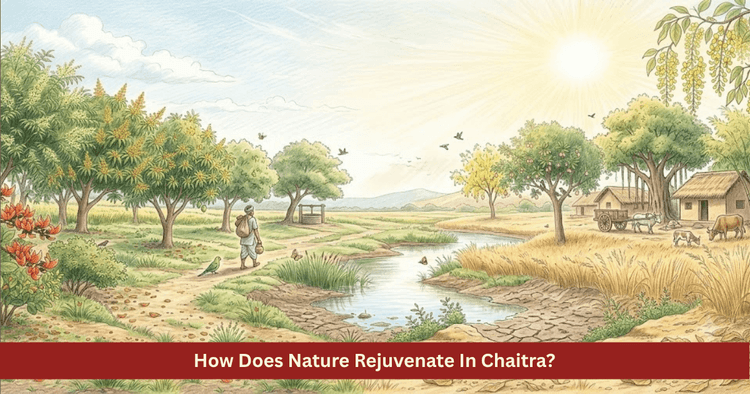
Table of Contents
Panchang Description And The Astronomical Science Of Seasonal Transition
Within the astronomical cosmology of the classical Vedic calendar, seasonal shifts are never regarded as random swings of ambient temperature. Instead, they represent the dynamic harmonization of solar radiation, terrestrial moisture and spatial equilibrium. According to classical computational astronomy, the month of Chaitra functions as the most sensitive seasonal junction (Ritu Sandhikala) bridging late winter-spring with the onset of radiant summer. Across this temporal phase, Lord Surya Deva traverses the final degrees of the watery sign of Pisces, crossing into his exaltation sign of Aries (Mesha Sankranti). Astronomically, this coincides with the vernal equinox, where the incident rays of the Sun cross the celestial equator, illuminating the northern hemisphere.
As the solar incidence angle becomes direct over terrestrial coordinates, diurnal hours expand steadily while nocturnal spans contract. Extending from late March through mid-April, this celestial transit alters atmospheric pressure, relative humidity and air currents across the subcontinental landmass. Foundational Vedic treatises-most notably the Shatapatha Brahmana and the Sharirasthana of the Charaka Samhita-classify this junction as the transition from Visarga Kala (the cooling, life-giving lunar phase) into the fiery dominion of Adana Kala, where the Sun extracts terrestrial moisture to stimulate the internal fire element.
| Astrological and Astronomical Factor | Classical Scriptural Description |
|---|---|
| Chronological Seasonal Position | Inaugural Month, Culmination of Spring, Ingress of Summer |
| Gregorian Calendar Conjunction | 20 March to 20 April (March-April Transition) |
| Solar Transit Dynamics | Transition from Pisces into Aries (Solar Exaltation Matrix) |
| Astronomical Phenomenon | Vernal Equinox (Balance of Day and Night Yielding to Long Days) |
| Dominant Elemental Shift | Contraction of Water Element, Expansion of Cosmic Fire |
| Visible Ecological Metaphor | Saffron Bloom of Palash, Mango Inflorescence, Wheat Harvest |
| Bestowed Spiritual Fruit | Biological Renewal, Ascending Vital Prana, Cellular Luster |
To harmonize the human physical vessel with this environmental shift and awaken dormant inner vitality during Chaitra, a spiritual seeker must observe rigorous scriptural conduct from dawn onward.
- Awakening before sunrise during Brahma Muhurta, bathing in cool or ambient fresh water consecrated with sacred river drops and fresh neem extract.
- Standing erect facing the eastern horizon following ablutions, pouring three continuous water oblations to Surya Deva from a copper vessel mixed with kumkum and unbroken rice.
- Drinking exclusively natural water cooled in unglazed terracotta urns, renouncing refrigerated and ice-chilled fluids completely.
- Practicing twelve cycles of Surya Namaskar postures followed by measured Bhastrika breath control at dawn.
- Incorporating light, easily digestible, bitter and astringent tastes into the daily diet while renouncing heavy, oily and stale leftovers.
- Avoiding direct, unprotected exposure to scorching midday winds (Loo) by shielding the cranial crown with unbleached natural cotton fabric.
- Kindling an unadulterated cow clarified butter lamp near the base of the sacred Tulsi plant at sunset to express gratitude to nature.
- Massaging the soles of the feet with pure cow clarified butter or unrefined coconut oil prior to nocturnal rest to soothe systemic vascular heat.
Botanical Radiance: The Saffron Blaze Of The Palash Forest
With the advent of Chaitra, the deciduous forests across the Indian landmass-most notably across the Vindhya, Satpura and Aravalli ranges-undergo an ecological metamorphosis. During this interval, the palash tree (Butea monosperma), historically known as the 'Flame of the Forest', sheds its foliage completely, clothing its branches in thick clusters of scarlet-orange blossoms. Gazing upon the forested horizons, one perceives what appears to be a cool fire sweeping across the terrain.
According to ancient botanical lore and the Atharvaveda, the palash tree embodies the unified presence of the cosmic trinity: Brahma resides at its root, Vishnu within its trunk and Lord Mahadeva Shiva across its flowering crown. The blooming of palash in Chaitra serves as a natural defensive shield for the environment:
| Botanical Component | Ecological and Environmental Dynamic | Somatic Action on Human Health |
|---|---|---|
| Palash Blossoms (Tesu) | Absorbs concentrated ultraviolet radiation | Cleanses dermal layers, purifies blood, cools tissue |
| Mango Inflorescence (Baur) | Nourishes honeybees and natural pollinators | Pacifies bile, clears anorexia, tones vocal chords |
| Madhuca Flowers (Mahua) | Emits sweet fragrance, sustains woodland fauna | Eliminates somatic fatigue, builds cellular stamina |
| Tender Neem Shoots | Neutralizes suspended airborne micro-pathogens | Delivers antiviral immunity, purges toxic heat |
Palash blossoms absorb solar thermal radiation, dispersing purified, pathogen-resistant atmospheric currents across surrounding ecosystems. Ancient traditions mandated bathing in infusions of boiled palash petals during the spring festivals, conditioning human dermal pores to endure the approaching summer heat without inflammatory eruptions.
Circadian Disruption, Thermal Dynamics And Tridoshic Pathology
Contemporary chronobiology and classical Ayurveda confirm that the sharp fluctuations in ambient temperature and daylight during Chaitra perturb the human biological clock (Circadian Rhythm). As daylight hours expand, the pineal gland recalibrates its nocturnal melatonin secretions, inducing daytime drowsiness, vivid dreaming and unprovoked somatic fatigue.
The Charaka Samhita warns that dense, unctuous kapha accumulated throughout winter liquefies rapidly under the heating rays of the spring sun. This liquefied kapha floods the gastrointestinal tract, suffocating the digestive fire. Consequently, incomplete assimilation creates a toxic metabolic residue known as ama, which enters vascular circulation to manifest as seasonal allergic rhinitis, viral fevers, measles and acute skin eruptions.
| Biological Matrix | Winter Physiological Baseline | Transitional Shift in Chaitra | Prescribed Ayurvedic Protocol |
|---|---|---|---|
| Digestive Fire (Jatharagni) | Intense, robust and capable of heavy fats | Dampened and erratic due to liquefied kapha | Dry ginger, roasted gram, light fasting |
| Circulatory Blood (Rakta) | Stable, dense, unctuous | Inflamed by mobilized kapha and rising pitta | Tender neem shoots, giloy tea, triphala water |
| Cutaneous Layers & Pores | Constricted to retain core heat | Pores dilate, initiating active perspiration | Chickpea flour and turmeric scrubs, cool baths |
| Neurological Stability | Quiescent, calm, anchored | Disturbed by fluctuating vata and pitta | Alternate nostril breathing, humming bee breath |
Left unaddressed through lifestyle adaptation, this mobilized kapha combines with early summer pitta to produce bilious fevers, gastrointestinal distress and stubborn respiratory allergies.
Agricultural Fulfillment: The Golden Harvest Of Rabi Grains
The transitional month of Chaitra also marks the fulfillment of agrarian labor across rural landscapes. During this interval, the foundational rabi harvest-wheat, barley, chickpeas, mustard and red lentils-ripens under the sun, turning fields into plains of shimmering gold.
The Taittiriya Upanishad crowns grain as an embodiment of the Absolute, declaring: 'Annam na nindyat tad vratam, annam bahu kurvita tad vratam'-Never dishonor food; make it a sacred vow to produce grain in abundance. When the farmer harvests these crops under the spring sky, that labor represents the culmination of a year's dedication:
- The Navanna Consecration: The fresh ears of newly harvested wheat are roasted over open embers to formulate parched grains (holha), presented first to ancestral spirits, village guardians and Agni Deva before domestic consumption.
- The Sustenance of Barley and Sattu: Fresh barley and chickpeas are dry-roasted and milled into flour, producing sattu. Sattu acts as a nutritional shield against dehydration and heatstroke throughout the summer.
- Agrarian Charity: The initial portion of harvested grain is distributed to the destitute, manual laborers and birds, sustaining universal balance.
Classical Chaitra Regimen: Nutrition, Hydration And Daily Routine
To navigate this delicate seasonal threshold in health and strength, classical medicine outlines an authentic daily protocol (Ritucharya) designed to harmonize human physiology with nature:
1. Dietary Inclusions and Restrictions
Nutritional guidelines during Chaitra diverge sharply from winter diets. Heavy, greasy and excessively sweet consumables must be eliminated:
- Items to Renounce: Aged jaggery, thick sour curd, unpolished heavy rice, refined flour, deep-fried snacks, stale leftovers and excess salt must be avoided.
- Items to Ingest: Chew seven tender neem leaves alongside two black peppercorns and a small morsel of rock sugar on an empty stomach at dawn. Eat dry-roasted chickpeas, barley sattu, split green gram khichdi, pointed gourd, drumstick pods, bitter gourd and fresh mint chutney.
2. Hydration and Natural Cooling Tonics
Perspiration increases water loss through dermal tissues during this transition. Drink water stored within unglazed terracotta pots rather than refrigerated containers. Infusing drinking water with fragrant vetiver roots, dried rose petals or holy basil maintains core temperature. Ingesting wood apple squash (bel sharbat), roasted raw mango coolers (aam panna) and fennel infusions at midday prevents internal heat exhaustion.
3. Diurnal Rhythms and Physical Exercise
- Sleeping during daylight hours throughout Chaitra is strictly forbidden. Daytime sleep triggers a surge in bodily kapha, inducing bronchial congestion and chronic torpor.
- Retire to sleep by ten at night and awaken before five at dawn to align with natural solar cycles.
- Morning exercise should induce light perspiration over the brow and axillary regions to clear blocked dermal channels, avoiding exhausting over-exertion.
Philosophical Meaning: The Art Of Flowing With Natural Change
The seasonal shift of Chaitra reveals an essential truth of Sanatana spiritual philosophy: Adaptation and surrender to cosmic change represent the foundation of life.
Just as deciduous trees shed their withered foliage without sorrow to put forth emerald shoots for the coming summer heat, so must human consciousness release ancient prejudices, mental rigidity and past grievances. Trees that remain flexible during seasonal transitions stand secure against passing storms, whereas rigid, dried timber snaps before the wind.
The meteorology of Chaitra assures us that cold and heat, joy and sorrow, gain and loss follow an eternal cycle. When we align our lifestyle with the wisdom of the seasons, this transition ceases to be a source of physical vulnerability. Instead, it rejuvenates our being, preparing the soul to walk into the approaching sacred year in health, clarity and peace.
FAQ
When does the transition from spring to summer begin in Chaitra?
This transition commences around 20 March with the vernal equinox, culminating as the Sun enters Aries during mid-April.
What is the ecological and medicinal significance of palash blossoms?
Palash blossoms absorb solar thermal radiation and bathing in their boiled extract clears cutaneous pores and protects the skin against summer burning.
What dietary items pacify liquefied kapha during this transition?
Consuming fresh tender neem shoots, dry-roasted chickpeas, dry ginger, barley sattu, bitter gourd and split green lentils balances kapha.
Why is sleeping during daylight hours prohibited in Chaitra?
Daytime sleep causes liquefied kapha to surge, dampening digestive fire and triggering respiratory infections, coughs and metabolic lethargy.
Which vessel is ideal for cooling drinking water during this month?
Storing drinking water within an unglazed earthen pot (matka) or an unblemished copper vessel stabilizes body temperature and preserves essential minerals.
Get your accurate Kundali
Generate KundaliDid you like it?
Author

Aparna Patni (63)
Experience: 20
Consults About: Family Planning, Career
Clients In: Punjab, Haryana, Delhi
Share this article with friends and family
WELCOME TO
ZODIAQ
Right Decisions at the right time with ZODIAQ
