What Is The Mystery Of Cheti Chand And Lord Jhulelal?
By Pt. Suvrat Sharma
The Sindhi New Year And The Advent Of Lord Varuna Deva
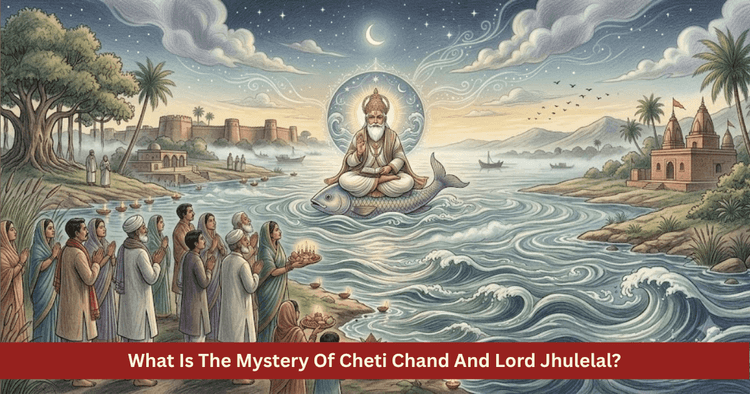
Table of Contents
Panchang Description And The Astronomical Framework Of The Sindhi New Year
Within the mathematical and metaphysical chronology of the classical Vedic calendar, the second lunar day of the bright fortnight of Chaitra (Chaitra Shukla Dvitiya) is venerated across the global Sindhi diaspora as the most sacred, auspicious and spiritually awakened day of the annual cycle. In the ancient Sindhi dialect and cultural memory, the month of Chaitra is revered as 'Chet', while the crescent Moon appearing upon the second lunar day is celebrated as 'Chand'. Thus, witnessing the auspicious crescent Moon during the month of Chet gives this sovereign festival its timeless scriptural designation: Cheti Chand.
In the computational architecture of the Vedic Panchang, this date dawns immediately following Chaitra Shukla Pratipada (the Vedic New Year). Astronomically, this marks the precise temporal station where the Moon breaks away from the combust darkness of the new moon (Amavasya), manifesting its initial luminous crescent. Visible against the twilight horizon, this delicate crescent Moon is far more than a physical satellite; it symbolizes the resurgence of the cosmic water element, mental tranquility and spiritual rejuvenation. Classical astrological digests assign the second lunar day to the jurisdiction of Lord Mahadeva Shiva, who holds the crescent Moon upon his matted locks. Within Sindhi spiritual history, upon this exact lunar date, Lord Varuna Deva-the cosmic sovereign of the waters-manifested upon the terrestrial plane as the divine infant Uderolal (Lord Jhulelal) to eliminate tyranny and safeguard religious freedom.
| Astrological and Astronomical Factor | Classical Scriptural and Historical Description |
|---|---|
| Lunar Phase and Fortnight | Chaitra Month (Chet), Bright Fortnight, Second Day (Dvitiya / Chand) |
| Canonical Liturgical Titles | Cheti Chand, Jhulelal Jayanti, Sindhi New Year Festival |
| Astronomical Lunar Position | Emergence of Crescent Moon (Conjunction with Ashwini or Bharani) |
| Sovereign Presiding Divinity | Lord Varuna Deva (Incarnation: Lord Jhulelal / Uderolal) |
| Historical Era of Advent | 10th Century CE (Vikram Samvat 1007 / 950-951 CE) |
| Consecrated Advent Sanctuary | Nasarpur, along the sacred banks of the Indus River (Sindh) |
| Primary Sacred Emblems | Bahrana Sahib, Unbroken Ghee Flame, Pallav Vow, Chhej Dance |
| Bestowed Spiritual Fruit | Purification of Water Element, Courage, Immunity, Prosperity |
To secure the spiritual blessings of Lord Varuna Deva, establish domestic harmony and reaffirm dedication to righteous living on Cheti Chand, a practitioner must observe disciplined scriptural decorum from dawn onward.
- Awakening before sunrise during Brahma Muhurta, bathing in cool fresh water consecrated with sacred river drops from the Ganga or the Indus.
- Dressing in clean traditional attire, standing facing eastward to pour three continuous water oblations to Surya Deva and Varuna Deva from a copper vessel.
- Lighting an unbroken lamp fueled by pure indigenous cow clarified butter before the consecrated icon or portrait of Lord Jhulelal in the domestic shrine.
- Preparing the sacred Bahrana Sahib altar plate, adorned with a sculpted flour lamp, whole green cardamom pods, cloves, crystalline rock sugar and fresh blossoms.
- Maintaining mental repetition of the victory chant 'Ayo Lal Sabhai Chao Jhulelal' and 'Jhulelal Beda Paar' throughout the daytime hours.
- Refraining from contaminating any natural or domestic water reservoir, treating every drop of life-giving water with reverence.
- Preparing and partaking of the sacramental noon offering comprising boiled seasoned chickpeas (chhola) and sweet saffron rice (tahiri), distributing portions to the needy.
- Participating in the vibrant cultural procession (Shobha Yatra) at dusk, executing the traditional martial stick dance (Chhej).
- Carrying the Bahrana Sahib to a living river or clean lake at night, immersing the offerings with prayers (Pallav) for universal welfare.
The Tyranny Of Mirakh Shah And The Forty-Day Chaliha Penance
Cheti Chand is far more than an ethnic New Year celebration; it stands as a testament to spiritual resilience, collective faith and the preservation of dharma against existential oppression. The historical background of this sacred festival dates to the tenth century of the common era (Vikram Samvat 1007), when the ancient province of Sindh was ruled by a despotic sovereign named Mirakh Shah, operating from the citadel of Thatta.
Influenced by religious zealots, Mirakh Shah issued an ultimatum to the indigenous Hindu populace: "Renounce your ancestral Vedic faith and embrace our creed or prepare for universal execution."
Confronting annihilation, the elders and scholars of the Hindu community petitioned for a brief reprieve to deliberate. Mirakh Shah granted them forty days. Lacking mercenary forces or worldly armaments, the people turned away from secular hope, seeking refuge before Lord Varuna Deva, the cosmic guardian of cosmic order and water.
| Ascetic Phase | Discipline of the 40-Day Chaliha Tapasya | Metaphysical and Somatic Influence |
|---|---|---|
| First 10 Days | Complete cessation of cooked grains, drinking water, sleeping on earth | Physical mortification, elimination of ego |
| 11th to 20th Day | Continuous chanting of the Varuna Gayatri and Vedic hymns | Mental coherence, awakening collective resolve |
| 21st to 30th Day | Standing chest-deep in the cold currents of the Indus River | Surrender, desperate prayer, emotional purity |
| 31st to 39th Day | Kindling unbroken ghee flames, observing silence (Mauna) | Projection of subtle spiritual vibrations |
| 40th Day | Terrestrial voice (Akashavani) granting fearless assurance | Prophecy of divine descent, elimination of fear |
Thousands of men, women, elders and children gathered along the banks of the sacred Indus River. They did not comb their hair, oil their limbs, change their simple garments or consume cooked food. Standing for hours in the cold river waters, they wept and prayed for divine intervention. This forty-day unbroken austerity is commemorated today as Chaliha Sahib.
On the midnight of the fortieth day, a light illuminated the dark waters of the Indus. From the depths manifested Lord Varuna Deva and a voice echoed across the riverbanks:
"Fear not, my beloved children! Your sincere penance, tears and unshakeable surrender have moved the cosmos. I shall take birth as an infant from the womb of Mother Devaki, wife of the pious Ratanchand Lohana, in the township of Nasarpur on the second lunar day of the bright fortnight of Chaitra. I shall dismantle tyranny, humble the pride of Mirakh Shah and protect your freedom of faith."
Hearing this divine promise, the community found renewed life, bowing before the waters in tears of gratitude.
The Miraculous Descent Of Infant Uderolal And His Divine Pastimes
In fulfillment of the prophecy, upon the auspicious second lunar day of the bright fortnight of Chaitra, a child of extraordinary radiance took birth in the household of Ratanchand Thakkar (Lohana) and Mother Devaki in the holy town of Nasarpur. The chamber filled with fragrance and celestial music resonated through the atmosphere.
Astrologers noted the divine marks upon the child's palms and feet, declaring him an incarnation of the cosmic water element. His cradle began to sway gently without physical human intervention, leading the citizens to name him with affection: Jhulelal (The Divine Child in the Cradle). Because he was seen hovering above the waters of the Indus, he was venerated as Uderolal (The One Who Traverses the Waters).
When word reached Mirakh Shah, he dispatched his trusted minister, Ahirio, to investigate:
- Transmutation of Lethal Venom: Ahirio presented a bowl of sweetened milk laced with fatal poison to the infant. Smiling, child Jhulelal touched the vessel; the venom dissolved into fragrant rose water and sweet nectar.
- The Cosmic Form (Vishwarupa): Gazing into the infant's face, Ahirio beheld the universe within his open mouth: the rushing Indus river and an elderly sage with a flowing white beard seated upon a swimming Hilsa fish (Palla machhi), holding the sacred Vedas in his hands. Terrified, Ahirio retreated to the royal court, warning Mirakh Shah that this child was a manifestation of the Divine.
- The Miracle of Elemental Fire and Water: Refusing to yield, Mirakh Shah deployed his imperial army to capture Uderolal. As the soldiers advanced upon Nasarpur, child Jhulelal transformed into a youth riding a white stallion, brandishing a sword of radiant light. When the tyrant refused to cease his persecution, Lord Jhulelal gestured toward the citadel; walls of flame surrounded the palace, while the waters of the Indus rose to submerge the ramparts.
Terrified by the rising waters and fire, Mirakh Shah ran barefoot to the feet of Lord Jhulelal, pleading for mercy. With compassion, Lord Jhulelal gestured for the elements to recede, delivering a sermon on spiritual unity:
"Hear, O Mirakh Shah! The Supreme Truth is one without a second. That Divine whom you address as Allah is the identical Reality venerated as Sri Hari and Varuna Deva. The Quran and the Vedas sing the glories of the same Divine Essence. To persecute human beings for their way of worship is an offense against the Creator. Return to your throne and establish complete freedom of faith for all citizens across your realm."
Humbled, Mirakh Shah bowed before Lord Jhulelal, pledging to protect freedom of worship and justice throughout his life.
The Esoteric Science Of Bahrana Sahib And The Unbroken Ghee Flame
Within Sindhi spiritual tradition, the primary liturgical medium for worshiping Lord Jhulelal is the ceremonial altar known as Bahrana Sahib. Consecrated on Cheti Chand, Bahrana Sahib represents an esoteric mandala that harmonizes the five cosmic elements (Earth, Water, Fire, Air and Space).
Every material element incorporated into Bahrana Sahib possesses symbolic and energetic significance:
| Structural Component | Elemental Nature | Subtle Energetic Function | Metaphysical and Puranic Symbolism |
|---|---|---|---|
| Polished Bronze/Brass Platter | Dense metallic base plate | Deflects external negative vibrations | Prithvi Tattva (The foundational Earth) |
| Sculpted Wheat Dough Altar | Uncooked whole wheat flour kneaded with water | Absorbs and stores life prana | Annam Brahma (The physical vessel) |
| Four-Wick Clarified Butter Lamp | Pure cow ghee with cotton wicks | Incinerates ignorance and fear | Agni Tattva (The immortal soul light) |
| Fresh Fragrant Blossoms | Rose, jasmine and marigolds | Promotes mental calm and devotion | Aesthetic grace, purity of thought |
| Cardamom, Cloves, Rock Sugar | Aromatic, digestive spices | Cleanses subtle sensory channels | Refinement of speech and sensory control |
| Natural Camphor and Incense | Aromatic purifying smoke | Disperses ambient negative vibrations | Vayu Tattva (Cleansing of the mind) |
| Copper Urn of Consecrated Water | Living pure river water | Induces mental stillness and peace | Varuna Deva (Primordial Water Element) |
Carrying this consecrated platter upon the head during processions calms nervous tension and dispels subconscious fear. At the close of festivities, when the Bahrana Sahib is immersed in a river or lake, the flour, sugar and grains provide food for aquatic life, embodying the Vedic ideal of compassion for all creatures.
The Sacred Prayer Of Pallav And The Chhej Martial Stick Dance
The emotional heart of Jhulelal liturgy is the supplication known as Pallav Paana. In the Sindhi language, pallav signifies spreading the two ends of one's shawl, scarf or cloth with both hands, adopting an attitude of surrender before God.
Following arati on Cheti Chand, the congregation stands together. Spreading their cloth in humility, seekers lower their heads before the altar of Lord Jhulelal, intoning with sincerity:
"Tuhin tu, tuhin tu, O Lal Sai! Asaan je mathe te daya jo hath rakh.
Sabhani ja beda paar kar, sabhani khe sukh, shanti ain nirogata bakhsh.
Asaan agyani aahiyun, asaan ja samast paap kshama kar ain dharma je marg te halaye."
(Meaning: You alone are the refuge, O Divine Lord Jhulelal! Rest your hand of compassion upon our heads. Guide the ship of every living soul across the ocean of worldly trials. Grant peace, health and contentment to all existence. Forgive our unconscious errors and guide our steps upon the path of righteousness.)
Chhej: The Sacred Dance of Valor and Ecstasy
Following the quietude of the Pallav prayer, the community transitions into the traditional dance known as Chhej. Similar to the Dandiya and Garba dances of western India, Chhej is distinguished by its dynamic tempo and martial resonance:
- Men and women form concentric circles, holding carved wooden sticks (dandiyas) in their hands.
- Dancing to the rhythms of dhol drums, brass cymbals and traditional flutes, the striking of the sticks echoes with vigor.
- This dance honors the martial heritage of the community, celebrating the courage required to protect faith. Participating in Chhej dissolves personal stress, uniting the community in shared rhythm and joy.
Sacramental Offerings: The Science Of Chhola And Tahiri
Across every household and community kitchen on Cheti Chand, two traditional dishes are prepared and shared: boiled savory chickpeas (chhola) and sweet saffron rice (tahiri).
Far from being ordinary confections, this combination serves as an Ayurvedic preparation designed to balance the physical humors during the spring-summer transition:
- Boiled Savory Chickpeas (Chhola): Brown chickpeas are steeped overnight and simmered with unrefined rock salt, roasted cumin seeds and cracked black pepper. In classical Ayurveda, chickpeas are astringent (kashaya), absorbing the excess kapha that liquefies in early spring. This dish stabilizes the stomach lining, strengthens digestion and delivers sustained energy.
- Sweet Saffron Rice (Tahiri): Long-grain rice is simmered with pure cow clarified butter, crystalline rock sugar, fragrant cardamom pods, cloves and saffron strands. This combination pacifies pitta, supplies quick glucose to bodily tissues and calms the nervous system.
Together, savory chhola and sweet tahiri provide a balance of complex carbohydrates, clean plant proteins and essential minerals, preventing dehydration and fatigue as seasonal temperatures rise.
The Universal Spiritual Message And Enduring Community Resilience
The advent of Lord Jhulelal imparts the universal truth that living water is sacred and righteousness is eternal.
Lord Jhulelal belongs not to one narrow faction but to universal humanity. He overcame fanaticism through moral truth, spiritual discipline and divine authority. His pastimes prove that when an individual or community remains dedicated to truth, nature protects them.
Following the partition of 1947, when the Sindhi community was displaced from its ancestral homeland, leaving behind properties, fields and temples, families crossed into new lands with few material resources. Yet they carried an enduring spiritual anchor-the sacred name of Lord Jhulelal and the blessing: 'Jhulelal Beda Paar' (Lord Jhulelal will guide our ship across). Grounded in that resilience, the community rebuilt its institutions, thriving across commerce, philanthropy and cultural life worldwide.
On Cheti Chand, let us bow before Lord Jhulelal, resolve to conserve and protect living waters, uphold universal fraternity and proclaim: 'May our sacred heritage endure and may the divine name of Lord Jhulelal inspire all generations.'
FAQ
On which specific lunar date is the festival of Cheti Chand observed?
Cheti Chand is celebrated on the second lunar day (Dvitiya) of the bright fortnight of Chaitra, marked by the appearance of the new crescent Moon.
Who is Lord Jhulelal according to Vedic scriptural tradition?
Lord Jhulelal (Uderolal) is venerated as an incarnation of Lord Varuna Deva, the sovereign presiding deity of the cosmic water element.
What historical event is commemorated by the forty-day Chaliha Sahib fast?
It commemorates the forty days of unbroken penance observed by the Hindu community along the banks of the Indus River to seek divine protection from tyranny.
What sacred items are assembled within the Bahrana Sahib platter?
The Bahrana Sahib includes a bronze platter, a sculpted flour lamp fueled by cow ghee, cardamom, cloves, rock sugar, fresh flowers and a pot of consecrated water.
What traditional sacramental dishes are prepared and shared on Cheti Chand?
Boiled seasoned chickpeas (chhola) and sweet saffron rice (tahiri) are prepared and distributed to all community members as sacred prasad.
Get your accurate Kundali
Generate KundaliDid you like it?
Author
Pt. Suvrat Sharma (63)
Experience: 20
Consults About: Family Planning, Career
Clients In: Punjab, Haryana, Delhi
Share this article with friends and family
WELCOME TO
ZODIAQ
Right Decisions at the right time with ZODIAQ
