What Is The Significance Of The End Of Kharmas And The Resumption Of Samskaras?
By Pt. Suvrat Sharma
End Of Kharmas, Resumption Of Marriages, Vivaha Muhurta And 16 Samskaras
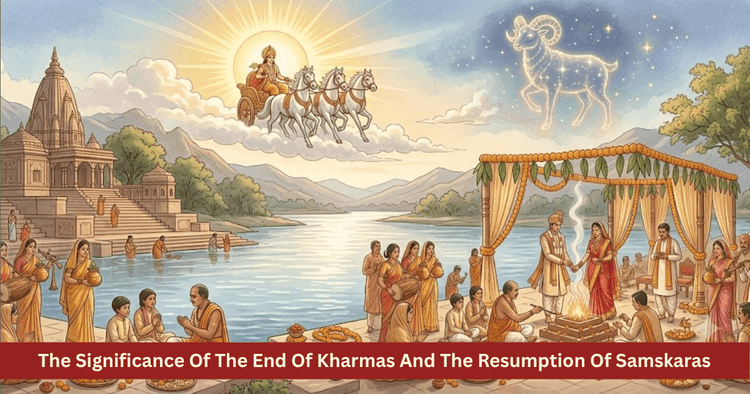
Table of Contents
Panchang Description And The Astrological Dimensions Of The End Of Kharmas
Within the mathematical cosmology of the classical Vedic calendar, the Muhurta Chintamani, the Dharmasindhu and the Nirnayasindhu, the conclusion of Kharmas (also known as Malmas) represents an astronomical liberation and renewal for societal, domestic and spiritual life. According to the computational principles of predictive Vedic astrology, whenever the sovereign cosmic luminary, Lord Surya Deva, transits through the two zodiacal signs owned by Jupiter (Brihaspati)-namely Sagittarius (Dhanu) or Pisces (Meena)-that thirty-day window is scripturally designated as Kharmas, Dhanurmas or Meena Malmas.
In the latter half of the lunar month of Phalguna, when the Sun entered watery Pisces, all major auspicious ceremonies and sacramental rites were paused. In the latter half of the month of Chaitra, at the precise moment of Mesha Sankranti, the Sun completes its passage through Pisces, entering the first cardinal fire sign of Aries (Mesha) at 0°. At this moment, the restriction of Kharmas lifts. As the Sun establishes itself in its exaltation sign of Aries, the cosmos receives an influx of solar prana, revitalizing life across the northern hemisphere. With this transit, the astrological windows for auspicious ceremonies-including weddings, engagements, housewarmings, tonsure rites, sacred thread investitures and business inaugurations-reopen.
| Astrological Factor | Scriptural and Astrological Detail |
|---|---|
| Duration of Kharmas | Solar Transit through Pisces (approx. March 14/15 to April 13/14) |
| Exact Moment of Conclusion | Ingress of Mesha Sankranti (Sun entering 0° Aries) |
| Inaugurated Solar Month | Solar Vaishakha Month (The First Month of the Solar New Year) |
| Astrological Dignity of the Sun | Liberated from Piscean restraint; entering its sign of exaltation |
| Resumed Sacramental Rites | Marriage, Sacred Thread (Upanayana), Tonsure, Housewarming, Enterprise |
| Sovereign Presiding Powers | Lord Surya Narayana (Sun God), Jupiter (Guru Deva), Mars (Mangala) |
| Core Elemental Synthesis | Harmonious balance of Jupiterian wisdom and Solar vital heat |
| Active Upcoming Liturgical Season | Vaishakha, Jyeshtha and Ashadha (active until Shayani Ekadashi) |
| Bestowed Spiritual Fruit | Marital Longevity, Domestic Stability, Ancestral Fulfillment |
To realign the domestic sphere with these revitalized cosmic energies and plan auspicious enterprises, a seeker must observe disciplined scriptural decorum from early dawn:
- Awaken before sunrise during Brahma Muhurta, bathing in ambient spring or river water consecrated with holy river drops.
- Stand facing eastward after ablutions, pouring three continuous water oblations to Surya Deva from a copper vessel enriched with red sandalwood paste, unbroken rice, red blossoms and raw jaggery.
- Kindle an unbroken lamp fueled by pure indigenous cow clarified butter before Lord Ganesha, Lord Satyanarayana and lineage guardian deities in the domestic shrine.
- Formally articulate pending intentions (such as weddings, construction or child investitures), seeking divine guidance and blessings.
- Consult a qualified traditional astrologer to examine the birth charts of prospective brides and grooms, selecting appropriate wedding windows (Vivaha Muhurtas) for the months of Vaishakha and Jyeshtha.
- Donate yellow split chickpeas, turmeric root, yellow clothing, bananas and roasted gram flour to teachers, ascetics or the underprivileged to honor Jupiter.
- Cleanse the domestic threshold with sacred water, hanging fresh mango leaf garlands across the lintel and marking an auspicious vermilion swastika upon the entrance.
- Kindle a lamp of cow ghee near the sacred Tulsi altar at dusk, offering prayers for peace and continuity in family life.
The Puranic Allegory: The Sun's Chariot And The Donkeys (Khar)
The Bhavishya Purana, the Padma Purana and classical solar treatises preserve a symbolic narrative explaining the origin and terminology of Kharmas.
At the dawn of manifestation, Lord Surya Narayana traversed the cosmos upon his golden chariot drawn by seven celestial horses (the Sapta-Ashva, symbolizing the seven visible colors and solar rays). The horses galloped continuously across space to maintain universal time and gravity, never pausing for rest.
Eventually, the seven horses grew weary. White foam gathered at their bits, their limbs trembled with fatigue and their speed began to slacken. Lord Surya beheld their exhaustion with deep compassion. The Lord faced a cosmic dilemma: if he halted the chariot, time and seasonal cycles would cease; yet if he forced the horses forward, they would perish.
At that moment, the chariot drew near a celestial lake where two wild donkeys (Khar) were grazing. To grant his horses rest, Surya unhitched the seven steeds, allowing them to drink and graze by the water and hitched the two donkeys to the chariot in their place.
| Narrative Milestone | Puranic and Metaphysical Detail | Astronomical and Philosophical Reality |
|---|---|---|
| Exhaustion of the Steeds | Seven horses (seven rays) growing weary | Weakening of solar thermal power in late winter |
| Hitching the Donkeys | The chariot drawn by slow, stubborn mounts | The Sun's perceived speed and energetic output declining |
| Coining of 'Kharmas' | The month named after the donkeys (Khar) | A period of reduced vital energy and worldly restraint |
| Transit through Jupiter's Signs | The Sun residing within Sagittarius and Pisces | The disciple (Sun) resting humbly in the house of the guru (Jupiter) |
| Re-hitching the Steeds | The horses returning at Mesha Sankranti | The Sun entering Aries, restored to peak vitality and power |
Donkeys move slowly and unevenly. Consequently, the progress of the chariot slowed and the radiant intensity of the Sun softened. For an entire month, the solar chariot traveled under this slower pace, earning this period the name Kharmas. At the end of the month, once the seven steeds had regained their strength, the Sun hitched his divine horses once more at the exact moment of Mesha Sankranti. With the horses restored, the chariot accelerated into Aries, illuminating the cosmos and signaling the resumption of dynamic life and celebratory ceremonies.
Astrological Analysis: Why The Sun Becomes Subdued In Jupiter's Signs
Why are major auspicious ceremonies prohibited during Kharmas? The answer lies in the classical astrological relationship between planetary rulers.
1. The Disciple-Guru Relationship of the Sun and Jupiter
In Vedic predictive astrology, Jupiter (Brihaspati) is the preceptor of the gods, governing spiritual wisdom, ethics, progeny and marital longevity. The Sun governs royal authority, executive power, ego and physical vitality.
- When the sovereign monarch (the Sun) enters the home of his spiritual master (Jupiter)-either fiery Sagittarius or watery Pisces-protocol requires the monarch to set aside administrative authority, ego and worldly ambition to sit humbly as an attentive disciple.
- Within Jupiter's domain, the Sun's assertive worldly potency yields to quiet contemplation.
2. The Mutual Neutralization of Planetary Energies
While the Sun resides in Jupiter's sign, Jupiter's independent karaka (significator) strength becomes subdued by solar proximity. In classical astrology, two planetary forces must be dignified to sanctify major life milestones:
- Surya Bala (Solar Vitality: Vital life force, executive purpose, lineage strength)
- Guru Bala (Jupiterian Grace: Wisdom, moral protection, marital felicity, healthy progeny)
During Kharmas, the Sun rests in contemplation while Jupiter's protective influence is constrained. This condition is termed the "clouding of Jupiter" (Malmas). Weddings conducted during this window are traditionally believed to suffer from communication barriers, domestic instability or delayed prosperity.
When the Sun enters Aries, it steps into the domain of Mars, where it attains its sign of exaltation. Here, solar vitality awakens in full strength, while Jupiter, freed from solar overshadowing, shines with unobstructed benevolence, creating an ideal cosmic environment for sacred vows.
The Sixteen Samskaras: Resuming The Sacraments Of Human Life
Sanatana Dharma structures human life from conception to departure through the Sodasha Samskaras (Sixteen Sacraments). These ceremonies mark conscious milestones in human development, sanctifying the physical vessel and aligning life with universal order.
With the conclusion of Kharmas, the path reopens for these foundational rites:
| Sacrament (Samskara) | Sequential Station | Spiritual Purpose and Procedure | Importance of Post-Kharmas Timing |
|---|---|---|---|
| Garbhadhana | 1st Sacrament | Conscious conception of a noble soul | Exalted solar energy infuses the embryo with vitality |
| Pumsavana | 2nd Sacrament | Safeguarding the physical and mental health of the fetus | Performed in the 3rd month to support fetal development |
| Simantonnayana | 3rd Sacrament | Uplifting the mother's emotional and mental peace | Performed in late pregnancy to shield the womb from stress |
| Jatakarma | 4th Sacrament | Feeding honey and ghee to the newborn with gold | Cultivating intellectual sharpness and vitality at birth |
| Namakarana | 5th Sacrament | Formal naming ceremony based on natal asterism | Establishing identity aligned with cosmic harmonics |
| Nishkramana | 6th Sacrament | Child's first venture outside into the elements | Introducing the infant to sunlight and open air |
| Annaprashana | 7th Sacrament | First sacramental feeding of solid grain porridge | Activating digestive enzymes and physical tissues |
| Chudakarana (Mundan) | 8th Sacrament | Ceremonial shaving of birth hair | Cleansing cranial pathways to support focus |
| Karnavedha | 9th Sacrament | Piercing the ears according to scriptural tradition | Stimulating subtle meridians to support sensory health |
| Upanayana (Yajnopavita) | 10th Sacrament | Investiture with the sacred thread; Gayatri initiation | Rebirth into study, discipline and scriptural learning |
| Vedarambha | 11th Sacrament | Formal commencement of Vedic and philosophical study | Engaging intellect, logic and ethical philosophy |
| Keshanta (Godana) | 12th Sacrament | First shaving of the beard at sixteen years of age | Marking the transition from youth to young adulthood |
| Samavartana | 13th Sacrament | Concluding formal education; returning to society | Convocation ceremony; committing to societal service |
| Vivaha Samskara | 14th Sacrament | Sacred marriage uniting two souls before the sacred fire | Foundation of domestic duty, lineage and mutual growth |
| Avasathadhana | 15th Sacrament | Establishing the household sacrificial fire | Sustaining daily obligations of charity and hospitality |
| Antyeshti | 16th Sacrament | Final rites consigning the physical body to the elements | Assisting the departing soul toward higher realms |
The Sacrament Of Marriage: The Principle Of Tribala Shuddhi
Among the sixteen sacraments, the Vivaha Samskara (Sacrament of Marriage) holds a central place, establishing the household as the foundation of cultural, social and spiritual life.
Following the conclusion of Kharmas, the months of Vaishakha, Jyeshtha and Ashadha offer auspicious windows for weddings. Classical manuals require an examination of Tribala Shuddhi (Threefold Planetary Strength) before selecting an auspicious wedding date:
The Three Pillars of Tribala Shuddhi
- Surya Bala (Solar Strength for the Groom): The transiting Sun must occupy the 3rd, 6th, 10th or 11th house from the groom's natal Moon for optimal strength. If occupying the 1st, 2nd, 5th, 7th or 9th house, propitiatory charity is required; if transiting the 4th, 8th or 12th house, weddings are avoided.
- Guru Bala (Jupiterian Strength for the Bride): Transiting Jupiter should ideally occupy the 2nd, 5th, 7th, 9th or 11th house from the bride's natal Moon, ensuring domestic protection and happiness.
- Chandra Bala (Lunar Strength for Both): On the wedding day, the transiting Moon must occupy favorable positions from both birth charts, strictly avoiding the 8th house (Ashtama Chandra).
| Liturgical Component | Scriptural Standard | Prohibited Conditions |
|---|---|---|
| Auspicious Lunar Dates | 2nd, 3rd, 5th, 7th, 11th and 13th tithis | Rikta tithis (4th, 9th, 14th), Amavasya, Purnima |
| Approved Asterisms | Rohini, Mrigashira, Magha, Uttara Phalguni, Uttara Ashadha, Uttara Bhadrapada, Hasta, Anuradha, Swati, Mula, Revati | Ardra, Ashlesha, Jyeshtha, Bharani, Krittika |
| Avoiding Flawed Alignments | Free from the 10 classical doshas (Lata, Pata, Yuti, Vedha, Jamitra) | Afflicted ascendants or malefic planets in the 7th or 8th house |
| Ascendant Purification | The 8th house of the wedding chart must remain unoccupied | Mars, Saturn or Rahu occupying the 7th or 8th house |
Consecrating New Homes And Enterprises In Vaishakha
Following the end of Kharmas, favorable windows open for housewarming ceremonies (Griha Pravesha) and inaugurating commercial enterprises.
Vaishakha is celebrated in sacred lore as Madhava Masa, an auspicious month beloved by Lord Vishnu:
- Apoorva Griha Pravesha (Inaugurating a New Home): Entering a newly built dwelling while the Sun is exalted in Aries supports long life, prosperity and peace for the family, aligning with the orientation of Vastu Purusha.
- Sapoorva Griha Pravesha (Renovating or Entering an Existing Property): Conducting Vastu Shanti rites during Vaishakha's asterisms clears lingering subtle energies, establishing peace within the living space.
- Commercial Foundations: Aries is a cardinal fire sign. Commercial enterprises inaugurated under its influence benefit from momentum, stability and growth, supported by solar strength.
Overview Of Auspicious Windows In Vaishakha And Jyeshtha
The period extending from Mesha Sankranti through Ashadha Shukla Ekadashi (Devashayani Ekadashi-when Lord Vishnu enters cosmic slumber for four months) forms an active season for ceremonies.
Significant Dates and Windows
- Akshaya Tritiya (Vaishakha Shukla Tritiya): Revered as the ultimate unblemished astrological window (Abujha Muhurta). Weddings, property purchases and major investments may proceed on this day without complex chart matching.
- Ganga Saptami and Janaki Navami: Auspicious dates for education, vows and commencing construction.
- Mohini Ekadashi and Vaishakha Purnima: Potent dates for spiritual disciplines, charity and Satyanarayana rites.
- Jyeshtha Muhurtas: Traditional rules note that an eldest child (Jyeshtha) should not marry during the month of Jyeshtha under the Jyeshtha asterism, while other ceremonies proceed unhindered.
- Bhadli Navami (Ashadha Shukla Navami): Occurring two days prior to Devashayani Ekadashi, this date serves as the final unblemished wedding window before Chaturmas pauses weddings for four months.
Philosophical Essence: Rest Precedes Creation
The conclusion of Kharmas and the arrival of Mesha Sankranti impart a practical spiritual lesson: True progress balances activity with rest; pausing to gather strength prepares the soul for constructive action.
The Sun allowing his steeds to rest demonstrates that wise action requires patience. Just as an archer draws the bowstring back before releasing an arrow, the pause of Kharmas encourages human society to turn inward, contemplate ethical priorities and gather energy.
Emerging from that reflective pause, life resumes with renewed focus, dignity and purpose. The sixteen sacraments are not mere social events; they are intentional milestones guiding human consciousness toward harmony, duty and spiritual realization.
As the Sun enters Aries, let us welcome its golden light, align our daily conduct with ethical principles and dedicate our domestic and creative endeavors to truth, harmony and peace.
FAQ
When does Kharmas conclude each year?
Kharmas concludes annually on Mesha Sankranti (around April 13th or 14th), the exact moment the Sun leaves Pisces to enter Aries.
Which solar transits create the period known as Kharmas?
Kharmas occurs whenever the Sun transits through the two signs ruled by Jupiter: Sagittarius (Dhanu) or Pisces (Meena).
Why are weddings and auspicious ceremonies prohibited during Kharmas?
Within Jupiter's signs, the Sun adopts a humble, contemplative disposition and Jupiter's protective vitality is subdued; without strong solar and Jupiterian blessings, weddings are avoided.
Which day after Kharmas is considered self-sanctified for weddings without detailed matching?
Akshaya Tritiya (the third lunar day of the bright fortnight of Vaishakha) is considered self-sanctified (Abujha Muhurta), allowing weddings and investments to proceed without chart matching.
How many classical sacraments (Samskaras) exist in Sanatana Dharma and what is their purpose?
There are sixteen sacraments spanning conception to final rites, designed to purify human consciousness and guide the soul through ethical and spiritual development.
Get your accurate Kundali
Generate KundaliDid you like it?
Author

Pt. Suvrat Sharma (63)
Experience: 20
Consults About: Family Planning, Career
Clients In: Punjab, Haryana, Delhi
Share this article with friends and family
WELCOME TO
ZODIAQ
Right Decisions at the right time with ZODIAQ
