What Is The Mystery Of Matsya Jayanti And Ketu Pacification In Chaitra?
By Aparna Patni
Preserving The Vedas, Hayagriva Subdual, Ketu Pacification And Evolution
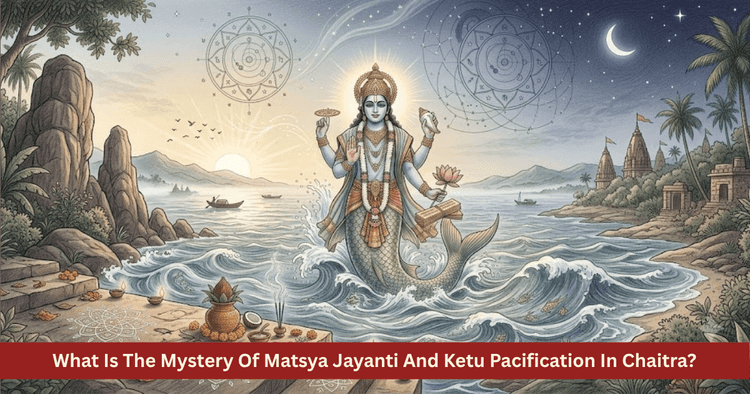
Table of Contents
Panchang Description And The Astrological Dimensions Of Matsya Jayanti
According to the classical mathematical cosmology of the Vedic calendar, the third lunar day (Tritiya) of the bright fortnight (Shukla Paksha) of the month of Chaitra is celebrated across the cosmos as Matsya Jayanti-the sacred advent day of Lord Sri Hari Vishnu's primordial aquatic incarnation. This sacred date occurs on the third station of Vasanti Navratri, coinciding with the adoration of Mother Chandraghanta and the celebration of marital felicity through Gangaur (Gauri Tritiya). This convergence represents a synthesis of transcendent power, cosmic preservation and the safeguarding of Vedic wisdom.
From an astronomical perspective, Chaitra Shukla Tritiya marks the junction of elemental water and cosmic fire. Lord Surya Deva departs from the final degrees of watery Pisces, advancing toward the fiery heat of his exaltation sign, Aries. In classical Vedic predictive astrology, the Matsya incarnation corresponds to the shadow planet Ketu (the South Node of the Moon) and the twelfth zodiacal sign, Pisces (Meena). Pisces governs oceanic depths, spiritual liberation (Moksha) and dissolution, while Ketu signifies detachment, esoteric perception, sudden obstacles and phobias related to water. When the Sun and Moon form this specific angular alignment in early spring, propitiating Lord Matsya calms natal Ketu afflictions, awakens intuitive discernment and dispels subconscious fear.
| Astrological and Astronomical Factor | Classical Scriptural and Astrological Description |
|---|---|
| Lunar Month and Fortnight | Chaitra Month, Shukla Paksha (Bright Fortnight) |
| Lunar Tithi | Tritiya (Third Lunar Station of Vasanti Navratri) |
| Canonical Liturgical Titles | Matsya Jayanti, Appearance Day of the First Incarnation |
| Dashavatara Chronological Order | First Incarnation (Primordial Aquatic Savior of Cosmic Life) |
| Sovereign Presiding Powers | Lord Matsya Narayana (Vishnu), Lord Varuna (Regent of Waters) |
| Governed Astrological Planet | The Shadow Planet Ketu (South Node) and Pisces (Meena Rashi) |
| Primary Historical Pastime | Deluge of Chakshusha Manvantara, Vedas Retrieval, Slaying Hayagriva |
| Core Liturgical Disciplines | Shaligram Abhisheka, feeding wild fish, water libations, Ketu japa |
| Bestowed Spiritual Fruit | Removal of water phobias, Ketu pacification, longevity, wisdom |
To assimilate the protective grace of Lord Matsya and balance volatile nodal energies, a seeker must observe disciplined scriptural protocols from early dawn:
- Awaken before sunrise during Brahma Muhurta, bathing in cool or ambient fresh water consecrated with drops of holy river water and black sesame seeds.
- Stand facing eastward after ablutions, pouring three continuous water oblations to Surya Deva and Lord Varuna from an unblemished copper vessel.
- Kindle an unbroken lamp fueled by indigenous cow clarified butter before the consecrated icon of Lord Matsya or the sacred Shaligram stone in the domestic shrine.
- Place the Shaligram stone within a wide copper or brass platter, performing the Panchamrita abhisheka (milk, yogurt, ghee, honey and sugar) while offering fresh tulsi leaves.
- Recite the classical Ketu formula Om Kem Ketave Namah or the sacred Matsya invocation Om Matsyarupaya Namah at least 108 times with inward stillness.
- Proceed to a clean river, lake or temple reservoir to feed small dough balls prepared from wheat flour, turmeric and jaggery to wild fish.
- Maintain a satvic diet or an unbroken fast throughout the day, eliminating grains, non-vegetarian food, onions, garlic and harsh speech.
- Listen to or study the narrative of the Matsya incarnation from the eighth skandha of the Srimad Bhagavatam or the Matsya Purana at dusk.
- Conserve potable water, refraining from wasting or polluting natural water sources under any circumstances.
Puranic Lore: The Deluge Of Chakshusha Manvantara And King Satyavrata's Surrender
The Srimad Bhagavatam (Canto 8, Chapter 24), the Shatapatha Brahmana and the Matsya Purana preserve the authentic narrative of the divine descent of Lord Matsya.
This pastime unfolded at the close of the Chakshusha Manvantara. King Satyavrata of the Dravida realm (who later became Vaivaswata Manu, the progenitor of our current human epoch) lived as a royal ascetic, subsisting on water while performing penance. One morning, as he offered water oblations to Surya Deva in the sacred Kritamala river (the modern Vaigai river in Tamil Nadu), a tiny golden fish entered his cupped palms alongside the water.
King Satyavrata prepared to release the creature back into the currents. Suddenly, the tiny fish cried out in a trembling voice:
"O righteous King! You are the protector of the helpless. Within these deep waters, predatory aquatic creatures prey upon tiny fish like me. Terrified of their jaws, I seek your shelter. Do not cast me back into this perilous water; protect my life!"
Moved by compassion, King Satyavrata placed the tiny fish within his water jug (kamandalu) and carried it to his hermitage. however overnight, the fish expanded so rapidly that the vessel could no longer contain it. The king transferred the fish to an earthen urn, then to a wide lake and eventually to the boundless ocean. Seeing the fish span hundreds of leagues across the waves, the king recognized the presence of the Divine.
Bowing low with folded hands, King Satyavrata prayed: "O Supreme Lord! You are none other than the imperishable Lord Sri Hari Narayana. Reveal to this humble servant the mystery of your transcendental aquatic form."
Lord Matsya smiled, revealing his cosmic identity and declared:
"O Satyavrata! In seven days from today, the three worlds shall be submerged beneath the waters of universal dissolution. As the deluge approaches, a massive celestial vessel dispatched by my potency shall arrive before you. Gather the seeds of all medicinal herbs, botanical specimens, the sacred Vedas and the Seven Sages and embark upon that vessel. When the fierce winds rage across the waters, I shall appear before you as a golden-horned fish."
| Deluge Event | Spiritual and Metaphysical Symbolism | Philosophical Meaning |
|---|---|---|
| Expansion from Jug to Ocean | The omnipresent, infinite nature of God | Transcending narrow ego into cosmic awareness |
| Presence of the Seven Sages | Unbroken custody of scriptural wisdom | Preserving intuitive discernment in crises |
| Gathering Botanical Seeds | Blueprints of physical life | Protecting creative potential and karmic seeds |
| Serpent Vasuki as the Cable | Mastery over the mind and sensory impulses | Yogic equilibrium amidst external turbulence |
When the deluge descended, Lord Matsya manifested with a golden horn. King Satyavrata utilized the celestial serpent Vasuki as a tether, securing the vessel to the divine horn of Matsya. Lord Vishnu guided the vessel across the turbulent waters, anchoring it securely upon the northern peaks of the Himalayas (the Naubandhana peak).
Slaying The Demon Hayagriva And Recovering The Sacred Vedas
The pastimes of Lord Matsya transcend the physical rescue of living species; they represent the defense of divine truth against ignorance.
According to the Srimad Bhagavatam, when Lord Brahma felt exhausted at the close of the universal day and entered cosmic slumber, an aquatic demon named Hayagriva (Shankhasura) stole the sacred Vedas as they emanated from Brahma's mouth, hiding them deep within the dark ocean floor. Deprived of Vedic revelation, the universe plunged into spiritual blindness.
Lord Matsya plunged into the subterranean depths of the ocean, confronting the demon Hayagriva. In a fierce aquatic battle, the Lord eliminated the demon, ripped open his form and recovered the four sacred Vedas-Rigveda, Yajurveda, Samaveda and Atharvaveda-restoring them to Lord Brahma as he awakened from his slumber.
This pastime demonstrates that safeguarding spiritual knowledge is the primary purpose of divine descent. Material forms dissolve during cosmic cycles but as long as divine truth is preserved, righteous civilization can always be rebuilt.
The Astrological Link Between Lord Matsya And The Shadow Planet Ketu
In classical Vedic astrology, Sage Parashara formulates the correlation between the Dashavataras and the planetary bodies in the Brihat Parashara Hora Shastra:
Ramo Ramavatarashcha Suryasya cha Janardanah.
Matsyah Ketorbabhoovatha Kurmo Mandasya chatmajah.
Meaning: The Sun descended as Lord Rama, the Moon as Lord Krishna, Mars as Narasimha, Mercury as Buddha, Jupiter as Vamana, Venus as Parashurama, Saturn as Kurma, Rahu as Varaha and the shadow planet Ketu manifested as Lord Matsya.
The Metaphysics of Ketu and the Matsya Incarnation
- The Pisces Axis and the Water Element: In the cosmic wheel (Kalapurusha), the twelfth sign is Pisces (Meena / The Fishes), ruled by Jupiter. Pisces represents spiritual liberation (Moksha), detachment and the dissolution of identity, while Ketu functions as the karaka (significator) of Moksha.
- The Headless Body and Aquatic Motion: Astrologically, Ketu is depicted as a torso without a head, signifying intuitive perception beyond sensory logic. Similarly, a fish traverses deep water currents through fluid coordination rather than rigid terrestrial mechanics, embodying non-attachment and surrender.
- Water Phobias and Sudden Afflictions: When Ketu occupies sensitive houses (the 6th, 8th or 12th) or afflicts the natal Moon, the individual often experiences deep water phobias, chronic anxiety, unexplained skin ailments, nervous twitches and spiritual disorientation. Propitiating Lord Matsya on this day pacifies these afflictions.
| Ketu-Induced Affliction | Observable Behavioral Patterns | Remedial Liturgy on Matsya Jayanti |
|---|---|---|
| Water Phobia and Anxiety | Fear of swimming, panic near deep waters | Panchamrita abhisheka of Lord Matsya, water tarpan |
| Cognitive Disorientation | Inability to decide, chronic suspicion, insomnia | Feeding wild fish with wheat dough, Ketu japa |
| Cutaneous and Nervous Stress | Sudden skin irritations, unexplained spasms | Donating black sesame and kusha, Shaligram worship |
| Spiritual Obstacles | Lack of focus in meditation, cynicism | Reciting the Matsya Purana or Bhagavatam Canto 8 |
Step-By-Step Liturgical Protocol For Matsya Jayanti And Ketu Pacification
To conduct the traditional worship of Lord Matsya and balance Ketu afflictions on Chaitra Shukla Tritiya, observe the following liturgy:
- Morning Purification and Water Altar Setup: Awaken before sunrise, bathing in ambient water consecrated with holy drops. Dress in clean yellow or white cotton vestments. Position a broad copper or brass platter in the domestic shrine, filling it with clean spring water and drops of Ganga water.
- Shaligram or Matsya Consecration: Seat the sacred Shaligram stone or an icon of Lord Matsya upon a stand or lotus blossom within the water. Bathe the deity with Panchamrita (raw cow milk, yogurt, ghee, honey and rock sugar) while reciting Om Namo Bhagavate Vasudevaya or Om Matsyarupaya Namah.
- Sacred Offerings: Dry the icon gently, anointing it with yellow sandalwood paste and unbroken rice. Present garlands of yellow marigolds and fresh tulsi leaves. Offer seasonal produce (cucumbers, melons, papayas), sweet milk rice (kheer) and churned butter mixed with rock sugar.
- Service to Marine Life (Fish Feeding): Proceed to a clean river, lake or pond. Stand in the water facing eastward, offering three water oblations to Lord Varuna and Lord Matsya. Feed small dough balls prepared from whole wheat flour, turmeric and jaggery to wild fish. Classical digests affirm that feeding fish dispels natal afflictions of Rahu, Ketu and the dread of premature mortality.
- Ketu Mantra Recitation: Seat yourself before the altar, using a rudraksha or tulsi rosary to chant the classical formula 108 times:
Om Kem Ketave Namah.
or
Om Hreem Kroom Krrura-roopine Ketave Svaha.
Evolutionary Biology And The Dashavatara Sequence
Comparing modern evolutionary biology with the classical sequence of the Dashavataras highlights the cosmic vision of the ancient Vedic seers.
In the nineteenth century, natural science proposed that biological life originated in aquatic environments before evolving onto land. Millennia earlier, Sanatana Dharma established that the primordial incarnation of the Supreme Lord was Matsya-the aquatic organism.
| Dashavatara Sequence | Evolutionary Stage (Modern Science) | Dimension of Conscious Awareness |
|---|---|---|
| 1. Matsya Avatar | Aquatic Organism (Marine Life) | Primal emergence of consciousness in fluid |
| 2. Kurma Avatar | Amphibian (Tortoise) | Transition bridging water and dry land |
| 3. Varaha Avatar | Terrestrial Mammal (Boar) | Anchoring life firmly upon solid earth |
| 4. Narasimha Avatar | Half-Animal, Half-Human Transition | Transmuting primal instinct into humanity |
| 5. Vamana Avatar | Early Human Form (Dwarf) | Awakening of analytical intellect |
| 6. Parashurama Avatar | Armed Hunter-Gatherer | Tribal defense and the mastery of tools |
| 7. Sri Rama Avatar | Civilized Moral Human | Peak of moral order, statecraft and duty |
| 8. Sri Krishna Avatar | Enlightened Statesman and Mystic | Mastery of diplomacy, arts and nonduality |
| 9. Buddha Avatar | Fully Enlightened Mind | Compassion, meditation and inner stillness |
| 10. Kalki Avatar | Future Cosmic Transcender | Annihilation of decay, reset of the Golden Age |
Philosophical Essence: Swimming Against The Mundane Current
The Matsya incarnation teaches that an authentic spiritual seeker must cultivate the fortitude to swim against the current of worldly materialism.
A living fish swims effortlessly against turbulent river currents, while a dead organism drifts passively with the stream. Similarly, an awakened human being must resist unrighteous societal trends, preserving spiritual integrity and self-discipline. When cosmic ignorance threatens to submerge civilization, spiritual wisdom (the Vedas) and conscious self-restraint (the serpent Vasuki) preserve the vessel of human awareness.
Matsya Jayanti reassures humanity that whenever truth, scriptural wisdom and righteous order face existential crises, divine grace descends to guide the sincere soul safely across worldly turbulence.
FAQ
On which lunar date is Matsya Jayanti observed?
Matsya Jayanti is observed on the third lunar day (Tritiya) of the bright fortnight of Chaitra during the sacred window of Vasanti Navratri.
What was the primary divine purpose of the Matsya incarnation?
Lord Matsya descended to recover the stolen Vedas from the demon Hayagriva, rescue living species during the great deluge and instruct King Satyavrata.
Which planetary body corresponds to the Matsya incarnation in Vedic astrology?
According to Sage Parashara's Brihat Parashara Hora Shastra, the Matsya incarnation corresponds to the shadow planet Ketu (the South Node of the Moon).
What spiritual benefits arise from feeding fish on Matsya Jayanti?
Feeding wheat dough to fish pacifies difficult nodal afflictions of Ketu and Kaal Sarp Dosha, averts water phobias and earns spiritual merit.
Who were preserved aboard the celestial vessel during the deluge?
King Satyavrata (Vaivaswata Manu), the Seven Sages (Kashyapa, Atri, Bharadvaja, Vishvamitra, Gautama, Jamadagni, Vashistha), the seeds of all botanicals and the sacred Vedas were preserved aboard the vessel.
Get your accurate Kundali
Generate KundaliDid you like it?
Author

Aparna Patni (63)
Experience: 20
Consults About: Family Planning, Career
Clients In: Punjab, Haryana, Delhi
Share this article with friends and family
WELCOME TO
ZODIAQ
Right Decisions at the right time with ZODIAQ
