What Is The Glory Of Mesha Sankranti And The Solar New Year?
By Pt. Sanjeev Sharma
Solar Exaltation In Aries, Pan-Indian New Year And Sacred Urn Donations
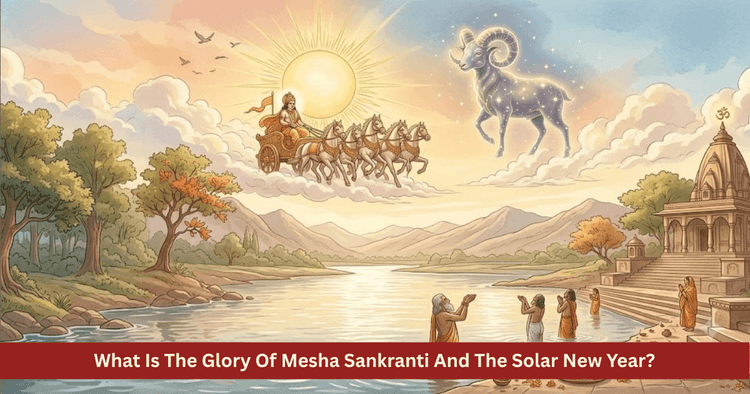
Table of Contents
Panchang Description And The Astrological Dimensions Of Mesha Sankranti
Within the mathematical cosmology of the classical Vedic calendar, the Surya Siddhanta and Vedanga Jyotisha, Mesha Sankranti represents the most dynamic, radiant and energetically decisive solar ingress of the entire astronomical year. According to predictive Vedic astrology, when the sovereign celestial luminary, Lord Surya Deva, departs from the terminal boundary of mutable watery Pisces (Meena) to enter the first cardinal fiery sign of Aries (Mesha), this cosmic ingress is celebrated across the cosmos as Mesha Sankranti.
From an astronomical perspective, this date marks the inception of the Vedic Solar New Year (Nirayana Solar Calendar), coinciding closely with the vernal equinox. Aries is the foundational quadrant of the cosmic wheel (Kalapurusha), symbolized by the Ram-representing primal vigor, executive initiative, pioneering courage and the ascending sap of physical life. In classical astrological treatises, the Sun attains its point of maximum exaltation (Paramochha) at exactly 10 degrees within Aries. This celestial ingress infuses the northern hemisphere with revitalized solar photons, warmth and biological prana, awakening dormant seeds and initiating the harvest cycle across the Indian subcontinent.
| Astrological and Astronomical Factor | Classical Scriptural and Metaphysical Detail |
|---|---|
| Solar Month and Ingress | Culmination of Meena, Inception of Solar Vaishakha Month |
| Zodiacal Transition | From Mutable Water (Pisces) into Cardinal Fire (Aries) |
| Astronomical Coordinate | Sun at 0° of the Zodiacal Belt (Nirayana Solar New Year) |
| Astrological Strength | Sign of Exaltation (Sun deeply exalted at 10° Aries) |
| Auspicious Punya Kala | 16 Ghatis preceding and 16 Ghatis succeeding the ingress |
| Sovereign Presiding Powers | Lord Surya Narayana (Sun God), Mars (Mangala Deva) |
| Core Elemental Transformation | Transition from Water to Fire, Awakening of Solar Will |
| Pan-Indian Festive Expressions | Baisakhi (Punjab), Bihu (Assam), Poila Baisakh (Bengal), Vishu (Kerala), Puthandu (Tamil Nadu) |
| Traditional Sacramental Offerings | Roasted barley/gram flour (Sattu), jaggery, melons, water urns, hand fans |
| Bestowed Spiritual Fruit | Enhancement of Vitality, Social Honor, Ancestral Peace, End of Kharmas |
To assimilate the transformative solar prana of Mesha Sankranti, strengthen somatic immunity and awaken spiritual resolve, a seeker must observe disciplined scriptural decorum from early dawn:
- Awaken before sunrise during Brahma Muhurta, bathing in a sacred river (Ganga, Yamuna or Narmada); or bathe in ambient water infused with holy river drops, red sandalwood and saffron.
- Stand facing eastward after ablutions, pouring three continuous water oblations to Surya Deva from an unblemished copper vessel enriched with vermilion, unbroken rice, red blossoms and raw jaggery.
- Gaze gently through the descending water stream at the rising solar disc, meditating upon the golden light of the Sun.
- Seat yourself comfortably before the domestic altar, reciting the Aditya Hridaya Stotra from the Valmiki Ramayana or the Gayatri Mantra at least 108 times with focused resonance.
- Consecrate a fresh earthenware urn filled with cool spring water, placing sweet melons, roasted gram flour (sattu), raw jaggery and a traditional hand fan upon its lid, donating it to a worthy ascetic or the underprivileged during the Punya Kala window.
- Partake of and distribute roasted gram flour mixed with water and jaggery as a traditional seasonal medicine protecting against summer heat exhaustion.
- Eliminate non-vegetarian food, alcohol, onions, garlic, deceitful transactions and arrogant speech completely.
- Kindle a lamp fueled by indigenous cow clarified butter at dusk, offering water oblations to ancestral lineage guardians.
Pan-Indian Celebrations: The Cultural Diversity Of The Solar New Year
Mesha Sankranti serves as a unifying cultural milestone across the Indian subcontinent. Diverse geographical regions celebrate this astronomical junction through distinct cultural, spiritual and agricultural expressions:
1. Baisakhi (Punjab and Haryana)
Across northern India, particularly throughout Punjab and Haryana, Mesha Sankranti is celebrated as Baisakhi.
- Agricultural Abundance: Farming communities celebrate the ripening of golden wheat fields, expressing gratitude to nature through the dynamic rhythms of Bhangra and Giddha folk dances.
- The Khalsa Panth Foundation: Historically, on this exact date in 1699 CE (Samvat 1756), the tenth Sikh Guru, Guru Gobind Singh Ji, established the Khalsa Panth at Anandpur Sahib, initiating the Panj Pyare (Five Beloved Ones) to defend righteousness and human dignity.
2. Bohag Bihu / Rongali Bihu (Assam and Northeast India)
In Assam, Mesha Sankranti marks the arrival of Bohag Bihu (or Rongali Bihu), celebrating the Assamese New Year. People don traditional woven attire, perform graceful Bihu dances to the melody of the buffalo horn pipe (Pepa) and present handwoven cotton towels (Gamosa) to elders to seek their blessings.
3. Poila Baisakh (West Bengal and Tripura)
In West Bengal, this sacred day inaugurates Poila Baisakh (the Bengali New Year / Nababarsho). Merchants close old financial ledgers and open new accounting books through the consecrated Haalkhata puja before Lord Ganesha and Goddess Lakshmi.
4. Vishu (Kerala)
In Kerala, Mesha Sankranti is celebrated as the auspicious festival of Vishu.
- The Vishu Kani Darshana: The defining custom is Vishu Kani-an arrangement prepared within a large bronze vessel (Uruli) before the icon of Lord Sri Krishna on the eve of the festival. It includes golden cucumber, yellow Kani Konna blossoms (Cassia fistula), raw rice, betel leaves, gold coins and a polished mirror. Family members are led blindfolded at dawn to gaze first upon this golden tableau, ensuring a prosperous year ahead.
- Vishu Kaineettam: Elders distribute coins to children and dependents, symbolizing the circulation of wealth and blessings.
5. Puthandu (Tamil Nadu)
In Tamil Nadu, this day marks Puthandu (the Tamil New Year). Households create colorful rice-powder designs (Kolam) at their thresholds and prepare Manga Pachadi-a sacramental dish incorporating neem blossoms (bitter), jaggery (sweet), raw mango (sour) and red chilies (pungent), reminding the family to navigate the diverse experiences of life with equanimity.
| State / Cultural Region | Traditional Festive Name | Core Cultural Observance | Traditional Culinary Preparation |
|---|---|---|---|
| Punjab & Haryana | Baisakhi | Harvest celebration, Khalsa Day, Gurdwara visit | Yellow sweet saffron rice, Makki roti, Sarson saag |
| Assam | Bohag Bihu (Rongali) | Bihu folk dance, Gamosa gift, cattle veneration | Pitha, Laru (sesame sweets), curd with flattened rice |
| West Bengal | Poila Baisakh | Haalkhata ledger puja, Kalighat pilgrimage | Sandesh, Rasgulla, Luchi, Chholar dal |
| Kerala | Vishu | Vishu Kani darshana, Vishu Kaineettam (coin gift) | Vishu Kanji, Thoran, sweet Payasam |
| Tamil Nadu | Puthandu | Kolam drawings, temple visits, almanac reading | Manga Pachadi (six-flavor philosophical dish) |
| Bihar & Eastern UP | Satua Sankranti / Jur Sital | Water urn donation, tree libations, sattu charity | Roasted sattu flour, raw jaggery, raw mango panna |
The Astronomy Of Solar Exaltation: The 10-Degree Coordinate In Aries
In the foundational texts of predictive astrology-including the Brihat Parashara Hora Shastra and Phaladeepika-the Sun is designated as the soul of the cosmos (Atmakaraka) and the cosmic eye (Jagatchakshu).
The movement of the Sun through the zodiac varies in energetic expression but its transit through Aries represents its supreme dignitary position:
- The Harmony of Primal Fire: The Sun embodies the fire element (Tejas) and Aries is a cardinal fire sign ruled by Mars. When the lord of cosmic fire enters an aligned fire matrix, its creative vitality operates with complete freedom.
- The 10-Degree Exaltation Peak: From 0° to 13°20' of Aries lies the asterism of Ashwini, governed by Ketu and presided over by the twin celestial healers, the Ashwini Kumaras. At exactly 10 degrees of Aries, the Sun reaches its maximum point of exaltation. At this coordinate, solar radiation stimulates physiological immunity, vitality and willpower across biological organisms.
- Significator of Royal Authority and Fatherhood: In predictive astrology, the Sun governs the father, ancestors, executive authority, leadership and social honor. For individuals with a debilitated or afflicted natal Sun, observing spiritual disciplines on Mesha Sankranti revitalizes personal vitality and career direction.
Ritual Bathing, Punya Kala and The Science Of Earthen Urn Donations
The moment of the Sun's ingress into a new zodiacal quadrant represents an energetic shift. Classical treatises confirm that spiritual disciplines executed during this alignment yield magnified spiritual merits.
The Mathematics of the Punya Kala
Astrological manuals prescribe that the 16 ghatis (approximately 6 hours and 24 minutes) preceding and succeeding the exact moment of the Sun's transit constitute the Punya Kala (Auspicious Window). The 3 ghatis immediately flanking the ingress represent the Maha Punya Kala. Spiritual practices and charitable acts performed during this window provide enduring spiritual merit.
The Science of Sattu and Earthen Urn Donations
In northern and eastern India, this festival is celebrated as Satua Sankranti. The materials donated on this day carry profound Ayurvedic and environmental benefits:
- Roasted Gram Flour (Sattu): Roasted chickpea and barley flour is celebrated in classical Ayurveda as an astringent, cooling food that balances digestive pitta and replenishes electrolytes. Consuming and donating sattu at the onset of summer shields the physiology from dehydration and heatstroke.
- Earthen Water Urns (Ghata Daan): Consecrating and donating an unglazed earthenware pitcher filled with clean spring water, crowned with sweet melons and a hand fan, is an ancient tradition. The Skanda Purana affirms that donating cool water to thirsty travelers during the summer transition satisfies ancestral spirits, securing health and domestic tranquility.
| Consecrated Offering | Somatic and Ayurvedic Quality | Subtle Metaphysical Action | Bestowed Spiritual Benefit |
|---|---|---|---|
| Terracotta Water Urn | Naturally chilled, mineral-rich water | Quenches thirst; balances water element | Relief from ancestral debts, lasting peace |
| Roasted Sattu & Jaggery | Light, protein-dense, electrolyte-rich | Calms gastric pitta; regulates digestion | Immunity against heatstroke, vitality |
| Traditional Hand Fan | Woven from vetiver, palm or bamboo | Circulates air; disperses ambient heat | Dissolution of internal restlessness, calm |
| Seasonal Fruits (Melons) | High water content, natural sugars | Nourishes tissues; prevents dehydration | Dissolution of past karma, domestic joy |
Step-By-Step Liturgical Protocol For Mesha Sankranti
To conduct the traditional worship of Lord Surya Narayana on Mesha Sankranti, observe the following liturgical sequence:
- Morning Purification and Sacred Intention: Awaken before sunrise, bathing in a sacred river or ambient water infused with Ganga drops and sandalwood. Dress in clean red, saffron or white cotton vestments. Take water, unbroken rice, a copper coin and sesame seeds in the right palm to make your formal sankalpa:
Om Suryaya Namah. Adya Mesha Sankranti punya-kale, mama sakala kayika-vachika-manasika papa kshayartham, Surya-preeti-kamanaya, atma-bala samvriddhyartham Sankranti snana-dana-pujanam aham karishye.
- Solar Libation (Surya Arghya): Fill an unblemished copper vessel with clean water. Add red sandalwood paste, unbroken rice grains, red flowers and a small piece of raw jaggery. Stand facing eastward, elevating the vessel above your brow and pour three steady streams of water while intoning:
Ehi Surya sahasramsho tejorashe jagatpate.
Anukampaya mam bhaktya grihanarghyam divakara.
Om Ghrinih Suryaya Namah. Om Adityaya Namah. - Altar Setup and Solar Yantra Adoration: Drape a low wooden platform in red silk. Install a consecrated copper Surya Yantra or an image of Lord Surya Narayana. Anoint the yantra with red sandalwood paste, offering scarlet oleander or red rose blossoms and kindle a lamp fueled by cow ghee.
- Recitation of the Aditya Hridaya Stotra: Sit before the lamp and recite the Aditya Hridaya Stotra from the Valmiki Ramayana three times. This hymn awakens inner courage, clears depression and grants victory over worldly and internal adversaries.
- Consecration of the Water Urn and Foods: Mark an auspicious swastika upon the unglazed earthenware urn using vermilion paste, winding sacred red thread around its neck. Fill it with clean water, placing sweet melons, a pouch of sattu, raw jaggery and a hand fan upon its lid, offering them before the Sun.
- Philanthropic Distribution: Present the consecrated urn, sattu, fruits and dakshina to a respected teacher, ascetic or impoverished family.
- Sacramental Meal: Conclude the observance by partaking of the sattu, jaggery and cool water prasad with the family.
Astrological Influence Across The Twelve Zodiac Signs
The ingress of the exalted Sun into Aries influences each zodiacal sign:
- Aries (1st House): Dramatic surge in self-confidence, vitality and social authority; practice mindfulness against impatience and anger.
- Taurus (12th House): Foreign travel opportunities, expenditure on spiritual causes; maintain awareness of sleep and eye health.
- Gemini (11th House): Expansion of revenues, professional gains, support from elder siblings and senior leaders.
- Cancer (10th House): Career advancement, success in administrative affairs, elevation in social status.
- Leo (9th House): Fortuitous turns of fortune, spiritual pilgrimages, deeper scriptural study and enhanced prestige.
- Virgo (8th House): Need for physical care and dietary discipline; unexpected financial developments or legacy gains.
- Libra (7th House): Practice patience in personal and business partnerships, prioritizing diplomatic communication.
- Scorpio (6th House): Decisive triumph over competitors, relief from lingering debts, improvement in vitality.
- Sagittarius (5th House): Heightened intellect and strategic clarity, academic achievements, positive news regarding children.
- Capricorn (4th House): Acquisitions involving property or vehicles; cultivate domestic peace and support maternal health.
- Aquarius (3rd House): Expansion of courage and initiative, fruitful short journeys, collaborative success with peers.
- Pisces (2nd House): Growth in savings, influential and articulate speech, leadership within family affairs.
Philosophical Essence: From Internal Darkness To Solar Illumination
Mesha Sankranti reveals a vital truth of Sanatana spiritual philosophy: When the soul (the Sun) transcends the inertia of past doubt (Pisces) and establishes itself in the seat of righteous action (Aries), true spiritual illumination dawns.
Moving from the passive waters of Pisces into the active fire of Aries teaches that an individual must step out of complacency, regret and doubt to embrace constructive action. The Sun shines impartially across all creation, giving life, light and warmth without seeking reward.
Mesha Sankranti calls upon each seeker to burn away internal ignorance, lethargy and selfishness in the furnace of self-discipline, emerging radiant, compassionate and steadfast in duty like the exalted Sun.
FAQ
When does Mesha Sankranti occur each year?
Mesha Sankranti occurs annually around April 13th or 14th of the Gregorian calendar, when the Sun enters the first sign of Aries.
At what degree is the Sun deeply exalted in Aries?
In classical Vedic astrology, the Sun attains its point of maximum exaltation (Paramochha) at exactly 10 degrees within Aries.
Why is Mesha Sankranti celebrated as the Solar New Year?
Because Aries is the foundational first sign of the zodiac belt, the Sun's ingress marks the start of the classical Nirayana solar calendar.
What is the significance of donating an earthenware pot and sattu on this day?
Occurring at the onset of summer, donating a cooling water pot quenches thirst, while sattu replenishes vital minerals and calms systemic heat, satisfying ancestors and supporting health.
Why is Baisakhi celebrated on Mesha Sankranti in Punjab?
Baisakhi marks the celebration of the golden wheat harvest and commemorates the historical creation of the Khalsa Panth by Guru Gobind Singh Ji in 1699 CE.
Get your accurate Kundali
Generate KundaliDid you like it?
Author

Pt. Sanjeev Sharma (63)
Experience: 20
Consults About: Family Planning, Career
Clients In: Punjab, Haryana, Delhi
Share this article with friends and family
WELCOME TO
ZODIAQ
Right Decisions at the right time with ZODIAQ
