What Is The Planetary Cabinet Of The New Samvatsara And Its Global Forecasts?
By Pt. Abhishek Sharma
Determination Of King & Minister, Ten Portfolios, Ardra Meteorology And Mundane Forecasts
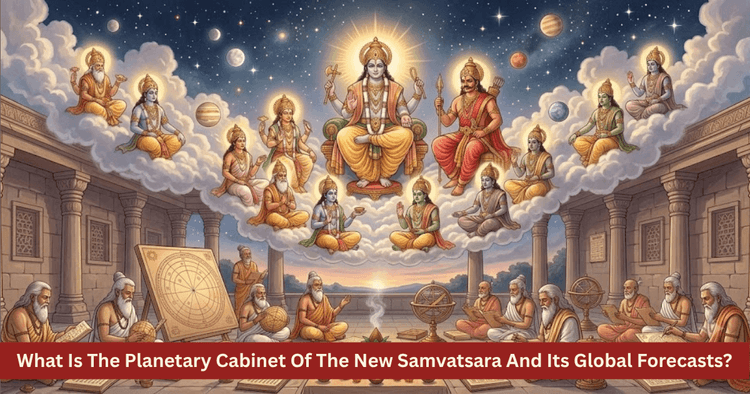
Table of Contents
Panchang Description And The Astrological Dimensions Of The Planetary Cabinet
Within classical Vedic predictive astrology, Mundane Astrology (Medini Jyotisha) and the foundational axioms of Varahamihira's Brihat Samhita, the advent of the Vedic New Year (Nav Samvatsara) marks the establishment of a subtle, cosmic administration known as the Planetary Cabinet of the Year (Samvatsara Mantrimandala). Just as a sovereign democratic nation or an empire governs its affairs through a structured cabinet-comprising a Head of State, Prime Minister, Defense Minister, Finance Minister and Agriculture Minister-the macrocosmic mechanics of time allocate specific executive portfolios among the nine planetary bodies (Navagrahas) to regulate global geopolitics, meteorological phenomena, monsoon rainfall, financial markets and agricultural output.
From an astronomical perspective, this administrative distribution is not symbolic allegory; it is calculated from the precise computational movements of the Sun and the Moon, the specific coordinates of zodiacal ingresses (Sankrantis) and the subtle vibrational frequencies of the weekday regents (Vara Adhipatis). The King (Raja) of the Samvatsara is determined by the planetary ruler of the weekday active at sunrise on Chaitra Shukla Pratipada (the dawn of the lunar year). Conversely, the Minister (Mantri) of the Samvatsara is governed by the planetary ruler of the weekday upon which Lord Surya Deva enters 0° of Aries (Mesha Sankranti, marking the solar year). In addition to these two supreme executive chairs, the planetary administration establishes a total of ten primary portfolios (Dashadhikaris) that collectively dictate the destiny of the world over the ensuing 365 days.
| Astrological Factor | Scriptural, Astrological and Mundane Detail |
|---|---|
| Calendrical Systems | Vikram Samvat and Shalivahana Shaka (Luni-Solar Synchrony) |
| Computational Rule for the King | Planetary ruler of the weekday at sunrise on Chaitra Shukla Pratipada |
| Computational Rule for the Minister | Planetary ruler of the weekday active at the ingress of Mesha Sankranti |
| Total Administrative Portfolios | 10 Portfolios (King, Minister, Commander, Finance, Two Agriculture, Meteorology, Fluids, Minerals, Flora) |
| Authoritative Mundane Treatises | Brihat Samhita, Narada Samhita, Bhuvana Deepika, Samvatsara Phala Darpana |
| Influence of Planetary Amity | Harmonious rulers yield peace, agricultural abundance and stable markets |
| Influence of Planetary Enmity | Combative or afflicted rulers produce geopolitical strife, inflation and volatility |
| Bestowed Astrological Insight | Accurate forecasting of economic, agricultural, meteorological and geopolitical trends |
To harmonize personal and domestic affairs with the incoming administrative energies of the New Samvatsara, a seeker must observe disciplined scriptural decorum from early dawn:
- Awaken before sunrise during Brahma Muhurta, bathing in ambient water infused with holy river drops while contemplating the planetary deities presiding as King and Minister.
- Cleanse the domestic altar, drawing a consecrated nine-planet mandala using vermilion, sandalwood paste and unbroken rice grains, invoking the celestial host with the formula Om Navagrahaya Namah.
- Listen to or study the official annual forecast (Panchang Sravana) through a qualified Vedic astrologer or classical almanac.
- If the King and Minister positions are occupied by natural malefic planets (Saturn, Mars, Rahu or the Sun), dedicate specific charitable acts and mantra recitations to mitigate potential friction.
- Offer grains and greens to cattle to appease the Lords of Agriculture and Wealth, supporting stable food supplies and financial health.
- Place the consecrated new almanac (Panchanga) at the household entrance or upon the altar on Pratipada morning, anointing it with fragrant sandalwood paste and unbroken rice.
- Recite the Gayatri Mantra or the Maha Mrityunjaya Mantra at least one complete rosary (108 times) to pray for peace, balance and protection against natural calamities.
The Ten Administrative Portfolios (Dashadhikaris) And Their Calculation
In classical Mundane Astrology, universal governance is categorized into ten specialized departments. The planetary ruler of each department is determined by precise astronomical transits:
1. The King (Raja / Head of State)
- Calculation: The planetary ruler of the weekday active at sunrise on the first lunar day of the bright fortnight of Chaitra (Chaitra Shukla Pratipada).
- Domain: The supreme monarch of the year. The innate temperament of the King governs the psychology of global heads of state, sovereign policies, military stability or unrest and the general contentment of humanity.
2. The Minister (Mantri / Prime Minister)
- Calculation: The planetary ruler of the weekday active at the exact moment Lord Surya Deva enters the sign of Aries (Mesha Sankranti).
- Domain: The chief executive advisor who implements sovereign policies. The Minister governs legislative actions, international treaties, administrative efficiency and institutional harmony.
3. The Commander-in-Chief (Senadhipati / Defense)
- Calculation: The planetary ruler of the weekday active at the moment the Sun enters the sign of Leo (Simha Sankranti).
- Domain: Military preparedness, territorial defense, law enforcement agencies, geopolitical conflict, border integrity and sovereign defense budgets.
4. The Lord of Early Harvest (Sasyadhipati / Kharif Agriculture)
- Calculation: The planetary ruler of the weekday active at the moment the Sun enters Cancer (Karka Sankranti / Dakshinayana).
- Domain: Monsoon-sown agricultural crops (Kharif harvest)-including paddy rice, millet, maize, legumes and raw cotton-along with rural market stability.
5. The Lord of Late Harvest (Dhanyadhipati / Rabi Agriculture)
- Calculation: The planetary ruler of the weekday active at the moment the Sun enters Sagittarius (Dhanu Sankranti).
- Domain: Winter-sown crops (Rabi harvest)-including wheat, barley, chickpeas, mustard seed and lentils-along with grain reserve infrastructure.
6. The Lord of Meteorology (Meghadhipati / Rainfall)
- Calculation: The planetary ruler of the weekday active at the exact moment the Sun transits into the asterism of Ardra (Ardra Pravesha).
- Domain: Monsoon dynamics, cloud formations, oceanic depressions, cyclonic events, drought risk and regional water security.
7. The Lord of Liquid Substances (Raseshadhipati / Fluids)
- Calculation: The planetary ruler of the weekday active at the moment the Sun enters Libra (Tula Sankranti).
- Domain: Edible and therapeutic fluids-such as milk, clarified butter, cooking oils, sugarcane, honey and pharmaceutical solutions-along with their supply chains.
8. The Lord of Dry and Mineral Goods (Neesaseshadhipati / Minerals)
- Calculation: The planetary ruler of the weekday active at the moment the Sun enters Capricorn (Makara Sankranti / Uttarayana).
- Domain: Solid commodities, minerals, precious metals, copper, structural iron, timber, stone, coal and petroleum resources.
9. The Lord of Flora and Orchards (Phaleshadhipati / Horticulture)
- Calculation: The planetary ruler of the weekday active at the moment the Sun enters Scorpio (Vrishchika Sankranti).
- Domain: Fruit orchards, medicinal herbs, forestry, root vegetables and environmental ecology.
10. The Lord of Wealth and Treasury (Dhanadhipati / Finance)
- Calculation: Calculated from the rising ascendant of the Mesha Sankranti chart or the planetary ruler of the weekday active upon the Sun's ingress into Aquarius (Kumbha Sankranti).
- Domain: Global economic markets, currency stability, inflation metrics, banking reserves, fiscal policies and trade liquidity.
| Portfolio | Astronomical Ingress Coordinate | Core Governance Mandate | Mundane Sphere of Influence |
|---|---|---|---|
| King (Raja) | Weekday at Chaitra Shukla Pratipada | Sovereign executive power, statecraft, peace or war | Global governance and societal morale |
| Minister (Mantri) | Weekday at Mesha Sankranti | Legislative enactments, diplomatic treaties, policies | Administrative balance and domestic law |
| Commander | Weekday at Simha Sankranti | Armed forces, national borders, defense logistics | Territorial security and defense readiness |
| Meteorology (Megha) | Weekday at Sun's ingress into Ardra | Atmospheric systems, precipitation, cyclonic storms | Monsoon stability and freshwater reserves |
| Kharif Harvest | Weekday at Karka Sankranti | Summer crops (paddy, corn, cotton, pulses) | Primary food production and rural trade |
| Rabi Harvest | Weekday at Dhanu Sankranti | Winter crops (wheat, mustard, chickpeas, barley) | Food reserves and national grain storage |
| Fluids (Rasa) | Weekday at Tula Sankranti | Liquid commodities (dairy, oils, sugarcane, honey) | Food processing and beverage supply chains |
| Minerals (Nirasa) | Weekday at Makara Sankranti | Heavy commodities (ores, steel, gold, oil, coal) | Mining operations and industrial supplies |
| Flora (Phala) | Weekday at Vrishchika Sankranti | Horticultural crops, medicinal herbs, forestry | Herbal medicine and environmental health |
| Treasury (Dhana) | Mesha Sankranti Ascendant / Kumbha Ingress | Central banking, currency, equity markets, revenues | Capital markets and monetary inflation |
Global Forecast Dynamics: The Combinations Of King And Minister
Classical treatises establish that when the King and Minister share mutual planetary friendship or are both natural benefics, a period of constructive peace, scientific progress and cultural growth unfolds. Conversely, when these primary seats are occupied by mutually antagonistic, combust or aggressive planets, international tensions escalate.
1. The Sun as King or Minister
- Constructive Influence: Decisive executive leadership, patriotic sentiment, administrative reform and major state-led initiatives.
- Challenging Influence: Autocratic tendencies, regional diplomatic standoffs, severe summer heatwaves, forest fires and elevated cardiovascular concerns.
2. The Moon as King or Minister
- Constructive Influence: Widespread social contentment, reliable water supplies, abundant dairy yields, creative flourishing and protective initiatives for women.
- Challenging Influence: Severe coastal storms, floods, seasonal respiratory concerns and public volatility driven by media sensationalism.
3. Mars as King or Minister
- Constructive Influence: Technological and infrastructural breakthroughs, modernization of defense equipment, disciplined law enforcement and real estate activity.
- Challenging Influence: Heightened border disputes, volatile geopolitical friction, industrial accidents, fire-related incidents and civil unrest.
4. Mercury as King or Minister
- Constructive Influence: Global commercial expansion, academic and scientific discoveries, technological automation, media integrity and adequate rainfall.
- Challenging Influence: Cyber-security vulnerabilities, financial fraud, volatile information channels and speech-related public controversies.
5. Jupiter as King or Minister
- Constructive Influence: Regarded as the most auspicious alignment. Ethical governance, judicial integrity, economic stability, agricultural abundance and spiritual renewal.
- Challenging Influence: Institutional corruption exposed, doctrinal disputes and health challenges related to metabolic lifestyle disorders.
6. Venus as King or Minister
- Constructive Influence: Growth in international trade, entertainment, creative arts, automotive innovations, plentiful agricultural yields and diplomatic accords.
- Challenging Influence: Hedonistic excesses, public scandals, speculative market bubbles and reproductive health concerns.
7. Saturn as King or Minister
- Constructive Influence: Empowerment of labor movements and agrarian workers, structural development in railways, heavy mining and alternative energy reserves.
- Challenging Influence: Severe inflationary pressures, international trade disputes, prolonged droughts or unseasonal cold snaps and social friction.
| King Ruler | Minister Ruler | Inter-Planetary Relationship | Anticipated Global Manifestation |
|---|---|---|---|
| Jupiter | Moon | Mutual Benefics (Gajakesari) | Peace and Prosperity: Stable food reserves, diplomatic cooperation, financial recovery. |
| Sun | Mars | Fiery Allies (Kshatriya Power) | Assertive Governance: Strong defense postures, geopolitical restructuring, heatwaves. |
| Saturn | Mars | Natural Adversaries (Angaraka) | Structural Volatility: Diplomatic standoffs, industrial labor disputes, supply disruptions. |
| Venus | Mercury | Harmonious Benefics (Commercial) | Innovation and Commerce: Rebounding equity markets, arts expansion, multilateral trade. |
| Sun | Saturn | Fundamental Opposites | Civic Tensions: Domestic policy standoffs, judicial revisions, complex regulatory shifts. |
| Moon | Venus | Receptive Benefics | Ecological Balance: Bountiful monsoons, agricultural health, cultural growth. |
The Meteorology Of Ardra Pravesha: Forecasting The Monsoon
Within mundane forecasting, the position of Meghadhipati (Lord of Rainfall) is critical for agrarian economies dependent on seasonal precipitation.
The Mechanics of the Ardra Solar Ingress
Annually, around late June, the Sun crosses 6°40' of Gemini, entering the asterism of Ardra. The horoscope erected for this ingress provides key meteorological indicators:
- The Four Cosmic Cloud Types (Megha Swarupa):
- Drona Megha: Generates balanced, well-distributed and life-supporting rains that nourish crops without flooding.
- Pushkara Megha: Produces variable rainfall, bringing abundant precipitation to some river basins while leaving adjacent lands dry.
- Avartaka Megha: Features loud thunder and electrical storms but yields patchy and localized rainfall.
- Samvartaka Megha: Unleashes severe storms, cloudbursts and flash floods that test infrastructure.
- Water-Element Ascendants: If the ingress ascendant falls within a watery sign (Cancer, Scorpio or Pisces) with benefics like Venus, Jupiter or the Moon occupying angular houses, widespread and reliable monsoon rains occur. If fiery signs (Aries, Leo, Sagittarius) rise under Mars or Sun aspects, prolonged dry spells may emerge.
- Wind Direction (Vayu Pariksha): The prevailing surface wind direction recorded at the moment of the ingress indicates the primary moisture paths for the season.
The Tajika System And The Determination Of The Year Lord
Beyond planetary cabinet portfolios, mundane astrologers erect the Jagat Lagna (World Horary Chart) at the precise conjunction of the Sun and Moon on Chaitra Amavasya as it transitions into Pratipada.
The Five Contenders for Year Lord (Panchadhikaris)
The classical Tajika predictive methodology evaluates five candidate planets to crown the singular Varshesha (Supreme Sovereign of the Year):
- Janmesha: The planetary ruler of the sign occupied by the Moon.
- Varsheshwara (Ascendant Lord): The planetary ruler of the rising sign at the ingress.
- Tribhagapati: The ruler of the specific decanate (one-third division) of the year ascendant.
- Dinaratripati: The ruler of the solar diurnal or lunar nocturnal period.
- Virashapathi (Dignity Lord): The planet exhibiting the highest intrinsic computational strength.
The candidate exhibiting the highest residential strength becomes the reigning Varshesha. Its natal house placement, aspects and planetary periods map out the year's significant turning points.
Scriptural Remedies For Challenging Alignments
If a year's planetary cabinet is dominated by challenging planetary placements, classical traditions prescribe community and personal remedial practices to support balance and protection:
- The Virtue of Almanac Recitation (Panchang Sravana): Scriptural treatises state that listening to the recitation of the new year's planetary predictions dispels mental anxiety and clears karmic debts:
Samvatsaraphalam shrutva Gangasnanaphalam labhet.
Ayurvriddhir dhanayushyam sarvapapapranashanam. - Community Rudrabhisheka: When Mars or Saturn hold executive authority, performing ceremonial ablutions over the Shiva Lingam using sugarcane juice or panchamrita calms societal stress and protects against natural disruptions.
- The Vishnu Sahasranama: If the financial and agricultural rulers are challenged, regular family recitations of the Vishnu Sahasranama and the Kanakadhara Stotra support financial resilience.
- Care for Cattle and Public Water Stations: Providing green fodder to cow shelters and setting up clean water stations for travelers calms challenging planetary influences, fostering collective goodwill.
Philosophical Essence: Divine Governance Within The Cycles Of Time
The ancient science of the Samvatsara Cabinet imparts an essential truth: Cosmic order is neither random nor chaotic; universal existence unfolds according to a structured cycle of cosmic law (Rta).
Planetary bodies are not mere inert mineral spheres; they serve as instruments of divine karma. When societies turn toward excess, conflict and environmental disregard, challenging planetary alignments reflect that imbalance through natural and social disruptions, inviting collective realignment. Conversely, when human conduct aligns with truth, compassion and ethical stewardship, harmonious rulers reflect peace, health and abundance across the land.
The planetary cabinet reminds us that while leadership and seasons change, the underlying spiritual foundation remains constant. A wise individual navigates worldly transitions with equanimity, anchoring daily action in duty, integrity and reverence for life.
FAQ
How is the King (Raja) of the New Samvatsara calculated?
The planetary ruler of the weekday active at sunrise on the first lunar day of the bright fortnight of Chaitra (Chaitra Shukla Pratipada) becomes the King of the year.
How is the Minister (Mantri) of the Samvatsara selected?
The planetary ruler of the weekday active at the exact moment the Sun enters the sign of Aries (Mesha Sankranti) becomes the Minister of the year.
How many portfolios make up the complete planetary cabinet?
There are ten primary portfolios: King, Minister, Commander, Early Harvest, Late Harvest, Meteorology, Liquids, Minerals, Flora and Finance.
What is the significance of the Ardra Pravesha ingress in mundane astrology?
The Sun's ingress into the Ardra asterism marks the primary computational moment for determining monsoon patterns, rainfall distribution and agricultural prospects.
What occurs when the King and Minister share planetary enmity?
When the King and Minister are natural adversaries or combust malefics, global affairs often encounter political volatility, administrative friction and market fluctuations.
Get your accurate Kundali
Generate KundaliDid you like it?
Author

Pt. Abhishek Sharma (63)
Experience: 20
Consults About: Family Planning, Career
Clients In: Punjab, Haryana, Delhi
Share this article with friends and family
WELCOME TO
ZODIAQ
Right Decisions at the right time with ZODIAQ
