What Is The Connection Between Ramacharitmanas And Chaitra Navami?
By Pt. Suvrat Sharma
Inception Of The Awadhi Epic By Tulsidas, Seven Cantos And Parayana Protocols
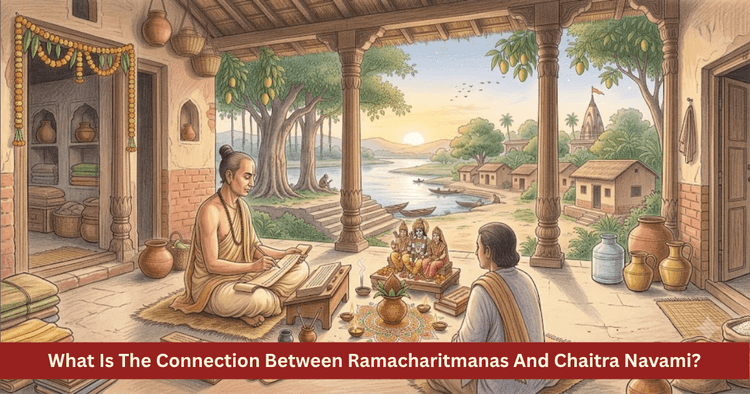
Table of Contents
Panchang Description And The Astrological Framework Of Samvat 1631
Within the mathematical cosmology of the classical Vedic calendar and the literary history of Sanatana Dharma, the ninth lunar day (Navami) of the bright fortnight (Shukla Paksha) of the month of Chaitra marks not only the advent of Lord Sri Rama but also the inaugural moment of the immortal epic Sri Ramacharitmanas. In Vikram Samvat 1631 (1574 CE), on this exact lunar date, Goswami Tulsidas dipped his reed pen into ink upon the banks of the sacred Sarayu River in Ayodhya, initiating the composition of this Awadhi masterpiece.
Astronomically and astrologically, this date replicated the celestial configurations of Treta Yuga attending the birth of Lord Rama. Goswami Tulsidas recorded the specific calendrical coordinates in the opening verses of the Bala Kanda:
Naumi bhauma vara madhu masa. Avadhapuri yehi charita prakasa.
Jehi dina Rama janama shruti gavahi. Teeratha sakala tahan chali aavahi.
Meaning: On the ninth lunar day (Navami), on Tuesday (Bhaumavara), during the spring month of Chaitra (Madhu Masa), this sacred narrative became manifest in the holy city of Ayodhya. Upon this very day celebrated by the Vedas as the birth of Lord Rama, all cosmic pilgrimage sanctuaries converged upon Ayodhya to witness the dawn of this spiritual offering.
| Astrological and Historical Factor | Classical Scriptural and Literary Detail |
|---|---|
| Lunar Month and Fortnight | Chaitra Month, Shukla Paksha (Bright Fortnight) |
| Lunar Tithi and Weekday | Navami Tithi, Tuesday (Mangalavara / Bhaumavara) |
| Historical Era of Inception | Vikram Samvat 1631 (1574 CE) |
| Consecrated Sanctuary of Writing | Ayodhya Dham, Sri Rama Janmabhumi Precinct / Sarayu Banks |
| Sovereign Author | Goswami Tulsidas (Revered as the Kali Yuga descent of Valmiki) |
| Literary Dialect and Metrics | Literary Awadhi (Doha, Chaupai, Soratha, Chhanda, Harigitika) |
| Total Duration of Composition | 2 Years, 7 Months and 26 Days (Completed Vivaha Panchami, Samvat 1633) |
| Metaphysical Substratum | Synthesis of Advaita, Vishishtadvaita, Bhakti and Social Ethics |
| Bestowed Spiritual Fruit | Purification of Mental Afflictions, Attainment of Devotion, Liberation |
To honor the inception of the Ramacharitmanas and internalize its transformative message on Chaitra Navami, a spiritual practitioner must observe disciplined scriptural decorum from dawn onward:
- Awaken during Brahma Muhurta, bathing in fresh water consecrated with drops from the holy Sarayu or Ganga rivers.
- Dress in clean, unstitched yellow cotton vestments, seating oneself facing eastward to meditate upon Lord Rama, Mother Janaki and Goswami Tulsidas.
- Place the consecrated volume of the Ramacharitmanas upon a low wooden altar draped in red or yellow silk, offering unbroken rice, blossoms, sandalwood paste and an unbroken ghee flame.
- Recite the classical introductory invocation from the Bala Kanda: Varnanam artha sanghanam rasanam chhandasam api... with focused resonance.
- Make a formal vow (Sankalpa) to undertake either the nine-day recitation (Navahna Parayana) or the unbroken 24-hour reading (Akhanda Patha).
- Maintain inward remembrance throughout the day with the awareness of Siyaramamaya saba jaga jaani (Seeing the divine presence in all creation).
- Wave natural camphor lamps before the sacred text at dusk, distributing fruits and sweet offerings to the underprivileged.
The Austerities Of Goswami Tulsidas And The Grace Of Lord Hanuman
The composition of the Ramacharitmanas was the fruit of decades of austere penance, renunciation and divine intervention. Born in Vikram Samvat 1554 in Rajapur (Banda district, Uttar Pradesh), the infant uttered the name 'Rama' at birth, earning the childhood name Rambola.
Separated from his parents in early childhood, he was sheltered by the ascetic Swami Narharidas, who initiated him into the esoteric pastimes of Lord Rama:
Main puni nija gura sana suni katha so sukarakheta.
Samujhi nahi tasi balapana taba ati raheun acheta.
Later, an admonition from his wife Ratnavali-"If the intense passion you direct toward this mortal frame of flesh and bone were directed toward Lord Rama, you would cross the ocean of worldly suffering"-awakened absolute renunciation within his heart. Abandoning domestic life, Tulsidas journeyed to Kashi, dedicating himself to scriptural study and asceticism.
The Ghost, Lord Hanuman and the Vision at Chitrakoot
While performing his morning ablutions along the banks of the Ganga in Varanasi, Tulsidas routinely poured remaining clean water at the roots of an ancient acacia tree. A disembodied spirit residing within the tree, nourished by the water, offered him a boon. Tulsidas asked for a vision of Lord Sri Rama. The spirit replied: "I lack the power to grant such a vision but I can direct you to Lord Hanuman. He attends the Ramayana discourses in the city disguised as an elderly leper, arriving first and departing last."
Tulsidas located the disguised leper and held his feet in surrender. Revealing his form, Lord Hanuman instructed Tulsidas to journey to the forests of Chitrakoot:
Chitrakoot ke ghat par, bhai santan ki bheer.
Tulsidas chandan ghisen, tilak det Raghubeer.
On the new moon of Mauni Amavasya in Vikram Samvat 1607, along the banks of the Mandakini River, Lord Rama and Lakshmana appeared before Tulsidas as young princes on horseback. Disguised as a parrot, Hanuman sang the verse to alert Tulsidas to the divine presence. Following this experience and guided by a vision from Lord Shiva in Kashi, Tulsidas settled in Ayodhya, commencing the Ramacharitmanas on Chaitra Shukla Navami, Samvat 1631.
| Milestone of Sadhana | Historical and Spiritual Pastime | Impact on Epic Composition |
|---|---|---|
| Initiation at Sukarkhet | Receiving Rama lore from Swami Narharidas | Grasping the spiritual foundation of the narrative |
| Renunciation at Varanasi | Embracing asceticism following his wife's admonition | Transmuting mortal attachment into pure divine love |
| Meeting Lord Hanuman | Encountering the master devotee in Varanasi | Receiving blessings and guidance for spiritual sadhana |
| Vision at Chitrakoot | Beholding Lord Rama along the Mandakini River | Translating personal mystical experience into poetry |
| Divine Command of Lord Shiva | Dream revelation at the Kashi Vishwanath temple | Authorization to render Vedic truths into vernacular Awadhi |
From Sanskrit To Awadhi: Democractizing The Vedas
During the sixteenth century, the Indian subcontinent faced cultural fragmentation and political upheaval. Spiritual wisdom remained preserved in Sanskrit, inaccessible to ordinary working people, women and marginalized communities.
When Goswami Tulsidas began composing the Ramayana in Awadhi-the spoken vernacular of northern India-the conservative scholastic elite of Varanasi opposed his work. They argued that translating Vedic truths into a vernacular tongue was disrespectful to sacred tradition.
Tulsidas responded with clarity:
Ka bhasha ka sanskrita prema chahi paacheena.
Kama jo aavai kamari ka lai karai kumeena.
Meaning: Whether speech is Sanskrit or the vernacular, what matters is pure love for the Divine. When a simple coarse blanket (kamari) dispels the winter cold, of what use is an inaccessible royal silk robe (kumeena)?
The Miraculous Seal: Satyam Shivam Sundaram
To test the sacred authenticity of the text, the scholars placed the manuscript inside the sanctum sanctorum of the Kashi Vishwanath temple overnight. At the base lay Tulsidas's Ramacharitmanas, surmounted by the Puranas, the Upanishads and the four sacred Vedas at the top. The heavy temple doors were sealed.
At dawn, when the doors were unsealed, the gathering witnessed a revelation:
- The Ramacharitmanas rested at the top of the stack, with the sacred Vedas beneath it.
- Inscribed upon its title page in radiant golden letters was the approval of Lord Shiva himself: Satyam Shivam Sundaram, accompanied by the divine mark of the trident.
This divine vindication silenced opposition. Goswami Tulsidas synthesized the essence of the Valmiki Ramayana, the Adhyatma Ramayana, the Bhusundi Ramayana and the Upanishads into seven structured cantos (Kandas): Bala, Ayodhya, Aranya, Kishkindha, Sundara, Lanka and Uttara Kanda.
The Seven Cantos: Seven Stations Of Human Consciousness
The seven Kandas of the Ramacharitmanas serve as a roadmap tracing the ascent of human consciousness from physical instinct to nondual liberation:
- Bala Kanda (The Awakening of Faith): The foundation of the epic, detailing the power of the divine name, the marriage of Shiva and Parvati and the childhood pastimes of Rama. It cultivates faith and wonder within the heart.
- Ayodhya Kanda (The Crucible of Duty and Ethics): Regarded as the heart of the epic, exploring family duty, statecraft, the selflessness of Bharata and the choices of Queen Kaikeyi. It provides ethical guidance during moral trials.
- Aranya Kanda (The Mastery of Sensory Urges): The forest exile depicting confrontations with lust (Surpanakha) and worldly greed (the golden deer). The sacrifice of Jatayu and the devotion of Shabari demonstrate pure love.
- Kishkindha Kanda (Righteous Alliance and Action): The alliance with Sugriva and the slaying of Vali teach that enduring friendship must be anchored in moral duty rather than convenience.
- Sundara Kanda (Selfless Service and Courage): Hanuman's leap across the ocean, the discovery of Sita and the surrender of Vibhishana. It awakens inner courage and dedicated service.
- Lanka Kanda (The Annihilation of Ego): The war between righteousness and unrighteousness. The ten heads of Ravana (representing sensory vices) are dissolved by the arrows of discriminative wisdom.
- Uttara Kanda (Enlightenment and Divine Order): The dialogue between Kakabhusundi and Garuda, detailing the nature of Kali Yuga and the establishment of Rama Rajya-universal peace and nondual liberation.
| Canto (Kanda) | Narrative Focus | Yogic / Metaphysical Center | Psychological Transformation |
|---|---|---|---|
| Bala Kanda | Advent of Rama, breaking of the bow | Muladhara (Faith and foundation) | Dissolving doubt, rooting devotion |
| Ayodhya Kanda | Exile, grief of Dasharatha, love of Bharata | Swadhishthana (Emotional purification) | Renouncing selfishness, honoring duty |
| Aranya Kanda | Surpanakha, golden deer, Shabari | Manipura (Self-restraint and tapas) | Conquering sensory lust, awakening love |
| Kishkindha Kanda | Friendship with Sugriva, slaying of Vali | Anahata (Heart-centered nobility) | Cultivating empathy, ethical alliances |
| Sundara Kanda | Leaping the ocean, burning Lanka | Vishuddha (Truthful speech and action) | Overcoming fear, dedicated service |
| Lanka Kanda | Bridge construction, fall of Ravana | Ajna (Intellectual discernment) | Slaying the ego, triumph of truth |
| Uttara Kanda | Rama Rajya, Kakabhusundi dialogue | Sahasrara (Nondual realization) | Freedom from worldly sorrow, peace |
Liturgical Protocol: The Nine-Day Navahna Parayana
The structured recitation of the Ramacharitmanas over the nine days of Chaitra Navratri-commencing on Shukla Pratipada and culminating at midday on Sri Rama Navami-is known as Navahna Parayana.
Classical Schedule of the Nine Recitation Windows
Goswami Tulsidas designated nine traditional pauses (Vishramas) throughout the text:
- Day 1 (Pratipada): From the opening of Bala Kanda through the dialogue of Shiva and Parvati (Rest 1).
- Day 2 (Dvitiya): From the penance of Manu and Shatarupa through the advent and pastimes of Rama (Rest 2).
- Day 3 (Tritiya): From the arrival of Vishvamitra through the bow sacrifice and the wedding of Sita and Rama (Rest 3).
- Day 4 (Chaturthi): The dialogue with Parashurama through the preparations for Rama's exile in Ayodhya Kanda (Rest 4).
- Day 5 (Panchami): Rama's departure for the forest, the boatman Kevata and settling at Chitrakoot (Rest 5).
- Day 6 (Shashthi): The passing of Dasharatha and the arrival of Bharata through the close of Ayodhya Kanda (Rest 6).
- Day 7 (Saptami): Recitation of the entire Aranya Kanda and the entire Kishkindha Kanda (Rest 7).
- Day 8 (Ashtami): The entire Sundara Kanda through the fall of Kumbhakarna and Meghanada in Lanka Kanda (Rest 8).
- Day 9 (Navami): The fall of Ravana, the return to Ayodhya, the coronation and the completion of Uttara Kanda (Rest 9).
Disciplinary Guidelines for Recitation
- Consecrate the altar before reading, invoking Lord Ganesha, Shiva-Parvati, Sage Valmiki, Lord Hanuman and Goswami Tulsidas.
- Refrain from secular conversation, interruptions or leaving the seat midway through a section; pause only at the end of a numbered Doha.
- Chanting the sacred refrain Sri Rama Jaya Rama Jaya Jaya Rama or Mangala Bhavana Amangala Haari after each couplet deepens focus.
- On Navami at 12:00 PM, when reaching the advent verse Bhaye Pragata Kripala, pause the reading to sound bells and conches, offer arati and present Coriander Panjiri.
Universal Philosophy And Enduring Significance
In the Uttara Kanda, Goswami Tulsidas described the psychological and societal challenges of the modern era (Kali Yuga):
Kaliyuga kevala nama adhara. Sumiri sumiri nara utarahin para.
In an age dominated by anxiety, fractured attention and moral complexity, prolonged austerities and elaborate rituals are difficult to maintain. Tulsidas presented the divine name and ethical living as an accessible spiritual anchor for daily life.
The Ramacharitmanas serves as a guide for living with purpose, dignity and compassion. It presents the ideal son (Rama), the ideal brother (Bharata and Lakshmana), the loyal friend (Guha and Sugriva), the selfless servant (Hanuman) and the just leader, offering a framework for personal integrity and social harmony.
On this sacred anniversary of Chaitra Navami, the verses of the Ramacharitmanas remind us that as long as humanity seeks truth, justice and love, Tulsidas's Awadhi verses will continue to inspire and uplift the human spirit.
FAQ
On which specific date did Goswami Tulsidas begin composing the Ramacharitmanas?
He commenced the composition on the ninth lunar day (Navami) of the bright fortnight of Chaitra, on a Tuesday, in Vikram Samvat 1631 (1574 CE) in Ayodhya.
How long did it take to complete the entire Ramacharitmanas?
The composition took 2 years, 7 months and 26 days, concluding on the fifth lunar day of Margashirsha (Vivaha Panchami) in Vikram Samvat 1633.
What inspired Tulsidas to compose the epic in the Awadhi dialect?
Lord Shiva and Mother Parvati appeared to him in a vision in Varanasi, instructing him to compose the sacred narrative in the spoken language of the people.
How many cantos (Kandas) comprise the Ramacharitmanas?
The epic comprises seven cantos: Bala Kanda, Ayodhya Kanda, Aranya Kanda, Kishkindha Kanda, Sundara Kanda, Lanka Kanda and Uttara Kanda.
What is meant by the Navahna Parayana of the Ramacharitmanas?
Navahna Parayana refers to the traditional nine-day sequential reading of the Ramacharitmanas, beginning on Chaitra Pratipada and culminating on Sri Rama Navami.
Get your accurate Kundali
Generate KundaliDid you like it?
Author
Pt. Suvrat Sharma (63)
Experience: 20
Consults About: Family Planning, Career
Clients In: Punjab, Haryana, Delhi
Share this article with friends and family
WELCOME TO
ZODIAQ
Right Decisions at the right time with ZODIAQ
