What Is The Glory Of Skanda Shashthi In Chaitra?
By Pt. Amitabh Sharma
Adoration Of Commander Kartikeya, Tarakasura Subdual And Mars Relief
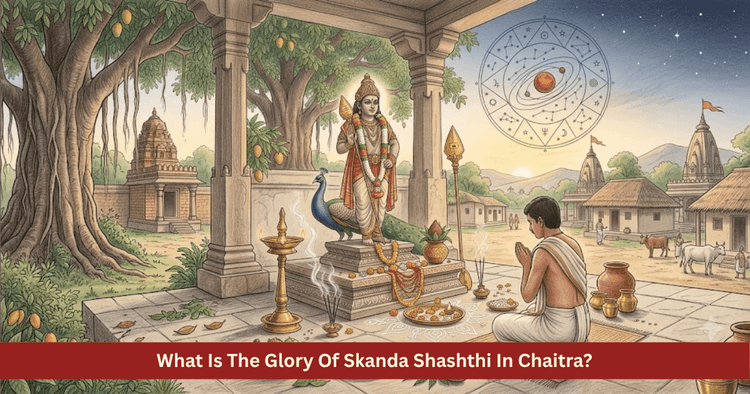
Table of Contents
Panchang Description And The Astrological Dimensions Of Skanda Shashthi
Within the mathematical cosmology of the classical Vedic calendar, the sixth lunar day (Shashthi) of the bright fortnight (Shukla Paksha) of the month of Chaitra is celebrated across the cosmos as Skanda Shashthi. This sacred date occurs directly upon the sixth station of Vasanti Navratri. Liturgically, this day harmonizes two profound streams of spiritual power: the adoration of Mother Katyayani (the slayer of Mahishasura and ruler of the Ajna chakra) and the veneration of Lord Kartikeya-also celebrated as Skanda, Murugan and Subrahmanya-the supreme commander-in-chief of the celestial forces and the eldest son of Lord Shiva and Mother Parvati.
From an astronomical perspective, Shashthi tithi and Lord Skanda are governed by the dynamic, fiery energy of Mars (Mangala). During this temporal window, Lord Surya Deva traverses the sensitive boundary of Pisces, preparing to enter his exaltation sign of Aries (Mesha), which is governed by Mars. In predictive astrology, Shashthi tithi is ruled directly by Kartikeya. The convergence of solar heat with the martial resonance of this sixth lunar day stimulates the blood tissue (Rakta Dhatu), bone marrow and the internal fire of human physiology. Consequently, for individuals suffering from severe Manglik Dosha, fraternal disputes, land conflicts, blood disorders or persistent adversaries, the spiritual sadhana of Chaitra Shukla Shashthi acts as an impenetrable shield.
| Astrological and Astronomical Factor | Classical Scriptural and Metaphysical Description |
|---|---|
| Lunar Month and Fortnight | Chaitra Month, Shukla Paksha (Bright Fortnight) |
| Lunar Tithi | Shashthi (Sixth Lunar Station of Vasanti Navratri) |
| Canonical Liturgical Titles | Skanda Shashthi, Kumara Shashthi, Katyayani-Skanda Convergence |
| Sovereign Presiding Divinity | Commander-in-Chief Lord Kartikeya (Skanda / Murugan / Subrahmanya) |
| Concurrent Navratri Divinity | Mother Katyayani (Regent of the Ajna Chakra) |
| Governing Astrological Planet | Mars (Mangala Deva: Governing Fire, Valor and Land) |
| Sacred Mount and Divine Weapon | The Peacock (Mayura) and the Invincible Vel (Shakti Lance) |
| Core Elemental Matrix | Pure Fire Element (Tejas) and Kshatriya Valor |
| Consecrated Altar Materials | Red Oleanders, Red Sandalwood, Cow Ghee, Red Lentils, Pomegranate |
| Bestowed Spiritual Fruit | Mitigation of Manglik Dosha, Victory, Land Gains, Health |
To assimilate the protective and martial grace of Lord Skanda and neutralize turbulent planetary heat, a seeker must observe disciplined scriptural decorum from early dawn:
- Awaken before sunrise during Brahma Muhurta, bathing in cool fresh water consecrated with sacred river drops and red sandalwood powder.
- Face the southern celestial quadrant following ablutions, pouring three continuous water oblations to Surya Deva and Mangala Deva from a copper vessel mixed with unbroken rice and vermilion.
- Dress in clean, unstitched or festive cotton attire of crimson, deep scarlet or saffron hues.
- Install an icon or portrait of Lord Kartikeya or an energized copper Mangala Yantra, upon a clean wooden altar draped in red silk.
- Kindle an unbroken lamp fueled by pure indigenous cow clarified butter orienting its flame toward the southern direction.
- Present scarlet blossoms (red hibiscus or oleander), red sandalwood paste and fresh pomegranate seeds before Lord Skanda.
- Recite the classical beeja formula Om Skandaya Namah or Om Kram Kreem Kroum Sah Bhaumaya Namah at least 108 times upon a red sandalwood or rudraksha rosary.
- Maintain a clean satvic fast throughout the day; consume a single meal of fruits or salt-free preparations, refraining entirely from anger, conflict and agitation.
- Conclude the evening with the resonance of the Skanda Stotra or Adi Shankaracharya's Subrahmanya Bhujangam, performing arati with pure camphor.
Puranic Lore: The Tyranny Of Tarakasura And The Advent Of Skanda
The Skanda Purana, the Kumara Khanda of the Shiva Purana and Kalidasa's classical epic Kumarasambhavam preserve the authentic narrative of the manifestation of Lord Kartikeya and the slaying of Tarakasura.
In ancient times, a formidable cosmic titan named Tarakasura unleashed havoc across the three worlds. Having performed severe austerities, he secured a boon from Lord Brahma that he could be slain only by a seven-year-old child born of the vital energy of Lord Mahadeva Shiva. Following the self-immolation of Sati, Lord Shiva was absorbed in unshakeable cosmic meditation. Tarakasura assumed the Lord would never marry again, rendering him practically immortal.
Oppressed by his tyranny, the gods sought divine intervention. Under Indra's instructions, Kamadeva (the god of desire) attempted to disrupt Shiva's meditation. Enraged, Mahadeva opened his third eye, instantly reducing Kamadeva to ashes. Later, moved by the severe penance of Mother Parvati, Lord Shiva accepted her as his consort.
| Narrative Milestone | Puranic and Metaphysical Detail | Philosophical Meaning |
|---|---|---|
| The Boon of Tarakasura | Death possible only at the hands of Shiva's child | Arrogance creates its own downfall; mortality is absolute |
| Incineration of Desire | Kamadeva reduced to ashes by Shiva's third eye | True spiritual power awakens only when lust is overcome |
| Transmission of Divine Fire | Agni and Ganga carrying the effulgent spark | Ultimate energy requires pristine channels to endure |
| Advent in the Reed Forest | The child manifesting in the Sharavana grove | Divine power nurtured within the quiet womb of nature |
| Nursing by the Krittikas | Assumption of six faces (Shanmukha) | Mastery over the six primal senses and internal vices |
| Celestial Coronation | Bestowal of the divine lance and peacock mount | Righteous duty requires discipline organization and grit |
| Slaying of Tarakasura | Decisive victory over the forces of tyranny | Unrighteousness collapses before concentrated truth |
The concentrated effulgence of Lord Shiva was so intense that even Agni Deva could not contain it, entrusting it to Mother Ganga. Ganga deposited the fiery energy into the reeds of the Sharavana forest at the foothills of the Himalayas, where it manifested as six children. Six celestial nymphs (the Krittikas or Pleiades) discovered the children and nursed them. When Shiva and Parvati arrived, Mother Parvati embraced the six infants, merging them into a child with six faces and a single body. Nurtured by the Krittikas, he was named Kartikeya and possessing six faces, he was hailed as Shanmukha.
The celestial host crowned the young prodigy as their commander-in-chief. Lord Shiva presented him with the invincible Shakti lance (Vel), while the son of Garuda gifted him a majestic peacock as his steed. At seven years of age, Commander Skanda led the celestial army, slaying Tarakasura and his brothers, thereby restoring peace to the cosmos.
Predictive Astrology: Manglik Dosha And The Science Of Martial Pacification
In classical Vedic astrology, Mars (Mangala) governs muscular vigor, courage, physical stamina, blood chemistry, executive decisiveness and real estate. When Mars occupies the 1st, 4th, 7th, 8th or 12th house from the natal ascendant or Moon, it forms Manglik Dosha.
Complications of Aggravated Mars
- Marital Friction: Persistent conflict, delayed marriage, acute discord or health risks to the spouse.
- Vascular and Surgical Afflictions: Chronic hypertension, blood contamination, recurring burns, cuts and emergency surgeries.
- Volatile Temperament: Unchecked rage, aggressive speech and the unprovoked generation of adversaries.
- Property Disputes: Protracted litigation involving real estate, land boundaries and fraternal assets.
Observing Skanda Shashthi during the bright fortnight of Chaitra is a scriptural method for harmonizing martial volatility. As the presiding deity of Mars, Lord Kartikeya channels aggressive energy into spiritual courage and disciplined leadership.
| Astrological Challenge | Planetary Placement | Remedial Liturgy on Skanda Shashthi |
|---|---|---|
| Severe Marital Delays | Mars in the 7th or 8th house | Offering red oleanders to Skanda; reciting the Vel mantra |
| Property and Real Estate Disputes | Mars in the 4th or 10th house | Installing a copper Mangala Yantra anointed with vermilion |
| Chronic Blood and Skin Disorders | Debilitated Mars in the 1st or 6th | Donating red lentils; offering water oblations to the Sun |
| Hostility and Legal Entanglements | Mars-Rahu conjunction in the 6th | Kindling a south-facing ghee lamp; reciting the Skanda Kavacha |
Step-By-Step Liturgical Protocol For Skanda Shashthi
To conduct the traditional worship of Lord Kartikeya on Chaitra Shukla Shashthi, observe the following liturgy:
-
Morning Purification and Sacred Intention: Awaken before sunrise, bathing in ambient water consecrated with holy drops and sandalwood. Dress in clean red or saffron cotton garments. Seat yourself facing southward before the altar, taking water, red flowers, unbroken rice and a copper coin in the right palm:
Om Vishnur Vishnur Vishnuh. Adya Chaitra mase shukla pakshe shashthyam tithau, mama sakala bhauma dosha (Mangala dosha) shamanartham, shatru badha nivaranartham, Sri Kartikeya preetaye Skanda Shashthi vratam aham karishye.
-
Altar Setup and Icon Consecration: Cover a wooden table with red silk fabric. Position an icon of Lord Kartikeya, a consecrated image or a copper Mangala Yantra upon the altar. Sketch a triangular fire mandala upon the platform using vermilion powder.
-
Abhisheka and Anointing: Bathe the icon with consecrated water mixed with raw milk, holy river drops and red sandalwood paste. Anoint the brow of the deity with vermilion and pure sandalwood, offering an unstitched red cotton sash.
-
Floral and Botanical Offerings: Present garlands of fresh red hibiscus, oleanders, scarlet roses and sacred shami leaves before Lord Skanda.
-
Incense, Lamps and Foods: Kindle a lamp fueled by cow ghee, pointing its flame southward. Burn natural guggul incense. Present sweet boondi, ripe red pomegranates, roasted gram mixed with jaggery and malpua confections.
-
Mantra Recitation and Hymns: Seat yourself comfortably, using a red sandalwood or rudraksha rosary to chant the following formula at least 108 times:
Om Shanmukhaya Namah.
or
Om Tatpurushaya Vidmahe Mahasenaya Dheemahi Tanno Skandah Prachodayaat.Follow this with the recitation of the Pragya Vivardhana Kartikeya Stotra by Sage Agastya or Adi Shankaracharya's Subrahmanya Bhujangam.
-
Camphor Arati: Wave burning camphor before the deity, praying for protection, courage and family health.
Symbolic Metaphysics Of Lord Kartikeya's Sacred Regalia
The iconography of Lord Kartikeya presents a symbolic blueprint for personal self-mastery:
- The Six Faces (Shanmukha): Represent complete mastery over the six internal adversaries-lust (Kama), anger (Krodha), greed (Lobha), infatuation (Moha), pride (Mada) and envy (Matsarya). In yogic anatomy, the six faces symbolize control over the six chakras from Muladhara to Ajna along the Sushumna nadi.
- The Peacock Steed (Mayura): The peacock is renowned for devouring venomous serpents. The serpent symbolizes time, base sexual desires and ego. Riding the peacock signifies transmuting base instinctual poisons into vibrant spiritual plumage.
- The Divine Lance (Vel / Shakti Astra): Narrow at the base, broad in the center and piercingly sharp at the tip.
- The narrow base teaches that concentration must be focused on a single point.
- The broad body dictates that knowledge must be comprehensive, deep and expansive.
- The sharp tip demands that human intellect (Viveka) must be incisive, distinguishing truth from falsehood in every circumstance.
| Sacred Symbol | Physical Feature | Subtle Metaphysical Reality | Practical Life Guidance |
|---|---|---|---|
| Six Faces (Shanmukha) | Faces oriented in all directions | Absolute mastery over the senses and mind | Vigilance, multifaceted focus, emotional balance |
| Peacock Steed (Mayura) | Serpent-devouring mount | Annihilation of ego and base desires | Transmuting inner negativity into poise |
| The Vel (Shakti Lance) | Piercing, broad spear | Sharp, expansive and focused discernment | Uncompromising dedication to righteousness |
| The Rooster Pennant (Kukkuta) | Dawn-crowing emblem | The herald of rising light over darkness | Renouncing spiritual lethargy; rising before dawn |
Murugan Liturgy In Southern India: Kavadi And The Splendor Of Shashthi
In northern India, Kartikeya is honored primarily as a brahmachari warrior and commander-in-chief. In southern India (Tamil Nadu, Kerala, Karnataka) and across the global Tamil diaspora (Malaysia, Singapore, Sri Lanka), he is venerated as Lord Murugan-the embodiment of beauty, youth and divinity.
The Tamil root Murugu signifies supreme beauty and grace. During Skanda Shashthi, devotees participate in the austere penance of Kavadi Aattam:
- Devotees carry elaborate wooden arches adorned with peacock feathers (Kavadi) upon their shoulders.
- Walking barefoot over miles, they make pilgrimages to Murugan's six sacred hill abodes-the Arupadai Veedu (Tirupparankunram, Tiruchendur, Palani, Swamimalai, Tiruttani and Pazhamudircholai).
- Many pierce their cheeks or tongues with miniature silver lances (Vel) to maintain silence and endure physical austerity. This intense discipline purges chronic physical infirmities, burns deep karmic impressions and cultivates mental focus.
Philosophical Essence: Slaying The Internal Demon
Skanda Shashthi imparts the timeless truth that the soul's sovereignty cannot be established until the internal demon of pride is overcome.
Tarakasura is not merely a mythological figure; he is the personification of vanity, lethargy, selfishness and indiscipline residing within human consciousness. This internal adversary cannot be conquered by superficial intellectualizing; he yields only to the advent of Skanda-the union of contemplative wisdom (Shiva) and dedicated devotion (Parvati), manifesting as dynamic willpower and discriminative intellect.
When an individual chooses truth, discipline and moral courage, Lord Kartikeya awakens within consciousness. Such a seeker masters personal weaknesses, emerging as a steady protector of righteousness within the family and society.
On this Skanda Shashthi, let us bow before Lord Kartikeya, praying that he incinerate our inner anger and lethargy, blessing us with fortitude, clarity and unyielding dedication to dharma.
FAQ
On which specific lunar date is Skanda Shashthi observed?
Skanda Shashthi is observed on the sixth lunar day (Shashthi) of the bright fortnight of Chaitra, coinciding with the sixth station of Vasanti Navratri.
What was the primary divine purpose of Lord Kartikeya's advent?
Lord Kartikeya manifested to eliminate the demon Tarakasura, deliver the cosmos from oppression and lead the celestial forces as commander-in-chief.
Which planetary body corresponds to Skanda Shashthi in Vedic astrology?
Skanda Shashthi corresponds directly to Mars (Mangala Deva); observing this fast mitigates severe Manglik Dosha and balances martial energies.
What do the six faces of Lord Kartikeya (Shanmukha) symbolize?
The six faces symbolize complete mastery over the six internal vices (lust, anger, greed, attachment, pride and envy) and the six spinal chakras.
By what names is Lord Kartikeya venerated in southern India?
He is venerated as Lord Murugan, Subrahmanya Swamy, Kandan and Kartikeya, serving as a primary family and regional deity.
Get your accurate Kundali
Generate KundaliDid you like it?
Author
Pt. Amitabh Sharma (56 Years)
Experience: 20
Consults About: Family Planning, Career
Clients In: Punjab, Haryana, Delhi
Share this article with friends and family
WELCOME TO
ZODIAQ
Right Decisions at the right time with ZODIAQ
