What Is The Glory Of Sri Rama Navami In Chaitra?
By Pt. Sanjeev Sharma
Advent Of Maryada Purushottama, Midday Celebrations And Philosophy
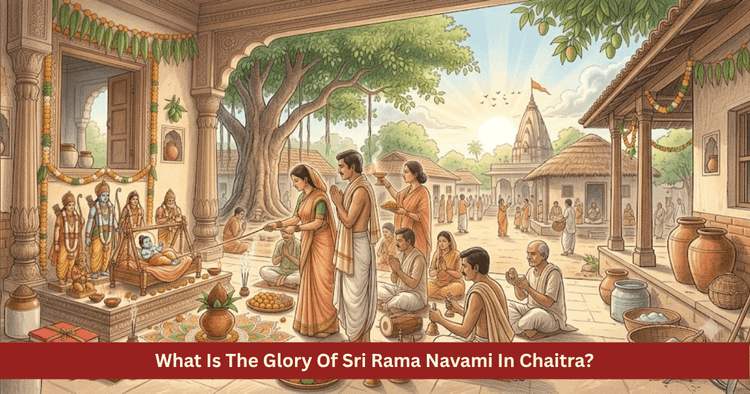
Table of Contents
Panchang Description And The Astrological Dimensions Of Sri Rama Navami
Within the mathematical and metaphysical chronology of the classical Vedic calendar, the ninth lunar day (Navami) of the bright fortnight (Shukla Paksha) of the month of Chaitra is celebrated across the cosmos as Sri Rama Navami-the sacred appearance day of the Supreme Sustainer, Maryada Purushottama Lord Sri Rama. This sovereign festival marks the culmination of the nine-day discipline of Vasanti Navratri. While the morning hours witness the completion of the adoration of Mother Siddhidatri (the bestower of all perfections), the exact midday hour celebrates the advent of absolute unmanifest consciousness in physical human form.
Astronomically and astrologically, Chaitra Shukla Navami represents the most luminous celestial conjunction in universal history. In the Bala Kanda of the Valmiki Ramayana, Sage Valmiki records the exact astronomical coordinates attending the appearance of Lord Rama:
Tato yajne samapte tu ritoonam shatsamatyayuh.
Tatashcha dvadashe mase Chaitre navamike tithau.
Nakshtre-aditidaivatye svochchasamstheshu panchasu.
Graheshu Karkate lagne vakpatavinduna saha.
Meaning: In the twelfth month following the sacrifice, upon the ninth lunar day of the bright fortnight of Chaitra, under the Punarvasu asterism (governed by Aditi), under Cancer ascendant (Karkata Lagna), five sovereign planets occupied their signs of exaltation. At that moment, Jupiter (Brihaspati) was conjoined with the Moon in the Cancer ascendant, forming the exalted Hamsa Mahapurusha Yoga and Gajakesari Yoga. Lord Surya Deva occupied the zenith of the sky (the tenth house) in his sign of maximum exaltation, Aries (Mesha), illuminating the three worlds with spiritual light.
| Astrological and Astronomical Factor | Classical Scriptural and Astrological Detail |
|---|---|
| Lunar Month and Fortnight | Chaitra Month, Shukla Paksha (Bright Fortnight) |
| Lunar Tithi | Navami (Maha Navami / Concluding Station of Navratri) |
| Canonical Liturgical Titles | Sri Rama Navami, Advent of Maryada Purushottama |
| Historical Era of Advent | Treta Yuga (Ikshvaku Dynasty / Solar Lineage) |
| Ascendant and Asterism | Cancer Ascendant (Karkata), Punarvasu Nakshatra (4th Pada) |
| Exceptional Planetary Alignment | Five Planets Exalted (Sun, Mars, Jupiter, Venus, Saturn) |
| Exact Hour of Advent | Exact Midday (12:00 PM, Abhijit Muhurta) |
| Sovereign Presiding Divinity | Lord Sri Rama (Seventh Incarnation of Lord Vishnu) |
| Traditional Sacramental Foods | Coriander Panjiri, Panchamrita butter-Sugar, Saffron Kheer |
| Bestowed Spiritual Fruit | Moral Rectitude, Dissolution of Karmic Debts, Liberation |
To assimilate the righteous grace of Lord Sri Rama and establish moral discipline within human awareness, a seeker must observe disciplined scriptural protocols from early dawn:
- Awaken before sunrise during Brahma Muhurta, bathing in ambient water consecrated with holy drops from the Ganga and fresh tulsi leaves.
- Dress in clean, unstitched yellow cotton or silk garments, offering three water oblations to Surya Deva from a copper vessel.
- Adorn the domestic shrine with fresh mango leaves, marigold garlands and rangoli, preparing a decorated cradle for infant Rama (Ramlala).
- Perform the Panchamrita abhisheka (raw cow milk, yogurt, ghee, honey and rock sugar) of the infant icon before midday.
- At exactly 12:00 PM, sound conch shells, bells and brass gongs, chanting the classical advent hymn Bhaye Pragata Kripala with devotion.
- Adorn the icon in yellow silk, placing a crown and tulsi garland upon his form and gently rock the cradle.
- Offer the sacred Coriander Panjiri (ground roasted coriander, raw sugar, foxnuts and nuts) alongside Panchamrita and fresh fruits.
- Maintain a satvic fast throughout the day; consume seasonal fruits while refraining from anger, deceit and harsh speech.
- Recite the Sri Rama Raksha Stotra, the Sundara Kanda or the Bala Kanda of the Valmiki Ramayana at dusk, concluding with the lighting of evening lamps.
Scriptural Lore: The Bala Kanda Narrative Of The Divine Descent
In the Treta Yuga, when demonic oppression and moral decay threatened cosmic balance under the tyranny of Ravana, Lord Sri Hari Vishnu resolved to descend in human form within the solar dynasty of King Dasharatha and Queen Kausalya in Ayodhya.
Grieved by childlessness, King Dasharatha performed the Putrakameshti sacrifice under the guidance of Sage Rishyashringa and Sage Vashistha. At the completion of the rites, Agni Deva emerged from the sacrificial flames holding a golden bowl containing celestial ambrosial porridge (Payasa). Dasharatha distributed the divine portion among his queens: Kausalya, Kaikeyi and Sumitra.
Empowered by this divine offering, upon the auspicious ninth lunar day of the bright fortnight of Chaitra, the transcendental advent unfolded in Ayodhya. In the Ramacharitmanas, Goswami Tulsidas depicts this moment:
Bhaye pragata kripala deenadayala Kausalya hitakari.
Harashita mahatari muni mana hari adbhuta rupa bichari.
Lochana abhirama tanu ghanasyama nija ayudha bhuja chari.
Bhushana vanamala nayana bisala sobhasindhu kharari.
Lord Vishnu first appeared before Mother Kausalya in his four-armed form, bearing the conch, discus, mace and lotus. Mother Kausalya folded her hands in awe and prayed: "O Supreme Lord! You encompass the entire cosmos within your breath. The thought that you took birth from my womb overwhelms the intellect. Withdraw this cosmic majesty and assume the form of an innocent infant, that I may shower you with maternal affection."
Smiling gently, the Lord veiled his cosmic majesty with yogic potency and assumed the form of an infant, crying softly. Joy swept through Ayodhya; celestial musicians sang, nymphs danced and showers of fragrant blossoms fell from the heavens.
| Phase of Advent | Scriptural and Astrological Detail | Philosophical Meaning |
|---|---|---|
| The Putrakameshti Sacrifice | Receiving celestial payasa from Agni Deva | Noble generation born of sacrifice, discipline and prayer |
| Five Exalted Planets | Sun, Mars, Jupiter, Venus and Saturn exalted | Cosmic order realigns when righteousness takes physical form |
| Cancer Ascendant and Jupiter | Hamsa Yoga and Gajakesari Yoga in the 1st house | Synthesis of compassion, wisdom and moral leadership |
| Midday Hour (12:00 PM) | Solar zenith standing directly overhead | Absolute truth banishes the darkness of ignorance |
| Transmutation of Form | Four-armed Narayana transforming into an infant | The Divine yields to pure love rather than intellectual pride |
Midday Liturgical Protocol: The Abhijit Muhurta And Arati Ceremony
The spiritual peak of Sri Rama Navami is the midday worship at exactly 12:00 PM. While other divinities are typically worshiped at dawn or dusk, Lord Rama's advent is celebrated at the solar zenith.
The Astronomical Significance of the Midday Hour
- Abhijit Muhurta: The eighth muhurta of the day occurs when the Sun reaches the meridian of the local sky. Solar rays fall perpendicular to the earth, neutralizing minor planetary flaws and bestowing stability upon all undertakings.
- The Solar Pause in Ayodhya: The Ramacharitmanas notes that Surya Deva was so captivated by the beauty of infant Rama that he halted his chariot across the sky, extending midday into an unbroken month of light:
Masa divasa kara divasa bha akani na jaanai koi.
Ratha sameta rabi thaakyo nisa kavani bidhi hoi.
Step-by-Step Midday Worship Procedure
- Panchamrita Abhisheka: Begin preparations at 11:30 AM. Position the brass or silver icon of infant Rama within a wide platter. Bathe the icon with raw cow milk, yogurt, ghee, honey and sugar. Conclude with a final stream of Ganga water poured from a conch shell while intoning Om Shreem Ramaya Namah.
- Adorning the Infant Deity: Dry the icon with an unbleached cotton towel, dressing him in yellow silk robes. Anoint his forehead with sandalwood paste, saffron and musk. Crown his head with a small peacock diadem and drape a fresh tulsi garland around his neck.
- Rocking the Sacred Cradle: At exactly 12:00 PM, amid the sounding of conches, bells and brass cymbals, place infant Rama within a floral cradle. Family members take turns gently pulling the cradle cord.
- Food Offerings (Naivedya): Present fresh Coriander Panjiri, Panchamrita, churned butter mixed with rock sugar, seasonal fruits and consecrated tulsi leaves.
- The Advent Hymn and Arati: Light a nine-wick cow ghee lamp and wave it before the altar, singing the traditional hymn Bhaye Pragata Kripala and the classical arati:
Arati keejai Sri Raghuvara ji ki. Sata chita ananda roopa parama pada ki.
Nutritional Science: The Ayurvedic Value Of Coriander Panjiri
Offering Coriander Panjiri on Sri Rama Navami is a time-tested dietary practice designed to protect the human physiology during seasonal transitions:
- Whole Coriander (Dhanyaka): Coriander is sweet and astringent, possessing cooling properties that balance systemic pitta and internal heat. As early spring gives way to summer, ambient temperatures provoke digestive inflammation and acidity. Roasted coriander seed powder soothes the stomach lining, supports hepatic function and prevents dehydration.
- Unrefined Cane Sugar (Khand): Delivers clean carbohydrates, cooling the bloodstream.
- Foxnuts (Makhana) and Raw Nuts: Provide vital minerals and plant proteins, stabilizing nervous and cardiovascular tissues.
- Panchamrita: Combining raw cow milk, yogurt, ghee, honey and sacred water creates a probiotic remedy that strengthens intestinal flora and boosts immunity during seasonal weather shifts.
The Philosophy Of Maryada Purushottama: The Ideal Of Dharma
In the opening verses of the Ramayana, Sage Valmiki asked Sage Narada: "Who in this mortal world embodies all sixteen noble virtues, remaining truthful, self-restrained, courageous and righteous?" Sage Narada replied without hesitation: Lord Sri Rama of the Ikshvaku dynasty.
Lord Rama did not navigate mortal existence through displays of omnipotence. Born as a human being, he demonstrated how to uphold righteousness amidst suffering, loss and moral tests:
| Role of Sri Rama | Embodied Ideal and Conduct | Lesson for Human Society |
|---|---|---|
| As a Devoted Son | Welcoming fourteen years of forest exile to honor his father's word | Filial respect, sacrifice and family integrity |
| As an Affectionate Brother | Loving Bharata, Lakshmana and Shatrughna unconditionally; renouncing the throne | Resisting greed and property disputes among siblings |
| As an Honorable Husband | Lifelong fidelity to Mother Sita (Ekapatni Vrata) | Moral purity, marital dedication and respect |
| As a Faithful Friend | Embracing Guha, Sugriva and Vibhishana regardless of social rank | Transcending prejudice; offering shelter to all |
| As a Righteous Monarch | Placing the welfare of citizens above personal comfort (Rama Rajya) | Ethical governance, accountability and justice |
| As a Righteous Adversary | Ensuring dignified funeral rites for the fallen Ravana | Magnanimity in victory; absence of personal malice |
The life of Sri Rama proves that power is dignified only through moral restraint. Possessing the strength to conquer worlds, he stood patiently before the ocean for three days, asking for passage with folded hands. Power guided by moral duty elevates civilization; power detached from ethics becomes destructive tyranny.
The Armor Of Chanting: The Sri Rama Raksha Stotra
Reciting the Sri Rama Raksha Stotra, composed by Sage Budhakaushika, establishes an energetic shield around human consciousness.
Revealed in a dream by Lord Shiva, this hymn systematically invokes the names of Lord Rama to protect every facet of the physical and subtle body:
Shiro me Raghavah paatu bhaalam Dasharathatmajah.
Kausalyeyo drishau paatu Vishvamitrapriyah shruti.
- The Protective Alignment: Let Raghava protect my head; let the son of Dasharatha guard my brow; let the son of Kausalya protect my eyes; and let the beloved of Vishvamitra shield my ears.
- Acoustic Mechanics: Chanting these verses with focused awareness vibrates the 72,000 subtle nadis, dissolving anxiety, dispelling planetary distress and steadying the mind.
Philosophical Essence: Awakening The Divine Within
Sri Rama Navami is more than an ancient anniversary; it marks the awakening of righteousness within the human soul.
The human body is Ayodhya (the fortress of peace); Dasharatha represents mastery over the ten senses; Kausalya embodies discriminative intellect; and Kaikeyi represents worldly delusion. When the senses are guided by wisdom, the light of Rama-divine awareness-is born within. Ravana is the ten-headed ego that steals our internal peace (Sita). When we align discriminative intellect (Lakshmana), unwavering devotion (Hanuman) and the bow of moral discipline, the ego is conquered, restoring inner balance.
On this Sri Rama Navami, let us not settle for outward ritual alone. Let us mold our actions in the furnace of moral rectitude. Honor your parents, speak the truth with kindness, protect the vulnerable and dedicate your actions to the light of righteousness: "May the divine name of Lord Sri Rama illuminate our hearts with truth, peace and universal harmony."
FAQ
On which specific lunar date is Sri Rama Navami observed?
Sri Rama Navami is observed on the ninth lunar day (Navami) of the bright fortnight of Chaitra, concluding the nine-day observance of Vasanti Navratri.
At what time and under which astrological ascendant was Lord Rama born?
Lord Sri Rama appeared at exactly 12:00 PM (midday) under Cancer ascendant (Karkata Lagna) and the Punarvasu asterism during Abhijit Muhurta.
Which five planets were in their signs of exaltation at the birth of Lord Rama?
According to the Valmiki Ramayana, the Sun (in Aries), Mars (in Capricorn), Jupiter (in Cancer), Venus (in Pisces) and Saturn (in Libra) were in their signs of exaltation.
Why is Coriander Panjiri offered on Sri Rama Navami?
Coriander is an Ayurvedic cooling spice that balances pitta; consuming it during the spring-summer transition calms internal heat and prevents digestive distress.
What is the connection between Vasanti Navratri and Sri Rama Navami?
Navratri cultivates spiritual strength across nine stations of sadhana, culminating in the advent of Lord Rama-the embodiment of righteousness, proving that power must always serve dharma.
Get your accurate Kundali
Generate KundaliDid you like it?
Author
Pt. Sanjeev Sharma (63)
Experience: 20
Consults About: Family Planning, Career
Clients In: Punjab, Haryana, Delhi
Share this article with friends and family
WELCOME TO
ZODIAQ
Right Decisions at the right time with ZODIAQ
