What Is The Spiritual Essence Of Vasanti Chaitra Navratri?
By Aparna Patni
Worship Of Adishakti Nine Manifestations And Inward Purification
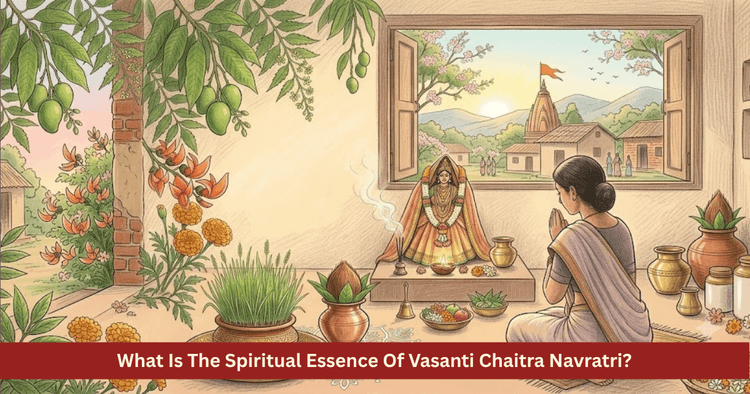
Table of Contents
Panchang Description And The Astronomical Framework Of Vasanti Navratri
Within the mathematical cosmology of the classical Vedic calendar, the nine sacred nocturnal stations extending from the first lunar day (Pratipada) to the ninth lunar day (Navami) of the bright fortnight of Chaitra are celebrated across the cosmos as Vasanti Navratri (or Chaitra Navratri). Classical treatises of Tantra, the Devi Bhagavata Mahapurana, the Devi Mahatmya (Durga Saptashati) from the Markandeya Purana and the Kalika Purana formulate an immutable cosmic principle: four distinct Navratri windows occur across the annual cycle-two manifest (Vasanti in Chaitra and Sharadiya in Ashvina) and two unmanifest or esoteric (Gupta Navratris in Ashadha and Magha). Among these, Chaitra Navratri holds the supreme seat for internal cellular detoxification, deep yogic contemplation and conscious alignment with cosmic nature.
From an astronomical perspective, this sacred festival unfolds at the sensitive seasonal junction (Vernal Equinox) where Lord Surya Deva departs from the watery quadrant of Pisces to enter his exaltation sign of Aries (Mesha). Diurnal and nocturnal hours balance across the equatorial plane and solar radiation begins its intense northern traversal. During this seasonal transition, manifest nature sheds the physical inertia, tamasic lethargy and accumulated kapha of the departed winter, adorning the earth with tender emerald shoots, blossoming floral buds and ascending life sap. In Sanatana Shakti philosophy, this universal awakening of the biological realm is recognized as the dynamic descent of Supreme Consciousness-Adishakti Bhagavati Mahamaya.
| Astrological and Astronomical Factor | Classical Scriptural and Metaphysical Description |
|---|---|
| Lunar Phase and Fortnight | Chaitra Month, Bright Fortnight, 1st to 9th Tithi (Nine Nights) |
| Canonical Liturgical Titles | Vasanti Navratri, Chaitra Navratri, Sri Rama Navaratra |
| Astronomical Solar Transition | Ingress of the Sun from Pisces into Aries (Vernal Equinox Matrix) |
| Sovereign Presiding Powers | Supreme Mother Adishakti Durga (Nine Forms) & Lord Sri Rama |
| Foundational Liturgical Rites | Ghatasthapana (Urn Consecration), Akhanda Jyoti, Sowing Barley |
| Foundational Liturgical Texts | Sri Durga Saptashati, Devi Atharvashirsha, Ramacharitmanas |
| Metaphysical Transformation | Annihilation of Tamas, Purification of Rajas, Awakening of Sattva |
| Bestowed Spiritual Fruit | Kundalini Awakening, Chakra Piercing, Tridoshic Balance, Moksha |
To assimilate the transformative cosmic prana of Vasanti Navratri, purify biological tissues and secure the grace of the Divine Mother, an aspirant must observe disciplined scriptural decorum from dawn onward.
- Awakening before sunrise during Brahma Muhurta, gazing upon both open palms while reciting the classical Karagre Vasate Lakshmi verse.
- Bathing in cool, fresh water consecrated with sacred river drops and boiled neem foliage extract to cleanse external and internal nadis.
- Dressing in clean unstitched or festive cotton/silk garments of white, crimson or golden-yellow, sitting quietly facing eastward or northward.
- Cleansing the northeastern quadrant (Ishanya) of the domestic shrine with holy river water, coating the ground with sacred earth or cow dung to prepare the altar.
- Sowing seven sacred grains (primarily unhusked barley) into a clean earthenware bed mixed with clean soil and river sand.
- Installing an unblemished copper or terracotta urn filled with pure water, river drops, an areca nut, a coin, unbroken rice and fresh mango leaves, crowning it with a husk-intact coconut wrapped in scarlet silk.
- Kindling an unbroken lamp (Akhanda Jyoti) fueled by pure indigenous cow clarified butter, taking a solemn vow to sustain its flame day and night.
- Observing satvic fasting across the nine days; partaking exclusively of seasonal fruits, water caltrop flour (singhara), buckwheat flour (kuttu), foxnuts (makhana) and rock salt, while renouncing heavy grains, onions, garlic and tamasic consumables.
- Reciting the Kavacha, Argala, Kilaka and the thirteen chapters of the Sri Durga Saptashati daily with clear resonance or chanting the Navarna mantra Om Aim Hreem Kleem Chamundayai Vichche at least 108 times upon a consecrated rosary.
- Waving unadulterated camphor flames before the altar at dusk, treating young maidens below nine years of age as the manifest embodiments of the Divine Mother.
The Metaphysics Of Navadurga And The Science Of Kundalini Chakras
Within Hatha Yoga, classical Tantra and the esoteric disciplines of Sri Vidya, the nine days of Chaitra Navratri represent a systematic progression for piercing the psychic energy vortices (Chakras) along the central spinal axis (Sushumna Nadi). Under the catalytic solar radiation of early spring, the dormant Kundalini Shakti awakens, ascending through the spinal matrix toward nondual union with Supreme Shiva within the Sahasrara. The nine manifestations of Mother Durga correspond to nine distinct evolutionary stations of human consciousness:
1. Day One: Mother Shailaputri (Muladhara Chakra)
Daughter of the Himalayas, Mother Shailaputri embodies unyielding physical stability, willpower and the foundational Earth element. Her worship activates the four-petaled Muladhara chakra at the base of the spine. Her grace anchors psychological grounding, burns primal survival fears and establishes an unshakable foundation for spiritual disciplines.
2. Day Two: Mother Brahmacharini (Swadhishthana Chakra)
Personifying intense penance, sensory restraint and dispassion, Mother Brahmacharini governs the six-petaled Swadhishthana chakra (Water element). Meditating upon her form calms instinctual cravings, transmutes base sexual energy into spiritual luster (Ojas) and awakens inner contemplation.
3. Day Three: Mother Chandraghanta (Manipura Chakra)
Adorned with a crescent moon shaped like a bell upon her brow, Mother Chandraghanta presides over the ten-petaled Manipura chakra (Fire element) at the navel. Her fiery presence reignites the digestive metabolic fire, dispels timidity and awakens dynamic spiritual courage.
4. Day Four: Mother Kushmanda (Anahata Chakra)
Projecting the cosmic egg through her subtle, luminous smile, Mother Kushmanda awakens the twelve-petaled Anahata chakra (Air element) within the heart center. Her grace expands unconditional love, universal empathy and receptive cosmic awareness.
5. Day Five: Mother Skandamata (Vishuddha Chakra)
As the divine mother of Lord Kartikeya (Skanda), Mother Skandamata commands the sixteen-petaled Vishuddha chakra (Ether element) within the throat. Governing speech, discriminative knowledge and creative expression, her adoration grants articulative eloquence, scriptural wisdom and truthful speech.
6. Day Six: Mother Katyayani (Ajna Chakra)
Manifested through the collective effulgence of the gods in the hermitage of Sage Katyayana to slay demonic tyranny, Mother Katyayani awakens the two-petaled Ajna chakra (Mind/Intellect) between the brows. Her grace sharpens intuitive discrimination, dissolves mental illusions and eliminates internal adversaries.
7. Day Seven: Mother Kalaratri (The Sahasrara Threshold)
Possessing a midnight-black complexion, disheveled hair and three blazing eyes, Mother Kalaratri destroys ignorance and the terror of mortality. She opens the gateway of the cranial crown (Brahmarandhra). Her fierce presence severs worldly attachments, bestowing absolute fearlessness.
8. Day Eight: Mother Mahagauri (Sahasrara Nectarine Radiance)
Radiant as a white conch shell, snow and the autumn moon, Mother Mahagauri embodies supreme serenity, forgiveness and purification. She represents the ambrosial nectar showering from the thousand-petaled lotus upon the awakened consciousness. Her grace dissolves past-life karmic impressions, leaving awareness spotless.
9. Day Nine: Mother Siddhidatri (Supreme Spiritual Attainment)
The bestower of the eight classical yogic perfections (Anima, Mahima, Garima, Laghima, Prapti, Prakamya, Ishitva, Vashitva) and all nine treasures of spiritual abundance, Mother Siddhidatri represents absolute nondual liberation (Kaivalya). Her supreme grace merges the individual soul with universal cosmic consciousness.
| Navratri Station | Divine Form | Spinal Energy Vortex | Primary Primal Element | Seed Syllable & Sonic Vibration | Bestowed Yogic Realization |
|---|---|---|---|---|---|
| First Day (1) | Mother Shailaputri | Muladhara Chakra | Earth Element (LAM) | Om Hreem Shivayai Namah | Grounded stability, willpower |
| Second Day (2) | Mother Brahmacharini | Swadhishthana Chakra | Water Element (VAM) | Om Hreem Shreem Ambikayai Namah | Sensory mastery, ojas expansion |
| Third Day (3) | Mother Chandraghanta | Manipura Chakra | Fire Element (RAM) | Om Aim Shreem Shaktyai Namah | Fearlessness, vital metabolic fire |
| Fourth Day (4) | Mother Kushmanda | Anahata Chakra | Air Element (YAM) | Om Koom Kushmandayai Namah | Unconditional love, compassion |
| Fifth Day (5) | Mother Skandamata | Vishuddha Chakra | Ether Element (HAM) | Om Hreem Kleem Svaminyai Namah | Vocal eloquence, refined intellect |
| Sixth Day (6) | Mother Katyayani | Ajna Chakra | Universal Mind (OM) | Om Kleem Katyayanyai Namah | Intuitive wisdom, subduing ego |
| Seventh Day (7) | Mother Kalaratri | Gateway of Sahasrara | Cosmic Dissolution Fire | Om Kleem Aim Shreem Kalikayai Namah | Destruction of ignorance, deathlessness |
| Eighth Day (8) | Mother Mahagauri | Sahasrara Lotus | Ambrosial Nectar (Soma) | Om Shreem Kleem Hreem Varadayai Namah | Dissolution of karmic residue, peace |
| Ninth Day (9) | Mother Siddhidatri | Absolute Kaivalya | Nondual Consciousness | Om Hreem Kleem Siddhaye Namah | Eightfold yogic perfections, liberation |
The Science Of Ghatasthapana: Condensing Cosmic Electromagnetic Waves
The liturgical consecration of the sacred vessel (Ghatasthapana) on the inaugural morning of Chaitra Navratri represents a sophisticated technology of cosmic energy condensation designed by ancient seers. The consecrated urn acts as a micro-cosmic antenna aligning the living dwelling with universal biofields.
- The Earthen Altar and Sacred Grains: Layering unblemished earth and sowing seven classical grains (primarily unhusked barley) forms the base. In Vedic lore, barley is crowned as the primordial grain of manifestation. As the barley shoots germinate across the nine days, their delicate cellular tissue absorbs subtle cosmic prana from ambient space. Vibrant, upright green shoots signify agrarian vitality, domestic health and spiritual abundance for the year.
- Metaphysics of the Kalasha: The base of the urn embodies Lord Brahma; its throat represents Lord Mahadeva Shiva; and its opening houses Lord Vishnu. The center is occupied by the Divine Mother goddesses, while the water within is consecrated with the sacred currents of the holy rivers (Ganga, Yamuna, Saraswati, Narmada, Indus, Kaveri).
- Botanical Science of Mango Foliage: The fresh mango leaves positioned within the rim of the urn absorb carbon dioxide, emitting life-sustaining oxygen and phytoncides that sterilize the liturgical space from airborne microbes.
- The Consecrated Coconut (Shriphala): Positioned over an earthenware dish filled with unbroken rice, a husk-intact coconut wrapped in unblemished crimson silk serves as the crowning antenna. The fibrous husk symbolizes the human ego, the hard shell represents the physical skull and the sweet inner water embodies pristine consciousness.
Physiological Rejuvenation Through Seasonal Navratri Fasting
Classical Ayurveda dictates that observing dietary abstinence (Langhana) during major seasonal transitions is the supreme therapeutic intervention for biological rejuvenation. When rising ambient heat mobilizes stagnant winter kapha, consuming dense, oily foods suffocates the digestive fire, precipitating acute illnesses.
The satvic fasting observed during Vasanti Navratri restores the equilibrium of vata, pitta and kapha. What contemporary cellular physiology identifies as Autophagy (awarded the Nobel Prize in Medicine in 2016)-the cellular process whereby biological systems consume and recycle damaged proteins, metabolic wastes and intracellular debris-was instituted millennia ago through Navratri fasting. Providing light, satvic nourishment over nine continuous days allows the body to purge accumulated toxins and regenerate internal tissues.
| Nutritional Medium | Prescribed Satvic Botanical | Somatic Action on the Vessel | Classical Ayurvedic Attribute |
|---|---|---|---|
| Whole Fresh Fruits | Papaya, sweet apple, pomegranate | Cellular hydration, bowel rest | Light (Laghu), digestive stimulant |
| Buckwheat / Water Chestnut | Kuttu and Singhara flours | Regulates blood glucose, mineral-rich | Astringent, pacifies kapha and pitta |
| Pure Mineral Rock Salt | Unrefined Halite (Sendha Namak) | Balances cellular electrolytes | Cooling thermal potency, digestive |
| Foxnuts & Raw Nuts | Lotus seeds (Makhana), almonds | Nourishes nervous tissue, builds ojas | Unctuous, tissue-building adaptogen |
| Indigenous Cow Milk & Ghee | A2 Cow milk and clarified butter | Lubricates digestive mucosa, builds luster | Sweet, rejuvenative brain tonic |
During fasting, drinking ambient water stored in terracotta urns, fresh lime water and tender coconut water accelerates the elimination of metabolic impurities through perspiration and urinary channels.
The Acoustics Of Sonic Mantras And The Unbroken Ghee Flame
The harmonious combination of an unbroken ghee flame and vocal mantra recitation during Navratri operates as a transformative alchemical crucible for human consciousness:
- The Physics of the Sacred Flame: An unbroken lamp fueled by indigenous cow clarified butter neutralizes particulate impurities and discordant electromagnetic fields in the surrounding space. The aromatic combustion of cow ghee soothes the hypothalamic axis of the human brain, lowering physiological cortisol levels and allowing awareness to rest in meditation.
- The Acoustic Science of the Navarna Mantra: The sovereign invocation of the Divine Mother is the nine-syllable Navarna Mantra:
Om Aim Hreem Kleem Chamundayai Vichche.
Each seed syllable resonates at an exact vibrational frequency within the human energy body:
- Aim (AIM): The seed of Mahasaraswati-dissolving mental inertia, refining analytical intellect and awakening spiritual wisdom.
- Hreem (HREEM): The seed of Mahalakshmi-transmuting turbulent rajas, generating divine abundance and nourishing the biofield.
- Kleem (KLEEM): The seed of Mahakali-annihilating tamasic ignorance, focusing one-pointed concentration and destroying internal obstacles.
- Chamundayai: The divine power that pulverizes the twin demons of arrogance (Chanda) and cynicism (Munda).
- Vichche: The prayer for absolute spiritual surrender, dissolving the individual ego into nondual cosmic awareness.
Reciting this formula with focused awareness upon a clear quartz crystal or unblemished rudraksha rosary circulates subtle electromagnetic currents through the 72,000 nadis, clearing subconscious blockages.
Kanya Puja: Honoring The Living Manifestation Of The Divine Feminine
On the eighth (Maha Ashtami) and ninth (Maha Navami) lunar days, the worship of young maidens (Kanya Puja) manifests the foundational Vedic principle that honors feminine consciousness as the direct terrestrial embodiment of the Divine.
The Devi Bhagavata Purana categorizes maidens from two to ten years of age as the direct representations of specific divine forces:
- Two-year-old Maiden: 'Kumarika' (The dispeller of sorrow, poverty and mental despair).
- Three-year-old Maiden: 'Trimurti' (The bestower of righteous duty, lawful wealth and noble desires).
- Four-year-old Maiden: 'Kalyani' (The dispenser of wisdom, academic excellence and victory).
- Five-year-old Maiden: 'Rohini' (The healer of chronic physical afflictions and bodily infirmities).
- Six-year-old Maiden: 'Kalika' (The destroyer of hidden adversaries, malevolence and dread).
- Seven-year-old Maiden: 'Chandika' (The bestower of material abundance, sovereign grace and prosperity).
- Eight-year-old Maiden: 'Shambhavi' (The reconciler of domestic disputes and dispenser of peace).
- Nine-year-old Maiden: 'Durga' (The deliverer from seemingly insurmountable worldly crises).
- Ten-year-old Maiden: 'Subhadra' (The fulfiller of all pure spiritual aspirations).
The practitioner washes the feet of the maidens with pure water and milk, seating them upon elevated platforms. Marking their brows with vermilion and unbroken rice, the seeker serves them sweet semolina pudding (halwa), crisp puffed flatbreads (puris) and seasoned black chickpeas. Offering modest gifts and touching their feet affirms the classical scriptural truth: where the feminine principle is revered, the divine forces reside.
Rama Navami: The Sacred Synthesis Of Moral Order And Transcendent Power
The ninth lunar day of Chaitra Navratri marks not only the culmination of mother worship but also the divine appearance day of Lord Sri Rama-Rama Navami.
The Valmiki Ramayana records that when unrighteous tyranny threatened creation, Lord Sri Rama descended upon the terrestrial plane on Chaitra Shukla Navami under the Punarvasu asterism and Cancer ascendant, precisely at midday as the five sovereign planets occupied their signs of exaltation:
Bhaye pragata kripala deenadayala Kausalya hitakari.
Harashita mahatari muni mana hari adbhuta rupa bichari.
This conjunction reveals a vital metaphysical lesson: the culmination of nine days of rigorous spiritual empowerment is the awakening of righteousness, compassion and moral order (Rama) within human consciousness. Power devoid of moral restraint devolves into the tyranny of Ravana; but power guided by dharma transforms into the loving protection of Lord Sri Rama, sustaining the welfare of creation.
The Philosophical Vision: Transmuting The Inner Battlefield
Vasanti Chaitra Navratri imparts the eternal truth that divine illumination cannot awaken until internal demonic tendencies are surrendered and dissolved.
The demon Mahishasura within our consciousness is personal inertia and stubborn ignorance; Shumbha and Nishumbha represent intellectual vanity and selfish possessiveness; Chanda and Munda are restless cynicism and argumentative pride; and Raktabija represents endless sensory desire that multiplies with every indulgence. When a spiritual seeker takes up the sword of daily sadhana during these nine days, incinerating these vices within the fire of conscious awareness, the radiant dawn of true wisdom illuminates the soul.
Let us welcome the dawn of Vasanti Navratri not through outward ostentation but through genuine inward purification. Purify your nutrition, measure your speech with kindness, honor the divine feminine and surrender your heart at the lotus feet of the Supreme Mother: 'Lead us, O Divine Mother, from ignorance unto wisdom, from darkness unto effulgence and from mortality unto eternal spiritual realization.'
FAQ
What is the foundational metaphysical distinction between Chaitra and Sharadiya Navratri?
Chaitra Navratri occurs at the onset of spring-summer, focusing on internal cellular purification, fasting and spiritual self-realization, while Sharadiya Navratri focuses on outward victory, righteous action and the triumph over darkness.
Why is unhusked barley sown during the ritual of Ghatasthapana?
Barley is revered as the primordial grain of cosmic manifestation; it absorbs subtle prana from ambient space and its upright green growth signifies domestic prosperity and health.
Why is the Navarna Mantra regarded as supreme during Navratri?
The Navarna Mantra integrates the root seed syllables of Mahasaraswati (Aim), Mahalakshmi (Hreem) and Mahakali (Kleem), purifying the three primal qualities of nature (Sattva, Rajas, Tamas).
Between what specific ages should young maidens be worshiped during Kanya Puja?
Maidens between two and ten years of age are worshiped, as each specific age embodies a unique, unblemished manifestation of the Divine Mother.
What is the spiritual connection uniting Rama Navami with Chaitra Navratri?
After nine days of dedicated worship of divine power, the embodiment of moral righteousness and cosmic order-Lord Sri Rama-descends within human consciousness, establishing the balance of power and virtue.
Get your accurate Kundali
Generate KundaliDid you like it?
Author

Aparna Patni (63)
Experience: 20
Consults About: Family Planning, Career
Clients In: Punjab, Haryana, Delhi
Share this article with friends and family
WELCOME TO
ZODIAQ
Right Decisions at the right time with ZODIAQ
