What Is The Glory Of Yamuna Chhath (Yamuna Jayanti) In Chaitra?
By Pt. Narendra Sharma
Advent Of Kalindi, Yamunashtakam Recitation, Chunri Manorath And River Ecology
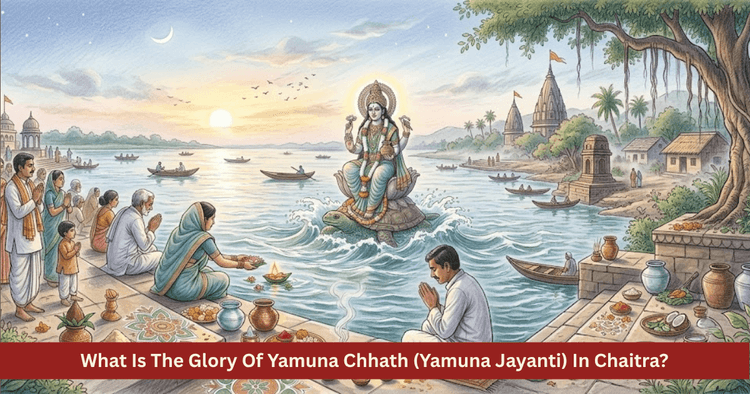
Table of Contents
Panchang Description And The Astrological Dimensions Of Yamuna Jayanti
Within the mathematical cosmology of the classical Vedic calendar, the sixth lunar day (Shashthi) of the bright fortnight (Shukla Paksha) of the month of Chaitra is celebrated across the cosmos as Yamuna Chhath-also revered as Yamuna Jayanti, the sacred advent day of Mother Yamuna, the daughter of the Sun God Surya, the sister of Yamaraja (the lord of death) and the sibling of Saturn (Shani Deva). This sacred date falls directly on the sixth station of Vasanti Navratri, coinciding with the worship of Mother Katyayani and the adoration of Commander-in-Chief Lord Kartikeya (Skanda Shashthi). This convergence harmonizes dynamic spiritual valor, maternal protection and the sanctifying grace of living water.
From an astronomical perspective, Yamuna Chhath marks a sensitive seasonal junction as spring yields to summer. Lord Surya Deva advances toward the fiery heat of Aries, increasing ambient temperatures and making water conservation essential for biological life. In predictive astrology, Mother Yamuna balances the complex relationships among the Sun (her father, representing the soul), Saturn (her brother, representing karma) and Yamaraja (representing cosmic justice). When the Sun and Saturn form challenging natal aspects or an individual undergoes the trials of Sade Sati, propitiating Mother Yamuna through sacred river ablutions and the recitation of the Yamunashtakam soothes astral friction and dispels the fear of untimely mortality.
| Astrological and Astronomical Factor | Classical Scriptural and Astrological Description |
|---|---|
| Lunar Month and Fortnight | Chaitra Month, Shukla Paksha (Bright Fortnight) |
| Lunar Tithi | Shashthi (Sixth Lunar Station of Vasanti Navratri) |
| Canonical Liturgical Titles | Yamuna Chhath, Yamuna Jayanti, Kalindi Advent Festival |
| Sacred Glacial Origin | Mount Kalinda (Yamunotri Glacier, Uttarkashi, Himalayas) |
| Celestial Lineage | Father: Surya Deva, Mother: Sanjna (Chhaya), Brothers: Yama and Shani |
| Transcendental Status | Foremost Queen Consort of Lord Sri Krishna, Liquid Love of Vaikuntha |
| Governing Astrological Planets | Surya (Father), Shani (Brother) and Chandra (Water Element) |
| Sacred Liturgical Offerings | Silk veil (Chunri Manorath), fresh butter, blue and yellow blossoms |
| Core Cultural Sanctuaries | Mathura (Vishram Ghat), Vrindavan (Kesi Ghat), Gokul, Prayagraj |
| Bestowed Spiritual Fruit | Freedom from Yamaloka torments, Shani pacification, Krishna Bhakti |
To secure the grace of Mother Yamuna and dispel subconscious fear on Yamuna Chhath, a seeker must observe disciplined scriptural decorum from early dawn:
- Awaken before sunrise during Brahma Muhurta, gazing upon both open palms while reciting the classical river invocation: Gange cha Yamune chaiva Godavari Saraswati.
- Bathe in the sacred currents of the Yamuna River; if observing at home, infuse clean ambient water with holy river drops and flower petals.
- Face eastward and southward following ablutions, offering three water libations to Surya Deva, Yamaraja and Shani Deva from an unblemished copper vessel.
- Dress in clean, unstitched or festive cotton vestments of pristine white, deep blue or golden-yellow hues.
- Kindle an unbroken lamp fueled by pure indigenous cow clarified butter before an icon of Mother Yamuna or a consecrated water urn.
- Present blue water lilies, red roses, a yellow silk veil, raw cow milk and eightfold sandalwood paste at the altar.
- Recite the classical hymn Yamunashtakam composed by Mahaprabhu Vallabhacharya at least seven or eleven times with focused devotion.
- Vow to preserve natural water bodies, refraining from discarding waste, plastic or pollutants into living streams.
- Float small earthen lamps (Deep Daan) upon river currents at dusk, echoing the traditions of Vishram Ghat in Mathura.
Puranic Lore: Daughter Of The Sun, Sister Of Yama and Consort Of Sri Krishna
The Srimad Bhagavatam, the Patala Khanda of the Padma Purana and the Garga Samhita preserve narratives detailing the transcendental lineage of Mother Yamuna.
Sanjna, the consort of Surya Deva and daughter of the celestial architect Vishwakarma, struggled to endure the blazing heat of the sun. During her union with Surya, she gave birth to twin souls: Yamaraja (the lord of righteousness and death) and Yamuna (the sanctifying river). Later, from Sanjna's shadow form (Chhaya), Shani Deva and the Tapti River were born. Thus, Mother Yamuna is the sister of both Yama and Shani.
Descending from Mount Kalinda, she earned the title Kalindi. Flowing through northern plains, her dark blue currents embraced the sacred geography of Braj, becoming the backdrop for Lord Sri Krishna's pastimes.
| Transcendental Title | Puranic and Metaphysical Foundation | Influence on Human Consciousness |
|---|---|---|
| Daughter of the Sun (Arka Suta) | Solar fire transmuted into cooling, life-giving water | Dissolution of ego; awakening of inner vitality |
| Sister of Yamaraja (Yami) | The affectionate sister who softens cosmic justice | Freedom from the terror of untimely death |
| Sister of Shani Deva | The soothing sibling who pacifies karmic severity | Mitigating the trials of Sade Sati and Saturn transits |
| Consort of Lord Sri Krishna | Fourth queen among the Ashtabharyas in Dvaraka | Attainment of selfless devotion (Prema Bhakti) |
| Lifeblood of Braj Mandala | Witness to the pastimes of Gokul and Vrindavan | Relief from emotional distress, anxiety and grief |
The Boon of Yamaraja: The Lore of Yama Dvitiya and River Cleansing
The Padma Purana records that Yamuna shared deep affection for her brother Yamaraja, repeatedly inviting him to dine at her hermitage. Preoccupied with administering cosmic karma, Yamaraja delayed his visit. Finally, on the second day of the bright fortnight of Kartika (Bhai Dooj / Yama Dvitiya), Yamaraja arrived at her dwelling.
Overjoyed, Yamuna welcomed her brother with fragrant unguents, prepared an elaborate feast and placed an auspicious vermilion mark upon his brow. Moved by her love, Yamaraja granted her a boon.
Mother Yamuna requested a universal blessing for humanity:
"O brother! If you are pleased with me, grant that any living being who bathes in my sacred waters and sips my currents shall be freed from the terror of your messengers and spared the torments of Yamaloka!"
Yamaraja replied: "So be it! Whosoever bathes in your sacred waters with a sincere heart-especially on Chaitra Shukla Shashthi and Kartika Shukla Dvitiya-shall be released from the fear of hell, earning safe passage to the transcendental realms."
The Pastimes Of Lord Sri Krishna And The Azure Currents Of Kalindi
Mother Yamuna is revered not merely as an earthly river but as the liquid embodiment of divine love. The Garga Samhita proclaims that the ambrosial nectar flowing through Vaikuntha descended to earth as the sacred Yamuna.
- Vasudeva's Midnight Crossing: On the stormy midnight when Vasudeva carried the infant Krishna in a wicker basket from Kamsa's dungeons toward Gokul, the Yamuna rose in flood. As soon as the infant's lotus foot touched the swirling waves, the river receded, granting safe passage.
- Subduing the Kaliya Serpent: When the venomous serpent Kaliya poisoned the Yamuna, killing birds and cattle along its banks, Lord Krishna leaped from a kadamba tree onto the serpent's hoods. Subduing Kaliya, Krishna cleansed the waters of poison. This pastime stands as an early scriptural narrative highlighting environmental restoration and river conservation.
- The Witness to the Rasa Dance: Beneath the kadamba trees of Vrindavan and along the steps of Kesi Ghat, Mother Yamuna's currents mirrored the beauty of the celestial Rasa dance.
- Why Are Her Waters Dark Blue? Classical lore explains that her waters took on an azure-dark hue from Krishna's regular bathing, the melting of musk and sandalwood from his transcendental form and the tears of separation shed by the gopis.
Mahaprabhu Vallabhacharya And The Acoustic Science Of The Yamunashtakam
In the Pushtimarg tradition (the path of divine grace), the revelation of Mother Yamuna holds central importance.
In 1492 CE (Vikram Samvat 1549), when Jagadguru Mahaprabhu Vallabhacharya arrived in Braj Mandala, he rested at Govinda Ghat in Gokul. Contemplating how fallen souls bound by the flaws of the Kali Yuga could re-establish their connection with Lord Sri Krishna, he entered deep meditation.
At midnight, Mother Yamuna manifested before him, revealing the path of Brahmasambandha (spiritual initiation). Overwhelmed with devotional ecstasy, Vallabhacharya composed nine Sanskrit verses known as the Yamunashtakam:
Namami Yamunam aham sakala siddhi hetum muda,
Murari pada pankaja sphurad amanda renutkatam.
Tatastha nava kanana prakata moda pushpambuna,
Surasura susupitaih stava shatair abhishtutam. 1.
The Metaphysical Power of the Yamunashtakam
- Sakala Siddhi Hetum: Mother Yamuna is the source of both worldly and spiritual fulfillment, calming mental restlessness.
- Tanu-Nava-Tvam (Spiritual Rejuvenation): Vallabhacharya explains that touching and sipping her waters purifies the seeker's subtle body, preparing the heart to receive pure devotion for Krishna.
- Transmuting Difficult Temperaments: Just as Yamuna's currents cut through rocky mountain gorges, daily recitation of the Yamunashtakam softens harsh anger, lust and stubborn pride, cultivating humility and grace.
Astrological Remedies: Harmonizing Sun-Saturn Friction And Dispelling Fear
In Vedic astrology, the Sun and Saturn-though father and son-are natural adversaries. When they form conjunctions or mutual aspects in a natal chart, an individual often encounters specific life challenges:
- Bitter friction and estrangement between father and son.
- Career instability, administrative hurdles and legal disputes.
- Bone disorders, ophthalmic weakness and circulatory illnesses.
- Chronic delays and lack of recognition despite hard labor.
Mother Yamuna is beloved by both her father Surya and her brother Saturn. Observing Yamuna Chhath provides an astrological remedy to soften this friction.
| Astrological Challenge | Natal Indicator | Remedial Liturgy on Yamuna Chhath |
|---|---|---|
| Sun-Saturn Conjunction | Father-son friction, career delays | Offering Yamuna water to Surya; kindling a lamp for Saturn |
| Sade Sati / Shani Dhaiya | Chronic depression, financial stagnation | Consigning black sesame to the Yamuna; chanting the Yamunashtakam |
| Fear of Premature Mortality | Afflictions in the 8th house | Sipping consecrated Yamuna water; offering Yama tarpan |
| Kaal Sarp and Nodal Distress | Severe Rahu afflictions to the Moon | Offering a small silver fish or blue silk into the currents |
Step-By-Step Liturgical Protocol For Yamuna Chhath
To conduct the traditional adoration of Mother Yamuna on Chaitra Shukla Shashthi, observe the following liturgy:
- Morning Purification and Sacred Intention: Awaken before sunrise, bathing in water infused with Yamuna or Ganga drops. Dress in clean white, blue or yellow cotton garments. Hold water, flowers, unbroken rice and a coin in the right palm:
Om Vishnave Namah. Adya Chaitra mase shukla pakshe shashthyam tithau, Kalinda-nandini Yamuna prakatyotsave, mama sakala yama-badha, Shani-dosha shamanartham, Sri Krishna prema-bhakti praptyartham Yamuna devyah pujanam aham karishye.
- Altar Setup and Invocation: Spread a clean yellow or blue cloth over a wooden platform, seating an icon of Mother Yamuna or a consecrated copper water urn. Add drops of attar, raw rice, an areca nut and fresh blossoms into the vessel:
Kalindi tvam Yama-bhagini Surya-putri surarchita.
Papam hara mamanantam dehi me paramam gatim. - Sixteenfold Adoration (Shodashopachara): Anoint the vessel with vermilion, chandan and ashtagandha. Present fresh blue water lilies, red roses and jasmine blossoms. Kindle natural incense and an unbroken cow ghee lamp.
- The Silk Veil Rite (Chunri Manorath): In Braj Mandala, offering a continuous silk veil across the river is an ancient tradition. In the domestic shrine, drape a delicate blue or red embroidered silk veil over the sacred urn.
- Food Offerings (Naivedya): Offer freshly churned butter mixed with rock sugar, sweet milk rice with foxnuts, chickpea flour laddoos and seasonal melons.
- Hymn Recitation and Floating Lamps: Recite the Yamunashtakam seven times. At dusk, float eleven, twenty-one or 108 small leaf-boat lamps (Deep Daan) upon river currents or a local clean water body.
Cultural Traditions Of Braj Mandala: Vishram Ghat And Kesi Ghat
In Mathura, Vrindavan and Gokul, Yamuna Chhath is celebrated as a grand festival:
- Vishram Ghat in Mathura: Puranic lore records that after slaying the tyrant Kamsa, Lord Krishna rested at Vishram Ghat and worshiped his queen Yamuna. On Yamuna Jayanti, the ghats are adorned with thousands of lamps and floral garlands and the deity is bathed with 108 containers of fresh milk.
- Kesi Ghat in Vrindavan: Where Krishna liberated the demon Kesi, royal barges navigate the waters and theatrical enactments of the Rasalila unfold along the riverbanks.
- The Chhappan Bhog Feast: Temples offer fifty-six preparations to Mother Yamuna, distributing the sanctified food to pilgrims and the destitute.
Environmental Stewardship: River Conservation In Sanatana Dharma
Yamuna Jayanti goes beyond ritual worship; it reinforces the ancient Vedic mandate that reveres rivers as sacred maternal entities.
The Rigvedic Nadi Sukta honors rivers as the life-sustaining mothers of civilization. As modern industrial effluents, plastics and municipal waste threaten the Yamuna, Yamuna Chhath calls for reflection on our relationship with living waters:
- Preserve every drop of potable water, eliminating wasteful domestic runoff.
- Refrain from disposing of plastic waste, chemical detergents and non-biodegradable debris into rivers.
- Support domestic water recycling and rainwater harvesting initiatives. Preserving the purity of natural waterways is the highest form of worship offered to Mother Yamuna.
Philosophical Essence: The Current Of Divine Grace
Yamuna Chhath imparts the timeless realization that selfless devotion purifies human consciousness, uniting the mortal soul with the Divine.
The heavenly Ganga represents the stream of discriminative wisdom (Jnana), carrying consciousness toward detachment and liberation. Mother Yamuna embodies the stream of ecstatic love (Prema), drawing the soul into the presence of Lord Sri Krishna. Wisdom provides clarity but divine love transforms human life into an expression of joy.
When a seeker surrenders pride, bitterness and past misdeeds into the waters of devotion, consciousness becomes transparent. The judgments of Yamaraja apply only to minds chained to unrighteousness; for those who take refuge in the currents of devotion, the fear of mortality dissolves into peace.
On this Yamuna Jayanti, let us bow before Mother Kalindi, resolve to protect our living waters and pray: "O Mother Yamuna, cleanse our inner minds and bless us with unshakeable devotion at the lotus feet of the Divine."
FAQ
On which lunar date is Yamuna Chhath celebrated?
Yamuna Chhath is observed on the sixth lunar day (Shashthi) of the bright fortnight of Chaitra, during the sixth station of Vasanti Navratri.
Who are the parents and siblings of Mother Yamuna?
Her father is Surya Deva, her mother is Sanjna (Chhaya) and her brothers are Yamaraja (the lord of death) and Shani Deva (Saturn).
What spiritual protection is granted by bathing in the Yamuna River?
Puranic tradition records that bathing in and sipping her waters frees the soul from the fear of untimely mortality and the torments of Yamaloka.
Who authored the sacred hymn 'Yamunashtakam'?
Jagadguru Mahaprabhu Vallabhacharya, the founder of the Pushtimarg tradition, composed the nine-verse Yamunashtakam in Gokul.
What is the transcendental relationship between Mother Yamuna and Lord Sri Krishna?
Mother Yamuna is revered as the fourth queen consort (Pattrani) of Lord Sri Krishna and the personification of divine love (Prema Rasa).
Get your accurate Kundali
Generate KundaliDid you like it?
Author
Pt. Narendra Sharma (63)
Experience: 20
Consults About: Family Planning, Career
Clients In: Punjab, Haryana, Delhi
Share this article with friends and family
WELCOME TO
ZODIAQ
Right Decisions at the right time with ZODIAQ
