Govardhan Puja and Annakut
By Pt. Nilesh Sharma
Nature worship, Gau Seva and Krishna divine story
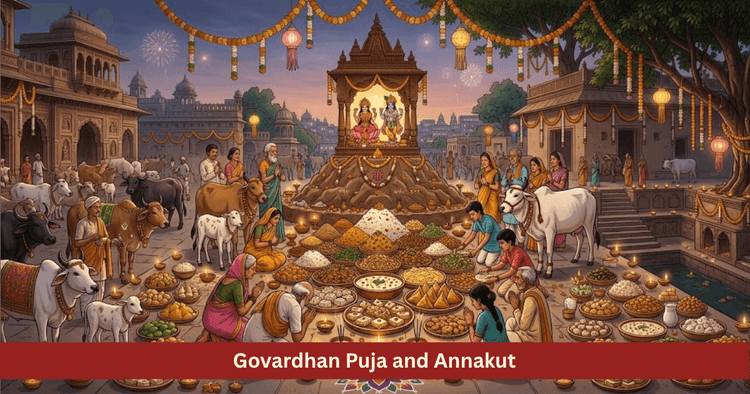
Table of Contents
A Festival of Gratitude to Nature, Cows and Food
Govardhan Puja is observed on Kartik Shukla Pratipada. It is the day after Diwali and is also celebrated as the Annakut festival. In 2026 many Panchangas place Govardhan Puja on Monday, 9 November while some New Delhi based calculations place it on Tuesday, 10 November because of the sunrise rule for Pratipada.
According to available calculations Kartik Shukla Pratipada will begin at about 12:31 in the afternoon on 9 November and end at about 2 in the afternoon on 10 November. Panchangas that consider Pratipada present at sunrise on 10 November observe the Puja on that day. Other traditions observe Annakut and Govardhan Puja on 9 November as the day after Diwali.
The final date should be decided according to the local Panchanga, regional tradition and the rule of Pratipada being present at sunrise. One available calculation gives a morning Muhurat from about 6:39 to 8:49 on 10 November. Traditions observing 9 November may have a different morning or evening time.
| Detail | Govardhan Puja 2026 information |
|---|---|
| Festival | Govardhan Puja and Annakut |
| Tithi | Kartik Shukla Pratipada |
| Possible observance | 9 or 10 November 2026 |
| Reason for regional difference | Pratipada Tithi and sunrise rule |
| Main worship | Shri Krishna, Govardhan Hill and cattle |
| Annakut | Collective offering of many foods and grains |
| Morning Muhurat | In some Panchangas about 6:39 to 8:49 on 10 November |
| Parikrama | About 21 kilometres in the actual Govardhan region |
| Home worship | Making a small Govardhan from dung, clay or flour |
| Main message | Respect for nature, water, hill, animals and food |
Basic Rules of Worship
• Confirm the date and Muhurat through the local Panchanga
• Remember Shri Krishna and Govardhan
• Offer fresh and sattvic food in Annakut
• Show compassion toward cows and all animals
• Install a Govardhan made of dung or clay in a clean place
• Perform Parikrama according to ability
• Understand hills, water, grass and cattle as parts of the natural system
• Avoid food waste and environmental pollution
Puranic Story of Govardhan Puja
According to the tradition of Braj the people of Nandgaon and Vrindavan worshipped Indra every year. Lord Krishna asked them what truly supported rain and life. The life of the people of Braj was connected with Govardhan Hill, cattle, vegetation, water sources and land.
Shri Krishna explained that the hill that provided grass, the land that provided grain, the forest that gave shelter to animals and the water that supported life deserved respect. He encouraged the people of Braj to perform Govardhan Puja and Annakut.
Indra considered this an insult. He sent excessive rain and storms over Braj. The people became frightened. Shri Krishna then lifted Govardhan Hill on His little finger and gave shelter to all the people and animals beneath it.
The people of Braj remained safe under the hill for several days. Finally Indra humility returned and he stopped the rain. Shri Krishna placed Govardhan Hill back on the earth. Govardhan Puja and Annakut are celebrated in remembrance of this story.
Spiritual Meaning of Indra Ego
In the Govardhan story Indra is the deity of rain and natural power. The story does not insult Indra. It teaches that power should not become ego.
When a person considers the self superior to others because of position, wealth, knowledge or authority the inner Indra becomes arrogant. Krishna lifting Govardhan shows that individual authority is limited before nature, community and cooperation.
The main messages of the story are as follows.
• Use strength for protection
• Respect nature through gratitude and not fear alone
• Stand together as a community during crisis
• Protect animals and vulnerable people
• Treat grain as a gift of the Divine
• Calm ego through knowledge and service
Symbolic Meaning of Govardhan Hill
Govardhan may be understood as the hill that nourishes cattle or supports cows. For Braj it was not merely a mass of stone and soil. It was a source of grass, water, forest, caves, medicine and shelter for animals.
In modern life Govardhan may be understood as all natural resources on which society depends.
| Element of Govardhan | Environmental meaning today |
|---|---|
| Hill | Land and natural balance |
| Grass | Animal fodder and biodiversity |
| Water sources | Drinking water and agriculture |
| Vegetation | Medicine, food and air |
| Caves | Natural shelter for living beings |
| Cattle | Agriculture, nourishment and rural economy |
| Grain | Foundation of community life |
Worship of Govardhan carries the resolve to reduce the exploitation of land, water and vegetation.
Importance of Annakut
Annakut means a mountain or large collection of food. Many dishes are prepared and offered to Shri Krishna and Govardhan. The tradition of Chhappan Bhog is also famous in Braj and Vaishnava temples.
The number 56 is not compulsory in every home. The central feeling of Annakut is variety, collective work and respect for food. A poor family may offer one simple meal with devotion.
What May Be Included in Annakut?
• Khichdi
• Lentils
• Rice
• Roti or Puri
• Seasonal vegetables
• Kadhi
• Sweets
• Fruits
• Milk and yogurt
• Green vegetables
• Grain preparations
• Jaggery and sesame
Annakut food is distributed as Prasada after worship. Food should not be wasted. If excess food is prepared it should be respectfully given to the needy, a cowshed or the community.
Method of Govardhan Puja at Home
Everyone cannot travel to Govardhan. The festival may also be observed simply at home.
A small Govardhan may be made from cow dung, clay, flour or another natural material. Keep it in the courtyard, worship area or on a clean platform. If cow dung is not available a symbolic form made from clay or flour is sufficient.
Simple Worship Order
- Clean the home and worship area
- Bathe and wear clean clothes
- Make a small Govardhan from dung, clay or flour
- Place a symbol of Shri Krishna and a cow near it
- Decorate Govardhan with flowers, Tulsi and grass
- Light a lamp and incense
- Offer water, Akshata, Roli and flowers
- Place Annakut and Naivedya
- Read a Krishna Mantra or Govardhan hymn
- Circumambulate Govardhan three or seven times
- Give fodder to cattle
- Distribute Prasada among family and needy people
Do not immerse a dung or clay idol in a water source. It may be respectfully mixed into clean soil or placed near plants.
Importance of Govardhan Parikrama
Govardhan Parikrama is one of the major religious traditions of Braj. The actual circuit of Govardhan is regarded as about 21 kilometres. Devotees walk it. Some perform prostration Parikrama while others take a shorter route according to ability.
The purpose is not only to complete a distance. It is gratitude toward the hill, nature, Krishna and the land of Braj. Every person does not need to complete 21 kilometres.
Rules of Parikrama
• Walk in a clockwise direction
• Begin and end at an authentic place
• Do not throw waste on the route
• Respect temples, ascetics and local people
• Consider bodily capacity in strong heat or cold
• Maintain safety for children and elders
• Carry water and necessary medicine
• Do not turn Parikrama into a competition
• Do not trouble animals
• Do not damage natural places
If a pilgrimage is not possible three or seven symbolic circumambulations of the home Govardhan may be performed. It is a devotional practice.
Importance of Cattle Worship
Service to cattle has special importance in Govardhan Puja. Cows are connected with Indian agriculture, rural life, milk, manure and religious tradition. Worship of a cow does not mean only applying Tilak to its forehead. Food, water, shelter, treatment and dignity are also parts of Gau Seva.
True forms of service include the following.
• Give clean fodder
• Arrange water
• Arrange treatment for an injured animal
• Support a cowshed
• Reduce burden and violence toward animals
• Protect animals from plastic and toxic materials
• Support local cattle keepers
On Govardhan Puja animals should not be troubled with colours, chemicals or uncomfortable decorations. Their comfort and health should be placed above ritual display.
Govardhan Puja and the Environment
The Govardhan story is especially relevant during the present environmental crisis. Erosion of hills, pollution of water sources, reduction of forests, decline of soil fertility and shrinking space for animals are major challenges before society.
Govardhan Puja does not solve these problems in one day but it gives an opportunity to change the way of thinking. If a hill is sacred how can uncontrolled mining be justified? If a river is sacred how can waste be thrown into it? If cows and animals are respected how can they be left hungry and unsafe?
Environmental Resolves
• Plant a tree and care for it
• Do not throw waste into water sources
• Reduce food waste
• Reduce plastic use
• Adopt local grains and seasonal food
• Keep water for birds and animals
• Respect soil and farm fertility
• Maintain discipline in hills and forest areas
Krishna Mantra and Govardhan Remembrance
Shri Krishna is remembered during Govardhan Puja. A simple mantra may be chanted.
Om Namo Bhagavate Vasudevaya
This means salutations to Lord Vasudeva.
Govardhanadharam Vande Gopalam Goparakshakam.
Its feeling is salutations to Gopala who held Govardhan and protects cattle.
The mantra may be chanted 11, 21 or 108 times. Along with japa take a resolve for service of food, water and animals.
Astrological View of Govardhan Puja
Govardhan Puja is observed on Kartik Shukla Pratipada. The bright fortnight begins a period of light, growth and a new cycle. Chandra, Guru, Shukra and the earth principle may be symbolically connected with Govardhan Puja.
| Principle | Feeling in Govardhan Puja |
|---|---|
| Chandra | Food, essence and mind |
| Guru | Krishna, dharma and knowledge |
| Shukra | Cattle, comfort and nourishment |
| Earth | Hill, land and stability |
| Water | Rain, agriculture and life |
| Surya | Energy and natural cycle |
The personal result of Guru, Chandra or Shukra in a birth chart may differ. Govardhan Puja should not be treated as a definite cure for a planetary affliction. It is a practice that strengthens the relationship with nature and dharma.
What Should Be Avoided During Worship?
• Do not wrap a dung or clay Govardhan in plastic
• Do not throw away Annakut food
• Do not trouble animals with colours or chemicals
• Do not throw waste during Parikrama
• Do not leave soap or chemicals at a pilgrimage place
• Do not turn Gau Seva into a photo display
• Do not undertake a fast or long walk beyond capacity
• Do not make loud noise in hills and forests
• Do not keep Prasada in an unclean place
Relationship Between Grain and Nature
The greatest message of Annakut is respect for food. Food is the combined gift of field, water, soil, farmer, animals and Sun. A meal with many dishes represents countless efforts and natural resources.
After Annakut worship the food should be accepted as Prasada. Leaving food on plates, throwing away grain or turning food into display goes against the feeling of the festival.
Children may be taught how one grain travels from the field to the home. This develops gratitude, saving and respect for agriculture.
Psychological Meaning of Govardhan Puja
Indra ego symbolises the desire for control within a person. Human beings may think they have authority over nature. The Govardhan story reminds them that life depends on collective cooperation and natural balance.
Krishna lifting the hill represents protection and leadership. Krishna does not protect Braj alone. The entire community gathers under the hill. This shows that society should support one another during crisis.
Annakut provides a psychological experience of shared food, labour and Prasada. Gau Seva awakens compassion. Parikrama gives the body and mind a rhythm.
Govardhan Puja and Modern Society
Today Govardhan Puja needs to become a lifestyle and not only a repeated story. In cities where making a mountain replica is difficult people may connect with parks, water sources, trees and animal protection.
Schools, families and temples may perform the following activities.
• Planting trees
• Water conservation campaigns
• Animal health camps
• Food distribution
• Honour for farmers
• Local grain exhibitions
• Plastic free worship
• Support for cowsheds
Govardhan Puja is humility of human beings before nature. It does not oppose development. It asks development to become balanced and responsible.
Feeling of Chhappan Bhog in Annakut
The tradition of Chhappan Bhog is especially famous in Vaishnava temples. Its feeling is devotion, variety and abundance of food. Preparing 56 dishes at home is not necessary.
A family may perform Annakut with Khichdi, lentils, roti, vegetables and sweets. Offering one nourishing meal to a poor family can also be a beautiful form of Govardhan Puja.
The best rule of Annakut is as follows.
• Food should be fresh
• Ingredients should be clean
• Quantity should not exceed need
• Prasada should be distributed
• Food should not be wasted
• Suitable fodder should be kept separately for animals
Lasting Message of Govardhan Puja
Govardhan Puja goes beyond the story of calming the ego of Indra. It is a festival of the relationship between human beings and nature. Shri Krishna taught the people of Braj to respect the land, hill, water and animals that supported life.
Today this means saving water, protecting soil from toxins, giving safety to animals, reducing food waste and respecting the limits of nature during development.
Parikrama is not only performed around a hill. A person must also circumambulate gratitude, service and restraint throughout life. Annakut is not only a pile of food. It is thanksgiving to earth, farmer, animal and society.
Shelter Under Nature
There are two views about Govardhan Puja in 2026, 9 November and 10 November. The difference arises from the beginning of Kartik Shukla Pratipada and the sunrise rule. Confirming the date through the local Panchanga is the first rule of the festival.
Whichever day is observed the day should remember Shri Krishna, Govardhan, cattle, grain and nature. A small Govardhan may be made at home and Annakut offered. Gau Seva may be performed. Parikrama should remain according to ability. The environment should not be harmed.
The light of Govardhan Puja is that human beings are not masters of nature. They are responsible companions of nature. When this feeling awakens Indra ego becomes calm, Krishna compassion appears and Annakut truly becomes a celebration of life.
FAQ
When will Govardhan Puja be observed in 2026?
In 2026 many Panchangas place Govardhan Puja on Monday, 9 November while some New Delhi Panchangas observe it on Tuesday, 10 November because of the sunrise rule for Pratipada. Confirm with the local Panchanga.
What is Annakut in Govardhan Puja?
Annakut is an offering of many fresh and sattvic dishes to Shri Krishna and Govardhan. Chhappan Bhog is famous but its number is not compulsory at home.
How long is Govardhan Parikrama?
The actual Govardhan circuit is regarded as about 21 kilometres. Everyone does not need to complete it. Three or seven symbolic circumambulations may be performed at home.
Why are cows worshipped during Govardhan Puja?
Cattle are connected with agriculture, grain, rural life and nourishment. Feeding, watering, treating and protecting cows is true Gau Seva.
What is the environmental message of Govardhan Puja?
The festival teaches gratitude toward hills, water, land, vegetation, grain and animals. Its modern message is water conservation, planting trees, saving food and protecting nature.
Get your accurate Kundali
Generate KundaliDid you like it?
Author
Pt. Nilesh Sharma (63)
Experience: 20
Consults About: Family Planning, Career
Clients In: Punjab, Haryana, Delhi
Share this article with friends and family
WELCOME TO
ZODIAQ
Right Decisions at the right time with ZODIAQ
