Karwa Chauth Vrat 2026
By Pt. Narendra Sharma
Rohini Nakshatra, Shiva Yoga and Moon worship vidhi
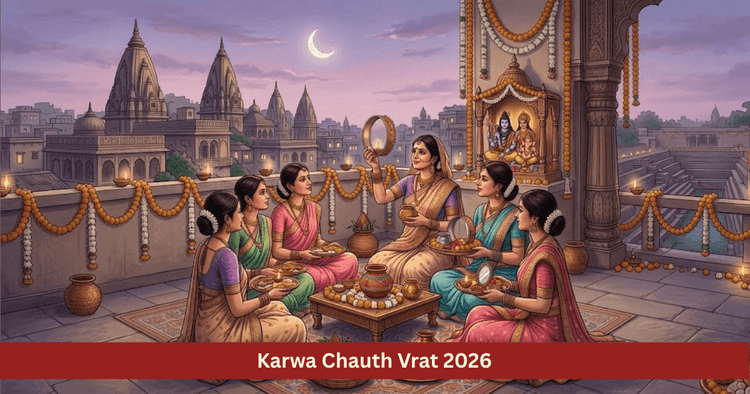
Table of Contents
A Festival of Love, Trust and Lunar Worship
Karwa Chauth is a marital festival observed on the Chaturthi Tithi of the Krishna Paksha in Kartik month. In 2026 the fast will be observed on Thursday, 29 October. According to the available Panchanga calculation for New Delhi the Chaturthi Tithi will begin at 1:06 in the night on 29 October and end at 10:09 in the night on the same day.
The fast is observed from sunrise until moonrise. In New Delhi sunrise is expected around 6:31 in the morning and moonrise around 8:11 at night. The general Karwa Chauth Puja Muhurat is given as 5:38 in the evening to 6:56 in the evening. Moonrise and worship timings may differ by city. The local Panchanga time should be followed for breaking the fast.
The Rohini Nakshatra and Shiva Yoga combination is being discussed as a special feature of Karwa Chauth 2026. Some Panchanga calculations place Rohini during the first part of the day and Shiva Yoga near moonrise. The ending time of the Nakshatra and Yoga can differ according to place and Panchanga method. This combination should therefore be understood as a supportive spiritual atmosphere and not as a fixed guarantee of marital happiness.
| Detail | Karwa Chauth 2026 information |
|---|---|
| Festival | Karwa Chauth or Karaka Chaturthi |
| Date | Thursday, 29 October 2026 |
| Paksha | Kartik Krishna Paksha |
| Tithi | Chaturthi |
| Tithi begins | 1:06 in the night on 29 October |
| Tithi ends | 10:09 in the night on 29 October |
| Fasting period | Sunrise to moonrise |
| New Delhi sunrise | Around 6:31 in the morning |
| New Delhi moonrise | Around 8:11 at night |
| Puja Muhurat | 5:38 in the evening to 6:56 in the evening |
| Special Nakshatra | Rohini according to location and Panchanga |
| Special Yoga | Shiva Yoga according to location and calculation |
| Main worship | Gauri, Ganesha, Shiva, Kartikeya and Chandra |
| Fast completion | Moon sighting, Arghya and prayer |
| Main rule | Fast according to health |
Basic Rules of Karwa Chauth
• Take Sargi or a pre dawn meal before sunrise
• Take the resolve after sunrise
• Observe a waterless fast only when health and tradition permit
• Listen to the Karwa Chauth story and worship Gauri during the day
• Perform Karwa worship during the evening Muhurat
• Break the fast after offering Arghya to the Moon
• Pregnant women, patients, elders and those taking medicine should seek medical guidance
• Connect the fast with mutual respect and love between husband and wife
The Real Spiritual Meaning of Karwa Chauth
To understand Karwa Chauth only as a fast for the long life of the husband limits its wider meaning. The festival remembers love, trust, restraint, communication and mutual responsibility in married life.
The Karwa is an earthen vessel. Earth represents patience, capacity to hold and stability. The Karwa of Karwa Chauth may be understood as a symbol of the ability of two people to hold both joy and difficulty with patience.
The Moon represents the mind, emotions and coolness. Offering Arghya to the Moon after a full day of fasting is not only a religious act. It is also a resolve to calm the mind, bring gentleness into the relationship and maintain emotional balance in family life.
Importance of Sargi
Sargi is the meal taken before sunrise. Traditionally the mother in law gives Sargi to the daughter in law. It may include fruits, nuts, sweets, Pheni, milk, Mathri and other nourishing items. In modern life its form may change according to family, health and availability.
The purpose of Sargi is to prepare the body for the day long fast. Excessively fried, very sweet or very salty food may increase thirst, acidity and weakness during the day.
What Should a Balanced Sargi Include?
• Enough water or coconut water
• Seasonal fruits
• Milk or yogurt when suitable
• A few nuts
• Light and nourishing food
• A suitable source of complex carbohydrates
• Limited sweets
Adequate sleep after Sargi is also necessary. Taking Sargi after staying awake all night may weaken the body.
Scriptural and Health View of the Waterless Fast
The tradition of a waterless fast is well known in Karwa Chauth. Nirjala means giving up both food and water. This fast is strict and is not safe for every person.
From the religious view a waterless fast represents resolve, austerity and love. From the health view long periods without water can cause dehydration, headache, weakness, dizziness, blood pressure changes and blood sugar problems.
Medical advice is necessary before a waterless fast in the following situations.
• Pregnancy
• Breastfeeding
• Diabetes
• Blood pressure problems
• Kidney or heart disease
• Migraine
• Frequent dizziness
• Regular medicine use
• Fever or infection
If fainting, difficulty breathing, extreme weakness, confusion, chest pain or continuous vomiting occurs during the fast immediate medical care should be taken. The purpose of a fast is not to place the body in danger. A simple fast with fruit or water may also be devotional.
Importance of Rohini Nakshatra
Rohini Nakshatra is regarded as dear to Chandra. It is associated with beauty, creation, nourishment, attraction, emotional gentleness and material prosperity. The relationship between Chandra and Rohini can give special feeling to the Moon sighting of Karwa Chauth.
Rohini is connected with the symbol of a chariot and the movement of growth. It indicates development, nourishment and the taking of a beautiful form. In married life Rohini may be understood through love, care and emotional security.
Yet one Nakshatra alone cannot decide the entire married life. The seventh house, Shukra, Guru, Chandra, Navamsha and marital planetary periods must be considered in the birth chart.
Meaning of Shiva Yoga
Shiva Yoga is one of the 27 Yogas of the Panchanga. The word Shiva indicates welfare, peace, transformation and auspicious consciousness. During Karwa Chauth Shiva Yoga may be connected with the marital ideal of Lord Shiva and Goddess Parvati.
The relationship of Shiva and Parvati represents more than love. It also represents austerity, dialogue, equality, patience and spiritual partnership. Therefore a marital prayer during Shiva Yoga should include the health, dignity and mutual trust of both partners and not only the long life of the husband.
The duration of a Yoga may change according to location in the Panchanga. One timing should not be applied to every city.
Preparation for Karwa Chauth Worship
Women generally decorate a beautiful Puja Thali for Karwa Chauth. The Thali may contain a Karwa, lamp, Roli, Akshata, sieve, sweets and water.
Puja Material
| Material | Use |
|---|---|
| Karwa or earthen vessel | Water Arghya and traditional worship |
| Lamp | Light and auspiciousness |
| Roli and Kumkum | Tilak and marital good fortune |
| Akshata | Completeness and resolve |
| Flowers | Offering to the Devi |
| Incense | Worship atmosphere |
| Sieve | Moon and husband viewing |
| Sweets | Prasada and fast completion |
| Water | Arghya to the Moon |
| Fruits | Ending the fast |
| Red or marital items | Gauri worship |
Plastic and material harmful to the environment should be reduced in worship. Buying an earthen Karwa from local artisans connects tradition with service.
Karwa Chauth Puja Vidhi
Karwa Chauth worship is performed in the evening during the auspicious Muhurat. According to family tradition Gauri, Ganesha, Shiva, Kartikeya and Karwa Mata are worshipped.
Simple Worship Order
-
Observe the fast during the day
-
Bathe in the evening and wear clean or festive clothes
-
Place a platform and clean cloth in the worship area
-
Install Gauri and Ganesha
-
Fill the Karwa with clean water
-
Offer Roli, Akshata, flowers and a lamp
-
Listen to or read the Karwa Chauth story
-
Pray to Gauri for marital happiness and family peace
-
Wait for the Moon to rise after worship
-
View the Moon through the sieve after moonrise
-
Offer water and Akshata to the Moon
-
View the husband and receive his blessing
-
Receive water from the husband or a family member
-
Take Prasada and break the fast
Many families worship together as husband and wife. This can make the fast a celebration of mutual love and support instead of one sided sacrifice.
Correct Method of Offering Arghya to the Moon
Moon sighting is the central stage of Karwa Chauth. After the Moon appears the woman observing the fast views the Moon through a sieve. The tradition then views the husband through the same sieve.
Arghya Method
• Take clean water in a Karwa or copper vessel
• Add Akshata and flowers to the water
• Fold the hands while facing the Moon
• Offer water to the Moon
• Remember a Moon mantra
• Pray for the health of the husband and family
• View the husband and receive his blessing
• Take water or Prasada and break the fast
Do not allow the Arghya water to fall on roads, electric wires or other people. Keep the material clean after worship.
Moon Mantra
Om Somaya Namah
This means salutations to Chandra in the form of Soma. Chandra represents the mind, coolness and emotional balance.
What If Clouds Hide the Moon?
Sometimes clouds, fog or local weather prevent the Moon from being seen. In that situation follow family tradition and the local Panchanga. Continuing a waterless fast for a very long time only because of social pressure is not safe.
Some families complete the worship after the Panchanga moonrise time by remembering the Moon mentally. Others view the Moon from a safe place or a temple. When medical need exists the fast may be completed in a simple manner.
Traditions may differ. One method should not be imposed as compulsory upon every family.
Spiritual Message of the Karwa Chauth Story
Several folk stories are connected with Karwa Chauth. The stories of Savitri, Veeravati and Karwa are heard in different forms in different regions. Their central feelings are love, devotion, courage, intelligence and steadiness during crisis.
It is more appropriate to understand these stories as moral and spiritual teachings and not only as historical events. The story of Veeravati teaches through haste and emotional weakness. The story of Savitri reveals the power of intelligence, truth and firm resolve. The story of Karwa shows marital devotion and courage for justice.
The shared message is that relationships survive not only through emotion but also through patience, truth and responsibility.
Modern Feeling of Karwa Chauth for Couples
Traditionally Karwa Chauth is associated with married women. In modern times many husbands also fast with their wives or support them by sharing food, water and household duties.
This change does not insult tradition. Its purpose is to increase mutuality in marriage. When a wife observes the fast and the husband supports her fatigue, water needs, childcare and household work the feeling of love in the fast becomes deeper.
Karwa Chauth may be observed in the following way.
• Both partners should care for each other health
• Husband and wife should respect each other
• Old disputes should be resolved peacefully
• Financial decisions should be made together
• Each partner should acknowledge the labour of the other
• The fast should not become pressure or competition
• Love should remain visible through conduct throughout the year
Astrological View of Karwa Chauth
Chandra, Shukra, the seventh house, the seventh lord, Guru and Navamsha may be considered in relation to Karwa Chauth. Chandra represents the mind and emotions. Shukra is connected with marriage, love and attraction. The seventh house represents marriage and partnership. In a woman horoscope Guru is connected with the indications of husband and marital protection while Shukra is a major significator of relationships in a man horoscope.
| Astrological element | Indication in Karwa Chauth |
|---|---|
| Chandra | Mind, emotional security and Moon sighting |
| Shukra | Love, marriage and beauty |
| Guru | Blessing, dharma and marital protection |
| Seventh house | Marriage and partnership |
| Seventh lord | Direction of married life |
| Navamsha | Depth and stability of marriage |
| Rohini | Nourishment, beauty and love |
| Shiva Yoga | Welfare, patience and auspicious feeling |
It is not proper to claim that the position of a planet changes only through fasting. A fast disciplines the mind and relationships. Planetary results require separate analysis.
Sattvic Remedies for Karwa Chauth
The following remedies may be performed for marital happiness and mental peace on Karwa Chauth.
• Offer red flowers to Gauri Mata
• Offer water to the Moon
• Chant Om Somaya Namah
• Remember Shiva and Parvati together
• Give marital items to a married woman
• Offer food or clothes to a needy woman
• Receive the blessing of parents and parents in law
• Avoid harsh speech and conflict at home
• Donate food after completing the fast
The purpose of a remedy should be to increase love and respect in the relationship and not to control another person.
Which Mistakes Should Be Avoided?
Some people neglect health and safety in their enthusiasm for Karwa Chauth. The following mistakes should be avoided.
• Do not keep a forced waterless fast during illness
• Do not pressure another person to fast
• Do not allow a delayed Moon to create a health emergency
• Do not take excessive fried or sweet food during Sargi
• Avoid abusive speech and arguments during worship
• Do not treat taking food during a health emergency as a moral crime
• Do not treat the fast as a fixed guarantee of the husband long life
• Do not pollute a road or river while offering Arghya
The purity of a fast is preserved through compassion and discernment. Protection of health is also part of dharma.
The Real Meaning of Saubhagya
Karwa Chauth includes a prayer for Akhand Saubhagya. Saubhagya does not mean only the long life of the husband or marital status. It also includes the health, dignity, peace, trust and safety of both partners and the family.
If there is no dialogue in a marriage, no equality in decisions and no respect for each other labour external worship cannot complete the meaning of Saubhagya. The true message of Karwa Chauth is to nourish marriage through love and responsibility each day.
Coolness of the Moon and Marital Balance
The fast maintained before Moon sighting teaches patience and restraint. Viewing the Moon through a sieve symbolizes focusing an unsettled mind. Viewing the husband through the same sieve connects the relationship with the coolness and light of the Moon.
This symbol becomes beautiful when husband and wife give equal respect to each other. One person sacrifice and the other person indifference cannot create marital balance. The Moon of Karwa Chauth reminds both partners that love remains luminous when trust and support come from both sides.
Love Completes the Fast
The Rohini Nakshatra and Shiva Yoga discussed for Karwa Chauth 2026 may be regarded as supportive of marital love, beauty and auspicious feeling. Yet the result of any Yoga depends on the birth chart, karma, relationship and conduct of the person.
From Sargi to the Moon Arghya the fast is a long period of waiting. During this waiting the body learns restraint, the mind learns prayer and the relationship learns gratitude. When the Moon appears the fast does not end only through food. It becomes complete through love, communication, blessing and a shared resolve for life.
The true blessing of Karwa Chauth is that both partners become like the Moon in coolness, like the Sun in clarity and like the Earth in stability for each other.
FAQ
When is Karwa Chauth in 2026?
Karwa Chauth will be observed on Thursday, 29 October 2026. It falls on the Chaturthi Tithi of the Kartik Krishna Paksha.
What time will the Moon rise on Karwa Chauth 2026?
In New Delhi moonrise is expected around 8:11 at night. Moonrise changes by city so the local Panchanga should be followed.
What is the Karwa Chauth Puja Muhurat in 2026?
For New Delhi the general Puja Muhurat is given as 5:38 in the evening to 6:56 in the evening. Local Panchanga timings may differ.
Do Rohini Nakshatra and Shiva Yoga occur on Karwa Chauth 2026?
Some Panchanga calculations mention Rohini Nakshatra and Shiva Yoga for Karwa Chauth 2026. The duration of the Nakshatra and Yoga may change according to location and calculation method.
Can every woman keep a waterless Karwa Chauth fast?
No. Pregnant women, breastfeeding mothers and women with diabetes, blood pressure, heart or kidney concerns should seek medical advice before keeping a waterless fast.
Get your accurate Kundali
Generate KundaliDid you like it?
Author
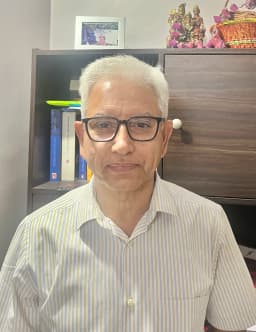
Pt. Narendra Sharma (63)
Experience: 20
Consults About: Family Planning, Career
Clients In: Punjab, Haryana, Delhi
Share this article with friends and family
WELCOME TO
ZODIAQ
Right Decisions at the right time with ZODIAQ
